- The paper presents a novel cut-cat state syndrome extraction protocol that halves ancilla qubit requirements while maintaining fault tolerance in CSS codes.
- It employs partial cat states and adaptive, repeated measurement rounds to confine error propagation up to d=9, with potential scalability to arbitrary distances.
- Numerical simulations validate that the logical error rate scales as O(p^(t+1)), demonstrating significant resource savings versus traditional methods.
Introduction and Motivation
Quantum error correction (QEC) underpins scalable quantum computation, mediating the deleterious effects of noise stemming from system-environment interactions. Syndrome extraction—the process of diagnosing errors via code stabilizer measurements—is a particular vulnerability, as non-fault-tolerant (FT) circuits can cause catastrophic error propagation, known as hook errors, thus undermining the code's protection. The established methodology for FT syndrome extraction utilizes either flag qubits or cat (GHZ) state ancillas, each entailing distinctive trade-offs in qubit overhead, circuit depth, and two-qubit gate complexity.
This work introduces the cut-cat state syndrome extraction protocol, a tailored FT method for CSS codes. The scheme leverages partial cat states and a protocol of ancilla-data qubit interactions, complemented by post-interaction cat stabilizer measurements. The proposed construction maintains parallelism in syndrome extraction with reduced qubit overhead and systematically suppresses hook errors up to arbitrary code distances.
Cut-Cat State Syndrome Extraction: Protocol and Circuit Analysis
The cut-cat protocol constructs an entangled ancilla (cat) state whose size is halved compared to the canonical cat-based approaches, with each cat qubit coupling to two (rather than one) data qubits. Following these couplings, dedicated cat stabilizer measurements (parity checks in the ancilla space) identify and correct correlated error propagation, ensuring any error pattern up to weight t=⌊(d−1)/2⌋ during syndrome extraction cannot escalate to higher-weight data errors, as required by FT constraints.
Crucially, the scheme implements cat syndrome extraction via repeated rounds and adaptive measurement strategies, supporting explicit FT up to d=9 and, by conjecture, arbitrary distances.
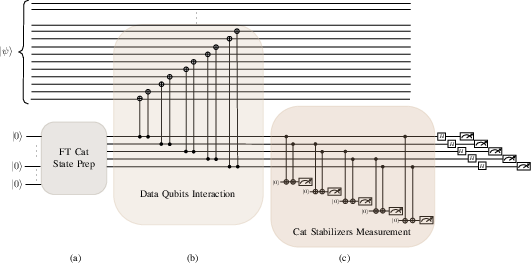
Figure 1: Cut-cat state 2-FT syndrome extraction protocol for an X-type stabilizer of weight γ=10 in a d=5 code.
The protocol in Figure 1 demonstrates the halved ancilla count and post-interaction cat stabilizer rounds, which serve to both detect and localize faults that could otherwise proliferate as correlated data errors.
Error Propagation and Decoding Rules
The principal threat in nontrivial gadget designs is the propagation of ancilla errors to multiple data qubits—a canonical example being a single X error on a cat qubit yielding two data qubit errors after sequential CNOTs.
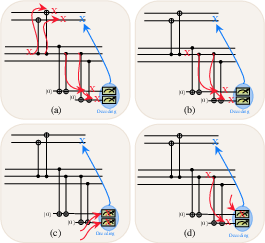
Figure 2: Error propagation cases: (a) a cat qubit X error pre-interaction yields weight-2 data error; (b–d) measurement errors and post-interaction errors lead to identical syndrome patterns, mandating precise decoding actions to confine error weight.
The decoding process, defined algorithmically for distances up to d=7, proceeds by analyzing triggered cat stabilizer outcomes and, if needed, invoking additional cat stabilizer measurement rounds to resolve ambiguity created by correlated fault patterns and measurement noise. The syndrome outcome is mapped to correction actions on associated data qubits according to precise rule sets, ensuring that the FT requirement on output error weight is preserved for every possible w≤t error pattern.
Fault-Tolerance Analysis
The theoretical validation of FT is formalized through a series of theorems (see Sections 5.1–5.5), demonstrating that the cut-cat circuit—when decoded by the prescribed algorithms and synchronized with syndrome measurement repetition—satisfies the standard FT gadget criterion. Concretely, any combination of up to t circuit faults (including data/ancilla preparation, CNOTs, and measurement) can yield at most an error of weight t, recoverable by an ideal decoder.
The protocol scales: for d=3,5,7, decoding is analytic; for d=9 and beyond, a lookup-table approach enumerates all possible syndrome patterns generated by faults of weight up to t.
Numerical Demonstration and Resource Analysis
Extensive circuit-level noise simulations confirm theoretical predictions. The cut-cat protocol adheres to the expected threshold behavior, with the logical error rate scaling as O(pt+1) under depolarizing noise (where d=90 is the gate/measurement error probability).
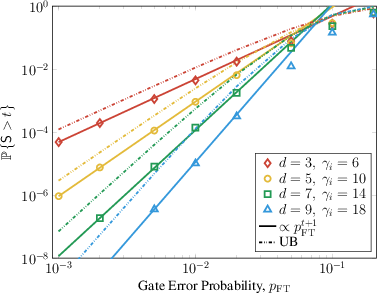
Figure 3: Probability that w > t errors are propagated vs. gate error probability with cut-cat extraction, verifying O(d=91) scaling.
Application to the d=92 triorthogonal code provides a concrete testbed, leveraging the cut-cat gadget for all high-weight (γ > 6) stabilizer extractions, with results confirming logical-level suppression commensurate with code distance predictions.
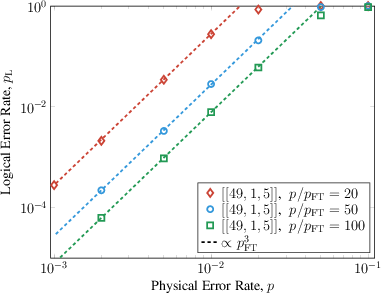
Figure 4: Logical error rate versus physical error rate for d=93 code under concatenated syndrome extraction, demonstrating correct O(d=94) scaling.
In resource trade-off benchmarks, the cut-cat scheme reduces simultaneous qubit requirements by more than 50% compared to full cat state extraction, while incurring only modest increases in two-qubit gate count (comparable for d=95, advantageous for d=96). The circuit depth for data-interacting gates remains lower than for flag-based gadgets due to the parallelism preserved by the cut-cat construction.
Practical and Theoretical Implications
For QEC code families with high-weight stabilizers—triorthogonal, QLDPC, and heavily concatenated codes—the cut-cat protocol is particularly advantageous. Qubit-limited architectures and devices seeking to minimize ancilla footprint benefit directly, especially when requiring FT magic state distillation or other resource-intensive FT primitives.
On a theoretical front, the results show that partial cat state interaction, with carefully orchestrated post-interaction checks, suffices for scalable, arbitrarily high-distance FT syndrome extraction. The approach bridges the qubit overhead/parallelization trade-off between flag-based and canonical cat-based methods; by adaptive measurement and decoding, it becomes a scalable and resource-efficient option for near-term and future quantum computers.
Potential future directions include: formal extension and proof of scalability for arbitrary code distance, optimization of decoding algorithms (including neural or tensor-network-based implementations for syndrome mapping), and experimental realization in physical QEC testbeds to validate practical resource scaling.
Conclusion
The cut-cat state FT syndrome extraction protocol synthesizes ancilla-efficient circuit design with robust suppression of hook errors in CSS codes. Analytic and numerical analyses validate FT up to d=97, with conjectured scalability to arbitrary distances. The protocol significantly reduces simultaneous qubit demand and supports low-circuit-depth extraction, occupying a critical niche in the resource-spectrum between full cat state and flag-based gadgets for QEC syndrome extraction. This positions the cut-cat approach as a compelling syndrome extraction strategy for high-performance quantum architectures going forward (2604.17339).

