- The paper demonstrates that incorporating deterministic chaotic perturbations into Prototypical Networks stabilizes embeddings for robust few-shot MRI classification.
- Methodology uses a selectively fine-tuned ResNet-18 with a Logistic Chaos Module, achieving 84.52% accuracy and a +4.8% improvement over standard ProtoNet.
- Implications highlight adaptive chaos intensity and multimodal integration as promising avenues for enhancing diagnostic performance in data-scarce settings.
Chaos-Enhanced Prototypical Networks for Robust Few-Shot Medical Image Classification
Introduction
Few-shot learning (FSL) is critical for medical diagnostics, particularly in neuro-oncology where annotated datasets are highly constrained. Prototypical Networks (ProtoNets), a cornerstone of metric-based FSL, often show instability in data-scarce medical domains due to prototype collapse in embedding space, driven by high intra-class variance and acquisition artifacts in medical images. The investigated paper proposes the Chaos-Enhanced Prototypical Network (CE-ProtoNet), which incorporates a Logistic Chaos Module (LCM) into a selectively fine-tuned ResNet-18 backbone. The LCM injects deterministic, ergodic perturbations into support embeddings during training, regularizing the embedding manifold such that class prototypes become noise-invariant, thereby improving generalization in high-variance, low-sample regimes.
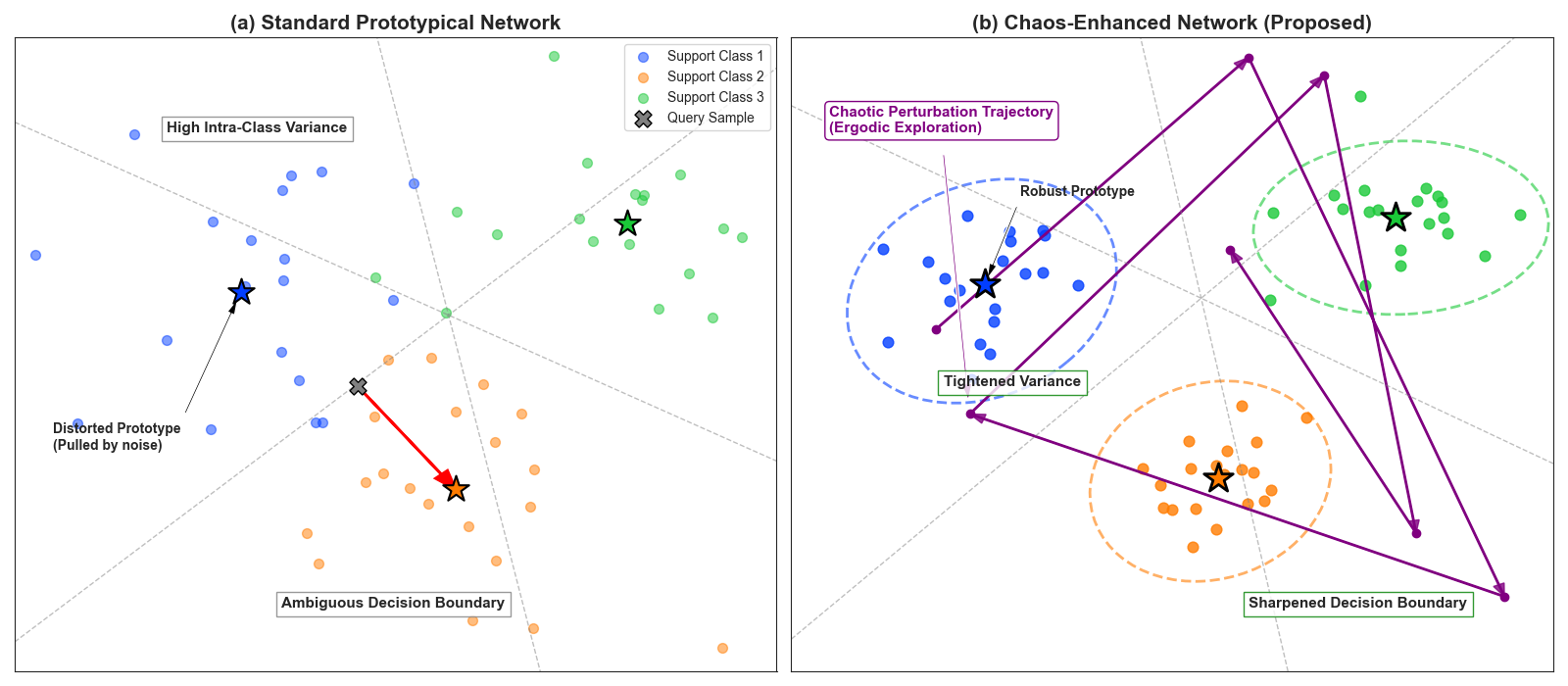
Figure 1: Conceptual illustration of how chaotic regularization sharpens boundaries and enforces prototype stability compared to baseline ProtoNet dynamics.
Methodology
Dataset and Preprocessing
The CE-ProtoNet is evaluated on a 4-way, 5-shot brain tumor MRI dataset with 3,264 scans distributed over Glioma, Meningioma, Pituitary Tumor, and No Tumor classes. Dynamic episodic sampling is used to create support and query sets in each episode, reflecting realistic deployment where batch sizes are inherently small and data heterogeneity is high.
Standard preprocessing pipelines—resizing, center-cropping, and normalization according to ImageNet statistics—are employed to align with the pre-trained ResNet-18 backbone.
CE-ProtoNet Architecture
The core architecture utilizes a ResNet-18 backbone with selective fine-tuning (frozen shallow layers for transferable visual primitives, unfrozen deep layers for task-specific representation). Embeddings from the final convolutional block are L2-normalized to decouple overall magnitude from the angular similarity used in metric-space classification.
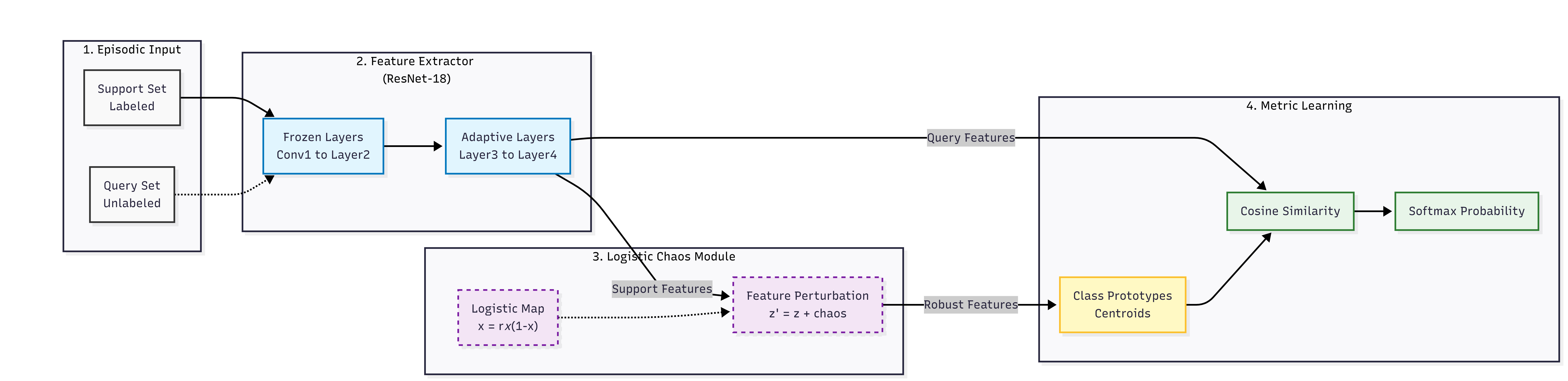
Figure 2: Schematic of the CE-ProtoNet architecture, detailing the point of chaos injection into support feature embeddings while preserving deterministic inference for query samples.
Logistic Chaos Module (LCM)
LCM implements the logistic map:
xn+1=rxn(1−xn)
with r=3.99 to maximize topological chaos. The chaotic sequence is seeded, centered, and scaled by a hyperparameter λ. The resulting noise vector is deterministically added to each support embedding during episodic training (not inference). Ablation over λ demonstrates that low intensities (λ≤0.10) yield insufficient regularization, while excessive perturbation leads to prototype destruction. Empirically, λ=0.15 is optimal.
The chaos injection is only active during training, ensuring deterministic and reproducible predictions during inference.
Class prototypes are computed as centroids over the perturbed support embeddings. Scaled cosine similarity (with a learnable temperature parameter τ) is used to mitigate softmax collapse and provide sharper class boundaries. Query embeddings, which are not perturbed, are scored against class prototypes for final classification. Cross-entropy loss over the scaled similarities guides the meta-learning objective.
Experimental Results
Ablation over Chaos Intensity
Comprehensive ablation over chaos intensities reveals a peak test accuracy of 84.52% and macro F1 of 0.8354 at λ=0.15, a relative improvement of +4.8% over standard ProtoNet (accuracy 79.70%). Beyond this point, increasing λ degrades performance due to semantic feature destruction.
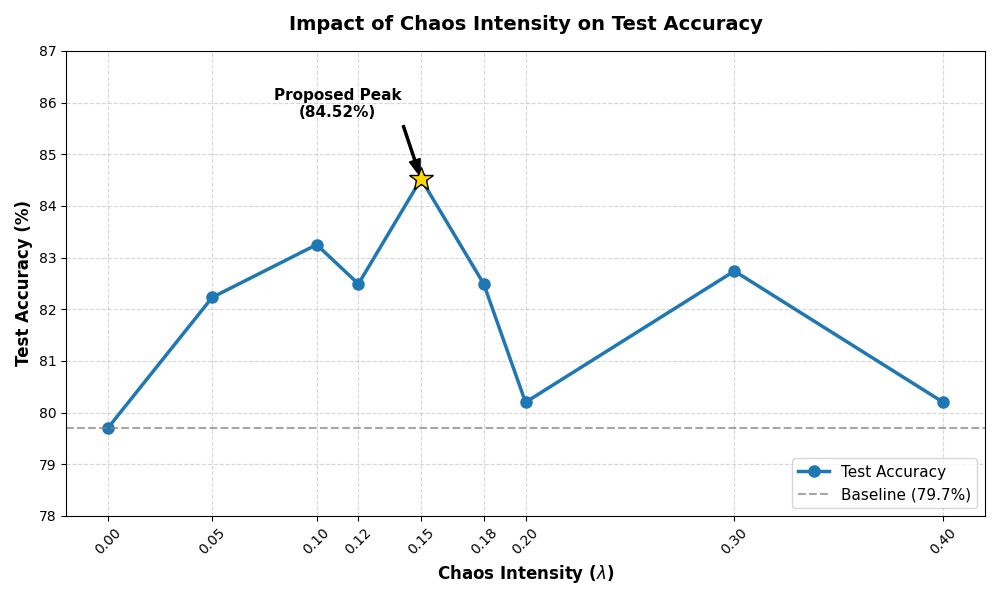
Figure 3: Test accuracy as a function of chaos intensity; optimal regularization occurs at xn+1=rxn(1−xn)0 with diminishing returns and rapid failure for high-intensity perturbations.
Geometric Structure of Embedding Space
t-SNE visualizations highlight the geometric effects of the chaos module: baseline ProtoNet clusters are structurally entangled, especially along the Glioma–Meningioma axis, reflecting fatal prototype overlap. CE-ProtoNet with xn+1=rxn(1−xn)1 spatially repels these clusters, reducing intra-class variance, but some residual overlap remains due to intrinsic morphological similarities in non-contrast MRI.
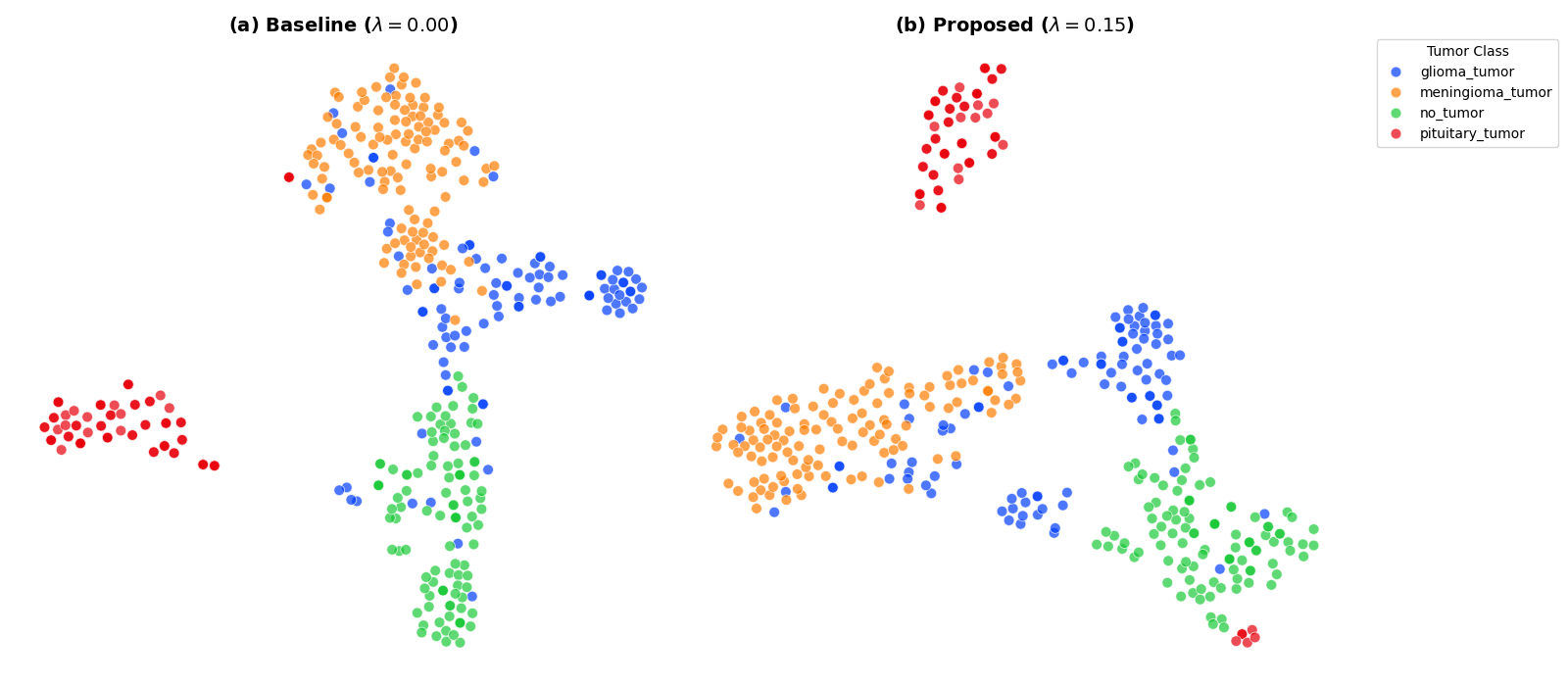
Figure 4: (a) Baseline ProtoNet embeddings showing Glioma–Meningioma entanglement; (b) CE-ProtoNet with chaotic regularization achieves distinct cluster separation and compactness.
Qualitative Assessment
Qualitative review of predictions confirms high-fidelity detection for well-demarcated classes (Pituitary and No Tumor), while failures consistently occur when class boundaries in the feature space are fundamentally ambiguous, especially for diffuse Gliomas lacking distinctive structure.
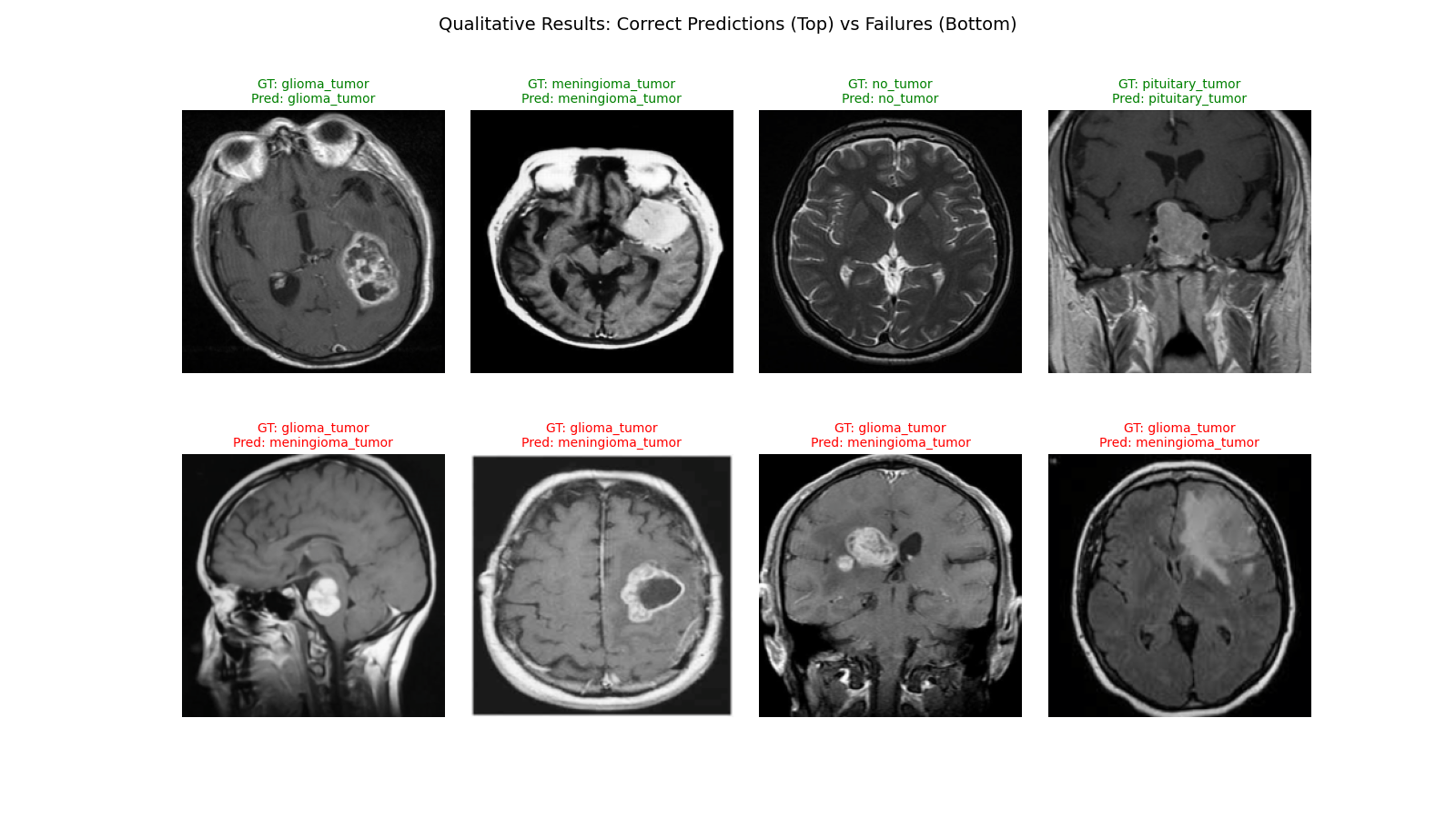
Figure 5: Top row: successful classifications; bottom row: persistent Glioma-Meningioma confusion attributable to inherent imaging ambiguities.
Implications and Theoretical Insights
The core contribution is demonstrating that deterministic, bounded chaotic perturbations outperform both unstructured noise and computationally expensive generative data augmentation for regularizing embedding space in FSL. The LCM effectively mitigates prototype bias, driving prototypes to become robust semantic anchors even when support samples are not representative.
The lightweight complexity (xn+1=rxn(1−xn)2 relative to baseline) and deterministic nature ensure clinical feasibility compared to GAN- or DDPM-based augmentation frameworks, which present risks of mode collapse or feature hallucination.
Nevertheless, the method exposes the limitations of single-modality, low-contrast imaging for pathology discrimination: no algorithmic intervention can resolve cases where the feature space is inherently degenerate due to absent physiological information. Theoretical upper bounds on embedding separability are dictated by acquisition protocol rather than metric-space geometry.
Future Directions
Adaptive chaos intensity, conditioned on local embedding entropy or uncertainty, could differentially regularize ambiguous samples without harming well-separated ones. Integrating multi-sequence or multimodal data would further enlarge intrinsic class margins by introducing distinct anatomical/functional features. Combining ergodic perturbations with local attention mechanisms also promises parameter-efficient gains for medical FSL.
Conclusion
CE-ProtoNet establishes that controlled deterministic chaos is a scalable, efficient, and effective strategy for prototype regularization in few-shot medical image classification. It achieves strong empirical gains and significant stabilization of representation geometry, outperforming alternative stochastic or generative regularization in clinically relevant, data-scarce settings. Persistent class ambiguity is an artifact of imaging modality rather than the architectural or learning paradigm. Future work should consider adaptive chaos scheduling and richer multi-modal representation learning to further elevate diagnostic performance.
Reference: "Chaos-Enhanced Prototypical Networks for Few-Shot Medical Image Classification" (2604.17300)