- The paper proposes Safety Token Regularization (STR) to preserve LLM safety by constraining safety token logits during parameter-efficient fine-tuning.
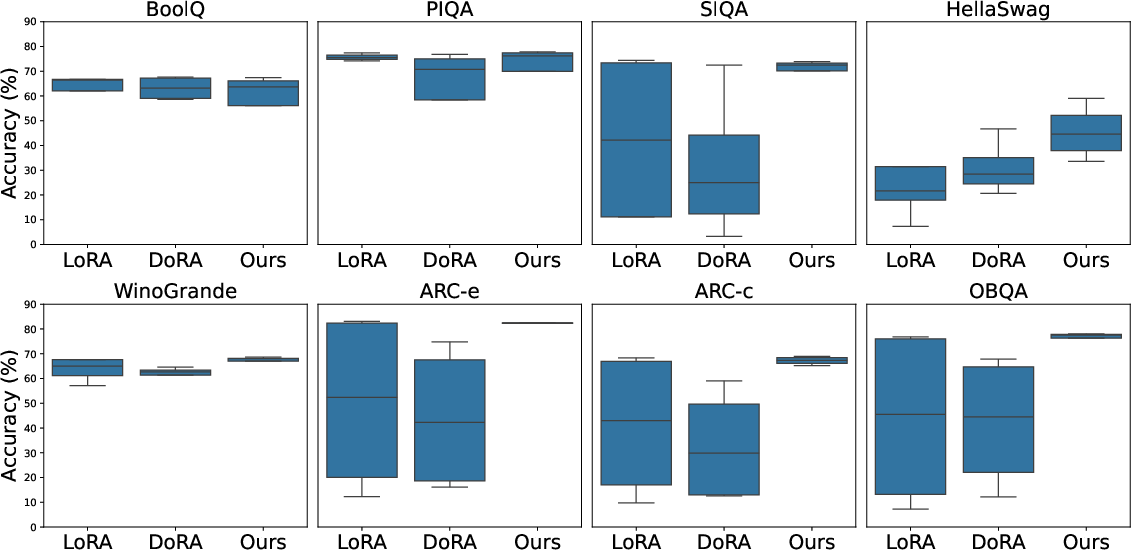
- STR achieves significant safety improvements by reducing harmful response rates to 0.0% in adversarial tests while maintaining competitive accuracy on mainstream benchmarks.
- The method integrates seamlessly with PEFT techniques like LoRA, enhancing model stability and supporting continual learning without substantial computational overhead.
Safety Token Regularization: A Logit-Space Guardrail for Preserving LLM Alignment
Introduction and Motivation
Fine-tuning LLMs on downstream tasks is a standard practice to adapt them for specialized domains. Despite careful pretraining alignment, this post-hoc adaptation can erode safety alignment, even when using ostensibly benign data. Prior approaches to alignment—most notably, Reinforcement Learning from Human Feedback (RLHF) and Direct Preference Optimization (DPO)—have a strong focus on pretraining. Existing Parameter-Efficient Fine-Tuning (PEFT) algorithms (e.g., LoRA, DoRA) reduce computational costs but lack explicit safety preservation guarantees.
"Guardrails in Logit Space: Safety Token Regularization for LLM Alignment" (2604.17210) introduces Safety Token Regularization (STR), a token-level fine-tuning-time regularization technique. STR specifically constrains the logits of safety-indicative tokens identified from the base model’s rejection templates, ensuring that fine-tuned models retain (or improve upon) the pretrained safety profile while maintaining task performance and achieving enhanced training stability.
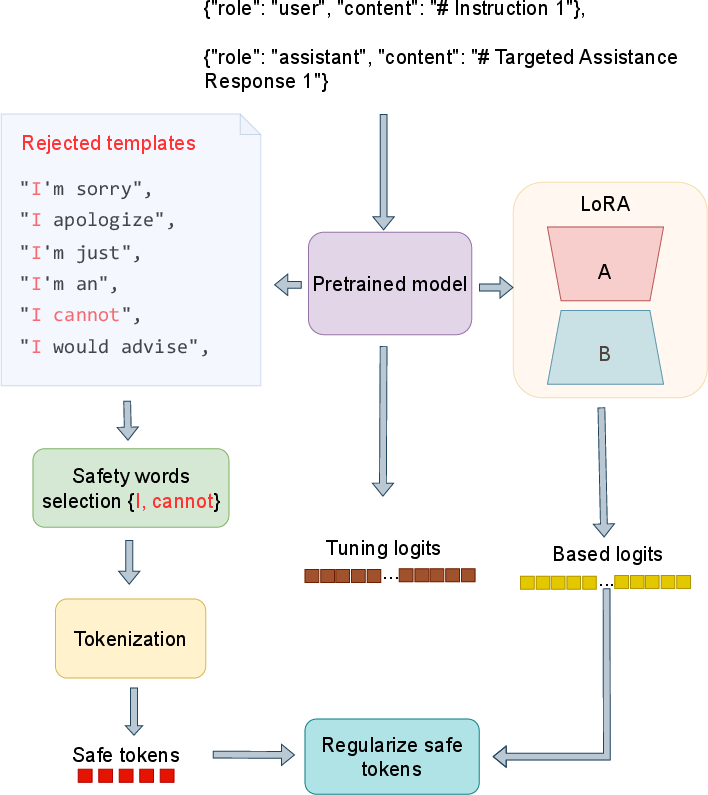
Figure 1: STR architecture overview—safe tokens are extracted from safety-aligned model rejection templates and their logits are regularized during PEFT updates, constraining fine-tuned behavior in the logit space.
Approach: Safety Token Regularization
STR is a lightweight regularization method easily integrated into standard PEFT pipelines. The approach consists of three essential steps:
- Identification of Safety Tokens: Instead of relying on static blacklists, STR analyzes the pretrained model's rejection templates in response to harmful prompts (e.g., expressions typically found in safe refusals such as "I," "cannot," "can't"). The most common corresponding tokens—post-tokenization—form the safety token set.
- Logit-Level Regularization: During fine-tuning, for each instance, STR computes the squared difference between the logits assigned to each safety token by the base and fine-tuned models, averaged over the sequence. This term is injected into the overall training loss alongside the canonical cross-entropy loss.
- PEFT Integration: Only the PEFT weights are updated, with base LLM parameters held fixed. This regularization can be directly applied with LoRA, DoRA, or similar methods, at negligible implementation complexity.
These constraints ensure the fine-tuned model's treatment of key safety-indicative tokens remains close to the pretrained model, preserving (and in some regimes, exceeding) baseline harmlessness.
Experimental Results
Safety Preservation on Benign and Adversarial Data
STR demonstrates strong preservation of safety properties in two critical settings:
- Benign Data (Alpaca Dataset): STR achieves lower Harmful Response Rate (HRR) than vanilla LoRA and shows parity or improvement over advanced post-hoc alignment methods (e.g., SaLoRA, Safe-LoRA), especially on LLaMA-2. Notably, at rank 32, the fine-tuned model's HRR is reduced to the level of the original pretrained model or lower.
- Adversarial Data (PureBad Dataset): When fine-tuned on exclusively harmful prompts, LoRA yields massive degradation of safety (HRR up to 62.3%). STR, by contrast, enables the fine-tuned model to retain pre-trained safety (0.0% HRR for LLaMA-2, and even improve upon LLaMA-3 pretrained safety).
Task Utility and Stability
Token Selection and Robustness
An intriguing result is that even "random tokens"—with no intrinsic safety connection—contribute to enhanced safety when regularized, albeit with diminished effect relative to targeted safety tokens. This suggests a more general principle: preserving token-level behavior acts as a regularizer against harmful divergence during fine-tuning, akin to behavior-conserving continual learning.
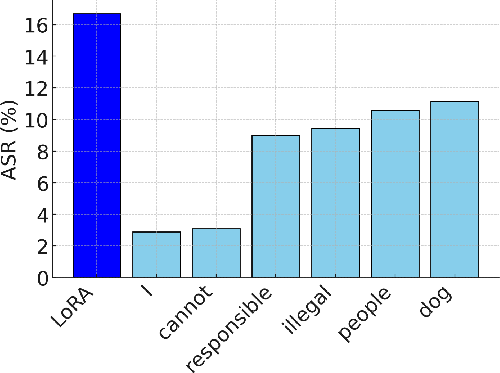
Figure 3: Comparison of safety token and random token regularization—both improve model safety, with safety tokens yielding superior results.
Trade-off Analysis
STR achieves safety gains with negligible impact on task-specific evaluation loss and runs only 1.34x slower per iteration than vanilla LoRA (yet faster than DoRA). Varying the regularization strength (λ) trades off stronger safety with only minor task performance penalty, confirming the effect is not due to over-regularization.
Theoretical and Practical Implications
STR establishes that token-aligned logit regularization provides a practical "guardrail" for continual alignment. While RLHF and DPO provide coarse, human-feedback-based signal, STR exploits a fine-grained, model-internal structure. The implication for LLM deployment pipelines is that safety alignment can be robustly, inexpensively preserved under iterative, domain-specific adaptation, without repeated costly human-in-the-loop preference tuning.
Practically, this means LLM custodians can confidently adapt foundation models to novel tasks without risking degenerate or unsafe outputs—provided that safety tokens are carefully selected, informed by underlying rejection heuristics. The demonstrated effect with random tokens also opens avenues for more generic behavioral regularization in continual learning and task transfer beyond safety alignment.
Limitations and Future Work
STR necessarily aligns the fine-tuned model's safety to the scope of the base model’s refusal patterns. Novel safety requirements or evolving definitions (beyond the vocabulary encoded in rejection templates) are not immediately accommodated. Extension to dynamic token sets, context-aware logit regularization, or integration with higher-level preference models could address these limitations and facilitate flexible, user-defined safety policies.
Conclusion
STR offers a principled, efficient, and effective framework for post-hoc safety alignment in LLM fine-tuning. By regularizing the logit-space behavior of safety-tokens, this method preserves or enhances pretrained harmlessness across diverse adaptation regimes, without sacrificing model utility or introducing training instability. Its integration into PEFT workflows is trivial, and its implications for safe, reliable, and continual deployment of LLMs in safety-critical domains are significant.
Reference: "Guardrails in Logit Space: Safety Token Regularization for LLM Alignment" (2604.17210)