- The paper establishes that standard greedy online RLHF and DPO methods achieve bounded O(1) cumulative temperature-zero regret by decoupling learning cost from policy randomization.
- It employs both nonparametric and parametric reward models under mild regularity conditions to reconcile rapid empirical convergence with pessimistic KL-regularized regret bounds.
- Empirical simulations in finite-action Bradley–Terry environments confirm that once the reward gap is resolved, cumulative temperature-zero regret plateaus, justifying the method’s practical efficiency.
Demystifying the Effectiveness of Online Greedy Alignment Methods
Introduction
This work addresses a crucial conceptual mismatch in the theory of preference-based online alignment methods for RLHF and DPO: while empirical observations repeatedly indicate strong efficiency of purely greedy, iterative online preference optimization, prior regret analysis—centered on KL-regularized policy regret—suggests only logarithmic cumulative regret, which appears pessimistic when compared to observed convergence and plateauing of empirical regret. The central claim is that this mismatch arises because KL-regularized regret confounds the learning-induced statistical cost and the dilution from deliberate policy randomization. The paper formalizes a decision-centric, "temperature-zero" regret criterion, and rigorously establishes that standard greedy alignment algorithms (online RLHF and DPO) achieve bounded (O(1)) cumulative regret with respect to this alternative notion. The work positions itself as a reconciliation of empirical efficiency and theoretical analysis by demonstrating that, under decision-centric evaluation, the cumulative regret attributable to learning is strictly constant; the remaining log-style growth in KL-regularized regret is attributed purely to residual policy stochasticity.
Alignment Model and Notions of Regret
The paper analyzes an online iterative preference-based alignment loop. At each round, the deployed policy generates a slate of candidate actions for a context, receives preference feedback via a (possibly unknown, MNL/BT-style) choice model, and fits an updated reward model via empirical risk minimization (typically Bradley–Terry logistic loss). The updated reward model then informs a new policy via KL-tilted exponential weights with respect to a reference (pre-alignment) distribution.
Traditionally, regret is computed with respect to a finite-temperature (softened) policy—the KL-regularized policy regret—which charges the learner both for not identifying the optimal response and for continued stochasticity in deployment. In contrast, the temperature-zero regret, advocated in this paper, measures only the (population) average suboptimality of the single top-ranked action induced by the reward model (namely, the argmax action), effectively separating the cost of exploration/identification from that induced by policy smoothing/regularization.
Main Theoretical Contributions
Bounded Temperature-Zero Regret
Theoretical analysis is given for both nonparametric and parametric reward classes subject to mild regularity conditions (compactness in the metric inherited from the support of the reference policy, and robust context-dependent gaps in optimality). The main result is that standard greedy online procedures—fitting the reward model by empirical risk minimization (ERM), and updating deployment via KL-tilted reweighting—achieve
supTRegretT=O(1)
cumulative temperature-zero regret. The proof leverages covering number arguments, support-local continuity, and strict margin conditions, akin to optimal arm spanning conditions in contextual bandits. Once the reward model identifies the optimal response in nearly all contexts (up to a vanishing measure), further policy updates yield zero additional temperature-zero regret; exploration is automatically supplied by data collected on a (softened, but improving) on-policy distribution.
Decision-Centric Perspective: Implications for Policy Evaluation
This finding gives a precise explanation for the observed empirical plateau in cumulative regret for online greedy RLHF and DPO. Under this evaluation, iterative greedy alignment strictly separates the one-time cost of identifying optimal responses from the perpetual, regularization-induced cost of continuing to randomize/compress, and thus explains why, empirically, greedy procedures rapidly "finish learning" in a finite number of rounds.
Empirical Validation
Empirical results are presented via controlled simulations in finite-action linear Bradley–Terry (BT) environments, closely following testbeds of recent RLHF theory work but evaluating only the top-ranked action's regret at each round. The experiments consider various regularization strengths and report results both for online RLHF and for the equivalent online DPO update in the pairwise setting.
After an initial period of learning, the one-step temperature-zero regret drops rapidly to effectively zero, and the cumulative regret curve flattens, with no further growth through the remainder of the horizon. This is in sharp contrast to the logarithmic cumulative growth predicted by KL-regularized regret accounting.
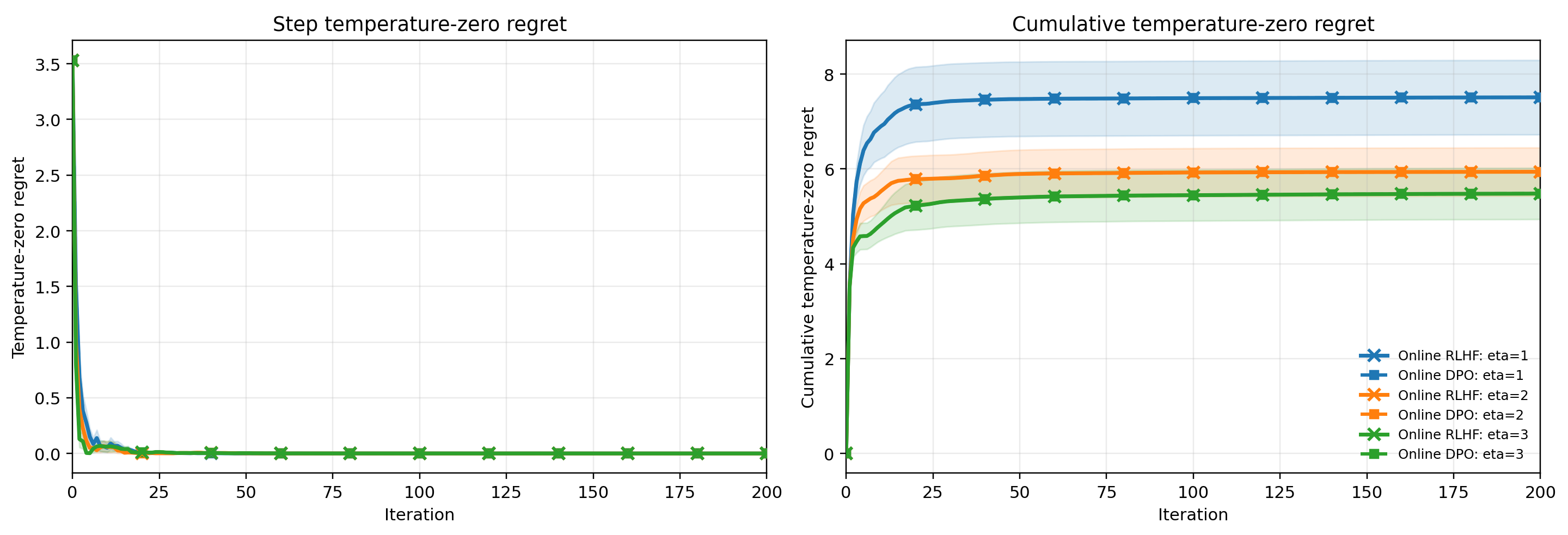
Figure 1: The mean and standard error (over 50 runs) of one-step and cumulative temperature-zero regret, for online RLHF and online DPO under various regularization strengths; temperature-zero regret collapses rapidly and cumulative regret plateaus.
Additional experiments with substantially lower gaps (harder identification instances) confirm the same qualitative pattern: once the reward gap is resolved, additional regret accrual ceases, and cumulative regret is manifestly bounded (though the plateau onset is delayed for small gap instances).
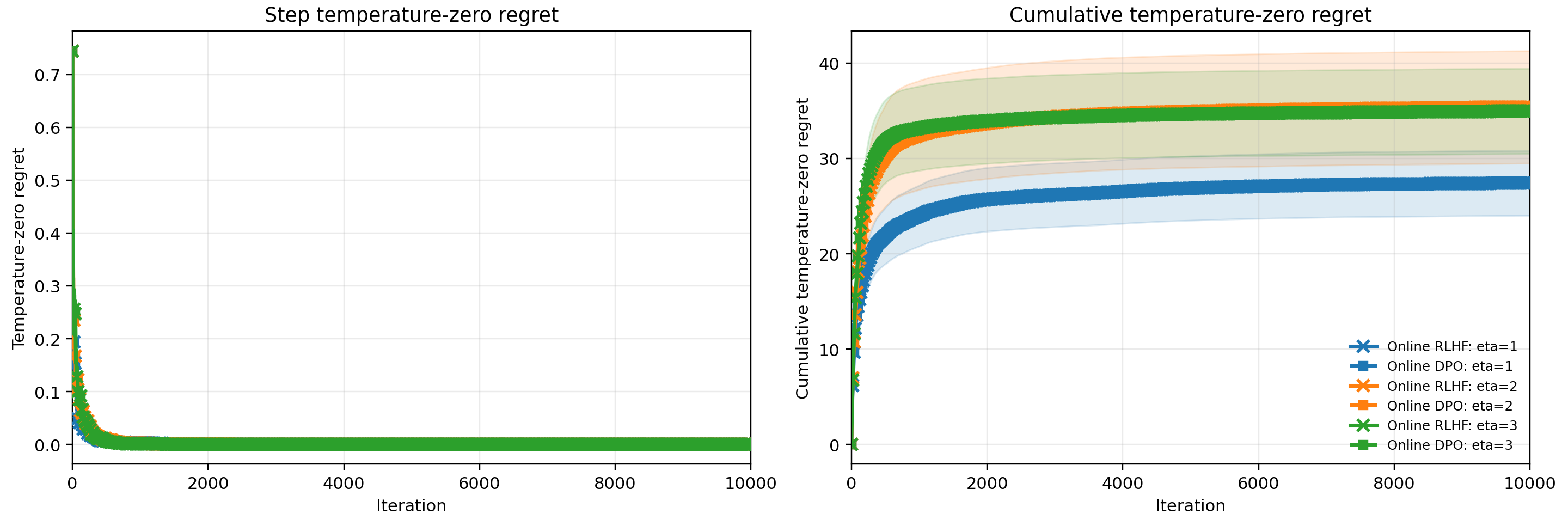
Figure 2: Replication in a low-gap regime (minimum probe gap 0.0204): temperature-zero regret again collapses and cumulative regret plateaus after gap identification, confirming the result holds beyond easy cases.
Discussion and Implications
Theoretical Significance
This result situates online greedy alignment within a growing literature on constant and sub-logarithmic regret for contextual bandits under benign data conditions—such as covariate diversity and favorable margins—which guarantee implicit exploration. It extends the reach of these "mostly exploration-free" results to the iterative RLHF/DPO setting, establishing that randomization is not required for exploration per se, only for smoothness or variance reduction.
Practical Impact
Practically, this finding justifies the empirical effectiveness of standard greedy RLHF alignment loops in achieving rapid selector identification. In deployment scenarios where only the final top selection matters, the theoretical analysis supports truncating the evaluation horizon after the decision-centric regret plateaus.
Limitations and Future Directions
The primary scope is limited to well-behaved preference models (notably, MNL/BT), structurally robust reward classes, and synthetic contexts and actions. Analysis in more complex, intransitive, or large-scale LLM settings is left for future work. Interpreting (and perhaps modifying) temperature-zero regret for richer or non-classical preference models, or for settings where non-argmax actions matter at inference time, is a key direction.
Conclusion
By reframing the evaluation of online alignment methods around the temperature-zero regret criterion, this work demonstrates that the standard greedy online RLHF loop, including its DPO instantiation, achieves provably bounded cumulative regret with respect to identifying correct top responses. The result not only sharpens existing theory—clarifying that observed logarithmic KL-regularized regret is induced by policy smoothing, not incomplete learning—but also motivates further investigation into decision-centric evaluation for alignment in more general models and deployments.
Reference: "Demystifying the unreasonable effectiveness of online alignment methods" (2604.17207)

