- The paper presents a fidelity-based criterion that quantifies and distinguishes quantum coherence transfer from classical processes in network settings.
- It outlines multiphoton experimental protocols using remote state preparation and Bell-state measurements to verify one-qubit and two-qubit coherence transfer.
- The study integrates semidefinite programming with advanced photonic fusion setups, providing practical methods for scalable quantum network verification.
Coherence Transfer in Quantum Networks: Principles and Multiphoton Experimental Realization
Introduction
Quantum coherence, the ability of a quantum system to exist in non-classical superposition states, underpins the operational advantages of quantum communication, computation, and metrology. The resource-theoretic characterization and detection of quantum coherence, especially in complex quantum networks involving multiple nodes and entanglement channels, is essential for confirming the nonclassicality and transport of information in next-generation quantum internet architectures. The work in "Coherence Transfer in Quantum Networks" (2604.17196) presents a rigorous framework for quantifying and experimentally detecting coherence transfer in multiphoton quantum networks, leveraging semidefinite programming, multipartite entanglement generation, and measurement-based protocols.
Coherence Transfer Criteria in Quantum Networks
The foundational aspect of this work is the introduction and justification of fidelity-based criteria for the detection of coherence transfer in networks. By defining a criterion kernel Q that quantifies the statistical discrepancy between the output population distributions produced by quantum-coherent versus classical-incoherent network processes, the authors provide a tool that can detect whether a network operation necessarily involves the creation or propagation of genuine quantum coherence.
In structured settings such as the triangular network, it is shown that even with a single quantum state setting, quantum networks can realize correlations unattainable by any classical network, as exemplified by parity constraints not achievable in classical postselected scenarios. This is formalized by explicit models linking the network topology to quantum and classical probability distributions, and determining that the quantum distribution yields Q>0 for all classical parameter settings, confirming intrinsic coherence transfer.
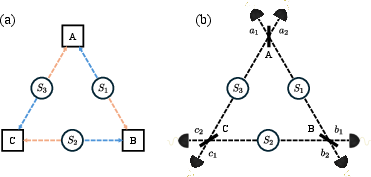
Figure 1: Classical versus quantum triangular networks, highlighting network processes and parity constraints not simulatable by classical mixtures.
A critical theoretical insight is the generalization to unstructured, device-independent scenarios, where the number of independent state settings (n) becomes relevant: at least d input/output state settings are required to resolve d2 variables and rule out all capable classical incoherent processes via SDP-based optimization.
Dynamical Coherence Witnessing and Quantum Transport
The framework is extended to open quantum systems and time-dependent scenarios via a time-resolved coherence-transfer criterion, Qt. In this context, the method certifies the generation of coherence over time in dissipative quantum systems, marking a practical advance over previous time-domain witnesses such as Leggett-Garg inequalities. The master-equation modeling of single-electron transport in double quantum dots is provided as an example, with the criterion detecting the temporal window of coherence beyond what is accessible through standard inequality violations.
Multiphoton Experimental Realization
A key experimental achievement is the realization of four- and six-photon entanglement networks using state-of-the-art SPDC sources, high-fidelity photonic fusion, and polarization analysis. Detailed experimental setups include high-brightness BBO sources, advanced filtering, and precise photon count coincidence logic.
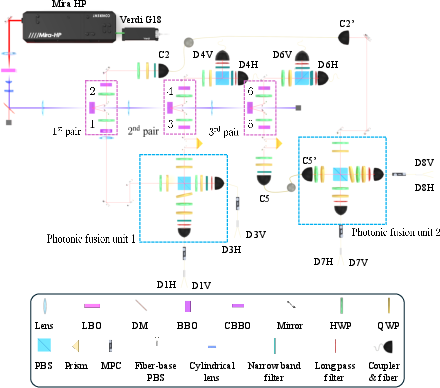
Figure 2: Complete experimental setup for generation and measurement in multiphoton entanglement networks.
The resource backbone consists of multiphoton entangled (GHZ) states synthesized via entangled photon-pair fusion, verified by entanglement witnesses and state fidelities. The achieved fidelities, coincidence rates, and entanglement witnesses (including observables ⟨X⊗6⟩ and ⟨Z⊗6⟩ for six-photon GHZ states) confirm the nonclassical, genuinely multipartite entangled nature of these networks.
One-Qubit Coherence Transfer: RSP and Photonic Fusion
The one-qubit coherence transfer protocol is executed with remote state preparation (RSP), photonic fusion, and population measurement, demonstrating that coherence can be injected at one node and faithfully transferred through the network to distant nodes as verified by the coherence kernel criterion. The sequence of unitary operations (implemented via wave plate settings) and postselective measurement protocols are detailed, with the experiment covering both the four-node (GHZ-4) and six-node (GHZ-6, i.e., star graph) networks.
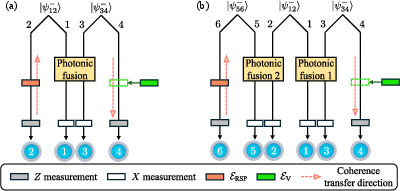
Figure 4: One-qubit coherence transfer scheme in four- and six-node photonic entanglement networks.
Experimental data, analyzed via SDP to bound the kernel Q under incapable process constraints, confirms that nonzero values are observed only when the network is operated in the quantum-capable regime.
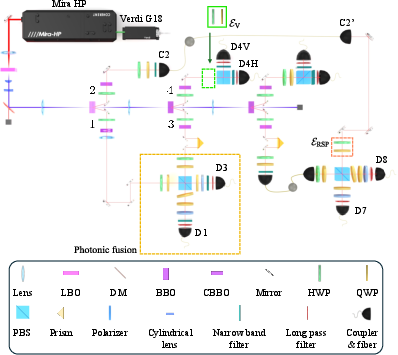
Figure 6: Experimental apparatus for detection of one-qubit coherence transfer in the four-photon network.
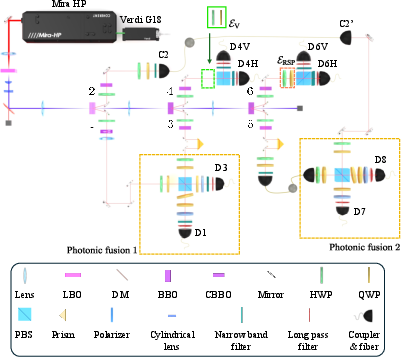
Figure 3: Experimental apparatus for the six-photon coherence transfer, with cascaded fusion stages and multiphoton detectors.
Two-Qubit Coherence Transfer: Entanglement Swapping via BSM
To realize and detect two-qubit coherence transfer, the authors implement Bell-state measurement (BSM) protocols in both four-photon and six-photon configurations. These protocols, effectively entanglement swapping operations, input Bell-coherent two-qubit states and conditionally transfer entangled coherence to output nodes, again using population and coherently-conditioned measurements.
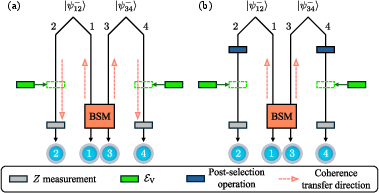
Figure 5: Scheme for two-qubit coherence transfer with BSM and measurement-based conditional operations in four-photon networks.
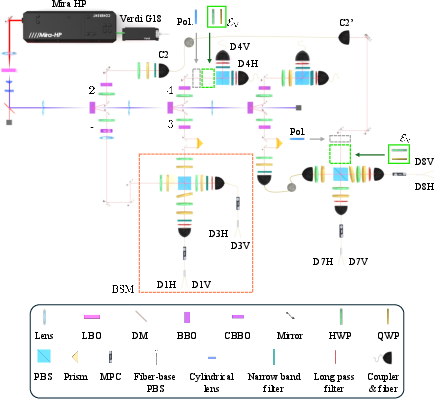
Figure 7: Experimental setup for two-qubit coherence transfer in the four-photon network.
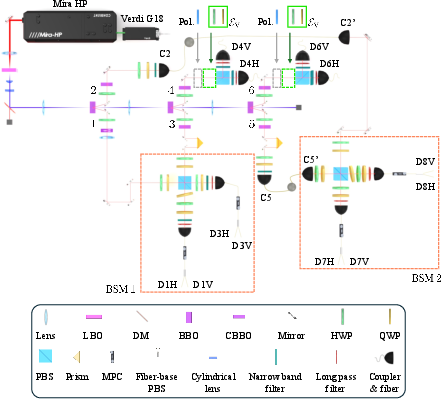
Figure 11: Experimental setup for two-qubit coherence transfer in the six-photon network, with dual BSM stages.
The control experiments, where polarizers are used to suppress coherence following the input Bell states, yield Q=0, robustly distinguishing coherent quantum transfer from classical mimicry.
Theoretical and Practical Implications
This work consolidates the operational methodology for both certifying and experimentally measuring quantum coherence transfer in complex networks, substantiating the distinction between classical and quantum networked processes. The approaches extend to device-independent and semi-device-independent frameworks relevant in untrusted or partially characterized quantum networks.
The implemented protocols are immediately applicable to quantum communication, distributed quantum computation, and metrology, including protocols requiring verified coherence at scale—such as entanglement swapping, teleportation, and cluster-state quantum computing.
At a fundamental level, the formalization provides a concrete test for resource-theoretic coherence transmission, implementing the conceptual program sketched in prior works on quantum network nonlocality, multipartite entanglement, and operational channel resource theory.
Future Directions
Possible extensions include fully device-independent coherence certification, generalization to higher-dimensional qudits and complex graph state topologies, and integration with quantum error correction and repeater schemes. As quantum networks scale and hybridize across platforms (e.g., photonic, atomic, and solid-state nodes), such operational and scalable coherence certification methods will be essential for quantum internet verification, benchmarking, and security.
Conclusion
"Coherence Transfer in Quantum Networks" (2604.17196) presents an analytical and experimental framework for detecting, quantifying, and operationally exploiting quantum coherence transfer in multiphoton entanglement networks. By integrating resource-theoretic criteria with large-scale photonic network experiments, the work provides both a theoretical toolkit and practical methodology for scalable quantum network verification, directly impacting quantum communication, distributed computation, and quantum-enhanced sensing.