- The paper establishes that Gram matrix positivity, derived from map-dependent quantum characteristic functions, is equivalent to complete positivity of quantum channels.
- It employs the Choi-Jamiołkowski isomorphism to develop CP-divisibility criteria, linking Gram matrix negativity to non-Markovian information backflow.
- Numerical simulations on amplitude damping and dephasing models confirm that negative eigenvalues in the Gram matrix serve as effective indicators of memory effects in quantum dynamics.
Map-Dependent Quantum Characteristic Functions and CP-Divisibility in Non-Markovian Dynamics
Introduction
This work presents a structural framework for characterizing non-Markovian quantum dynamics through the introduction of map-dependent quantum characteristic functions. By leveraging the Choi-Jamiołkowski isomorphism, the paper establishes an equivalence between the positivity of an associated Gram matrix constructed from the characteristic function and the complete positivity (CP) of the underlying quantum channel. This equivalence is formalized as the Bochner--Choi positivity theorem. The framework is then used to define a criterion for CP-divisibility in time-dependent quantum dynamics, relating the emergence of non-Markovianity to the negativity of the two-time Gram matrix. Detailed analysis and simulations on amplitude damping and pure dephasing models demonstrate the approach and confirm its correspondence with traditional information backflow measures.
Quantum Dynamical Maps and the Choi Representation
The dynamical evolution of open quantum systems is described by time-dependent quantum dynamical maps Φ(t,0), which act on the space of density operators. Markovianity in this setting is typically characterized by CP-divisibility: a process is CP-divisible if, for all t≥s, the intermediate map Φ(t,s) is CP. The Choi representation provides an operational tool: a linear map Φ is CP if and only if its Choi operator J(Φ), defined as (Φ⊗I)(∣Ω⟩⟨Ω∣), is positive semidefinite.
Map-Dependent Quantum Characteristic Functions
To generalize the characteristic function framework to quantum channels, the normalized Choi operator ΩΦ=J(Φ)/d is introduced, which retains unit trace for trace-preserving maps. The map-dependent quantum characteristic function is defined as χΦ(Uμ)=Tr(ΩΦUμ) for unitaries {Uμ} forming an operator basis on the doubled Hilbert space. The Gram matrix
GμνΦ=Tr(ΩΦUμ†Uν)
encodes positivity properties analogous to classical characteristic functions. Notably, the paper proves that t≥s0 if and only if t≥s1 is CP.
The Bochner--Choi Positivity Theorem
A central formal result is the equivalence between the positivity of the Gram matrix and the complete positivity of the underlying map (Theorem 1). Proof proceeds by noting that t≥s2 can be written as the expectation value of positive operators with respect to t≥s3, and invokes the Choi theorem.
This result directly extends to time-dependent maps: defining the two-time characteristic function and associated Gram matrix for t≥s4, the paper shows that CP-divisibility is equivalent to the positive semidefiniteness of t≥s5 for all t≥s6.
The breakdown of CP-divisibility—signaled by the negativity of Gram matrix eigenvalues—is linked to non-Markovian memory effects, coinciding with the emergence of information backflow as measured by revivals in the trace distance between initially distinct states (the BLP criterion).
Numerical Analysis: Amplitude Damping and Dephasing Models
Amplitude damping and pure dephasing models are analyzed to illustrate the theoretical framework. Non-Markovian time dependence is induced by time-local decay rates t≥s7, which are engineered to be temporarily negative. The intermediate map parameter t≥s8 serves as an order parameter for non-CP-divisibility.
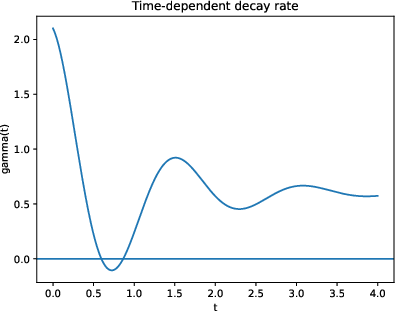
Figure 1: Time-dependent decay rate t≥s9 for amplitude damping, with negative intervals indicating non-Markovian behavior.
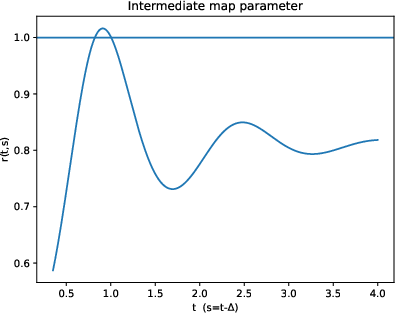
Figure 2: The intermediate map parameter Φ(t,s)0, with values exceeding unity indicating non-CP-divisible dynamics.
The minimum eigenvalues of the Gram matrix and the Choi operator are plotted to demonstrate that their negativity coincides, as predicted by the Bochner--Choi theorem.
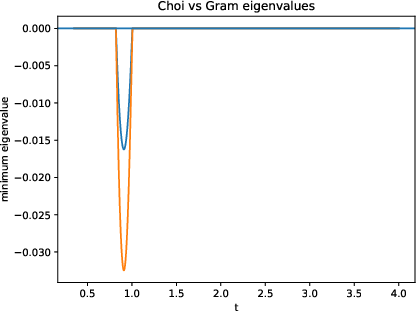
Figure 3: Minimum eigenvalues of the Choi operator and Gram matrix, tracking the breakdown of CP-divisibility.
Information backflow is confirmed by the revival of the trace distance, which quantifies the distinguishability of quantum states and is a direct signature of non-Markovianity.
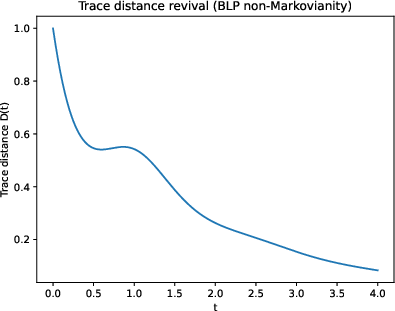
Figure 4: Trace distance between two states, with revivals signaling information backflow.
In the dephasing model, periods of negative dephasing rate induce coherence revival in the system.
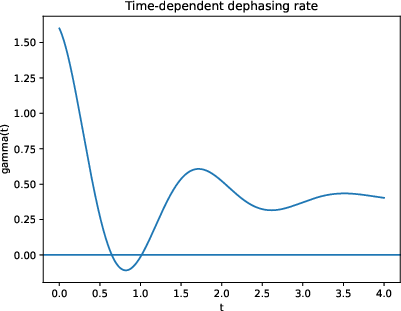
Figure 5: Time-dependent dephasing rate Φ(t,s)1 for the pure dephasing model.
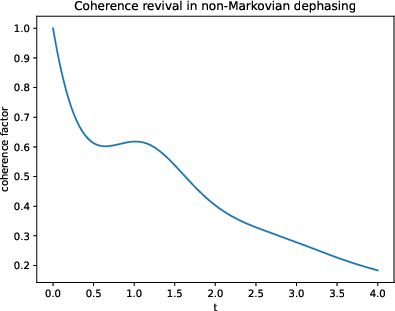
Figure 6: Coherence revival in non-Markovian dephasing dynamics.
Implications and Outlook
This framework establishes a structural and functional connection between characteristic-function positivity and CP of quantum maps, and between Gram matrix negativity and non-Markovian phenomena such as information backflow. For qubit and low-dimensional systems, a unitary operator basis (such as Pauli matrices) yields a tractable computational scheme. For larger systems, potential directions include basis truncation or tensor network compression.
Experimentally, statistical errors in process tomography can impact the empirical Gram matrix. Therefore, significance of Gram matrix negativity should be contextualized via statistical uncertainty, for instance using confidence bounds on minimum eigenvalues.
Extending the method to multi-time processes, including higher-order process tensors, would parallel recent trends in operational non-Markovianity analysis. Connections to resource theories, temporal correlations, and non-classicality witnesses constitute interesting theoretical directions. The formalism also complements recent approaches in quantifying structure in dynamical phase diagrams and operational measures of information flow.
Conclusion
By formulating quantum characteristic functions for dynamical maps and connecting Gram matrix positivity to CP-divisibility, this work unifies structural and information-theoretic perspectives on non-Markovian quantum processes. The Bochner--Choi positivity theorem links characteristic function methods with quantum map theory and provides a computationally accessible witness for memory effects in quantum dynamics. Future developments may focus on scalability, robustness to noise, and operational extensions to multi-time quantum processes.
Reference: "Map-Dependent Quantum Characteristic Functions and CP-Divisibility in Non-Markovian Quantum Dynamics" (2604.17185).