- The paper establishes a bijection between half-zipper trees and CaTherine wheels, enabling the unique reconstruction of space-filling curves from LQG geodesic trees.
- It employs rigorous topological and probabilistic methods to analyze measurability, uniqueness, and area properties of the induced curves.
- The research extends classical continuum Peano curve theory beyond the Brownian map to cover the full LQG universality class for γ in (0,2).
CaTherine Wheels, Trees, and Liouville Quantum Gravity: An Expert Overview
Introduction and Context
This work rigorously analyzes CaTherine wheels, a canonical class of space-filling curves f:S1→S2 characterized by the property that the image of every closed interval is a closed topological disk with boundary respected by the map. These objects, originally arising in the context of Cannon-Thurston maps, are closely related to Peano curves in low-dimensional topology and probability theory. The paper focuses on a topological and probabilistic characterization of such curves, particularly as they manifest in random metric geometries like Liouville quantum gravity (LQG).
Crucially, any CaTherine wheel induces a zipper, i.e., a pair of disjoint, dense, topological trees in S2. The authors’ principal contributions are:
- Providing necessary and sufficient topological criteria for when a given tree arises as (half of) the zipper associated with a CaTherine wheel.
- Applying these findings to the geodesic tree structure present in the γ-LQG metric for γ∈(0,2), thereby constructing a unique space-filling CaTherine wheel—interpreted as a contour exploration of the LQG geodesic tree.
- Analyzing measurability, uniqueness, and structural properties, and situating the construction within the probabilistic context of random planar geometry.
Main Definitions and Results
CaTherine Wheels and Zippers
The essential definition imposes that f:S1→S2 maps intervals to disks with appropriately aligned boundaries, yielding, via limiting processes, two associated dense, disjoint trees Z+ and Z−. The primary focus is on reconstructing f given only one of these zippers, which leads to the notion of a half-zipper: a dense, uniquely geodesic tree in S2 where every point is a cut point and everything is expressible as an exhaustion by finite trees with "short hair."
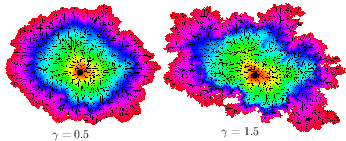
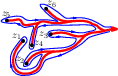
Figure 1: Simulations of LQG metric balls and corresponding geodesics for different γ (left/middle), and the induced order of contour exploration on sample points (right).
Topological Characterization
The core theoretical result is a bijection between half-zippers with short hair and CaTherine wheels: A set S20 is a half-zipper with short hair if and only if there exists a unique CaTherine wheel whose zipper includes S21; explicit construction is given via topological order completion. This is formalized via a precise analysis of path structures, convex hulls, and the behavior of ends (Freudenthal compactification and ideal gaps) in the tree, paralleling concepts from the prime end theory of planar domains.
Application to Liouville Quantum Gravity
In the probabilistic setting, let S22 and consider the S23-LQG metric S24 constructed from the Gaussian free field by regularization and limiting procedures. The union of all S25-geodesics from points in S26 to infinity, denoted S27, satisfies the half-zipper conditions almost surely:
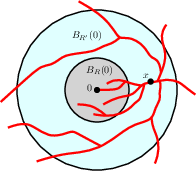
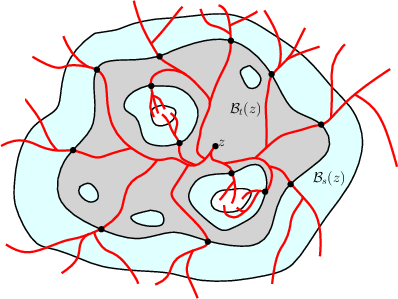
Figure 3: Confluence property across an LQG annulus: a finite set S29 (black) is hit by all γ0-geodesics (red) from the center to the exterior.
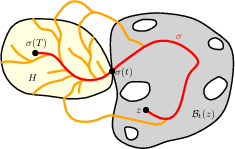
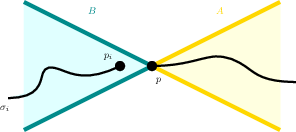
Figure 4: In the geodesic tree γ1, removing a point disconnects the tree, with no paths remaining between pre- and post-cut segments.
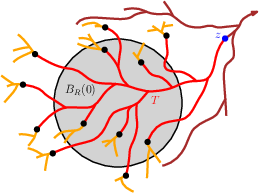
Figure 5: In the LQG setting, a finite subtree γ2 (red) exhausts the geodesic tree γ3 up to small-diameter “hairs”; path components off the subtree have arbitrarily small diameter.
Applying the main theoretical criterion, γ4 thus uniquely determines a CaTherine wheel γ5. This curve is the unique space-filling loop whose half-zipper is the LQG geodesic tree, i.e., it is the "contour exploration" Peano curve of the random LQG metric.
Order, Uniqueness, and Area Properties
Strong additional properties are obtained:
- Almost surely, γ6 is a singleton.
- There is a reparametrization γ7 such that segments have γ8-LQG area precisely matching the length of interval in parameter space.
- The curve’s visit order respects the merge structure of the geodesic tree: for typical γ9 in the plane, γ∈(0,2)0 visits γ∈(0,2)1 before γ∈(0,2)2 iff the geodesic from γ∈(0,2)3 merges to that from γ∈(0,2)4 on the right.
Broader Context and Implications
This work unifies topological and probabilistic perspectives on space-filling planar curves, connecting the Cannon–Thurston theory, Thurston-type Peano curves, and recent advances in random planar geometry. The LQG CaTherine wheel extends the canonical continuum Peano curve description beyond the Brownian map (γ∈(0,2)5)—where this object is known in detail via the Brownian snake—to the full LQG universality class with γ∈(0,2)6.
Crucially, the technique requires only "one side" (the geodesic tree) of the zipper, in contrast to classical probabilistic constructions relying on both trees; this suggests a powerful template for future constructions in random geometries with partially characterized metric trees.
From a geometric analysis perspective, CaTherine wheels provide insight into:
- The geometric encoding of random surfaces by curves, further linking metric and probabilistic structure.
- The possibility of reconstructing other random space-filling Peano curves (in e.g., random triangulations, the directed landscape, Poissonian metrics) from only partial data.
Potential directions include characterizing Peano curves in further metric settings, extending to γ∈(0,2)7 (the critical LQG case), and leveraging the "one side suffices" philosophy for more general topological encoding theorems.
Conclusion
This work provides a definitive topological criterion for the existence and uniqueness of a CaTherine wheel corresponding to a given tree (half-zipper), and leverages this result to rigorously construct and analyze the canonical contour exploration of the LQG geodesic tree for all γ∈(0,2)8. The construction elucidates the interplay between topological, combinatorial, and probabilistic aspects of random planar geometry and establishes a technical foundation for further investigations of Peano-type curves in complex random metric spaces.