- The paper presents a two-tier HAPS-SMBS architecture that integrates wireless energy harvesting with joint optimization of node positioning and time-switching factors.
- It employs both iterative (IDFA) and model-free Q-learning methods to optimize system performance under linear and nonlinear energy harvesting models.
- Numerical simulations demonstrate up to an 11% improvement in data rate, highlighting the practical benefits and challenges for energy-efficient 6G networks.
Two-Tier HAPS Wireless Energy Harvesting: Architecture, Modeling, and Joint Optimization
Introduction
The proliferation of 6G and beyond communication networks is closely linked with integrating non-terrestrial platforms—most notably high-altitude platform stations (HAPS) and unmanned aerial vehicles (UAVs)—to fill coverage gaps and offer resilient connectivity in disaster and remote scenarios. The major operational bottleneck for sustained aerial platform deployment remains energy scarcity. The paper "Two-Tier High Altitude Platform Stations (HAPS) for Exploring Wireless Energy Harvesting" (2604.17169) systematically develops and analyzes a novel two-tier HAPS super-macro base station (HAPS-SMBS) architecture with integrated wireless energy harvesting (EH), addressing the optimization of network node positioning and time-switching EH factors using both iterative methods and model-free reinforcement learning.
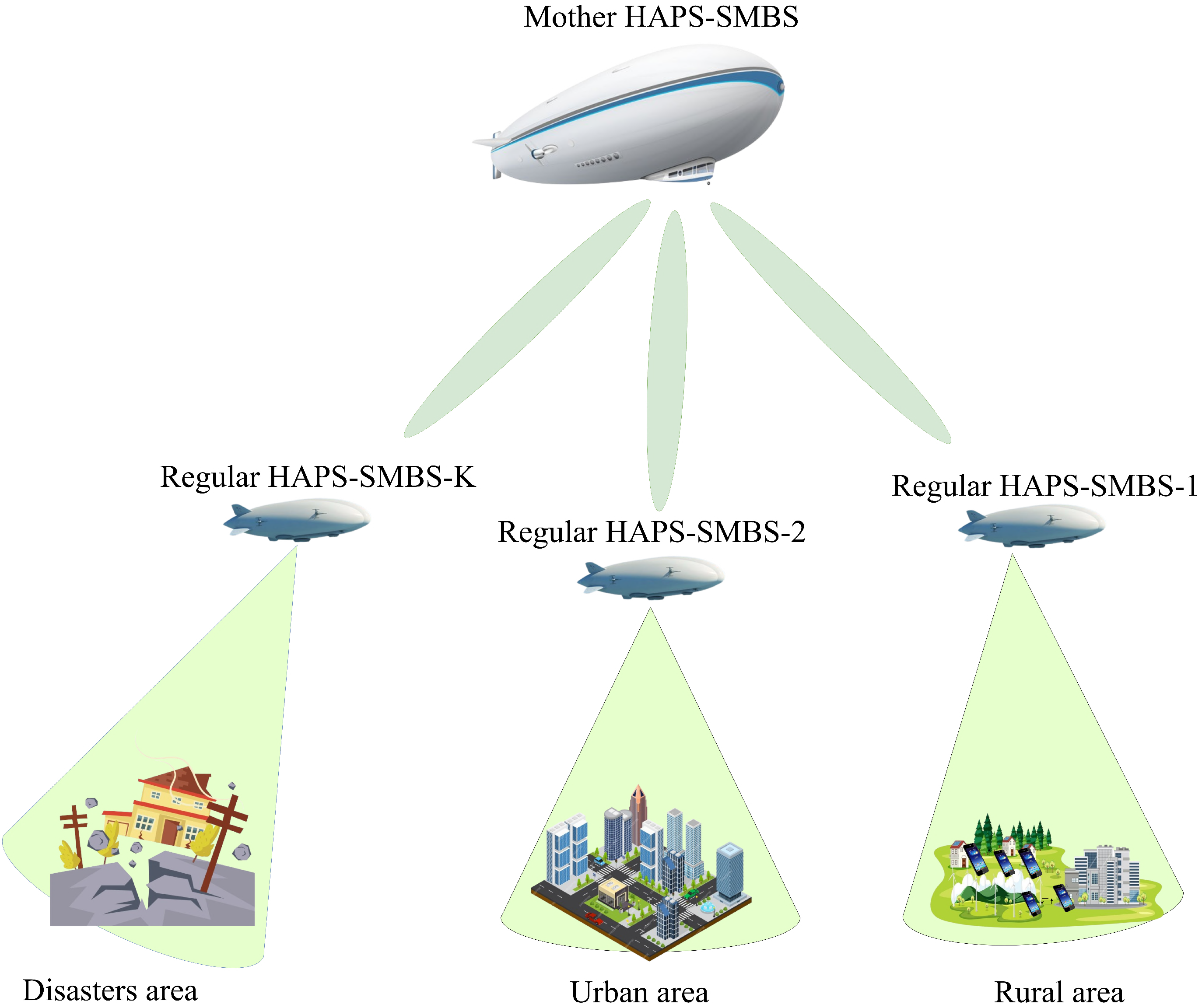
Figure 1: Generic architecture of HAPS-SMBS supported by the EH scheme.
System Architecture and Propagation/EH Model
The architecture consists of a two-tier HAPS system comprising a centrally managed, larger mother HAPS-SMBS node and K regular HAPS-SMBSs, as shown in (Figure 1), in which the mother HAPS-SMBS is responsible for backhaul/management links with the ground station and for wirelessly transmitting energy to the subordinate regular HAPS-SMBSs. This architectural separation allows the regular HAPS-SMBSs both to perform RAN operations and to harvest energy from the mother HAPS-SMBS, effectively converting ambient inter-platform RF signals into useful power.
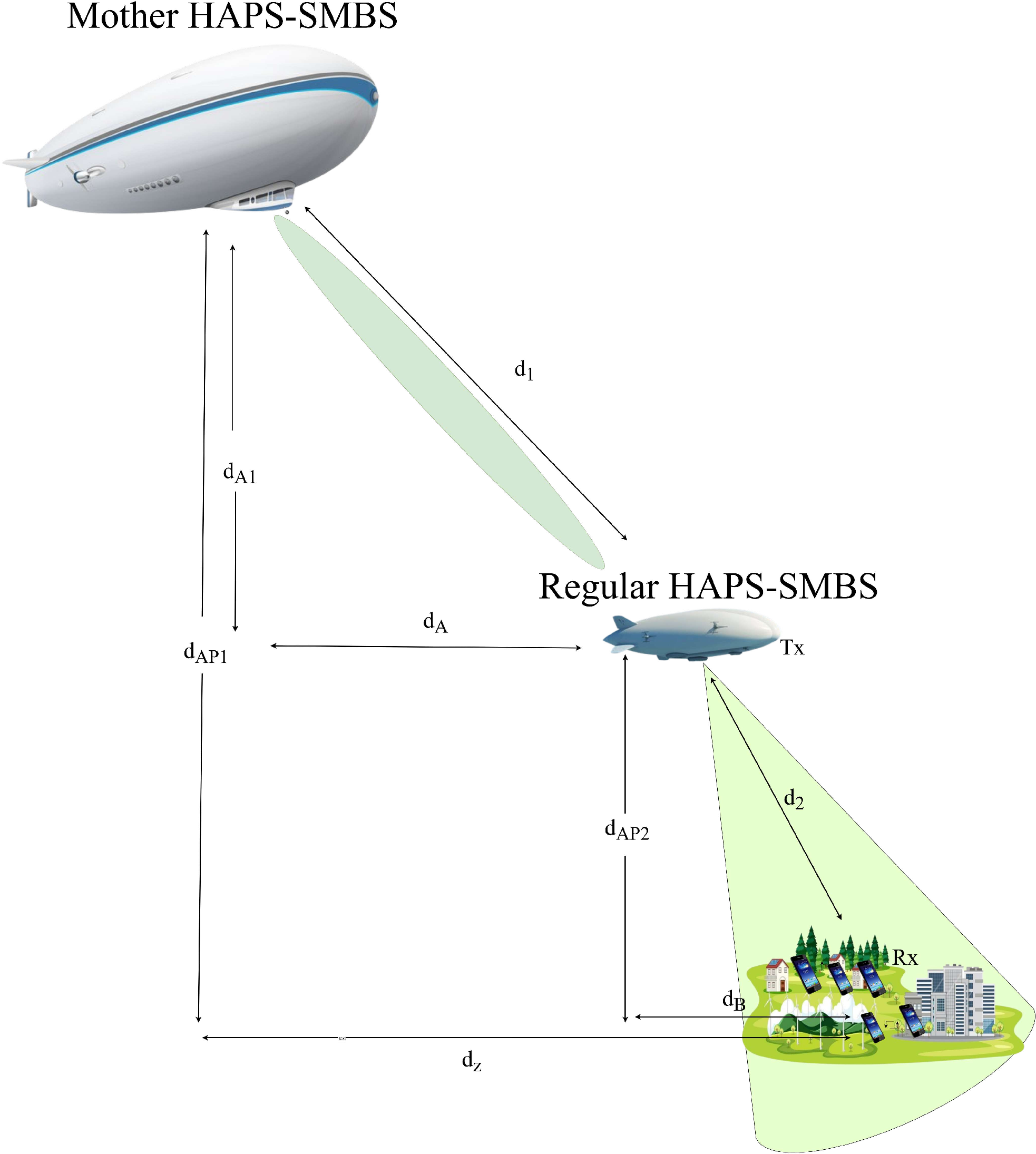
Figure 2: HAPS-SMBS supported by the EH scheme; the mother node transmits energy to subordinate HAPS-SMBSs, who serve ground users.
The paper employs both linear and nonlinear EH models to capture the real-world behavior of the rectification and storage circuits commonly used in aerial nodes. The block-level operation—energy harvesting during τT followed by information transmission during (1−τ)T—is clarified in (Figure 3).
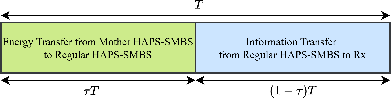
Figure 3: Block diagram illustrating energy harvesting and subsequent information transmission.
For the nonlinear case, saturation and threshold effects are modeled via parameterized input/output relationships. The wireless channel is abstracted using log-distance path-loss expressions, with the two-hop nature of the energy and information flows explicitly captured.
Optimal HAPS-SMBS Positioning for Maximizing Harvesting and Rate
The paper provides a technical optimization for positioning regular HAPS-SMBSs with respect to the mother HAPS-SMBS under both linear and nonlinear EH assumptions. In the linear case, the optimal horizontal separation between energy source and harvester is derived in closed form, explicitly as the minimizer of multiplicative path losses. In the nonlinear regime, the solution exploits the decoupling between the two propagation distances introduced by nonlinearity, yielding optimality when the regular node is aligned as closely as possible to the mother node (zero horizontal offset) or, for the information link, maximally separated. This rigorous geometric treatment highlights key physical limitations inherent in air-to-air EH links under practical nonlinearity.
Joint Optimization: EH Factor and Node Position
Central to the work is the formulation and solution of a non-convex joint optimization problem where the decision variables are the horizontal positioning of the regular HAPS-SMBS and the time-switching EH factor τ. The objective is maximizing average data rate, subject to practical operational constraints such as minimum transmit powers and feasible time-splitting ratios.
The first solution approach is an Iterative Distance and EH Factor Algorithm (IDFA), which alternately fixes τ and node position, optimizing each in turn. This coordinate-descent method is guaranteed to converge to a local optimum but may not achieve the global solution in non-convex landscapes.
To address this, the authors implement a model-free Q-learning framework, treating system state as a tuple of (dA, τ) index, reward as the resultant data rate, and actions as discrete moves in the configuration space. Through intensive episodic training, the Q-learning agent can explore nontrivial dependencies and find superior joint operating points in the linear case, with demonstrated convergence in a moderate number of episodes.
Transmit Power Management and Energy Inventory Optimization
The analysis is extended to scenarios where harvested energy is insufficient for target transmit power. The regular HAPS-SMBS is allowed to draw from its onboard reserves, but the minimization of this consumption becomes an objective so as to maximize operational life. The optimal energy draw is explicitly characterized, and backup energy is allocated only when RF-harvested reserves fall short. This convex programming approach ensures that the system's use of precious inventory energy is minimized, serving as a blueprint for practical flight mission management algorithms.
The authors provide a comprehensive suite of simulations reflecting realistic HAPS operating parameters. Key findings include:
- Joint IDFA and Q-learning frameworks yield up to 11% data rate improvement (linear EH, τT0-learning) and up to 7% (linear EH, IDFA) over random or suboptimal assignment strategies.
- In nonlinear EH scenarios, performance gains are more subdued (maximum 1.8%).
- Rigorous sensitivity analysis demonstrates that higher operating frequencies and increased separation degrade EH yield due to atmospheric and free-space losses, with nonlinear circuits saturating at comparatively lower power levels.
- Proper selection of receiver antenna gain significantly enhances total harvested energy, advocating for large-array or intelligent surface solutions.
- When incorporating transmit power management, the EH-enabled system can outperform non-EH configurations—especially in regimes where harvested energy exceeds minimum transmitter requirements—thus extending flight endurance and reducing downtime.
Theoretical and Practical Implications & Future Directions
This work establishes a foundational methodology for exploiting two-tier HAPS topologies with wireless EH, moving beyond traditional ground-sourced or solar-only architectures. The dual use of model-based (IDFA) and data-driven (Q-learning) optimizers demonstrates that tailored reinforcement learning can effectively circumvent non-convexity and environmental uncertainty in practical NTN deployments.
Because nonlinearities in EH significantly impact achievable gains, future systems will need more advanced circuit models and hardware mitigations. The approach outlined naturally extends to multi-agent reinforcement learning for denser or more heterogeneous NTN scenarios, and integration with RIS and FSO technologies is expected to further enhance both the energy and data plane performance.
Conclusion
This paper provides a rigorous and technical blueprint for the realization of energy-harvesting-two-tier HAPS networks, showing significant system-level gains via both geometric and learning-based optimization of node positioning and energy allocation strategies. The detailed modeling and comprehensive numerical evaluation underpin the utility and constraints of non-terrestrial EH in the 6G era and provide actionable theoretical tools for the design of future robust, resilient aerial communication platforms.