- The paper introduces a novel time-domain method using phase-sensitive heterodyne detection to measure nuclear gravitational redshifts.
- The experiment employs dual-arm detection with enriched 57Fe absorbers and Doppler-driven detuning to extract differential phase signals.
- Monte Carlo simulations confirm that meter-scale baselines can achieve 5σ detection in hours, paving the way for stringent EEP tests.
Nuclear Heterodyne Interferometry for Gravitational Spectroscopy
Background and Motivation
Gravitational redshift (GRS) measurements constitute a critical experimental test of general relativity and the Einstein equivalence principle (EEP). While modern optical clocks have yielded sub–10−18–level precision in electronic-transition gravitational shifts, complementary tests involving nuclear sector transitions have stagnated since the canonical M\"ossbauer-based studies of Pound and Rebka. These benchmarks leverage nuclear transitions, whose energies are primarily set by strong interaction dynamics, thus providing unique sensitivity to possible violations of EEP not accessible to atomic measurements. The lack of progress in the nuclear domain is due not only to experimental complexity but also to fundamental limitations inherent in prior methodologies, which are based on energy-domain detection.
Principle of Nuclear Heterodyne Interferometry
The approach introduced in "Nuclear Heterodyne Interferometry for Gravitational Spectroscopy" (2604.17157) enables time-domain detection of gravitational redshifts via phase-sensitive nuclear heterodyne interferometry. The scheme utilizes time-resolved nuclear resonant scattering of monochromatic synchrotron X-ray pulses. A Doppler-driven reference absorber imparts a controllable detuning (Δωhet) to the incident X-rays, generating time-dependent heterodyne oscillations after interacting with spatially separated absorbers along different gravitational potentials.
The experimental geometry, as depicted in (Figure 1), consists of two arms (upper and lower) separated by a baseline h. Both arms contain identical single-line nuclear absorbers (e.g., enriched 57Fe foils). By detecting delayed intensity signals IU(t) and IL(t) after each synchrotron pulse, one can extract the gravitational frequency shift δω as a differential phase drift between heterodyne beat signals accumulated coherently over time.
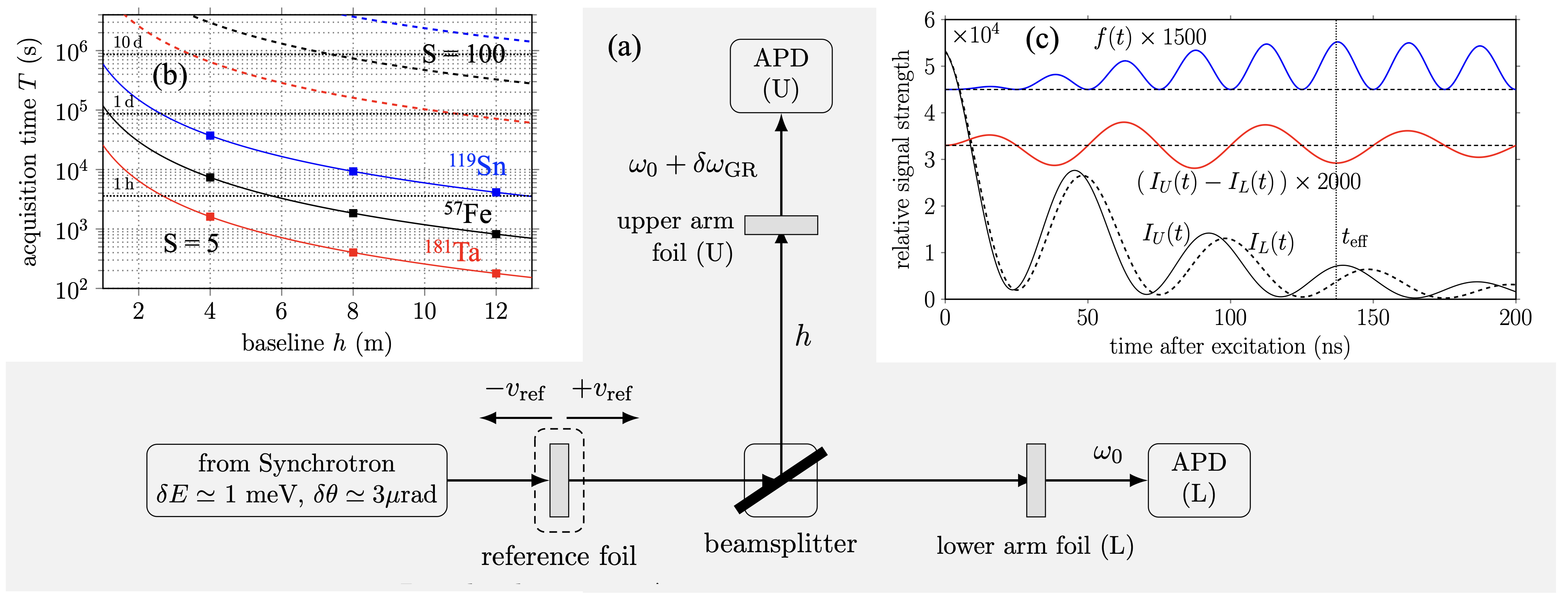
Figure 1: (a) Layout of the interferometer. A Doppler-driven reference introduces heterodyne detuning, X-rays are split, and interact with two absorbers at different heights. The resulting phase drift corresponds to the gravitational redshift. (b) Acquisition times required for specified significance levels S as a function of vertical baseline h. (c) Example heterodyne beat signals and Fisher information density.
Statistical Analysis and Sensitivity
The statistical framework is grounded in Fisher information analysis, which quantifies the attainable precision for δω in the presence of Poisson counting noise. The relevant waveforms are:
- Δωhet0 (lower arm)
- Δωhet1 (upper arm)
The differential signal, Δωhet2, is proportional to Δωhet3 times a known temporal kernel Δωhet4, exhibiting maximal sensitivity around times where Δωhet5 approaches the phase-accumulation window, determined by the effective linewidth Δωhet6 of the nuclear absorber. The Fisher-information density peaks near Δωhet7, enabling efficient phase accumulation in the time domain. This approach realizes a direct analogy to Ramsey interferometry but avoids the technical complexities of coherent quantum state recombination.
Monte Carlo simulations corroborate the analytic Fisher predictions. For state-of-the-art beamline parameters (delayed count rate Δωhet8, contrast Δωhet9, h0, h1 ns, and h2), a h3 detection of the nuclear gravitational redshift (using h4Fe and h5 m) is achievable within roughly 2 hours. Percent-level constraints on deviations from general relativity (h6) require h7(days) for an 8 m baseline.
Experimental Implementation and Systematics
All essential apparatus—enriched single-line h8Fe foils, X-ray beamsplitters using Si(840) Bragg reflection at 14.4 keV, fast avalanche photodiode detectors, and precision Doppler drives—are available at synchrotron beamlines. The architecture supports dual-arm detection with symmetry-based rejection of dominant systematics via:
- Arm subtraction, cancelling common-mode energy drifts
- Detuning reversal, removing odd-order instrumental offsets
- Detector/channel interchange, isolating detector-side asymmetries
The parity signature of the GRS signal (odd under arm exchange, even under detuning and detector reversal) distinguishes it from most systematic noise sources. Residual systematics—such as temperature gradients, normalization mismatches, and baseline calibration—are subdominant at the present precision goal but remain limiting factors for sub-percent determinations.
Scalability, Isotope Coverage, and Prospects
A strength of this method is its scalability in both physical baseline (h9) and isotope choice. Increasing 570 from a few meters to tens of meters dramatically reduces the required acquisition time for fixed statistical significance. Extensions to 571Ta, 572Sn, and nuclear clock isomers such as 573Sc are straightforward since all steps utilize direct ground-state transitions. Synchrotron-based platforms worldwide provide the necessary infrastructure, and forthcoming sources (e.g., X-ray free-electron lasers, diffraction-limited rings) will further increase available flux and coherence, reducing statistical errors and enabling higher-precision EEP tests in the strong interaction sector.
Theoretical and Practical Implications
The realization of time-domain nuclear heterodyne interferometry yields complementary access to possible new physics in gravitational coupling, especially regarding nuclear binding-energy dependence and composition-dependent violations of EEP. It provides a platform for stringent tests of general relativity distinct from those available in optical or atomic clock-based experiments. The method transforms nuclear GRS experiments from static, energy-domain resonance techniques to dynamic, phase-sensitive acquisitions, unlocking substantial gains in sensitivity by exploiting the full temporal waveform information.
Conclusion
Nuclear heterodyne interferometry, as formulated in this work (2604.17157), establishes a scalable, robust, and statistically efficient route to precision gravitational spectroscopy in the nuclear regime. It robustly extends the historical reach of M\"ossbauer-based GRS tests, enables rapid acquisition at meter-scale baselines, and provides a pathway to nuclear-sector EEP constraints at or below the percent level. This methodology broadens experimental access to strong-interaction effects in gravitational physics and augurs new avenues for probing possible deviations from general relativity using the unique properties of nuclear transitions.

