- The paper presents the LIR framework, unifying inference, adversarial training, and classic algorithms by iteratively resolving local inconsistencies in probabilistic dependency graphs.
- It demonstrates that controlled attention mechanisms enable targeted parameter updates, mirroring processes in SGD, EM, and transformer architectures.
- Empirical results show that localized refocus strategies enhance convergence, stability, and robustness in various probabilistic modeling scenarios.
Local Inconsistency Resolution: A Unified Perspective on Probabilistic Modeling, Attention, and Control
Introduction and Motivation
The paper "Local Inconsistency Resolution: The Interplay between Attention and Control in Probabilistic Models" (2604.17140) introduces the Local Inconsistency Resolution (LIR) framework as a general algorithmic and epistemic foundation for learning and inference in probabilistic models. It proposes that many established machine learning algorithms—ranging from EM and variational inference to message passing and adversarial training—are naturally recovered as special cases of iterative, local resolution of inconsistency in Probabilistic Dependency Graphs (PDGs). LIR is presented not only as a unifying theoretical lens, but as a practical tool for model training, approximate inference, and reconciliation of conflicting information within probabilistic structures.
PDGs are leveraged due to their capacity to represent inconsistent probabilistic beliefs with explicit confidence weights and their generalization of classic graphical models. Unlike conventional approaches focusing solely on global consistency, PDGs provide a tractable, flexible interface for the iterative resolution of local contradictions. LIR operationalizes this process by introducing the concepts of “attention” (which model components are attended to when measuring inconsistency) and “control” (which parameters are updated when resolving inconsistency), making the algorithm particularly adapted to computationally bounded settings.
Probabilistic Dependency Graphs and Inconsistency
PDGs generalize graphical models via directed (hyper)graph structures where arcs encode conditional probability distributions (CPDs) with explicit parameterizations and confidence weights. Inconsistency in a PDG is a formal measure of the extent to which the globally induced distribution can satisfy all CPDs; mathematically, it is computed as a weighted sum of KL divergences between marginalizations of the joint and the CPDs.
Resolving inconsistency amounts to minimizing this composite discrepancy. Exact evaluation is generally intractable (NP-hard), but becomes feasible under local focus via restricted subgraphs or simplified inference, accommodating bounded computational resources and limited observability/actuatability.
The Local Inconsistency Resolution (LIR) Algorithm
LIR proceeds iteratively: at each step, an attention mask φ determines which arcs (or loss components) contribute to the evaluated inconsistency, and a control mask χ determines which parameters may be updated. This leads to an update:
θ(t+1)←expθ(t)(−χ⊙∇θInconsistencyφ⊙M)
where exp denotes (possibly approximate) integration along the negative gradient flow, and M denotes the underlying PDG. Selection of “foci” (combinations of attention and control) generalizes the variety in classic optimization schedules (SGD, coordinate descent, etc.), message-passing schedules, and alternation between players in adversarial games.
Through this structure, LIR succinctly encompasses general inference, learning, and multi-component adaptation, systematically handling settings where full global resolution is impossible, unnecessary, or undesirable.
Unification of Major Algorithms
Viewing the parametric classifier pθ(Y∣X) and a labeled example (x,y) as a PDG, the local inconsistency between model output and label is simply the negative log-likelihood. By restricting control to the network parameters θ, input x, or label y, LIR respectively recapitulates standard training (SGD), adversarial example construction, and inference. Adversarial training naturally falls out as alternation between refoci on input and parameters (modifying the data or the classifier), underlining the symmetry between question (input), answer (label), and model (parameters). The approach encompasses both SGD and robustification procedures.
EM, Variational Methods, and VAEs
The EM algorithm is shown to be an instance of alternating control focus in LIR: first, with control over posterior approximations χ0 and fixed parameters χ1 (“E-step”), then control over χ2 with fixed χ3 (“M-step”). The inconsistency in the relevant PDG is exactly the negative ELBO, establishing a direct correspondence with variational inference and VAEs. Partial, incremental-EM, and online-EM variants emerge as natural modifications of the attention/control scheduling.
Generative Adversarial Networks
GAN training alternates between two foci: the discriminator receives attention to the CPD corresponding to χ4 and (optionally) discounts the generator’s “equal likelihood” prior, while the generator focuses on the reverse. The GAN objective arises as the inconsistency to be minimized in each case, formalizing GANs as adversarial inconsistency minimization in PDGs under appropriate attention/control alternation.
Belief Propagation and Message Passing
The sum-product algorithm and related message-passing procedures are formalized as specific LIR schedules over PDGs representing factor graphs. Each message update corresponds to resolution of local inconsistencies within a star-shaped subgraph surrounding a variable or factor, with foci encapsulating all legal message-passing schedules.
By constructing a PDG with pairwise arcs between all input/output token pairs, the transformer’s attention mechanism is recovered as a particular (exponentiated dot-product) attention mask within LIR, where resolution steps update output token representations to locally minimize inconsistency with the attention-weighted sum of input projections. This yields the softmax-based attention as a unique solution to the local minimization, directly connecting transformer mechanics to inconsistency resolution principles.
GFlowNets and Trajectory-Balance Losses
GFlowNet models are cast in the LIR framework by parameterizing policies and flows via forward (χ5) and backward (χ6) trajectories within a trajectory-labeled PDG. The TB and modified TB (trajectory-length-normalized) losses naturally arise as inconsistency measures with appropriate attention re-weighted by surprisal, and controlling the relevant parameters leads to standard and improved GFlowNet training, respectively. Modified variants (see figure below) show quantitatively improved convergence and training stability.
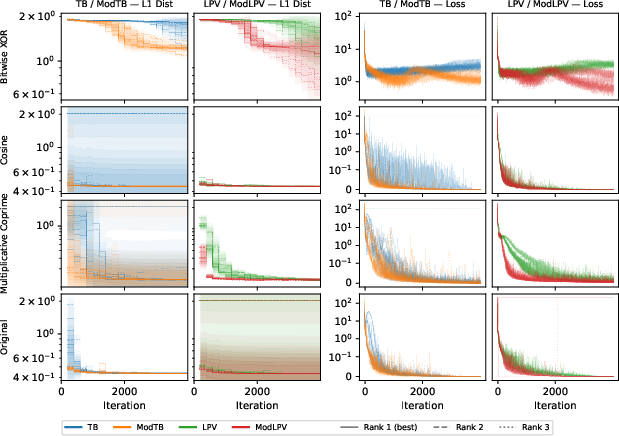
Figure 1: L1 distance and loss traces for TB, ModTB, LPV, and ModLPV on GFlowNet environments, showing accelerated and more stable convergence for the modified, normalized variants.
Empirical Analysis of Refocus Strategies
Experiments on synthetic PDGs with manufactured inconsistencies systematically compare several refocus (attention) strategies: uniform (global), partial (subgraph), and hub (single-variable-neighborhood) attention. Performance metrics include final inconsistency reduction, total variation distortion, and efficiency. Results indicate:
- Uniform and hub refocus achieve high inconsistency resolution but the hub strategy does so with less global distortion, highlighting the value of localized, focused adaptation.
- Partial refocus is less efficient, especially for small or sparse graphs.
- Consistency reduction can be achieved without destructive overfitting (i.e., maintaining fidelity to initial belief structure), highlighted by metrics tracking joint distribution shifts.
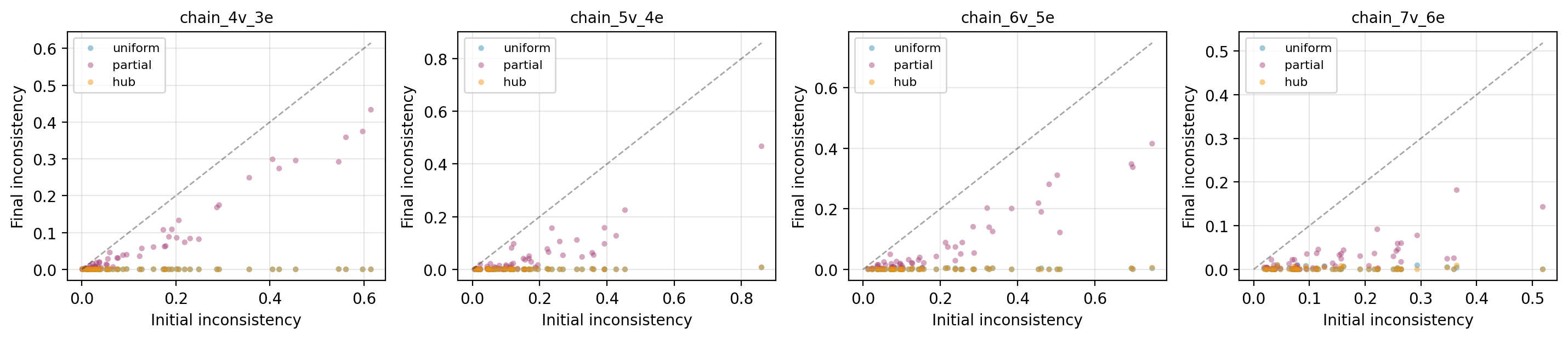
Figure 2: Initial vs. final inconsistency values under different attention strategies, demonstrating efficacy and selectivity of local resolution.
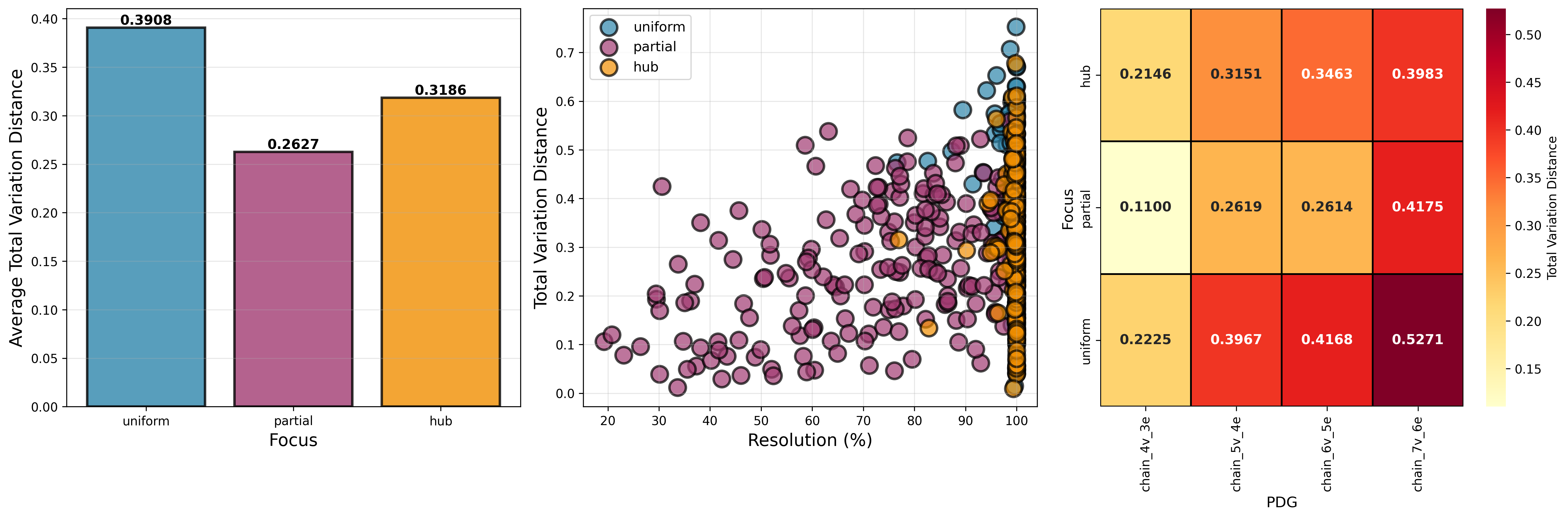
Figure 3: Total variation distortion analysis across refocus strategies, illustrating the varying trade-off between resolution and model change for each approach.
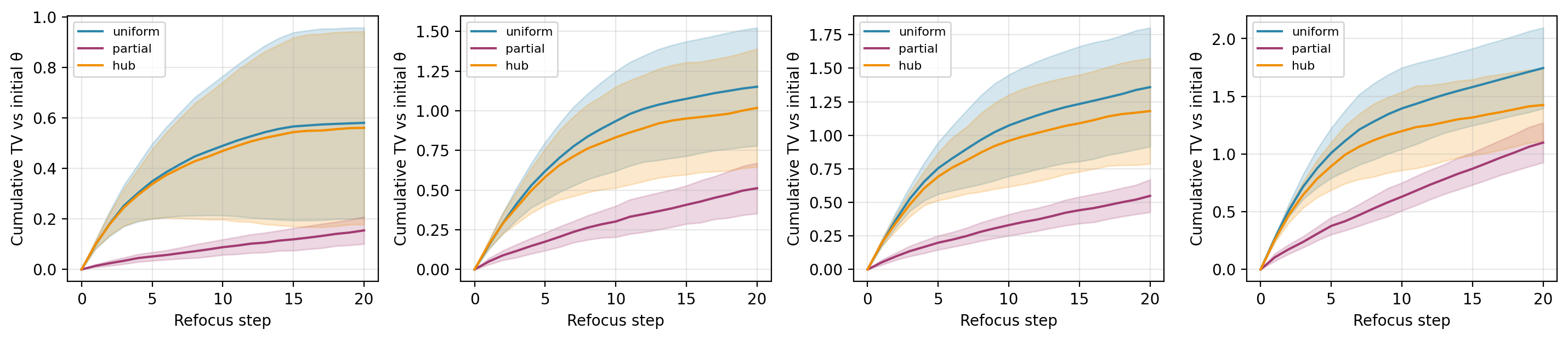
Figure 4: TV distance between CPD parameter states throughout LIR training, with confidence bands highlighting the typical stability features of different refocus protocols.
Theoretical and Practical Implications
LIR offers a compositional, flexible, and epistemically interpretable recipe for algorithm design in probabilistic modeling, suggesting a general principle: many learning and inference algorithms—whether viewed as maximizing likelihood, minimizing KL, adversarial loss, or inconsistency—are, at their core, special-case traversals of the inconsistency landscape over PDGs under constrained attention and control. This perspective breaks down the dichotomy between data, structure, and model parameters, allowing arbitrary hybridization.
The framework makes explicit how allocation of computational attention and adaptation capacity trades off global optimality, tractability, and robustness. It provides the vocabulary to articulate both neurocognitive theories (attention-driven learning via local inconsistency) and algorithmic procedures. There is a strong suggestion that adaptive, learned strategies for setting attention and control foci—akin to transformer-like mechanisms—will be fruitful directions for future research in both model robustness and meta-learning.
On the practical side, LIR suggests that modest modifications to existing loss functions—such as the normalized variant of TB for GFlowNets—can deliver measurable improvements in convergence and stability without fundamental changes to modeling assumptions.
Conclusion
Local Inconsistency Resolution systematically unifies a broad class of probabilistic inference and learning algorithms, revealing their epistemic underpinnings and illuminating the consequences of restricted focus and control. It reconfigures machine learning as a process of iterative, context-sensitive inconsistency elimination, subsuming classic and modern approaches within a single paradigm. The empirical and theoretical findings suggest that more powerful, interpretable, and robust algorithms will emerge from future investigation of adaptive refocus mechanisms and the principled exploitation of inconsistency measures.

