- The paper introduces a convex, geometry-aware DOE framework that leverages coordinated aggregator control to significantly enhance grid flexibility.
- It employs an ellipsoid-to-polytope conversion with a budgeted uncertainty model to maintain operational limits under variable loads.
- Fairness constraints are integrated to balance individual and aggregate headroom, achieving a 25% flexibility increase with 30% coordinated loads.
Coordinated Dynamic Operating Envelopes for Unlocking Additional Flexibility at Grid Edge: An Expert Analysis
Introduction and Motivation
The proliferation of DERs in distribution systems—encompassing PV, storage, and EVs—necessitates operational paradigms that balance network safety with maximized flexibility. Dynamic Operating Envelopes (DOEs) have emerged as a robust method for signaling time-varying, connection-specific power limits to end-users or aggregators, ensuring compatibility with nodal voltages and line ratings. A persistent limitation of extant DOE implementations is their overly conservative nature stemming from strictly independent, axis-aligned envelopes. This conservatism leaves substantial, physically admissible flexibility unutilized.
This paper presents a convex, geometry-aware DOE framework that explicitly incorporates partial resource coordination via aggregators. The core contributions are (i) a polytopal modeling of the DOE for coordinated cohorts, juxtaposed with hyperrectangular DOEs for non-coordinated entities; (ii) direct inclusion of fairness constraints on import/export flexibility allocations; and (iii) robustification against forecast uncertainty in fixed (inelastic) loads using a tractable, budgeted uncertainty model.
The distribution grid is described using a linearized branch-flow model, which permits the aggregation of operational bounds—voltage and thermal—into a global feasibility polytope for the vector of net power injections. The DOE optimization assigns an axis-aligned hyperrectangle to the non-coordinated set, ensuring feasibility under all admissible combinations (“worst-case” decoupling across users), and a high-dimensional polytope, internally constructed via an inscribed ellipsoid, to the coordinated group. The distinction between axis-aligned (independence-limited) DOEs and fully coupled polytopal (coordinated) sets is visually acute.
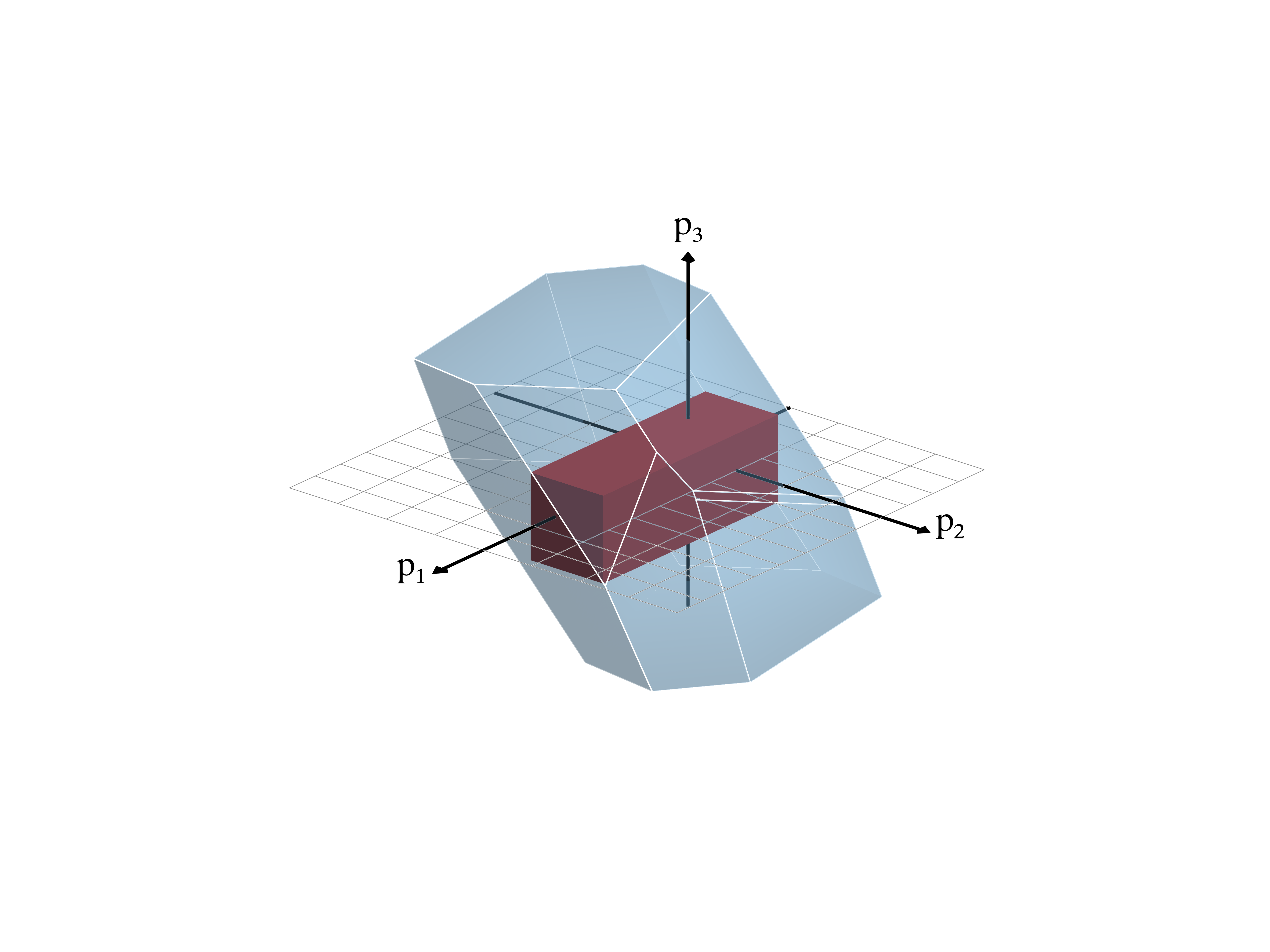
Figure 1: Coordinated (polyhedral) DOE versus independence-limited (axis-aligned) DOE. The hyperrectangle must fit inside the polytope to remain feasible for all uncoordinated choices.
The aggregate DOE is optimized using a concave objective comprising logdet(W) for the ellipsoid and the sum of log-widths for non-coordinated bounds, maintaining convexity. The inclusion of the ellipsoidal surrogate enables the tractable maximization of joint flexibility volumes, subsequently converted to a polyhedral DOE for explicit enforcement.
Integration of Robustness and Fairness Constraints
To ensure operational guarantee under fixed demand forecast uncertainty, the authors embed a Bertsimas-Sim budgeted uncertainty model. The robustified problem tightens the DOE constraints by a data-driven margin, parameterized by the budget (Γ) and relative magnitude (η) of uncertainty. This approach is statistically agnostic, requiring only upper bounds on possible deviations.
Additionally, a directional fairness constraint on DOE allocation is introduced. This is formalized by lower-bounding individual (non-coordinated) and aggregate (coordinated) headroom by weighted fractions of the system-wide envelope, with the fairness-stringency controlled by a scalar σ. Smaller σ yields allocations closer to a perfectly equitable split, at the explicit cost of aggregate volume.
Numerical Validation on the European LV Test Feeder
The DOE construction is validated using the European LV test feeder benchmark.
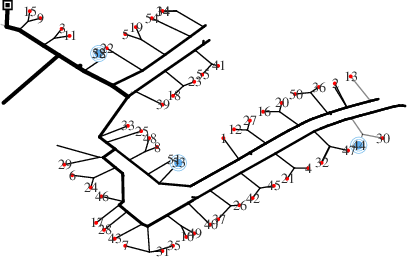
Figure 2: European LV feeder with highlighted coordinated loads.
Three coordinated loads are selected (customers #44, #52, #53), with remaining loads as non-coordinated. The geometric contrast in DOEs is captured in projection:
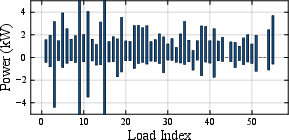
Figure 3: DOEs for non-coordinated loads. The DOE for coordinated customers #44, #52, and #53 is not shown here.
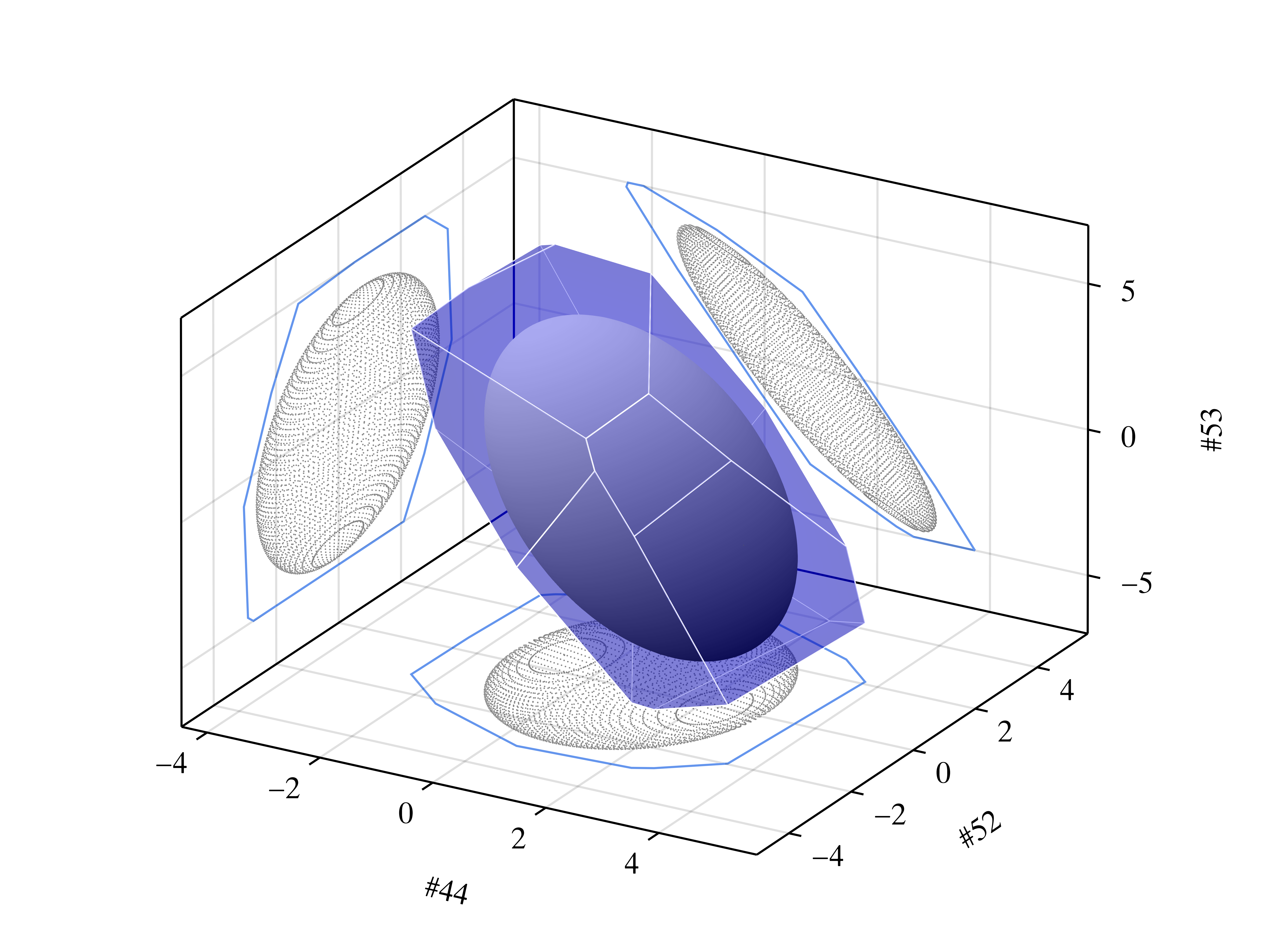
Figure 4: The published coordinated polytopal DOE for customers #44, #52, and #53, inscribed ellipsoid used during DOE design, and their projections on the three pairwise coordinate planes for better visualization. The three axes correspond to the active-power operating points of the coordinated participants, in kW.
Feasibility Stress Testing
DOE feasibility (designed via linear branch-flow models) is stress-tested against full nonlinear AC power-flow under adversarial objectives (max/min voltages, max apparent power per line):
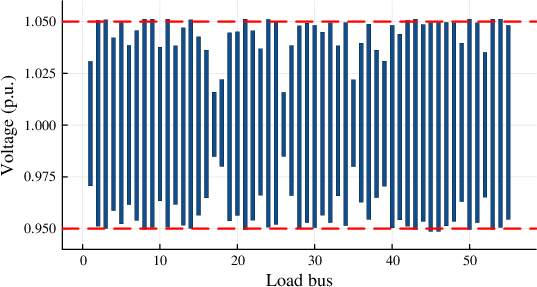
Figure 5: Adversarial AC power-flow results: minimum and maximum voltage magnitudes attained over DOE-admissible injections
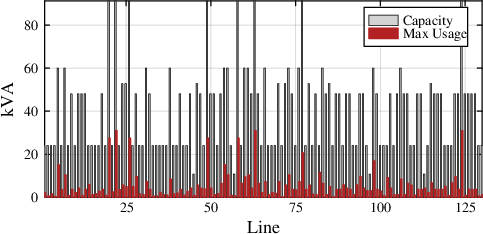
Figure 6: Adversarial AC power-flow results: maximum apparent-power loading on each line over DOE-admissible injections (red bars). Grey bars show line ratings.
Results confirm that all admissible injections stay in compliance with grid operational limits under the specified DOEs.
Quantitative Impact of Coordination
Scalability and the system-level benefit of coordination are systematically evaluated by varying the cardinality of the coordinated cohort. A 30% cohort increases aggregate active-power DOE range by ~25% over the baseline, non-coordinated scenario.
Computation time scales with the coordinated group size due to semi-definite variable growth, but remains tractable for prototypical feeder sizes.
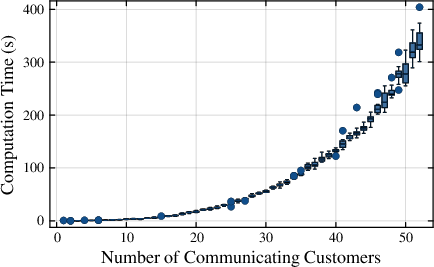
Figure 7: Optimization problem computation time vs. the number of coordinated loads. Each bar shows the range of computation times across 10 randomized customer groupings for each coordination level.
Robustness to Fixed-Load Uncertainty
Aggregate available flexibility decreases monotonically with the uncertainty level (η) and budget parameter Γ. This contraction is far more pronounced under higher grid loading, with up to 53% range reduction at the most conservative robustification.
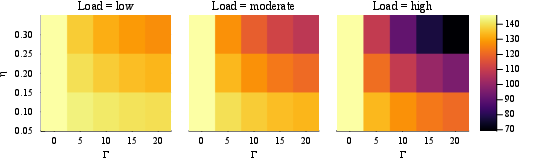
Figure 8: Aggregate network-level DOE range (kW) under fixed-load uncertainty. The uncertainty magnitude η scales the component-wise deviation bounds Δ in \eqref{eq:fixed_load_uncertainty_model}.
At the customer level, robustification narrows individual headroom most in the highly loaded regime.
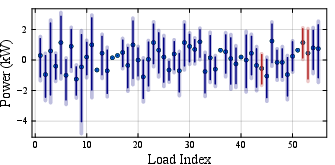
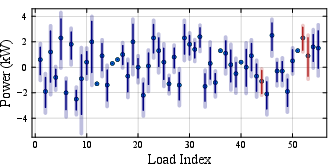
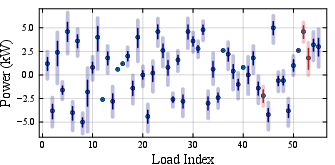
Figure 9: Low loading.
Fairness-Volume Tradeoff
Directional fairness is quantified via the Gini index on weight-normalized flexibility allocations. Tighter fairness (σ) enforces more equitable distributions, compressing the variability across connection points and reducing average available envelope by up to 14%.
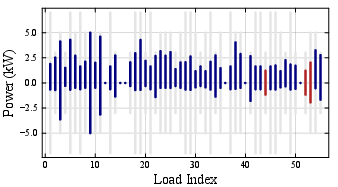
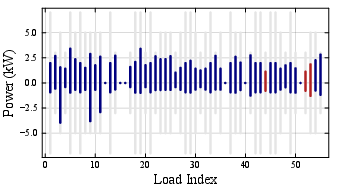
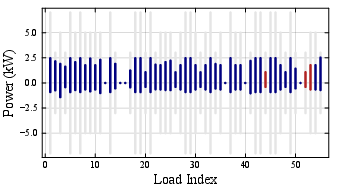
Figure 10: Γ0.
Visualizing customer headroom under different Γ1 values demonstrates the tradeoff between least flexibility disparity and maximal global headroom provision.
Implications and Theoretical Significance
The introduction of a coordinated polytopal DOE set concurrent with independent user DOEs addresses fundamental limitations of prior frameworks which were unable to exploit energy community/aggregator coordination. The ellipsoid-to-polytope pipeline yields a tractable convex program for maximizing flexibility. The simultaneous integration of explicit uncertainty models and tunable fairness constraints renders the design paradigm deployable for future grid codes and flexibility markets, with precise tradeoffs between operational risk, equity, and system utilization.
Practically, aggregator or community-based DER coordination is shown to unlock significant energy market participation opportunity, even without system-wide universal coordination. From a theoretical perspective, the volumetric separation between coordinated and non-coordinated feasibility sets formalizes the price of independence in DOE design.
Forward Directions
The framework motivates several research extensions, including optimal coordinated cohort selection for service procurement, disjoint multi-aggregator analysis, integration of temporal and economic fairness models, and data-driven DOE estimation leveraging real-world historical network and behavioral data.
Conclusion
This work delivers a scalable, geometry-aware DOE design that admits partial coordination, robust allocation, and explicit fairness. Strong numerical results on realistic feeders validate the increased aggregate flexibility that coordination enables—quantitatively, a 25% expansion for 30% coordinated participation. The framework offers a direct pathway for DSO/aggregator protocols to move beyond conservative, independence-limited envelopes, informing both policy and future algorithmic developments in DER-rich grids.