The Limiting Distribution of Elliptic Dedekind Sums
Published 18 Apr 2026 in math.NT | (2604.17077v1)
Abstract: We consider elliptic Dedekind sums that were introduced by Sczech as generalizations of the classical ones to complex lattices. We prove that these sums -- suitably normalized -- have a Gaussian limiting distribution. As an application, we prove a conjecture due to Ito.
The paper shows that, unlike classical Dedekind sums converging to a Cauchy distribution, elliptic Dedekind sums converge to a Gaussian distribution in the limit.
It employs a refined dynamical systems framework with complex continued fractions and Markov partitions to control the spectral properties of transfer operators.
The study quantifies the convergence rate with explicit error bounds, offering a rigorous resolution of Ito’s conjecture in the elliptic setting.
The Limiting Distribution of Elliptic Dedekind Sums
Introduction and Motivation
This work rigorously establishes the limiting distribution for elliptic (Sczech) Dedekind sums, which generalize the classical Dedekind sums from the modular group setting to imaginary quadratic fields with class number one. Classical Dedekind sums s(h,k), intrinsically connected to the transformation properties of the Dedekind η-function and modular forms, admit deep connections with continued fractions, Kloosterman sums, and the spectral theory of automorphic forms. In the classical rational case, their normalized values converge in law, under uniform sampling, to a Cauchy distribution [Vardi, 1993].
Sczech’s elliptic generalization, denoted D(a,c), is situated in the arithmetic of rings of integers of imaginary quadratic fields and is closely related to the values of elliptic functions on complex lattices. This paper focuses on the case where the base field K=Q(−D) has class number one, specifically for D∈{2,7,11}. The central result demonstrates that, in stark contrast to the classical case, the normalized Sczech sums, as ∣c∣2→∞, converge in law to a Gaussian rather than a Cauchy distribution.
Structure and Main Results
The core of the paper is a deep operator-theoretic and dynamical analysis, merging continued fraction expansions in complex quadratic fields and a refined thermodynamic formalism. The authors construct a Markov partition for the associated complex Hurwitz maps and transfer operators, enabling fine control of their spectral properties and linking the probabilistic behavior of cost functions to eigenvalues of dynamical operators.
Main Theorem:
Let D∈{2,7,11} and K=Q(−D). For z=ca∈K, define the normalized elliptic Dedekind sum
D~(a,c):=i∣D∣G2(0)1D(a,c).
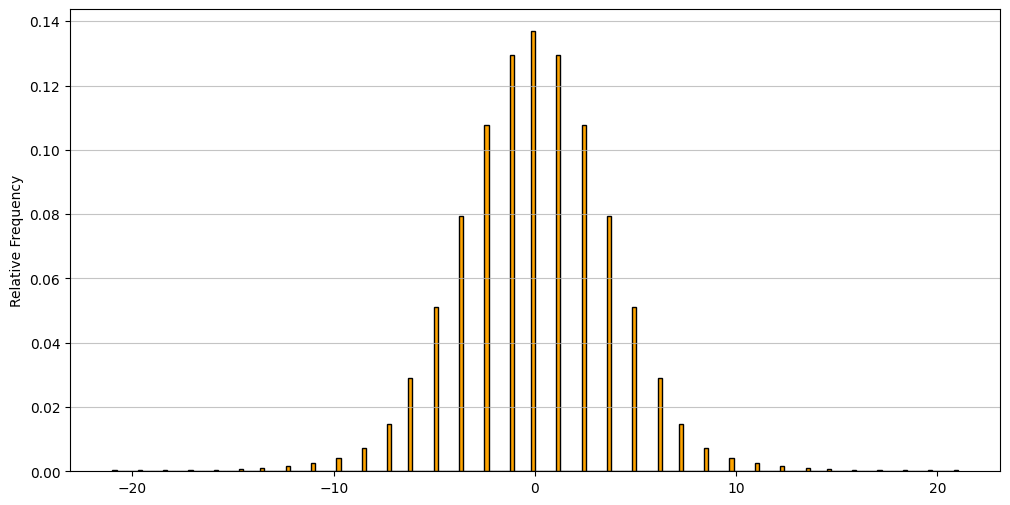
Sampling over η0 with η1, the distribution of η2 converges, in law, to the standard Gaussian as η3.
The theorem is both qualitative and quantitative, giving an explicit rate: the error of convergence to the normal law is η4.
Figure 1: Plot of η5 normalized by η6 for η7, η8, exhibiting the emergence of a Gaussian profile.
Continued Fractions over Imaginary Quadratic Fields
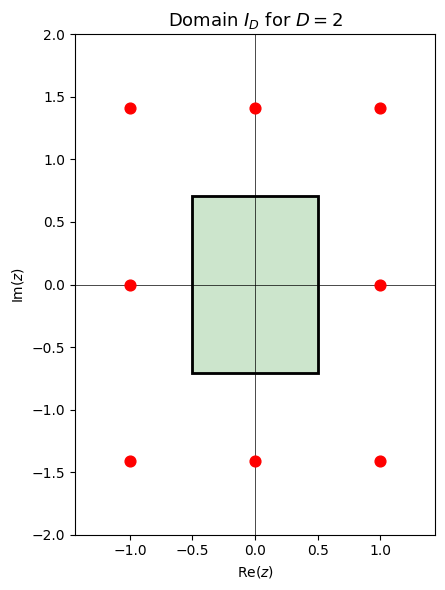
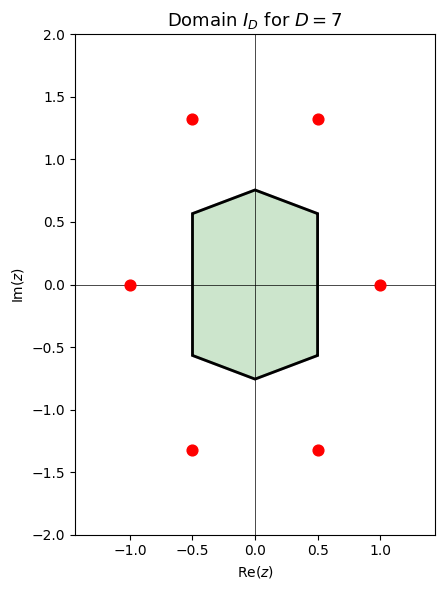
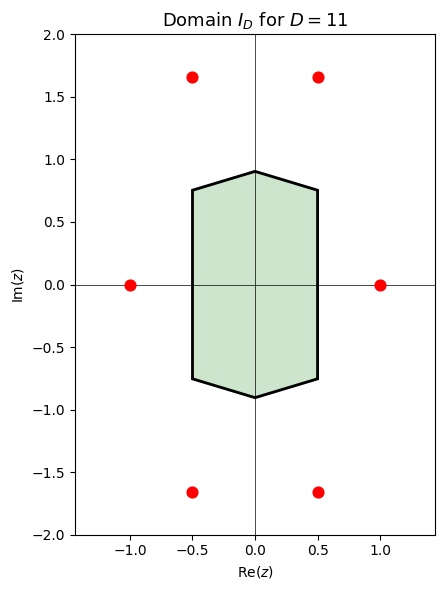
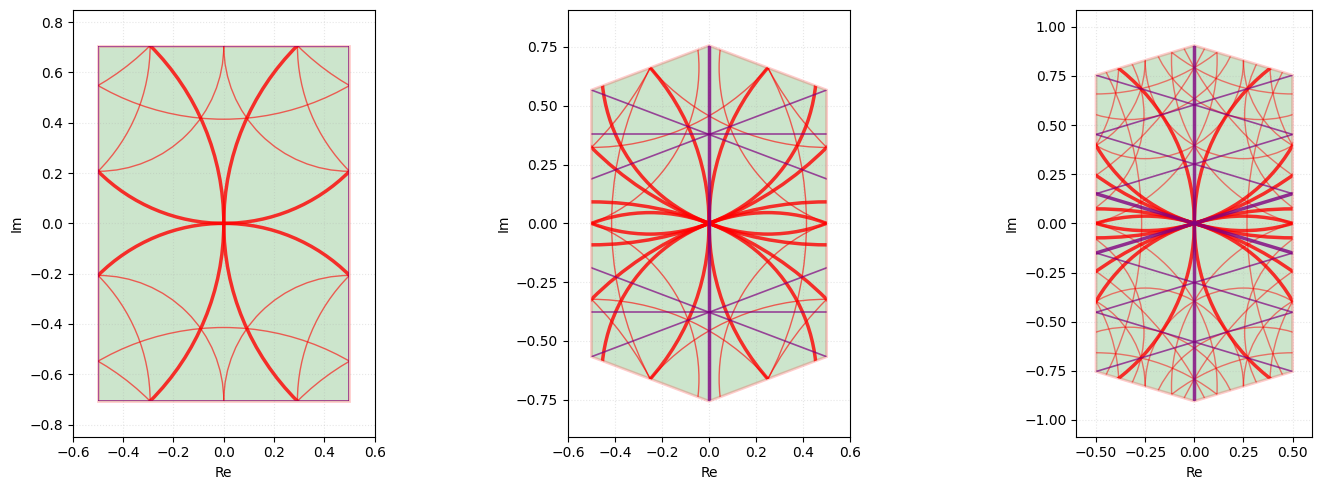
The analysis fundamentally relies on complex continued fraction algorithms over η9 (the ring of integers of D(a,c)0), specifically using the Hurwitz map D(a,c)1. Unlike the real Gauss map (which is full-branch), the complex counterpart requires careful Markov partitioning due to a finite set of exceptional branches, a feature meticulously handled via subdivision into geometric parts (rectangles and hexagons depending on D(a,c)2).
Figure 2: The fundamental domains D(a,c)3 for D(a,c)4, which tile the complex plane under action by D(a,c)5.
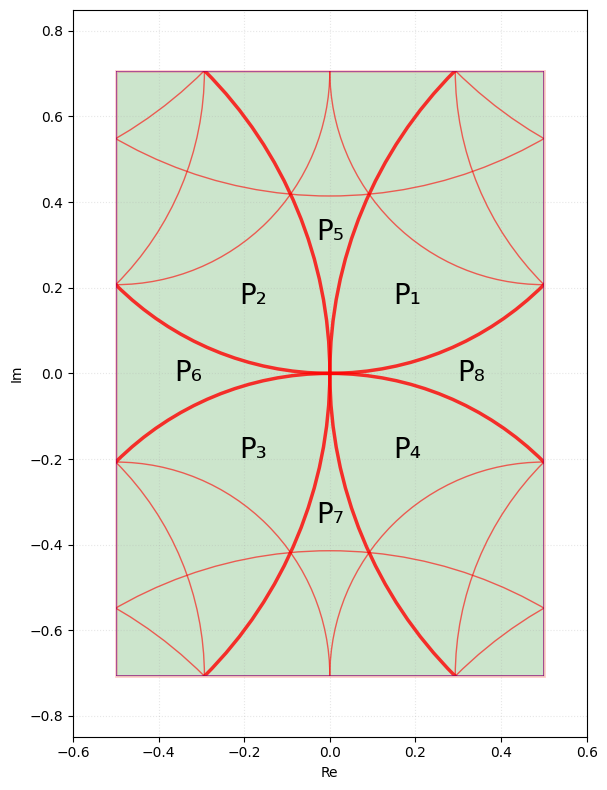
Figure 3: The combinatorial Markov partition D(a,c)6 for D(a,c)7, revealing the structure for transfer operator dynamics.
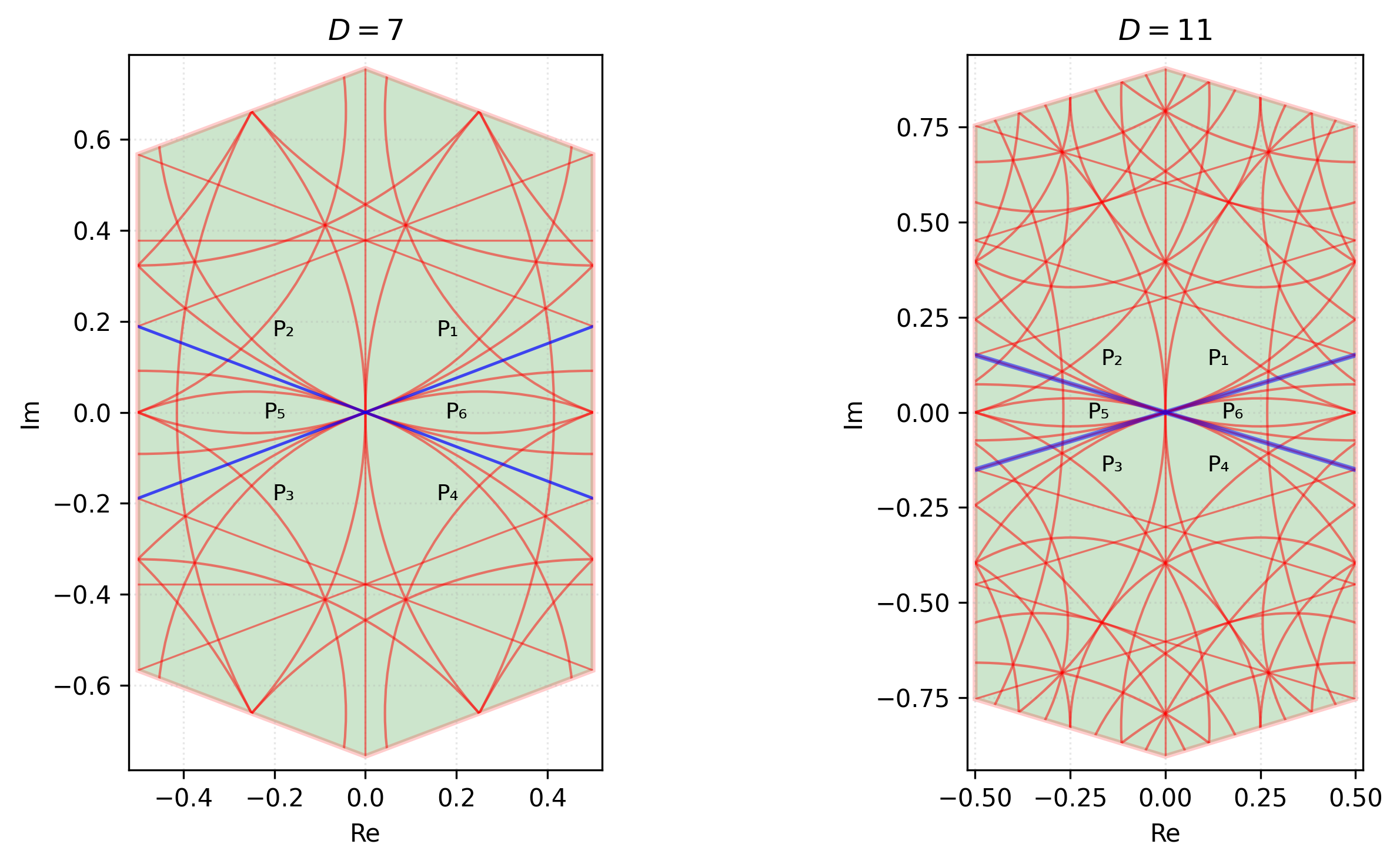
Figure 4: Canonical labeling of the key partition elements D(a,c)8 dominating major level sets of the cost function for D(a,c)9.
Figure 5: Central partition subdivisions for cases K=Q(−D)0 highlighting relevant K=Q(−D)1 for supporting main asymptotic arguments.
These partitions underlie the construction of transfer operators encoding the distribution of the cost function
K=Q(−D)2
where the period law and choices for K=Q(−D)3 tie directly to the structure of K=Q(−D)4.
Operator Theoretic Framework and Spectral Analysis
Key to the proof is writing the problem in terms of dynamical zeta functions:
K=Q(−D)5
Controlling the meromorphic continuation and locating poles of K=Q(−D)6 is equivalent to understanding eigenvalues of the transfer operator family K=Q(−D)7. Perturbation theory shows the presence of a simple leading eigenvalue near K=Q(−D)8, and subsequent Dolgopyat-type estimates yield nontrivial bounds for the error terms vital for extracting a quantitative central limit behavior.
A crucial innovation is the handling of period functions K=Q(−D)9 that are not of “moderate growth” (i.e., those that are not coboundaries and whose growth is not log-bounded), notably appearing in the context of Sczech sums. This precludes the direct use of classical quasi-power theorems and necessitates refined spectral and oscillatory integral techniques.
Evaluation of Oscillatory Integrals
The limiting characteristic function for D∈{2,7,11}0 is governed by the behavior of the leading eigenvalue’s perturbation, expressed through oscillatory integrals involving the D∈{2,7,11}1 term over the invariant measure D∈{2,7,11}2 derived from the transfer operator. The behavior is dominated by the D∈{2,7,11}3 term—characteristic of variance growth in the central limit theorem context for dependent (Markov) structures—consistent with the normal, not Cauchy, limit.
Markedly, the authors derive, uniformly:
D∈{2,7,11}4
where D∈{2,7,11}5 and the constants depend (ineffectively) on the fractal geometry of the Markov partition and the field.
Implications and Theoretical Consequences
Strong contrasts arise with the classical setting:
Classical normalized Dedekind sums (over D∈{2,7,11}6) have heavy tails and asymptotically Cauchy law [Vardi, 1993].
Elliptic (Sczech) Dedekind sums, by contrast, are normally distributed in the limit, confirming and extending a conjecture of Ito [Ito, 2004].
This phenomenon is fundamentally dynamical: the additional algebraic degrees of freedom and complex lattice structure enforce sufficient mixing and decay, pushing sums towards normal behavior as predicted by advanced transfer operator theory.
From a moment perspective, mean and higher even moments can be analyzed, distinguishing sharply the growth rates: for the normalized sums, mean absolute values diverge as D∈{2,7,11}7, an analog of classical results but with Gaussian, not Cauchy, scaling.
The immediate resolution of Ito's conjecture regarding the divergence of restricted averages in the elliptic setting is a direct corollary.
Comparison to Literature
The analysis extends operator-theoretic approaches of [Bettin & Drappeau, 2022] and [Kim, Lee, Lim, 2025] to the genuinely complex setting with non-moderate cost functions.
The dynamical systems approach, via explicit Markov partitions and explicit spectral analysis, connects deep ergodic-theoretic properties with number-theoretic combinatorics in imaginary quadratic fields.
Potential Future Directions
Explicit Constants: While the paper quantifies behavior up to explicit asymptotics, the constants (e.g., D∈{2,7,11}8) are not currently known in closed form due to the intricate geometry of the fractal domains underlying the invariant measure D∈{2,7,11}9.
Higher Moments and Moderate/Non-moderate Costs: Extending the transfer operator framework to even more general cost functions beyond ∣c∣2→∞0 would help elucidate distribution transitions between normal and non-normal laws, especially in quadratic fields beyond class number one.
Spectral Gaps and Rate Improvements: Fine-tuning the Dolgopyat-type spectral gap machinery could produce sharper quantitative rates or potentially extract large deviation phenomena.
Conclusion
The paper provides a comprehensive and rigorous resolution of the limiting distribution problem for elliptic Dedekind sums, establishing a Gaussian law and sharply contrasting the classical Cauchy regime. The approach showcases the power of modern dynamical and spectral methods in arithmetic statistics, explicitly connecting transfer operator theory, Markov partitions, and asymptotic distributional analysis in the non-commutative setting of imaginary quadratic fields.
This result fundamentally advances our understanding of probabilistic phenomena in the theory of special values of modular and automorphic functions, highlighting deep arithmetical and dynamical dichotomies between the real and complex analytic worlds.
“Emergent Mind helps me see which AI papers have caught fire online.”
Philip
Creator, AI Explained on YouTube
Sign up for free to explore the frontiers of research
Discover trending papers, chat with arXiv, and track the latest research shaping the future of science and technology.Discover trending papers, chat with arXiv, and more.