- The paper presents a scalable DFT and Wannier-based workflow to systematically evaluate symmetry-allowed transport and optical responses in altermagnets.
- It identifies distinct signatures in metallic altermagnets, such as AHE and anomalous Nernst effects, driven by momentum-dependent spin splitting and spin–orbit coupling.
- The study reveals giant Kerr rotations in insulators and high shift-current responses in inversion-asymmetric compounds, offering actionable design routes for applications.
Medium-Throughput First-Principles Evaluation of Transport and Optical Responses in Altermagnets
Introduction
The emergence of altermagnetism delineates a new magnetic symmetry class distinct from both ferromagnets and conventional antiferromagnets, characterized by pronounced momentum-dependent spin splitting without net magnetization. These unique features facilitate symmetry-dictated phase textures in the Bloch states and, consequently, yield a rich spectrum of unconventional transport and optical responses. This study establishes a scalable computational workflow leveraging magnetic and crystal symmetry, density functional theory (DFT), and automated Wannier interpolation to evaluate linear and nonlinear response functions in a comprehensive set of experimentally reported altermagnets. The results rigorously connect the underlying spin-lattice symmetry to observable phenomena such as the anomalous Hall effect (AHE), magneto-optical Kerr effect (MOKE), and bulk photovoltaic effect (BPVE), underscoring material candidates with experimentally accessible and potentially functional transport signatures.

Figure 1: Computational workflow for the symmetry-based filtering and evaluation of transport and optical responses in altermagnets.
Symmetry-Guided Screening and Computational Workflow
A curated set of 203 stoichiometric altermagnets from the MAGNDATA database was refined through DFT+U calculations accounting for spin–orbit coupling (SOC), yielding 132 compounds with well-converged electronic and magnetic ground states. An in-house automated Wannierization pipeline facilitated the construction of maximally localized Wannier functions, enabling efficient evaluation of response tensors. The workflow integrates symmetry analysis at every stage, ensuring that computed response functions accurately reflect the allowed tensorial components and their constraints. Subsets of these materials, classified by their symmetry and electronic structure (metallic, insulating, or inversion-asymmetric), were systematically analyzed in subsequent sections.
Magnetic space-group symmetry plays a decisive role in determining the existence and magnitude of Berry-curvature-driven transverse responses in altermagnets. Only a limited subset of metallic candidates—specifically those lacking certain antiunitary or spatial symmetries—exhibit finite AHE tensors under experimentally relevant N\'eel-vector orientations. The study identifies and quantifies the proper tensorial components for each compound.
\ce{VNb3S6} exemplifies this phenomenology. With the N\'eel vector along the a-axis and space group C2′2′21, it supports symmetry-allowed off-diagonal AHE and ANC components. Analysis of the band structure reveals pronounced momentum-dependent spin splitting in the absence of net magnetization. The energy-dependent Hall conductivity and corresponding k-resolved Berry curvature exhibit sharp Fermi-surface-localized peaks, demonstrably enhanced by SOC, which locks the spin texture to the lattice.
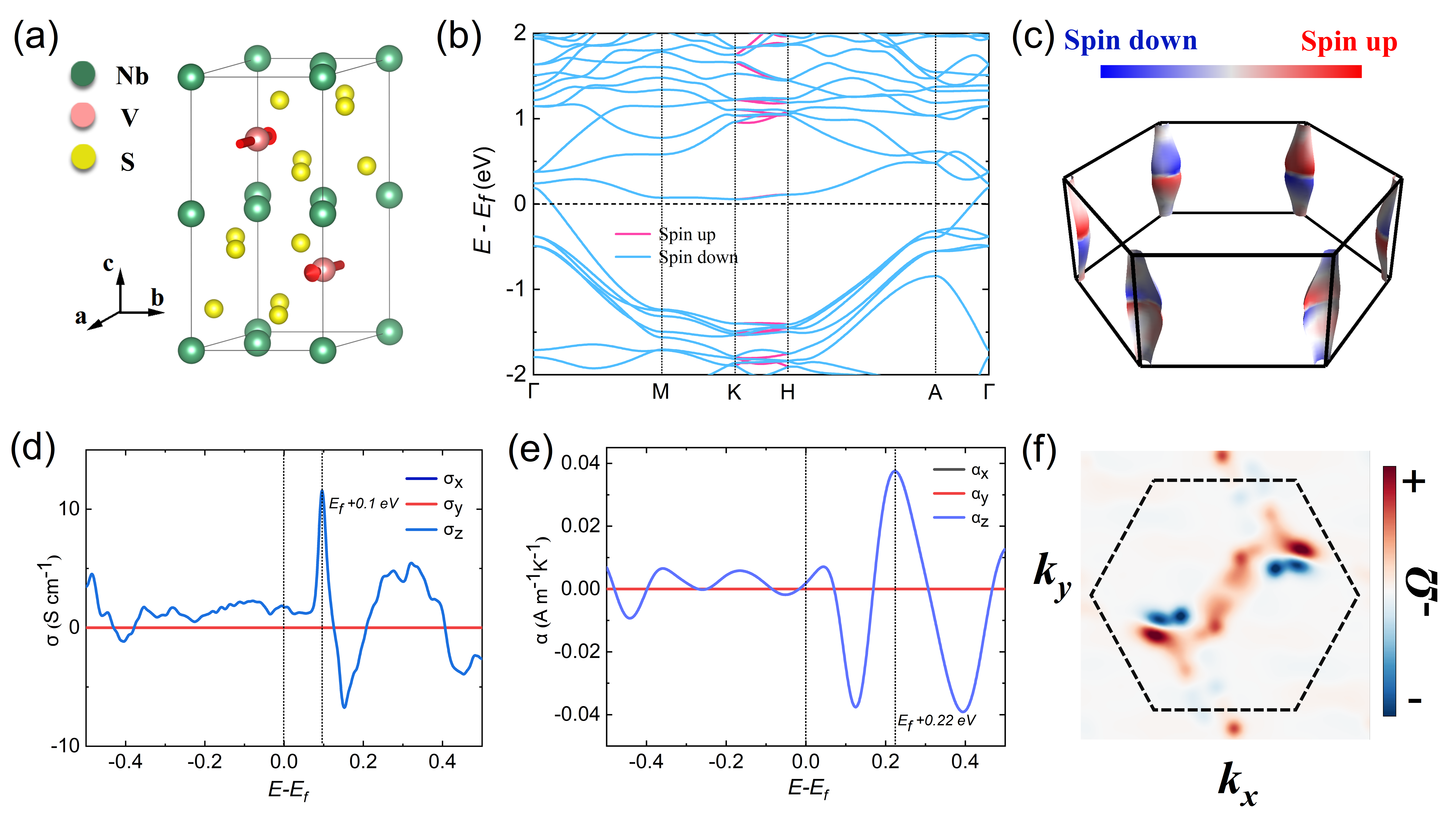
Figure 2: Microscopic origin and symmetry-resolved calculation of AHE and ANC in \ce{VNb3S6}; includes crystal structure, spin-resolved bands, Berry curvature, and conductivity spectra.
The interplay of SOC and symmetry engineering in altermagnets allows for the activation or suppression of transverse transport signatures via N\'eel-vector manipulation or external strain, as observed in other candidates such as \ce{RuO2} and \ce{CrSb}.
Optical Responses in Insulating Altermagnets: Magneto-Optical Kerr Effect
For insulating compounds, MOKE provides a robust probe of transverse magnetic ordering and spin–orbit-induced electronic structure reconstruction. The magnitude and allowed components of the Kerr tensor are strongly dictated by the magnetic space group and orbital content. Heavier $4d$ and $5d$ elements with strong SOC, such as Os- and Ir-based oxides, exhibit significantly enhanced responses.
The most pronounced Kerr signal is obtained in \ce{CaIrO3}, which exhibits a giant Kerr rotation of 3.5∘ in the symmetry-allowed θzx component. The origin of this response lies in the SOC-entangled jeff=1/2 Mott insulating state, further reconstructed by octahedral tilting that breaks combined PT symmetry and enables altermagnetic spin splitting. Detailed DFT and Wannier-based calculations link peak features in the Kerr spectrum to interband transitions between orbitals with mixed a0 character.
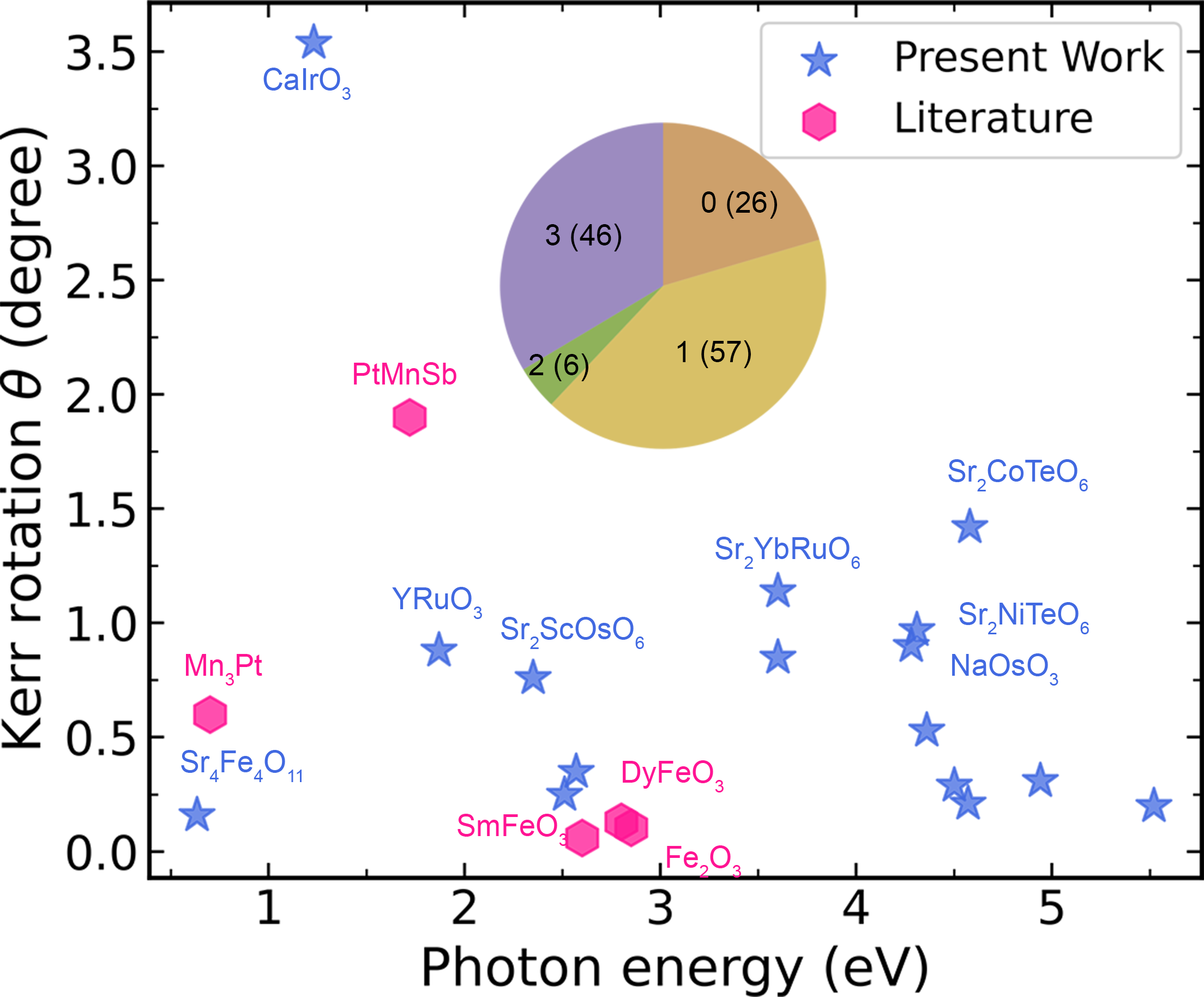
Figure 3: Calculated Kerr rotation angles as a function of photon energy in altermagnets; distribution of symmetry-allowed MOKE tensor elements and comparison with literature values.
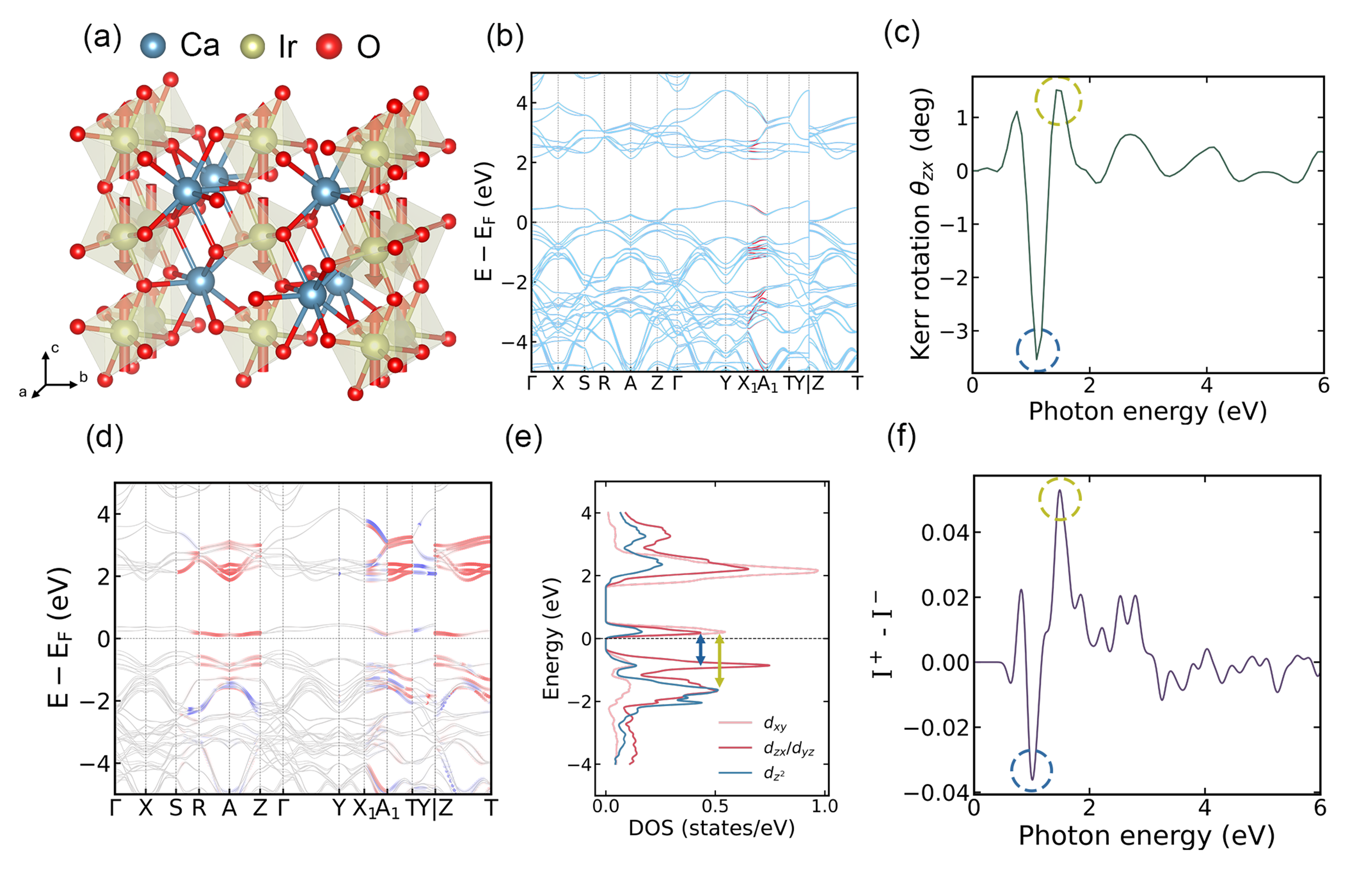
Figure 4: Crystal structure, band structure, Kerr spectrum, and orbital-resolved density of states for \ce{CaIrO3} illustrating the theoretical basis for giant MOKE.
Nonlinear Responses in Inversion-Asymmetric Altermagnets: Bulk Photovoltaic Effect
The breaking of inversion symmetry in a subset of altermagnets enables giant second-order nonlinear optical effects, including the BPVE. Here, shift-current contributions arising from quantum geometrical properties such as the Berry curvature dipole are symmetry-selected. Among the 22 eligible non-centrosymmetric candidates, several compounds exhibit shift-current conductivities surpassing the best-known bulk photovoltaic materials.
The correlation between band gap and the magnitude of the shift current is material dependent and non-monotonic, reflecting complex details of the band structure and interband transition matrix elements.

Figure 5: Calculated maximum shift-current conductivity versus band gap for all non-centrosymmetric altermagnet candidates.
\ce{CuFeS2} is identified as a prominent BPVE material, with calculated peaks in the shift-current tensor reaching values above a1, and momentum-resolved analysis showing that the dominant contributions stem from particular regions in the Brillouin zone with a high joint density of states.
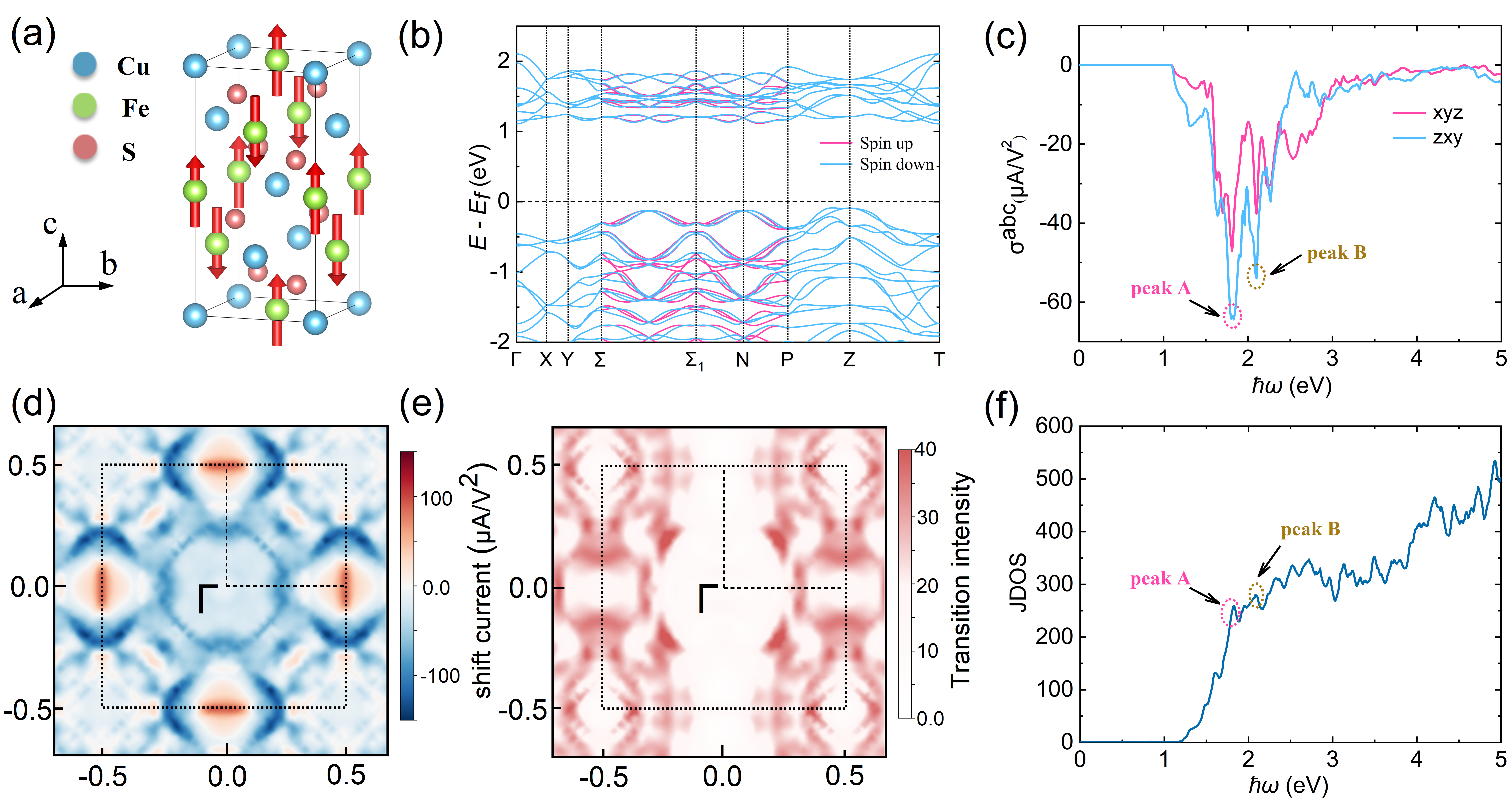
Figure 6: Shift-current tensor, crystal structure, band structure, a2-resolved shift-current distribution, and correlated JDOS for \ce{CuFeS2}.
Practical and Theoretical Implications
This comprehensive symmetry-guided approach demonstrates that altermagnetic transport is inherently multifaceted, with accessible and potentially functional signatures in both linear and nonlinear regimes. The study clarifies that observable phenomena such as AHE, MOKE, and BPVE depend not just on band topology or magnetization, but on the detailed interplay of spin–orbit interaction, magnetic and spatial symmetry, and quantum geometry. Importantly, the methodology provides actionable routes for material design—e.g., activation/suppression of responses via N\'eel-vector orientation, strain/tuning of band structure, or targeted selection of magnetic space groups.
On the fundamental side, these results underscore the power of symmetry-based design in engineering Berry curvature and higher-order quantum geometric responses, positioning altermagnets as a robust platform for the exploration of momentum-dependent phenomena inaccessible in traditional magnetic materials.
Conclusion
The integration of large-scale DFT, precise Wannier interpolation, and exhaustive symmetry analysis enables a systematic identification and quantification of transport and optical fingerprints in a broad class of altermagnets. The findings reinforce that the distinctive properties of altermagnets are not captured by a single response channel, but by a suite of symmetry-selected observables, including tunable AHE in metals, giant Kerr rotation in insulators, and large shift currents in inversion-asymmetric systems. This framework provides a roadmap for experimental validation, materials engineering, and the realization of new classes of multifunctional quantum materials for applications in spintronics, magneto-optics, and nonlinear photonics.
References
- Fu Li, et al., "Medium-Throughput Evaluation of Transport and Optical Responses in Altermagnets" (2604.17071)