- The paper's main contribution is the N-DCA algorithm that uses a bijection between combinatorial necklaces and coalition value calculations to ensure non-redundant and fair assignments.
- It employs Increment Arrays to guarantee that each agent computes only coalitions they belong to, with load differences of at most one coalition per agent.
- Empirical evaluations show that N-DCA reduces memory usage to about one-third of previous methods and scales efficiently for large numbers of agents.
Succinct Expert Analysis of "From Necklaces to Coalitions: Fair and Self-Interested Distribution of Coalition Value Calculations"
This paper rigorously addresses a classic challenge in distributed characteristic function game (CFG) settings: allocating exponentially many coalition value calculations among agents without redundancy, without inter-agent communication, while guaranteeing per-agent fairness, balanced computational load, and self-interest. The problem is non-trivial—the combinatorial explosion in coalition counts (2n−1 for n agents) interacts with issues of incentive alignment and equitable resource allocation, especially in adversarial multi-agent scenarios.
To analytically resolve the mapping between coalitions and agent assignments, the authors introduce a precise mathematical framework built around Increment Arrays (IAs). These arrays compactly represent cyclic distances between coalition members, encapsulating each coalition as an ordered tuple up to rotation. The key insight is the bijection between canonical equivalence classes of IAs (modulo rotation) and two-colour combinatorial necklaces. This mapping enables leveraging established combinatorial algorithms for enumeration and lays the foundation for communicating formal fairness and redundancy guarantees.

Figure 1: Examples of two-colour necklaces with n=6, k=2, illustrating equivalence under rotation and non-equivalence for distinct orderings.
Algorithmic Solution: N-DCA Construction
The centerpiece of the work is the Necklace-based Distributed Coalition Algorithm (N-DCA), which systematically provides every agent with an explicit description of its unique coalition value allocation—without coordination.
Mapping Necklaces to IAs
Given a necklace (binary string of length n with s white beads), a canonical IA is extracted via a run-length encoding algorithm. This conversion is efficiently realized, as is the inverse; this bijection guarantees that every canonical coalition structure is covered exactly once across equivalence classes.

Figure 2: Complete N-DCA pipeline per agent: necklace generation, IA extraction, periodicity analysis, rotated agent designation, and coalition construction.
Redundancy-Free, Fair, Self-Interested Assignment
Critical to N-DCA's efficacy is its designation mechanism for periodic IAs (necklaces with non-maximal period), which—by formal proof—ensures no agent computes a coalition in which it is not a member, and no coalition is computed more than once. The paper proves tight bounds on agent load imbalance: using a rotated designation scheme, each agent is responsible for either ⌊n2n−1⌋ or ⌈n2n−1⌉ calculations, a difference of at most 1 coalition across agents. These assignment windows are implemented solely via each agent's own ID and n, making the approach fully decentralized.
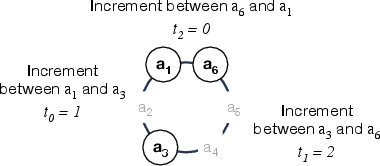
Figure 3: Illustration of IA-based increments for agents in a coalition, emphasizing cyclic structure and canonical mapping.
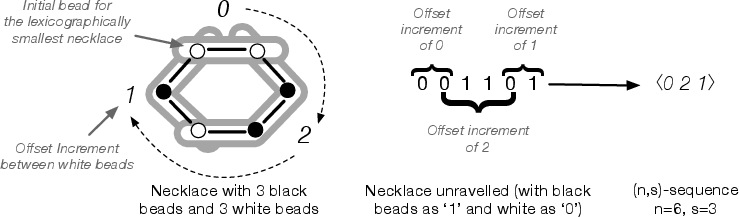
Figure 4: Two-colour necklace encoding for n=6, n0 (coalition members as white beads), supporting visual intuition for coalition enumeration.
Empirical Evaluation: Computational and Memory Efficiency
The authors provide an in-depth, multi-dimensional empirical assessment against the canonical DCVC (Distributed Coalition Value Calculation) approach [Rahwan2007]. Key findings are:
- N-DCA utilizes n1 the working memory of DCVC, as it avoids recursion and large-integer binomial index calculations.
- Total runtime: DCVC is faster by a factor that increases with n2 (from n3 to n4 for n5), principally due to N-DCA's O(n6) per-necklace IA generation, whereas DCVC achieves near-constant time per predecessor.
- In practice: For realistic coalition value evaluation costs, N-DCA and DCVC are effectively equivalent in total wall-clock performance; the generation overhead is negligible compared to subsequent evaluation.
- Scalability: Unlike DCVC, N-DCA is not constrained by integer overflows for n7; it can, in principle, run for arbitrarily large n8, although exponential scaling remains.
- Load balancing: Experimental results robustly confirm the theoretical tightness of the agent imbalance bounds.
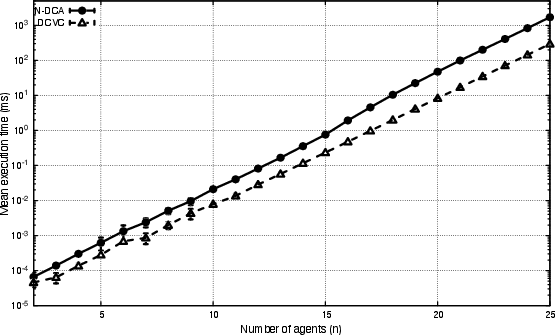
Figure 5: Mean total execution time for coalition generation by N-DCA and DCVC as n9 increases (logarithmic scale, error bars: ±1 SD over n=60 runs).
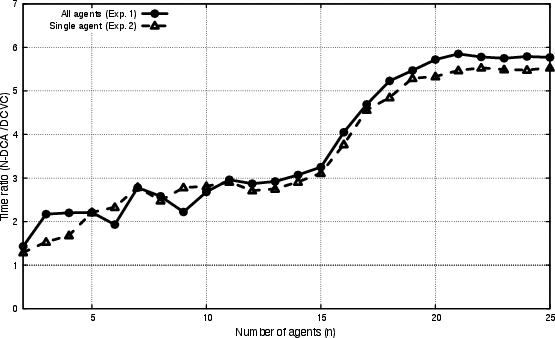
Figure 6: N-DCA/DCVC time ratio; values n=61 indicate DCVC is faster. The ratio stabilizes at n=62–n=63 for n=64.
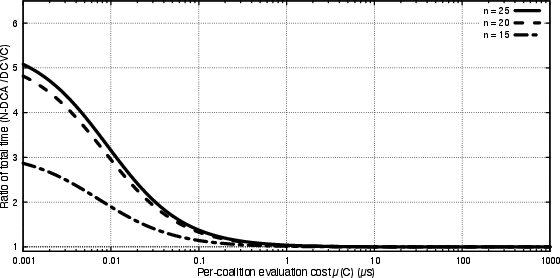
Figure 7: Amortized time ratio as a function of characteristic-function evaluation cost. For realistic costs, difference is negligible.
Broader Significance and Technical Implications
The N-DCA framework addresses a limitation in all prior distributed coalition value calculation methods (notably DCVC): self-interested assignment. By constructing only coalitions that contain the agent, incentive incompatibility for non-members is eliminated, directly mitigating the risk of strategic misreporting and reducing the attack surface for adversarial manipulation. N-DCA directly enables the mechanism to be adapted for downstream integration with distributed structure-search algorithms (e.g., D-IP), supplementing them with provable fairness and incentive guarantees.
The mathematical reduction to necklaces unlocks the full arsenal of constant amortized time generation algorithms from the combinatorics literature. Moreover, the conceptual framework—partitioning cyclically symmetric objects, fair transversal designation under modular constraints—generalizes to broader distributed task allocation problems.
Contradictory and Strong Claims
- The paper demonstrates formally and empirically that, compared to all prior approaches, N-DCA is the only method simultaneously achieving the following five properties: decentralization (no communication), redundancy elimination, load balance, equitable allocation, and self-interest.
- The load imbalance is provably at most one coalition across agents, both for aggregate assignment and per-size allocation—this is a strong formal result, validated by exhaustive empirical tests.
Prospective Developments
An open direction is the development of true O(1) incremental IA update algorithms to reduce current O(n=65) per-necklace overhead. The authors also note the needed exploration of integrating N-DCA-type value assignment with decentralized mechanism design protocols that further mitigate intra-coalition misreporting. Finally, while the current theoretical framework is for unrestricted CFGs, extending the approach to settings with externalities, dynamic populations, or privacy constraints would require new algorithmic and game-theoretic advancements.
Conclusion
"From Necklaces to Coalitions" contributes a mathematically transparent, implementationally practical, and game-theoretically robust solution to distributed coalition value calculation. The N-DCA framework achieves the strictest fairness, incentive alignment, and cost-efficiency known under the standard assumptions of unrestricted characteristic function games. Its tight formal and empirical analyses set a new benchmark for distributed, self-interested, non-redundant multi-agent resource allocation in both coalition formation and broader combinatorial domains.