- The paper introduces the CERD framework, coupling conditional evidence reconstruction with a sparse Mixture-of-Experts backbone to achieve improved diagnostic metrics (+1.17% accuracy, +0.61% F1, +2.03% AUC) over baselines.
- The paper leverages cross-attention mechanisms for subject-specific imputation and decomposes fused modality features into shared and unique components, enhancing clinical interpretability.
- The paper demonstrates that this robust design effectively handles incomplete, heterogeneous clinical data from the ADNI dataset, supporting practical deployment in real-world scenarios.
Conditional Evidence Reconstruction and Decomposition (CERD) for Robust and Interpretable Multimodal Diagnosis
Introduction
Diagnosis of complex neurobiological and neurodegenerative disorders requires the integration of heterogeneous data ranging from imaging and genetics to biospecimens and clinical measures. However, the incomplete nature of real-world clinical datasets presents a significant hurdle; most individuals have only partial modality coverage, making conventional multimodal approaches brittle and less applicable outside controlled research environments. Furthermore, existing multimodal models lack transparency, failing to provide clear attribution of diagnostic evidence to specific modalities or their interactions, which is crucial for clinical acceptance.
The Conditional Evidence Reconstruction and Decomposition (CERD) framework directly addresses both these core challenges. CERD couples conditional, subject-specific representation completion with a mechanism for logit-level evidence attribution, yielding both missing-modality robustness and structured, clinically-aligned interpretability.
CERD Architecture and Methodology
Conditional Evidence Reconstruction and Subject-Conditioned Completion
CERD processes multimodal input by first tokenizing subject-level data into a unified latent space, using explicit availability masks to encode which modalities are observed. For instances where modalities are missing, a set of modality-specific generators reconstructs latent representations by conditioning on the observed modalities, trained with explicit reconstruction loss using subjects with complete data. This conditional generation operates in token space, leveraging cross-attention mechanisms for instance-adaptive imputation that surpasses standard group-wise or static prior-based filling strategies.
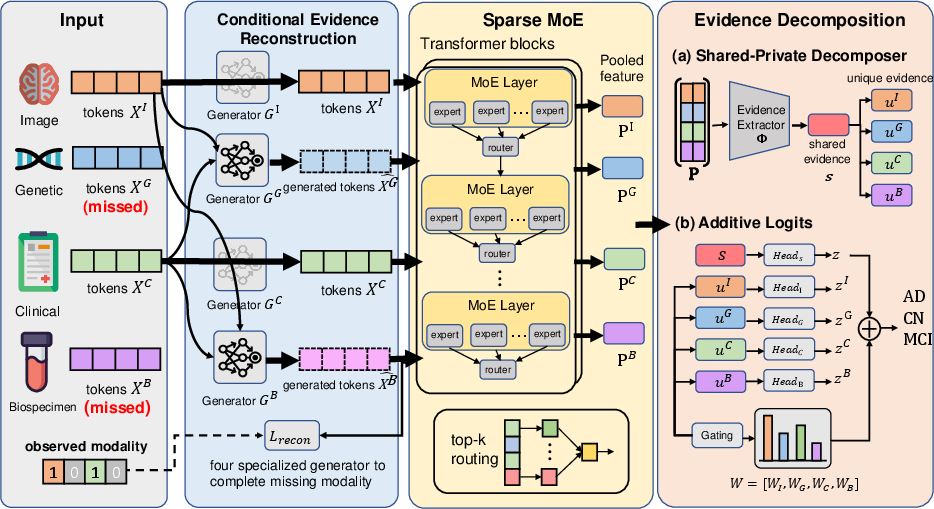
Figure 1: The CERD architecture integrates a conditional completion module for per-instance imputation, a sparse Mixture-of-Experts backbone for adaptive multimodal fusion, and an evidence decomposition head that produces additive logit-level attributions for shared and unique diagnostic cues.
Sparse Mixture-of-Experts Backbone for Adaptive Fusion
Following the completion of missing modalities, CERD concatenates observed and imputed tokens and processes them with a sparse Mixture-of-Experts (MoE) backbone. The routing mechanism—explicitly aware of modality availability—assigns modality token combinations to a learned subset of k experts out of E total, implemented via a transformer encoder. This adaptive backbone captures cross-modality dependencies and is computationally efficient, addressing the combinatorial explosion of possible modality configurations without parameter sharing degradation.
Evidence Decomposition and Logit Attribution
The evidence decomposition head post-processes the fused modality features to achieve interpretable attribution at logit level. The approach decomposes the fused representation into a shared cross-modal component and modality-unique residuals via projection in the latent space. Shared and private evidence are mapped to logits with modality-specific softmax gating, such that the overall diagnostic prediction is partitioned into additive contributions from corroborative multi-source evidence and distinct, modality-specific cues. This yields explicit attribution vectors aligned with clinician reasoning, supporting evidence-driven clinical deployment.
Quantitative Evaluation and Empirical Findings
The evaluation utilized the multi-modal Alzheimer's Disease Neuroimaging Initiative (ADNI) dataset comprising clinical, biospecimen, imaging, and genetic data, all with substantial missingness. CERD was compared to representative shallow and deep baselines: SVM, MLP, MAG (multimodal adaptive gating transformer), and Flex-MoE (static MoE from prior work).
CERD achieved superior results over all baselines, exceeding the closest competitor (Flex-MoE) by +1.17% accuracy, +0.61% F1, and +2.03% AUC, demonstrating the efficacy of subject-conditioned reconstruction and interpretable decomposition for robust multimodal diagnostics in the presence of incomplete data. Static embedding completion (Flex-MoE) and simple fusion approaches (MAG, MLP) consistently underperformed, underscoring the need for CERD's subject-adaptive conditional modeling.
Structured Attribution and Interpretability
Interpretability analysis compared CERD's evidence decomposition to a naive one-layer MLP importance gate baseline. The latter produced near-uniform modality weights, indicative of weak and unreliable attribution. In contrast, CERD assigned highest importance to genetics and clinical measures, consistent with domain knowledge about ADNI—genetic risk for preclinical disease and clinical measures for current cognitive status.
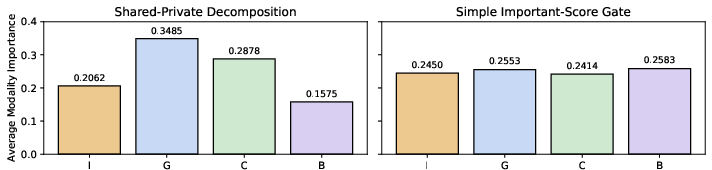
Figure 2: Comparison of modality attributions: CERD's shared-private decomposition (left) versus naive gating (right); CERD yields structured, clinically-plausible importances, while the baseline's importances are largely uninformative.
Ablation Study
Component ablations established the unique utility of the CERD components: removing conditional evidence reconstruction produced notable performance drops, while substituting static fills (as in Flex-MoE) or removing the MoE backbone also degraded accuracy. While removing evidence decomposition caused a more modest quantitative drop, it severely impaired model interpretability. These findings demonstrate that subject-specific completion and structured decomposition are both necessary for achieving robustness and interpretability.
Implications, Limitations, and Future Directions
CERD constitutes a significant advancement in robust, interpretable multimodal diagnosis for clinical settings where data incompleteness is intrinsic. Its framework supports per-instance imputation, interpretable attribution, and computationally efficient adaptive fusion. For practical deployment, CERD's additive attribution can facilitate clinician trust and post-hoc model auditing, while subject-conditioned completion can flexibly handle arbitrary missingness patterns.
Potential avenues for future research include:
- Scaling to higher modality dimensionalities and larger modality sets: Addressing combinatorial challenges in even richer clinical settings.
- Extending evidence decomposition to hierarchical or multilevel explanations: Enabling even more granular attributions, including temporal progression in longitudinal data.
- Integrating with counterfactual and recourse methods for actionable interpretability and patient-specific intervention planning.
- Applying CERD to additional disorder domains beyond Alzheimer's, where multifactorial etiology and incomplete datasets similarly arise.
Conclusion
The CERD architecture for interpretable multimodal diagnosis unifies subject-conditioned evidence completion with logit-level additive attribution, resulting in a system that is both robust to missing modalities and directly interpretable. Empirical results validate both the diagnostic superiority and the clinical alignment of the model’s attribution structure. The framework provides a scalable foundation for deploying multimodal diagnostic models in real-world, incomplete-data scenarios and opens substantial avenues for further research in robust, explainable healthcare AI.

