- The paper develops an analytical framework capturing quantum phase transitions by balancing rotational kinetic energy and dipolar interactions.
- It employs perturbative analysis and harmonic approximations to derive closed-form expressions for ground state energy, angular momentum variance, and polarization.
- The results offer actionable insights for designing quantum simulations and experiments with dipolar molecular chains, confirmed by numerical methods.
Effective Theory of Quantum Phases in the Dipolar Planar Rotor Chain
Introduction and Motivation
The study develops a controlled analytical framework for understanding the quantum phases realized in chains of interacting dipolar planar rotors. These systems, where each constituent possesses a rotational degree of freedom and interacts via nearest-neighbor dipole-dipole couplings, have direct implications in condensed matter physics, quantum simulation, and quantum computation with molecular arrays. The competition between rotational kinetic energy (parameterized by the rotational constant B) and the dipolar interaction (scaling as μ2) generates a quantum phase transition between disordered and ordered ferroelectric phases.
The universal relationship between B and μ controlling the system's phase structure is encapsulated in a phase diagram (Figure 1), which demarcates the ordered, disordered, and critical regions for experimentally relevant endofullerene chain realizations.
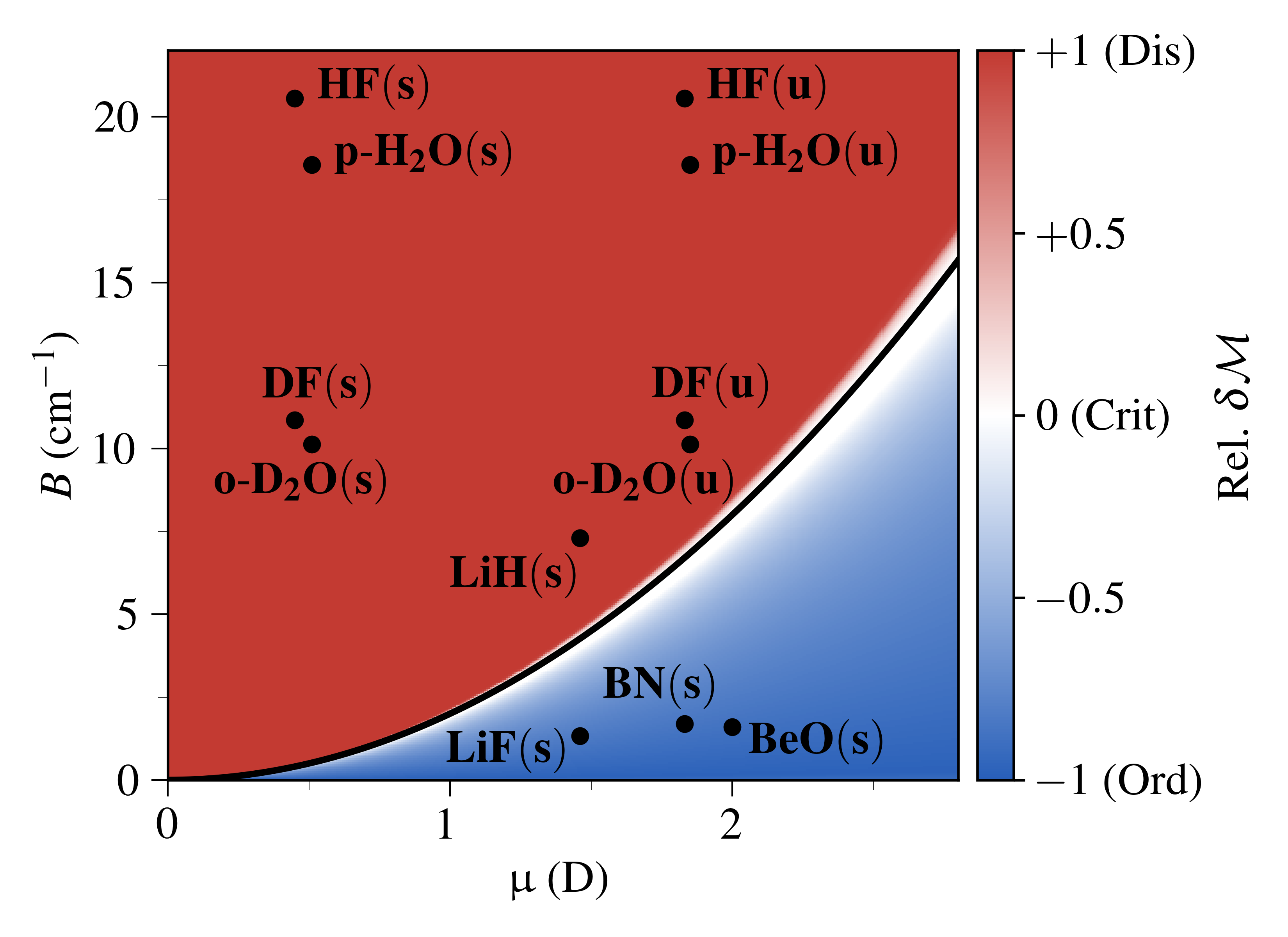
Figure 1: Phase diagram for endofullerene chains showing ordered (blue), disordered (red), and critical (white) phases as a function of molecular rotational constant B and dipole moment μ. The black curve indicates critical boundary.
The Hamiltonian describes N planar rotors coupled by nearest-neighbor dipole-dipole interactions and possessing kinetic energy from free rotations; the total Hamiltonian is
H=i∑Li2+g⟨ij⟩∑[sinφisinφj−2cosφicosφj]
where g∝μ2/r3 encapsulates the effective interaction strength. The model features a Z2 symmetry (invariance under μ20 for all μ21), leading to a quantum phase transition at a critical μ22.
The spatial structure is a linear co-planar chain (Figure 2).

Figure 2: The μ23 planar rotor chain arranged linearly in a co-planar geometry.
Analytical Treatments
Distinct analytical frameworks are constructed for each phase.
Disordered Phase (μ24)
Treating μ25 as a perturbation, ground state properties are computed to second-order via standard time-independent perturbation theory in the angular momentum basis. For the ground state energy, variance of total angular momentum, polarization, and correlation functions, closed forms are derived, e.g.
μ26
Polarization vanishes in this regime. This approach is quantitatively validated via exact diagonalization for small μ27 (Figure 3).

Figure 3: Ground state energy and variance of total angular momentum for μ28 planar rotors versus μ29: agreement between ED and analytical results is manifest in both phases.
Ordered Phase (B0)
The system is expanded around one of the two symmetry-broken ordered configurations (B1 or B2), and a quadratic (harmonic) approximation is used for small fluctuations. After Fourier transformation into normal modes, the Hamiltonian becomes a sum of decoupled QHOs (normal mode phonons). Quantization is implemented via second quantization, yielding the spectrum and observables in terms of the normal mode frequencies.
The ground state energy is, up to leading order and in the thermodynamic limit,
B3
where B4 is a complete elliptic integral. Corrections to the spectrum from quartic (and higher) terms are also analyzed, showing that only the quartic term provides a finite correction in the large-B5 limit: a constant shift of B6 per degree of freedom, which is required for agreement with exact diagonalization (Figure 4).
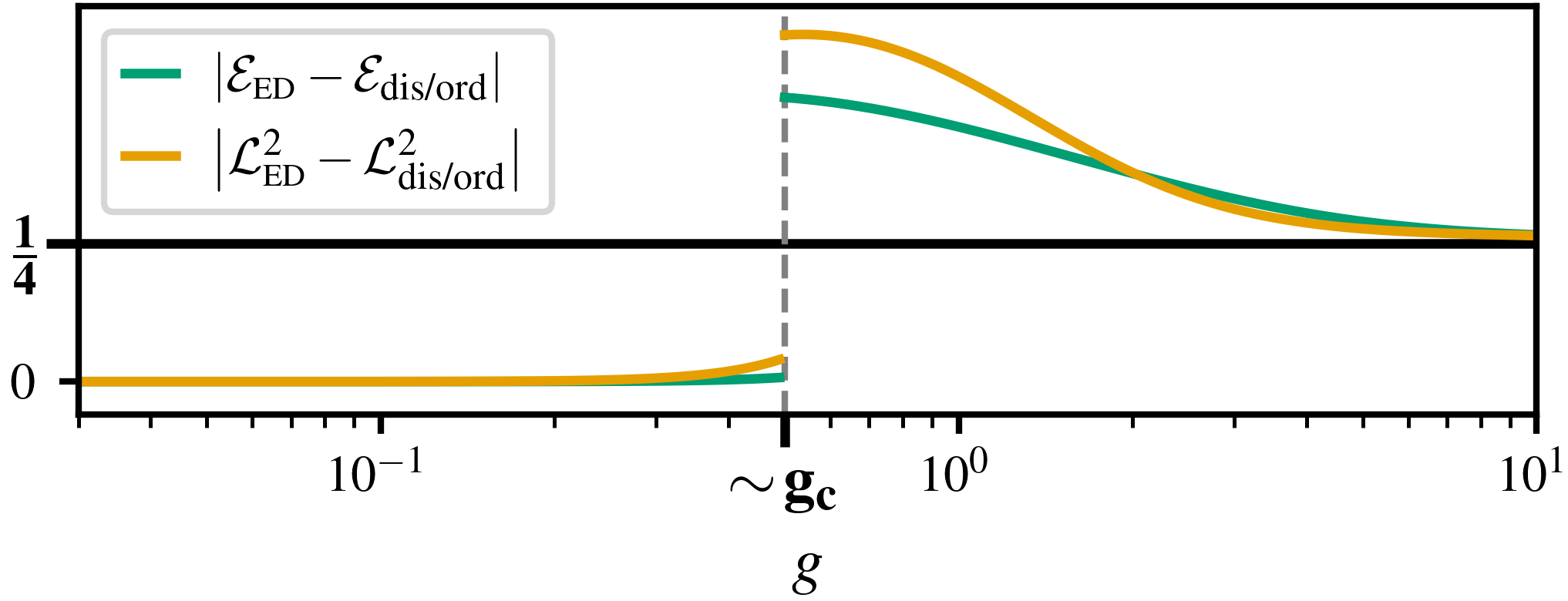
Figure 4: Absolute errors between ED and analytical results reveal a spectrum shift for B7 traceable to quantization ambiguities on compact manifolds.
Systematic comparison with DMRG for large B8 further verifies the harmonic theory, including its limitations in the critical domain (Figures 5, 6, and 7). As illustrated in Figure 5, finite-size convergence and the analytic thermodynamic limit are established for both strongly ordered and disordered regimes.

Figure 5: Chemical potential as function of chain size B9 for various μ0; analytic predictions closely track DMRG except near criticality where correlations grow.

Figure 6: Analytical vs. DMRG for several observables (energy, angular momentum variance, polarization, orientational correlation) as functions of μ1 for μ2.
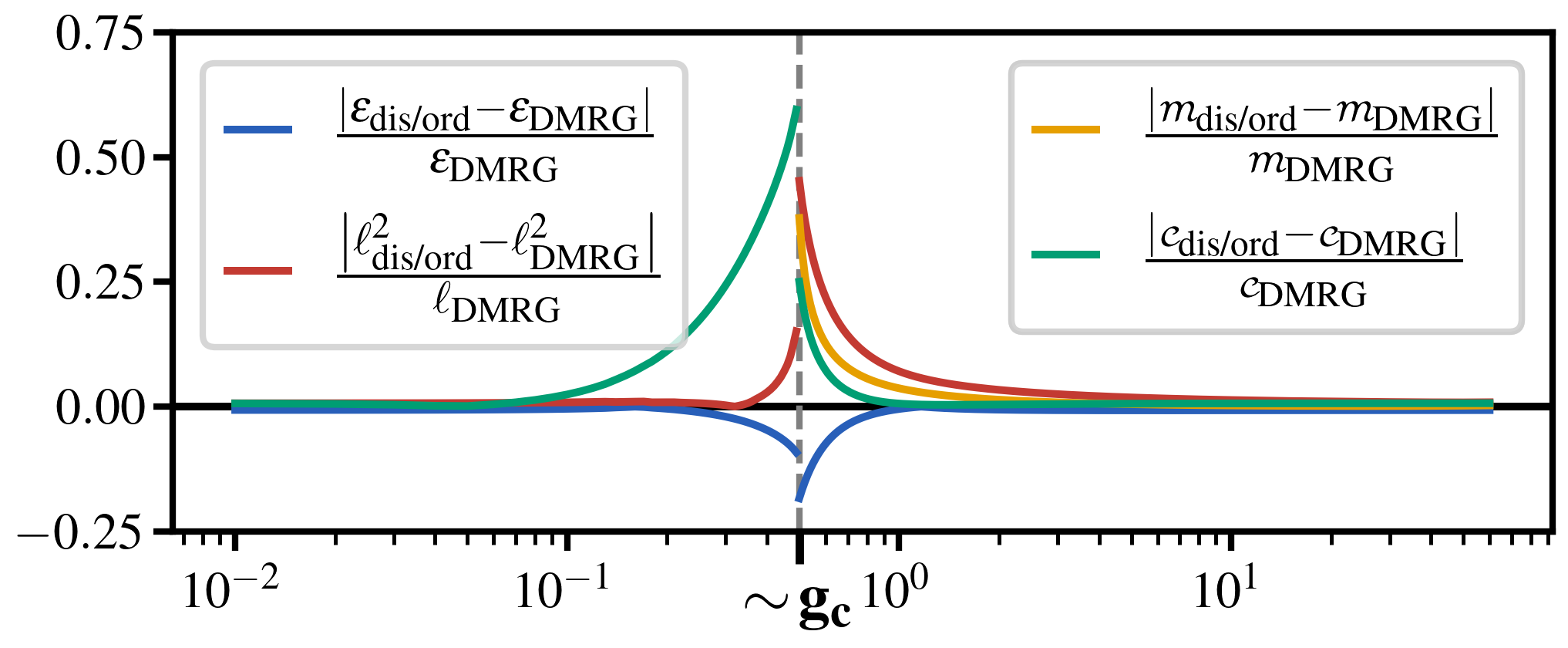
Figure 7: Relative discrepancies between analytic and DMRG calculations across all observables, outside the critical regime, are minimal.
Quantization Ambiguity and Higher-Order Corrections
A key theoretical insight is the necessity to consistently handle quantization on compact manifolds (μ3) rather than μ4. Neglecting this affects spectrum and observable calculations in the ordered phase. This is resolved by incorporating quartic terms in the potential expansion, verified explicitly in the exactly-solvable two-rotor case via mapping to Mathieu equations. The shift is demonstrated to be a universal correction per mode in the large-μ5 regime.
Implications and Outlook
This analytic framework yields quantitatively robust predictions for ground state energy, angular momentum, polarization, and correlation functions across the full range of physical parameters, excepting a narrow critical window near the quantum phase transition. The methods presented circumvent limitations of numerical approaches (ED, DMRG, PIMC, neural-network wavefunctions) regarding system size and computational cost.
The results directly inform the phase structure of realistic molecular systems—e.g., endofullerene and water-in-nanotube chains—enabling rapid evaluation of phase diagrams across molecular parameter space. For quantum simulation contexts, analytic access to excitation spectra and correlations can guide design and interpretation in quantum device architectures based on molecular arrays.
A natural extension is the rigorous global development of a μ6 field theory to describe the ordered phase, which could account for fluctuation-mediated corrections and provide analytic access even closer to the critical regime. The presented techniques are also adaptable for computing observables such as entanglement entropy and linear response functions.
Conclusion
A controlled and detailed analytic treatment for the dipolar planar rotor chain problem is achieved, with explicit capture of quantum phase structure, numerical accuracy confirmed against state-of-the-art methods, and illumination of foundational aspects such as quantization on manifolds. The approach provides actionable insight for both theoretical studies of quantum phase transitions in low-dimensional rotor systems and practical guidance for experimental platforms exploiting collective rotational degrees of freedom.