- The paper uses high-precision Gaia DR3 astrometry to map the kinematics of young stellar associations and the Radcliffe wave in the Galactic disk.
- It quantifies age estimates and dynamic parameters, linking supernova feedback and spiral structure morphology to local star formation processes.
- The paper uncovers the phase spiral as a tracer of past perturbations, offering robust constraints on models of the Milky Way’s disk evolution.
Kinematic and Morphological Structures in the Galactic Disk with Gaia Astrometry
Introduction
This paper provides a comprehensive analysis of recent developments in the characterization of local and large-scale Galactic structures, enabled by the astrometric and radial velocity data from the Gaia space observatory. Leveraging the high-precision measurements for an unprecedented sample size of stellar objects, the study quantifies kinematic parameters, elucidates spatial distributions of nearby stellar associations, examines the Radcliffe wave, questions the ubiquity of similar wave phenomena elsewhere in the Galaxy, and analyzes phase-space substructure in the solar neighborhood. The work emphasizes the theoretical and practical implications of these results on Galactic evolution and dynamical modeling.
Kinematic Characterization of Local Young Stellar Associations
The analysis begins with the construction of the spatial distribution of young stellar associations and moving groups located within 200 pc of the Sun, based on Gaia DR3 trigonometric parallaxes and proper motions. For each association, radial velocities are integrated from both Gaia and ground-based measurements. The paper specifically reviews the TW Hya association, utilizing backward orbital integration and an instantaneous velocity divergence analysis, yielding age estimates of t=4.9±1.2 Myr and t=9.5±1.1 Myr, respectively. These values reinforce models of localized, volumetric expansion as a dominant kinematic process in the youngest groups. For the US association, the adoption of a stochastic, as opposed to sequential, star-formation scenario is supported by small group kinematic substructure.
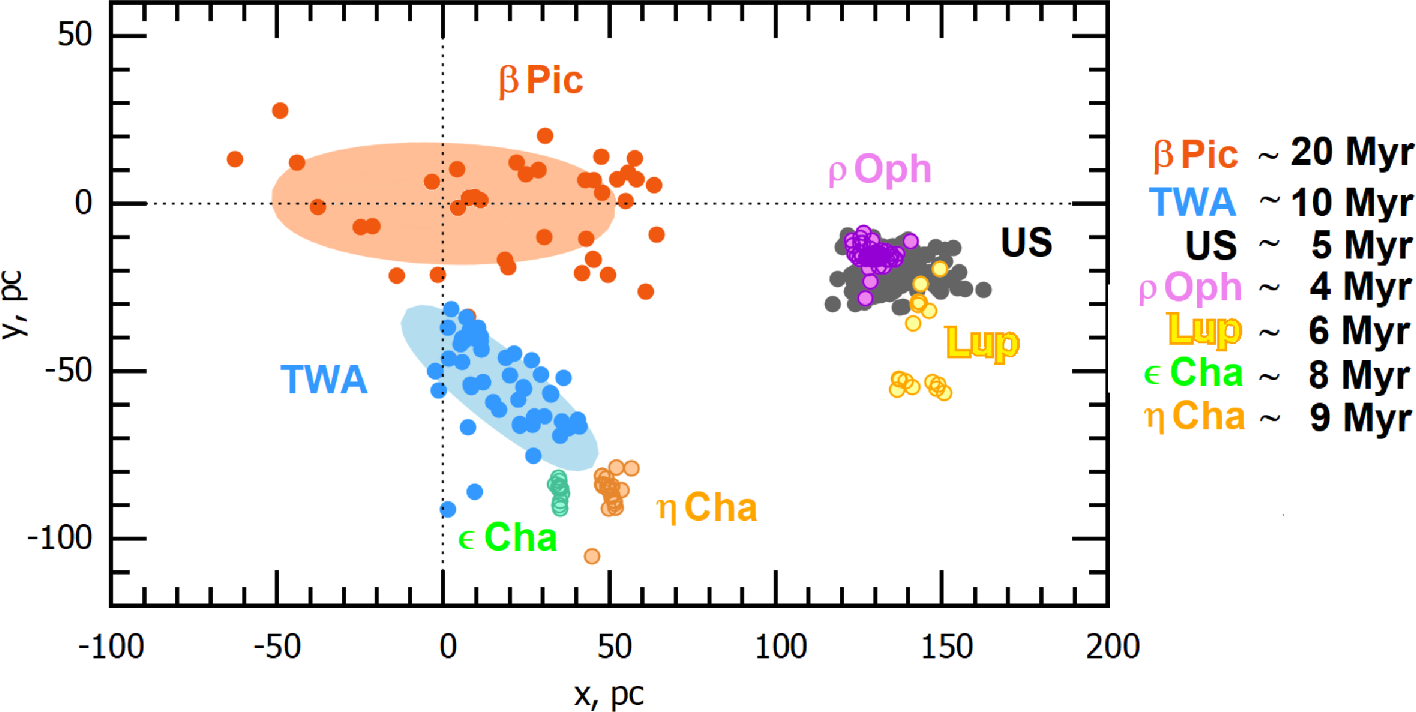
Figure 1: Distribution of the closest young stellar associations and moving groups to the Sun projected onto the Galactic xy-plane.
Morphology and Kinematics of the Radcliffe Wave
A major focus is placed on the Radcliffe wave—a ∼2.7 kpc linear chain of molecular clouds in the local spiral arm, first identified from 3D cloud mapping. The wave is inclined approximately 30∘ to the y-axis, with the solar neighborhood near its maximum vertical displacement of z∼160 pc. Cross-validation with CO clouds, masers, T-Tauri stars, and OB associations confirms the reality and coherence of the vertical oscillatory pattern. The detection of a vertical velocity amplitude of 5.1±0.7 km/s among masers and open clusters establishes the dynamical nature of the wave. This kinematic coherence, including anticenter-directed and azimuthal motions, underscores its significance in the vertical structure of the disk.
The paper presents bubble distributions—attributed to supernova feedback—overlaid with stellar cluster positions. It is argued that the spatial coincidence of evolved clusters (the progenitors of OB supernovae) and bubbles suggests that the latter are an effect, not a cause, of the Radcliffe wave's development and propagation.
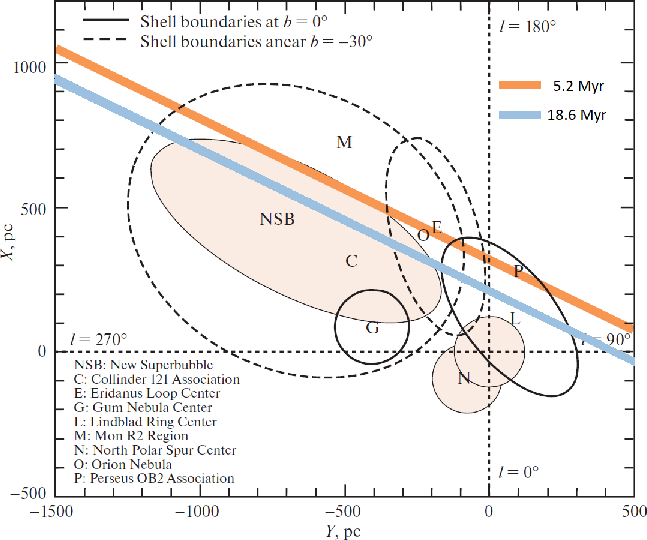
Figure 2: Supernova-inflated bubbles (circles) and loci of open star clusters of various ages shown on the Galactic xy-plane.
Radcliffe Wave Comparison and Spiral Structure Modeling
The possibility that the Radcliffe wave is a generic disk phenomenon is tested via a search for analogous wave-like perturbations in other spiral arm segments. An extended maser chain (∼3–4 kpc), hypothetically a Radcliffe wave analog, is analyzed in the Carina-Sagittarius–Scutum region. The negative result—no significant vertical coordinate or velocity oscillations—rules out the ubiquity of the Radcliffe wave pattern and supports its linkage to peculiarities of the Local arm.
A secondary result arises from the configuration of maser sources, suggesting that the observed chain traces a high pitch-angle spiral segment (t=9.5±1.10) likely connected to the Galactic bar’s ends. Modeling supports a bar pattern speed of 40–50 km/s/kpc, resulting in a t=9.5±1.11100 km/s differential rotation with the disk near the Sun. This has direct implications for shear-driven turbulence, spiral arm formation, and local star formation.
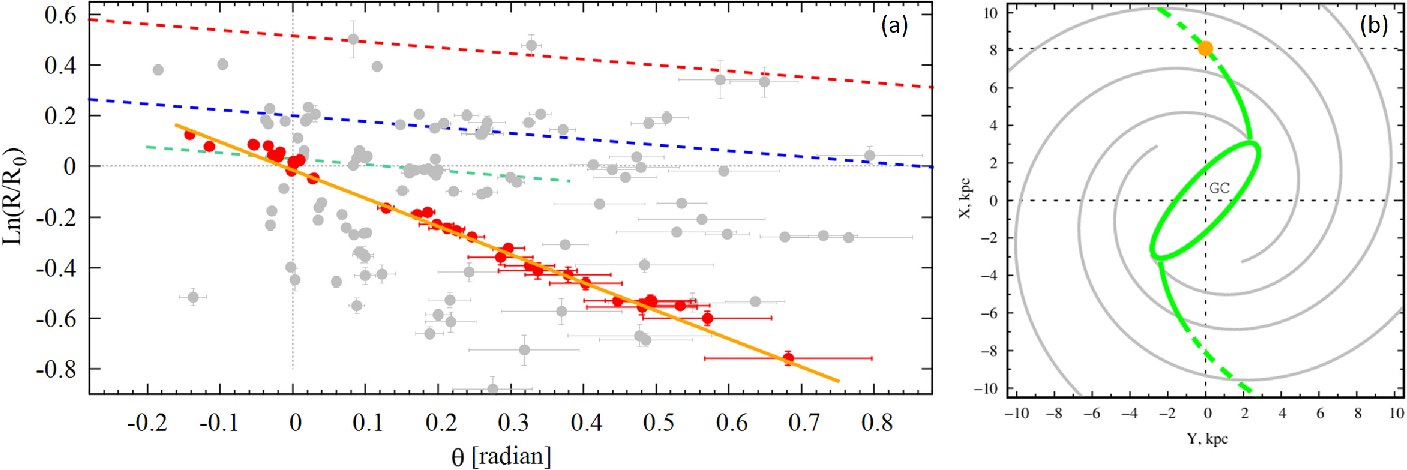
Figure 3: (a) Masers projected onto the t=9.5±1.12 plane; (b) model showing two spiral arm segments with t=9.5±1.13 pitch angle emanating from the bar ends.
Discovery and Interpretation of the Phase Spiral
The Gaia DR2 revolutionized the examination of vertical phase space in the Galactic disk with the identification of the "phase spiral" in the t=9.5±1.14 plane in the solar vicinity. The spiral’s morphology, further refined in DR3, is consistent with a disk response to an impulsive perturbation, notably attributed to a past Milky Way–Sagittarius dwarf galaxy encounter 300–900 Myr ago. Theoretical work suggests such phase wrapping encodes the timing and spatial geometry of historical perturbations, making the phase spiral a powerful probe of the disk's dynamical history and ongoing relaxation processes. The formation and persistence of these structures present stringent constraints on dynamical models, disk heating mechanisms, and the roles of recent accretion events.
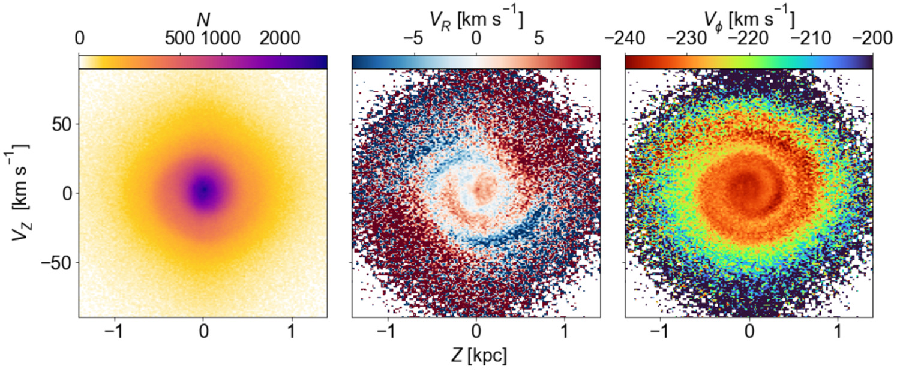
Figure 4: Measurement of vertical velocities t=9.5±1.15 as a function of t=9.5±1.16, showing the phase spiral in the Gaia DR3 solar neighborhood sample.
Implications, Open Questions, and Future Prospects
The data presented solidify the Gaia catalog's transformative impact on the dissection of Galactic morphology and kinematics. The strict constraints on young stellar association expansion, the detailed mapping and dynamic analysis of features like the Radcliffe wave, and the phase spiral discovery each provide robust tests for models of disk evolution, star formation, feedback physics, and interaction-driven perturbations.
Critical open problems include discriminating between formation scenarios for the Radcliffe wave (Kelvin-Helmholtz instability, external impactors, feedback), quantifying the role of magnetic fields, explaining the apparent localization (rather than globality) of wave phenomena, and fully reconstructing the perturbative history encoded in vertical phase-space patterns. Progress in these domains will rely on further Gaia data releases, integration with VLBI astrometry, more sophisticated chemodynamical simulations, and identification of additional kinematic substructures throughout the disk.
Conclusion
The paper provides a thorough overview of recent advances in the study of Galactic structure and kinematics using Gaia, with an emphasis on the characterization of the nearest young stellar associations, the properties and kinematics of the Radcliffe wave, the investigation of spiral structure morphology adjacent to the Galactic bar, and the dynamical relevance of the phase spiral in the solar neighborhood. The synthesis of spatial, kinematic, and evolutionary data offers tight constraints for Galactic dynamical models and identifies critical open questions regarding mechanisms of disk oscillations, the impact of external perturbers, and the time-evolving three-dimensional structure of the Milky Way.