- The paper uses joint Bayesian inference to integrate multi-frequency astrophysical and cosmological data, achieving robust calibration and foreground modeling.
- Utilizing iterative Gibbs sampling through successive Commander framework versions, it rigorously propagates uncertainties from time-ordered data to cosmological parameters.
- Results include improved polarization maps, a unified spectral energy density model across five decades, and a scalable pipeline for next-generation CMB experiments.
Cosmoglobe: Joint Bayesian Mapping of the Astrophysical and Cosmological Sky
Project Objectives and Motivations
The Cosmoglobe project pursues a statistically coherent, joint analysis of cosmological and astrophysical datasets spanning radio, microwave, sub-mm, and infrared frequencies. The fundamental goal is to construct a unified model of the sky that naturally accounts for inter-experiment correlations, systematics, and degeneracies by leveraging all available data simultaneously. The initiative addresses the longstanding issue in CMB science of fragmented analysis pipelines, where isolated treatment of experiments such as Planck, WMAP, and COBE introduces systematic inconsistencies and suboptimal parameter inference. Through a Bayesian, full end-to-end analysis architecture, Cosmoglobe propagates uncertainties rigorously from raw time-ordered data to derived cosmological parameters, ensuring robust marginalization over nuisance parameters.
The Commander Framework: Algorithmic Foundations and Evolution
Central to Cosmoglobe is the Commander Bayesian inference framework. The iterative Gibbs sampling engine models the joint posterior of astrophysical components, cosmological signals, and instrumental parameters. The code family has undergone major revisions:
- Commander1 (Fortran): Developed for Planck's component separation, assuming common angular resolution across frequency channels, which necessitated prior smoothing and limited resolving power for multi-resolution datasets.
- Commander2: Extended to handle multi-resolution data, utilized for Planck PR3 and PR4.
- Commander3: Enabled full end-to-end analysis from time-ordered data to cosmological parameters, implemented linear parallelization. This version powered the initial Cosmoglobe releases and the BeyondPlanck reanalysis.
- Commander4: A substantial rewrite featuring distributed parallelization for massive HPC environments, crucial for future experiments with larger datasets (e.g., Simons Observatory, LiteBIRD). The Python/C++ architecture improves modularity, flexibility, and community contributions.
Adoption of these frameworks enables joint analysis cycles over large, heterogeneous datasets and systematic exploration of highly non-Gaussian posteriors.
Data Integration and End-to-End Analysis
Cosmoglobe orchestrates the integration of Planck LFI, WMAP, COBE-DIRBE, and complementary datasets. The multi-instrument Bayesian approach demonstrated tangible scientific advances, including:
- Resolution of Planck/WMAP Polarization Discrepancies: Cosmoglobe DR1 (Watts et al., 2023) performed a joint time-ordered data level analysis of LFI and WMAP, breaking internal calibration degeneracies that were insoluble in isolated pipelines. The resulting polarization maps are statistically consistent and substantially improved over instrument-specific products.
- Improved Modelling of Astrophysical Foregrounds: Inclusion of ancillary datasets, particularly for low-frequency (Haslam, CHIPASS) and high-frequency (Gaia, Planck HFI, FIRAS, HI4PI, WHAM, Dame) sky, provided enhanced characterization of synchrotron, free-free, anomalous microwave emission, and especially dust and zodiacal light.
Notably, Cosmoglobe DR2 (Watts et al., 2024) presented a comprehensive sky model from COBE-DIRBE and associated data, extending coverage over five orders of magnitude in frequency.
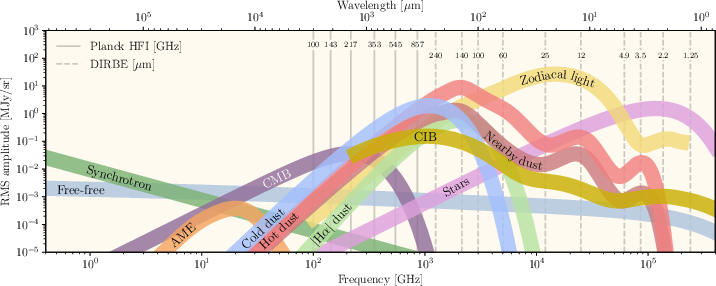
Figure 1: The spectral energy density of the DR2 sky model, spanning the radio to the far-infrared, demonstrates the dataset integration range and foreground complexity.
This model achieves unprecedented uniformity in foreground corrections, with improved zodiacal light-corrected maps and refined characterization of thermal dust.
Pipeline Automation and Reproducibility
A critical Cosmoglobe innovation is the minimization of manual intervention between data processing stages. While previous collaborations operated disjointed pipelines with significant human coordination (e.g., Planck LFI calibration in Trieste, mapmaking in Helsinki, component separation in Oslo), Cosmoglobe and the precursor BeyondPlanck [bp01] tightly coupled these steps into an automated loop, enabling thousands of analysis cycles and efficient convergence.
The project prioritizes open science and reproducibility (Gerakakis et al., 2022), with all source code and results publicly available, facilitating auditability and community validation.
Numerical Results and Strong Claims
Cosmoglobe's joint Bayesian inference has delivered strong numerical outcomes:
- Joint LFI/WMAP calibration convergence: DR1 resolves previous polarization map discrepancies, with cross-calibrated uncertainty bands and full posterior access, outperforming isolated pipelines.
- Full error propagation on τ (optical depth to reionization): The approach provides the first joint estimation of the posterior including all systematics, highlighting correlations inadequately resolved in prior CMB analyses.
- DR2 sky model spans five decades in frequency: The resultant SED (see Figure 1) evidences improved consistency between microwave and IR data, resulting in tight constraints on dust emission parameters and other astrophysical components unachievable by single-instrument approaches.
Implications and Future Prospects
Cosmoglobe establishes a new paradigm for CMB and astrophysical analysis, offering practical and theoretical benefits:
- Systematics Mitigation: By integrating diverse datasets and conducting simultaneous instrument calibration, the framework suppresses experiment-specific biases and increases reliability of cosmological parameter inference.
- Preparations for Next-Generation Surveys: Commander4's scalable, modular architecture is tailored for Simons Observatory, LiteBIRD, and FOSSIL, preparing the ecosystem for petabyte-scale, high-resolution datasets. The project pipeline is being actively adapted for these applications.
- Expansion to Line Intensity Mapping and Gamma-ray Astronomy: Ongoing and future analyses target AKARI (zodiacal light modeling), FIRAS (CMB spectral distortions), Planck HFI (polarization systematics), CHIPASS (synchrotron), Fermi-LAT (gamma-ray extension), and COMAP (line-intensity mapping).
- Tensor-to-Scalar Ratio (r) Measurements: High-fidelity, foreground-mitigated CMB maps from joint processing will be critical for limits on primordial B-modes.
These developments have implications for large-scale structure recovery, dark energy constraints, and improved characterization of galactic/extragalactic foregrounds, solidifying the link between astrophysical and cosmological analysis.
Conclusion
Cosmoglobe delivers a statistical framework and practical implementation for the unified Bayesian analysis of the astrophysical and cosmological sky. Through Commander, it has demonstrated the superiority of joint, iterative end-to-end processing over disjoint, experiment-specific pipelines, resolving critical calibration and foreground modeling challenges. The project portfolio is rapidly expanding to encompass future experiments and new frequency domains, providing a community resource for robust, reproducible inference in precision cosmology.