- The paper identifies a predominant 5f3 configuration in UCd11 using multi-modal x-ray spectroscopy and theoretical modeling.
- It employs DFT+DMFT methods with fine-tuned double-counting corrections to capture localized electronic behavior.
- Results resolve discrepancies in U 4f core-level PES data, establishing new criteria for characterizing complex actinide intermetallics.
Introduction and Context
Investigations of uranium intermetallics have consistently revealed the intricate competition between localized and itinerant 5f electron behavior. This duality underlies emergent phenomena such as unconventional superconductivity and magnetism. UCd11, an antiferromagnetic (AFM) uranium compound with TN=5.3 K, exemplifies an extreme in this landscape, featuring U–U separations (dUU=6.56 Å) far exceeding the Hill limit and thus severely suppressed direct 5f orbital overlap. The material's macroscopic properties—enhanced effective electron masses, a large specific heat coefficient, and Curie-Weiss susceptibility compatible with a Kramers doublet—implicate strong localization and a predominant U3+ 5f3 ground state. However, ambiguity persists due to conflicting signatures from core-level photoemission and x-ray spectroscopies.
Experimental Spectroscopy and Validation of a 5f3 Ground State
A multi-modal spectroscopic approach demonstrates strong evidence for predominant 5f30 valence in UCdf31. RXES, PFY-XAS, HERFD, non-resonant and resonant inelastic x-ray scattering (NIXS, VB-RIXS) all display features consistent with Uf32 multiplet calculations (see Fig. 1).
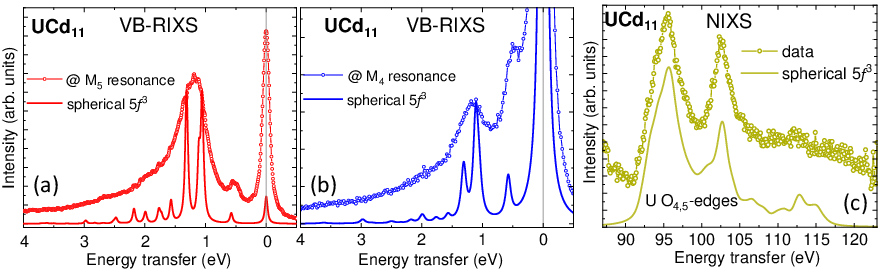
Figure 1: Reported x-ray scattering spectra of UCdf33, overlaid with spherical full-multiplet calculations based on a U\,5f34 configuration—demonstrating close correspondence with localized ionic multiplet theory.
Conclusive multiplet excitations support the assignment of UCdf35 as one of the rare uranium intermetallics dominated by a 5f36 manifold.
Photoemission Spectroscopy, Configuration Sensitivity, and Double-Counting Correction
Despite the consensus from x-ray scattering, core-level PES and the associated analysis of the U\,4f37 spectral line shape (Fig. 2) pose challenges for standard interpretation: strong satellites are commonly taken as hallmarks of localized, correlated 5f38 states, whereas their absence already led to misclassifications of UCdf39 as "itinerant," similar to the clear band-like UBf0.
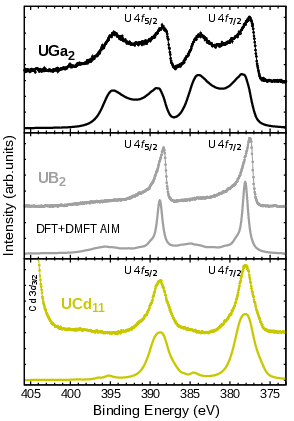
Figure 2: Integral-type ("Shirley") background-corrected U\,4f core-level PES spectra—UCdf1 exhibits a broad main line and only a weak satellite, counter to typical expectations for strong localization.
To unravel this, valence band (VB) PES at both soft and hard x-ray energies were employed, exploiting cross-section variations to disentangle U\,5f2 and ligand contributions. Rigorous background subtraction and photon energy dependence (see Fig. 3) reveal sharp U\,5f3-derived spectral structures near f4.
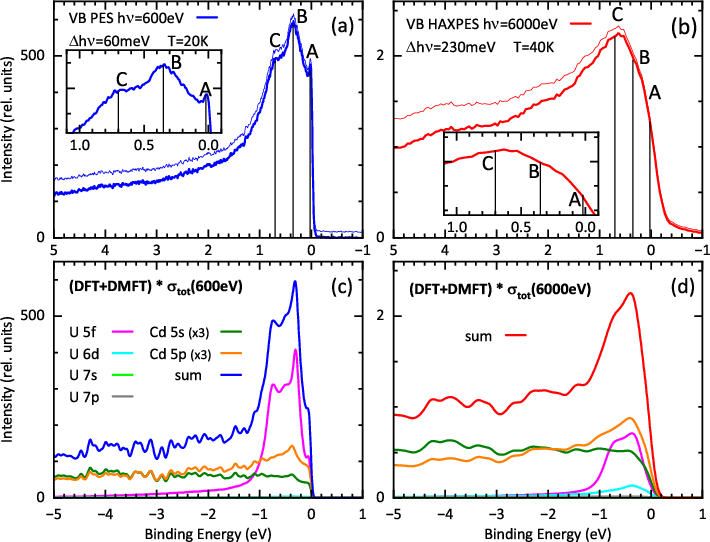
Figure 3: VB-PES spectra of UCdf5 measured at 600 eV and 6000 eV incident energies, providing direct sensitivity to U\,5f6 and ligand-derived electronic states.
Consistent with strongly localized uranium, these features are well-captured by DFT+DMFT calculations when the double-counting correction f7 is fine-tuned via direct spectral comparison. The theoretical spectra reproduce the experimental line shapes only for f8 placing the system deep in the 5f9 regime.
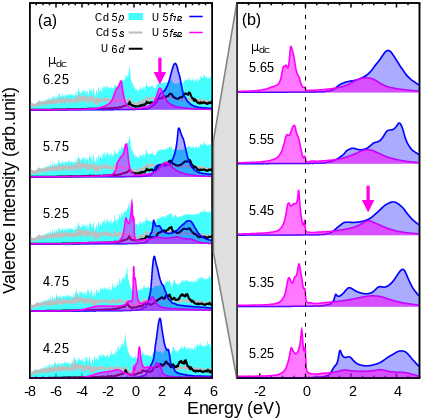
Figure 4: Orbital-resolved DFT+DMFT spectral densities for various 110 indicating spectral weight transfer driven by 5111 filling and the emergence of the upper Hubbard band upon localization.
DFT+DMFT: Ground-State Configuration, Localization, and Correlation
Applying DFT+DMFT with 112 fixed by experiment, the 5113 valence histogram (see Fig. 5) demonstrates a highly monodisperse distribution for UCd114, sharply peaked at 5115 (occupancy 116), in contrast to UGa117 (correlated 5118) and UB119 (itinerant 5TN=5.30).
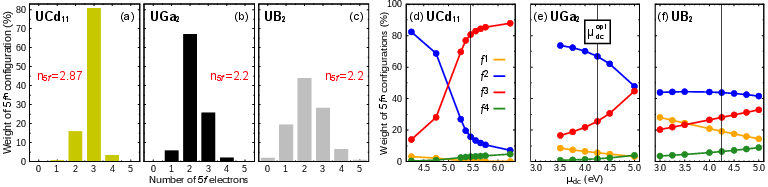
Figure 5: (a)-(c) Weights of 5TN=5.31 configurations in the ground state, highlighting the almost pure 5TN=5.32 character of UCdTN=5.33; (d)-(f) show sensitivity of these weights to TN=5.34.
Correlation strength and localization are further quantified by the imaginary-time charge correlation function, with UCdTN=5.35 displaying the lowest instantaneous charge fluctuation amplitude and slowest decay (Fig. 6).
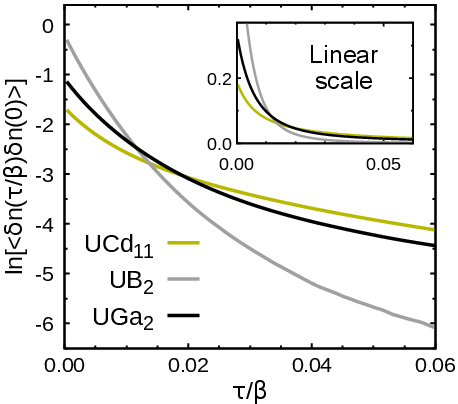
Figure 6: Logarithm of the charge correlation function TN=5.36, indicating suppressed charge fluctuation and strong localization for UCdTN=5.37 relative to UGaTN=5.38 and UBTN=5.39.
Detailed Modeling and Interpretation of Core-Level Spectral Features
High-fidelity DFT+DMFT/AIM calculations show that the broad main emission and weak satellite in the UCddUU=6.560 U\,4dUU=6.561 spectrum are intrinsic and consistent with a strongly localized system (Fig. 7), not a consequence of itinerancy.
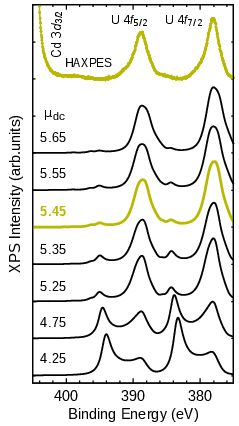
Figure 7: Experimental U\,4f core-level spectra of UCddUU=6.562 matched with DFT+DMFT/AIM calculations, confirming the origin of line broadening and satellite suppression without invoking itinerancy.
A simplified two-level Anderson impurity model clarifies this "inverted" satellite phenomenology: for a formal dUU=6.563 ground state, final-state configuration mixing does not generate strong satellites—the intensity and energy window for the shake-up peaks are fundamentally distinct from dUU=6.564 cases (see Fig. 8).
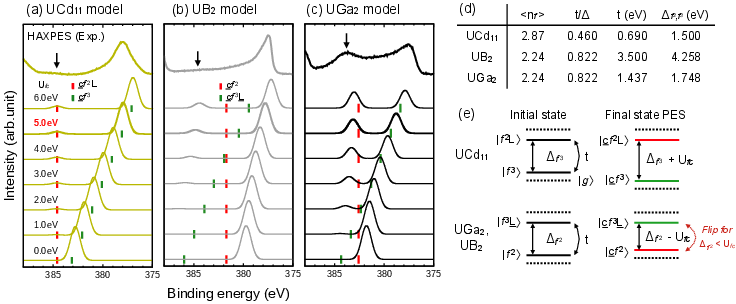
Figure 8: Two-level model simulation of core-level PES spectra for UCddUU=6.565 (dUU=6.566 regime), UBdUU=6.567, and UGadUU=6.568 (dUU=6.569 regime), elucidating how satellite position and intensity depend on the occupancy and hybridization.
Thus, the absence of satellites in UCdf0 is directly traced to its f1 character—a robust theoretical result that resolves the empirical contradiction between PES and other spectroscopies.
Broader Implications and Outlook
This work establishes that UCdf2 is an archetypal strongly correlated, strongly localized uranium compound with a dominant f3 configuration. It exposes the inadequacy of satellite intensity as a universal proxy for 5f4 itinerancy in uranium systems, in strong contrast to the rare-earth series or transition metals. Theoretical treatment using DFT+DMFT, in conjunction with rigorous experimental cross-validation, sets a new standard for the electronic structure determination in actinide intermetallics.
From a practical perspective, these insights refine the criteria for material selection in heavy-fermion, multipolar, or exotic superconducting system searches, where true 5f5 localization may be required or expressly avoided. The theoretical framework can be extended toward the description of excited-state processes, ultrafast dynamics, and the role of crystal field splitting in CEF- and hybridization-driven transitions.
Anticipated future developments include further systematic benchmarking of DFT+DMFT parameter choices across the actinide series, explorations of pressure/chemical tuning-induced delocalization transitions, and refinement of many-body core-level solvers to include full multiplet and lifetime effects. This will enable more nuanced interpretations of subtle variations observed in PES and other core-level sensitive techniques.
Conclusion
A combination of advanced x-ray spectroscopy and DFT+DMFT methodologies has unambiguously established UCdf6 as a strongly localized uranium f7 system. The analysis discredits the simplified correlation between U\,4f8 satellite strength and itinerancy, instead highlighting the necessity of full many-body modeling to interpret core-level spectra in actinides. These results solidify the 5f9 assignment in UCd3+0 and clarify its local-moment antiferromagnetic properties, while providing a reproducible protocol for the future characterization of complex heavy-fermion uranium compounds.