- The paper presents the GM* mechanism which guarantees Nash Equilibria with near-optimal cost when only a subset of agents act strategically.
- It establishes tight bounds on both Price of Stability and Price of Anarchy, demonstrating that equilibria remain efficient even with moderate strategic manipulation.
- The study shows that in one-dimensional settings, strong Nash Equilibria exist, ensuring robust, coalition-proof solutions under collective deviations.
Strategic Facility Location with Limited Liars: A Technical Analysis
This paper addresses the classical facility location problem under strategic manipulation, considering a practical relaxation: only a subset of clients (agents) are strategic liars, while the remainder always report their true locations. The setup is as follows: n clients exist in a metric space with a finite set of candidate facility locations F. The objective is to select a facility minimizing the sum of client-facility distances (minisum). Out of n clients, k can act strategically, misreporting their positions to decrease their personal costs if possible, while the remaining n−k always report truthfully.
The motivation for this model arises from empirical and theoretical settings where not all agents act strategically, due to verification, simplicity, or behavioral factors. This is substantiated by cited empirical work on voting and matching games. From a mechanism design perspective, the degree of strategyproofness is thus interpolated between classical worst-case analysis (all agents are strategic) and fully strategyproof mechanisms (which incur high approximation ratios in many topologies, e.g., Ω(n) in general metric spaces).
Mechanism and Solution Concepts
The authors focus on a simple and natural deterministic mechanism, denoted GM∗. For any vector of reported locations, GM∗ selects the candidate facility minimizing the sum of reported (truthful or strategic) distances–that is, the perceived minisum solution. Ties are broken according to a fixed rule. Unlike median or arbitrary monotone strategies, GM∗ mirrors the optimal unconstrained solution if all reports are truthful.
Two solution concepts are studied:
- Nash Equilibrium (NE): No individual strategic client benefits by unilaterally misreporting their location.
- Strong Nash Equilibrium (SNE): No coalition of strategic clients can all benefit by jointly misreporting.
The paper focuses on quantitative metrics standard in algorithmic mechanism design:
- Price of Stability (PoS): The best NE/SNE relative to the true optimum.
- Price of Anarchy (PoA): The worst NE/SNE relative to the true optimum.
Main Results
Nash Equilibrium Existence and Bounds
The authors show that NE always exists for GM∗, regardless of metric and the selection of strategic clients (Theorem 3). This is accomplished constructively: if all strategic clients report the optimal facility for the truthful clients, an equilibrium is reached.
The analysis proceeds to establish tight bounds on equilibrium approximation:
- Price of Stability (PoS):
- For F0: F1
- For F2: F3
- This ratio is close to 1 as F4 grows.
- Price of Anarchy (PoA):
- For F5: F6 in general metrics.
- For line metrics (clients/facilities on a line): F7
- Bounds are tight for all anonymous monotonic mechanisms.
These results quantitatively demonstrate that as long as F8 is a moderate fraction of F9 (e.g., n0), all NEs remain near-optimal.
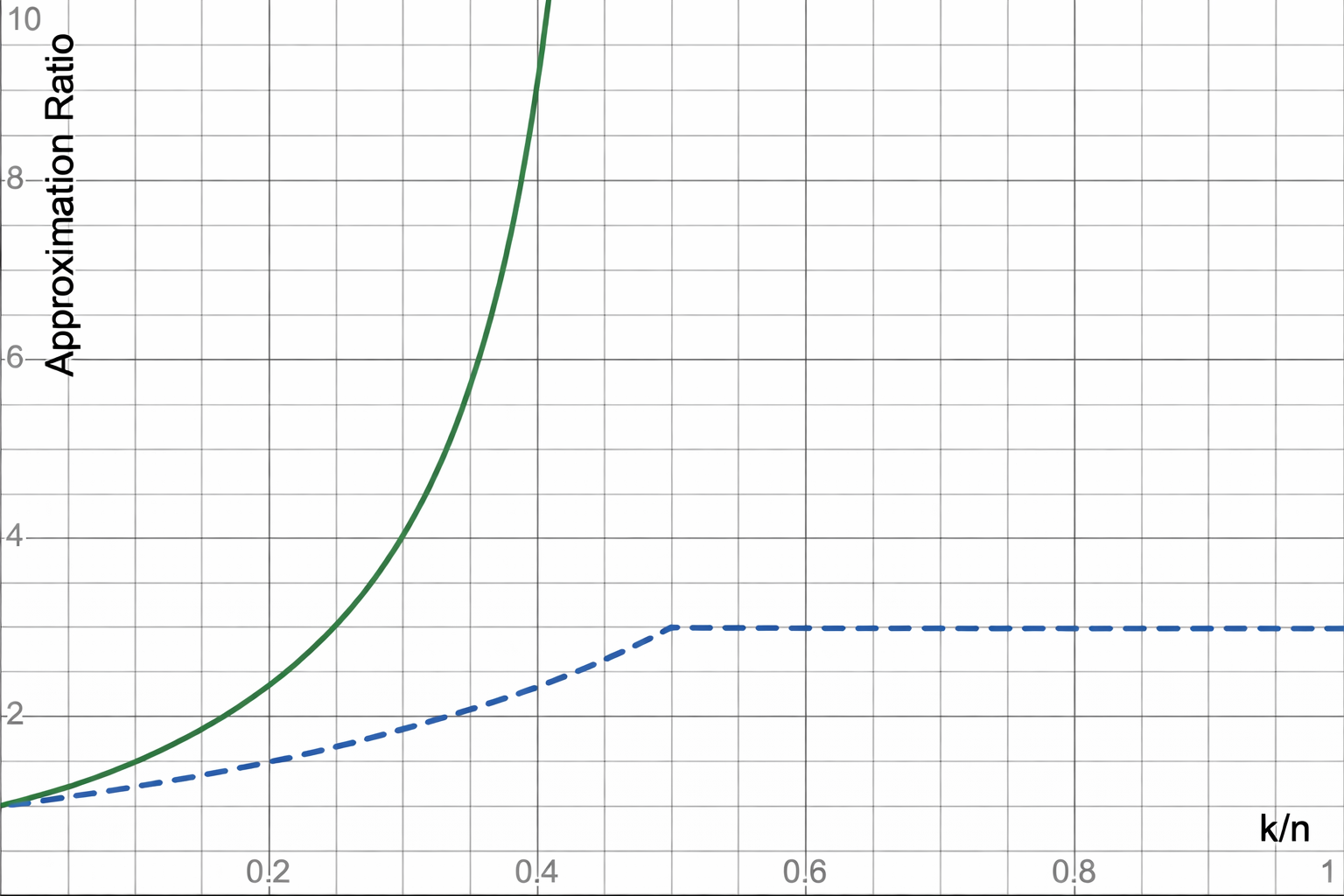
Figure 1: Theoretical and empirical upper bounds for the price of anarchy (solid) and strong price of anarchy (dashed) in terms of the strategic client fraction n1, for general (NE) and line (SNE) metrics.
Strong Nash Equilibrium: Existence and Bounds
The coalition-resilient SNE concept is more nuanced. The existence of SNE is not guaranteed in general metric spaces; indeed, the paper provides a cycle (Condorcet) example without SNE. However, if the space is a line (1D), SNE always exist and have strong efficiency guarantees:
- Any profile where all clients (strategic/truthful) report their closest facility forms an SNE for n2.
- Strong PoS/PoA (SPOA):
- For n3: SPOA n4
- For n5: SPOA n6 (the classical bound for deterministic strategyproof mechanisms in 1D)
- These bounds are asymptotically tight (via constructed instances).
The proof utilizes geometric properties of median intervals and the inability of coalitions to shift the winning facility arbitrarily without incurring cost to some member.
Implications and Comparative Analysis
The analysis yields several important implications:
- Relaxed strategyproofness and equilibrium quality: With a moderate fraction of strategic agents (n7), the equilibria obtained via n8 are vastly better than what is possible for strategyproof mechanisms, especially outside 1D. In general metric spaces, SP mechanisms have at best n9 approximation, while equilibria here yield small constant factors unless nearly all agents are strategic.
- Tightness and optimality: Bounds are shown to be tight for all anonymous monotonic mechanisms, establishing the canonical status of k0 in this intermediate strategyproofness regime.
- Robust coalition-resilient allocations in 1D: The existence and quality of SNE show robustness even under collective deviations when not too many agents are manipulative.
Practically, these findings support the use of simple, non-strategyproof social choice mechanisms (e.g., facility siting, location-based services, voting) when a substantial truthful client base exists, as often happens due to verification or behavioral inertia.
Open Problems and Future Directions
The paper highlights several research directions:
- Convergence dynamics: While equilibrium existence is established constructively, it remains to formally characterize myopic or best-response dynamics leading to NE/SNE.
- Partial manipulation: Extensions to settings where agents may only misreport within bounded uncertainty are suggested.
- k1-Strong Equilibrium: There is room to extend the bounds to equilibria stable to deviations by coalitions of size k2.
The introduced model and the sharp bounds invite further exploration in other social choice settings with partial strategyproofness, including more complex facility objectives, multiple facilities, or various voting/ranking rules.
Conclusion
This paper rigorously characterizes the interplay between strategic manipulation and equilibrium efficiency in facility location games with partial strategyproofness, interpolating between negative worst-case manipulative impacts and large truthful populations. For a broad range of parameter values, equilibria retain near-optimal cost properties, and robust coalition-proof solutions exist in structured spaces like the line. These results inform the practical deployment of simple optimal mechanisms in realistic social choice and public good settings where only a subset of agents have the incentive or capability to manipulate outcomes.