- The paper presents an integrated framework coupling large-scale numerics, high-resolution spectroscopy, and analytic field theory to accurately parameterize quantum magnetic systems.
- It demonstrates that controlled numerical tools such as QMC, DMRG, and TRG, alongside refined Hamiltonian extraction, yield precise phase diagrams and clarify spin liquid behaviors.
- The study emphasizes iterative model validation, where experimental comparisons falsify mean-field approximations and guide the refinement of effective Hamiltonians.
Theoretical and Numerical Advances in Quantum Magnetism: Integrating Experiment, Computation, and Analytic Theory
Introduction
Quantum magnetism underpins a broad class of strongly correlated quantum systems, hosting phenomena such as quantum spin liquids (QSLs) and unconventional ordered states. Historically, progress in the field was often siloed into either materials synthesis and experiment, analytic field theory, or numerical quantum many-body approaches. However, the inherent complexity of frustrated quantum magnets—their sensitivity to disorder, the proliferation of competing interactions in realistic Hamiltonians, and computational bottlenecks—has revealed the limitations of any isolated methodology. This paper advocates forcefully for an integrated framework coupling experimental characterization with large-scale numerics and analytic field theory, asserting that only such a conjoined approach offers a robust path towards identifying, parameterizing, and interpreting novel quantum phases.
The paper presents three testbeds where this paradigm has yielded decisive insights: quasi-1D and 2D triangular lattice quantum magnets and kagome Heisenberg antiferromagnets. In all cases, controlled numerical tools (e.g., QMC, DMRG, TRG), improved Hamiltonian extraction protocols, and high-resolution spectroscopies are coordinated in a cycle of prediction and validation. The approach unambiguously refines parameter spaces, diagnoses limitations in mean-field or semi-classical treatments, and discriminates spin-liquid behavior from proximate glassy or ordered states.
Quasi-One-Dimensional and Triangular Lattice Quantum Ising Magnets
Research on 1D spin chains established the prototypical scenario for quantum fractionalization: integer-spin elementary excitations are replaced by collective fractionalized spinons, described by the Luttinger liquid paradigm. Early analytic progress via Bethe ansatz and field theory was supported by exact and QMC-based calculations of the dynamical structure factor, which were directly validated against neutron scattering on high-purity chain materials [haldane1981, lakeQuantum2005, coldeaQuantum2010]. The robustness of these findings relies on (i) synthesis of clean quasi-1D compounds, (ii) minimal-spin Hamiltonians with dominant nearest-neighbor terms, and (iii) controlled computation of dynamical correlations.
These ingredients become severely constrained in higher dimensions due to residual three-dimensional coupling, disorder sensitivity, and an explosion of competing terms in the spin Hamiltonian. In turn, analytic, numerical, and experimental approaches must operate in close coordination for meaningful progress.
A paradigmatic case is the triangular lattice quantum Ising material TmMgGaO4 (TMGO), which uniquely supports unbiased, sign-problem-free QMC and TRG studies due to its strong Ising anisotropy. Large-scale QMC/thermal TRG calculations were quantitatively matched to specific heat and inelastic neutron spectra, extracting precise Hamiltonian parameters and locating TMGO in a nontrivial regime of its phase diagram hosting both clock-ordered and finite-temperature BKT phases (Figure 1).
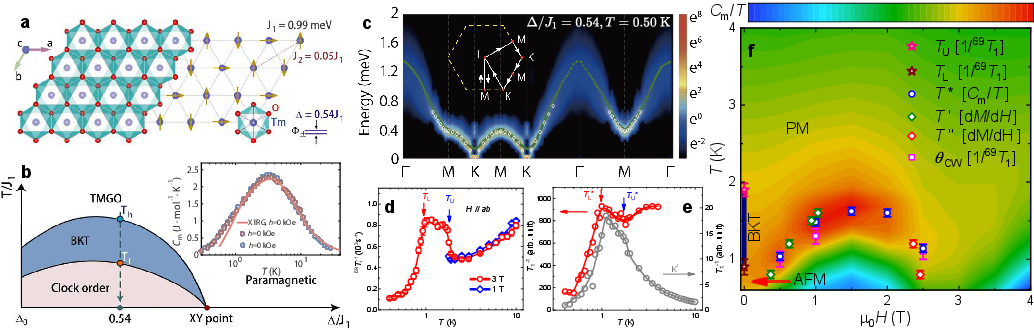
Figure 1: Triangular lattice quantum Ising magnet TmMgGaO4, highlighting electronic structure, model Hamiltonian, phase diagram, and associated experimental-theoretical comparisons (specific heat, neutron scattering, NMR, phase boundaries).
This joint theory-experiment campaign provided falsification of analytic mean-field treatments, which dramatically overestimate transverse field strengths and miss BKT physics. QMC-based theoretical predictions of a finite-temperature BKT phase—absent in mean-field—were confirmed ex post facto by NMR, establishing a rigorous cycle of theory-led experiment. This workflow iterates: parameter extraction from experiment calibrates simulation, which in turn predicts and motivates new measurements [liKosterlitz2020, huEvidence2020].
Triangular Lattice Heisenberg Antiferromagnets: Interplay of Fractionalization and Order
Quantum spin-1/2 triangular lattice Heisenberg antiferromagnets (TLHAFs) have been central in the quest for QSLs since Anderson’s RVB proposal. Although the ground state exhibits long-range magnetic order with a strongly reduced sublattice moment, the proximity to QSL physics manifests through broad excitation continua, anomalous dynamical spectral weight, and sharp magnon decay [Capriotti99, Starykh06, Zhitomirsky13]. Numerical studies of extended J1–J2 Heisenberg models identified a continuous quantum phase transition at J2/J1≈0.06 separating ordered and spin liquid phases (Figure 2a), motivating a new material search and precise spectroscopic characterization.
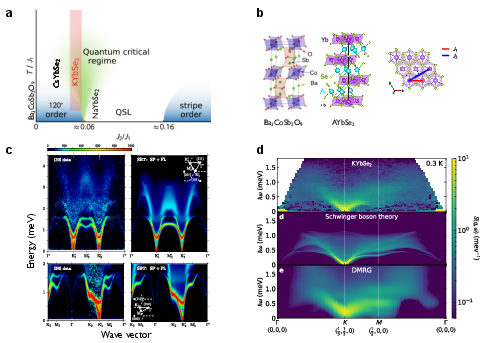
Figure 2: Triangular Lattice Heisenberg Antiferromagnets—(a) schematic phase diagram, (b) candidate material structures, (c) comparison of inelastic scattering with Schwinger boson theory, (d) neutron data versus DMRG and Schwinger boson calculations.
Here, large-N Schwinger boson field theory is validated as an analytic technique, predicting both spinon continua and two-spinon bound state magnon excitations. Integration with experimental data on Ba3CoSb2O9 and various delafossite compounds—fertile grounds for tuning proximity to quantum spin liquid phases—demonstrated that only beyond-mean-field treatments (with explicit gauge fluctuation corrections) could reproduce observed features such as extended continua and strong dynamical renormalization [Ghioldi22, scheieProximate2024].
Furthermore, DMRG ground-state phase diagrams and dynamical structure factor calculations not only confirm the character of the ordered and spin liquid phases but are crucial to refute spin liquid interpretations in systems where disorder generates spin-glass rather than quantum spin liquid ground states (e.g., YbZnGaO4 [maSpinGlass2018]). This exemplifies the power of parameter exhaustiveness and systematic comparison with a broad family of Hamiltonians, which rules out competing scenarios in ambiguous cases.
Kagome Heisenberg Antiferromagnets: Progress and Open Problems
Among frustrated magnets, the kagome Heisenberg antiferromagnet remains an archetype of conflicting theoretical and experimental interpretations. The complexity of candidate QSL materials is exacerbated by structural disorder, weakly correlated impurities, and the presence of further neighbor or Dzyaloshinskii-Moriya terms.
Prominent examples such as YCu40-Br and Y41Cu42-Cl highlight the need for an overview of ab initio Hamiltonian extraction (identification of bond disorder and motif structuring), DMRG/LLG dynamical simulations, and high-resolution neutron and Raman spectroscopy. YCu43-Br, for instance, displays a conical low-energy continuum with linear spectral width—consistent with a Dirac spinon cone, as predicted for a U(1) Dirac spin liquid (Figure 3c,d). This feature cannot be mimicked by disorder-broadened semi-classical spin-wave calculations, confirming intrinsic fractionalization [ZengZ24].
(Figure 3)
Figure 3: Kagome lattice antiferromagnets—structure, local disorder, dynamical neutron response (both experiment and DMRG/theory), and the consequences of bond disorders and breaking of translational symmetry.
Detailed examination of wavevector-resolved spectral intensity reveals that even modest local-structural distortions (arrangement of two inequivalent hexagons) are sufficient to produce split static and dynamic structure factors, driving deviations from the idealized homogeneous kagome model. This indicates that QML/DMRG-based model construction must explicitly account for material-specific distortions and compositional randomness [HeringM22, ChatterjeeD23].
Initial progress—such as numerical reproduction of static and high-energy spectral features and computation of the effect of Dzyaloshinskii-Moriya terms on the excitation spectrum—highlights both the power and ongoing limitations of current methods, particularly at low energies where larger system sizes and improved finite-size scaling remain critical.
Discussion and Implications
These three vignettes articulate a clear methodological conclusion: the identification, diagnosis, and classification of quantum spin liquids and related exotic quantum phases are not attainable via any singular approach. Only through synergy—integrating experiment (for model input and validation), advanced simulation (parameter-dependent thermodynamics and spectra), and analytic field theory (diagnostics for fractionalization, emergent symmetry, and gauge structure)—can the field robustly distinguish between proximate phases, optimize effective Hamiltonians, and quantitatively compare with experiment.
From a practical perspective, the recent deployment of stochastic analytic continuation has enabled QMC to bridge the gap from imaginary-time path integral data to experimentally accessible dynamical spectra [shaoNearly2017], significantly enhancing the direct interpretability of neutron and NMR measurements. The advent of machine-learning-driven model optimization schemes is anticipated to further streamline the parameter-fitting pipeline.
Weaknesses remain; e.g., tensor network approaches are still fundamentally limited by their quasi-one-dimensional geometry, and QMC suffers from the minus-sign problem in frustrated or further-neighbor Hamiltonians. However, the ongoing development of sign-problem-free effective models for realistic 2D frustrated systems, together with enhanced Schwinger boson and large-N frameworks incorporating higher-order gauge fluctuations, is expected to mitigate many of these limitations [willsher2025, Shackleton25].
For the broader quest to identify and verify Kitaev and related QSLs in honeycomb lattices, the paper’s advocated methodology generalizes immediately: one must combine systematic ab initio parameter extraction (involving multi-orbital and further-neighbor exchanges), thermodynamic fitting, and dynamical experiment, guided by analytic treatments that allow for complex, multi-term Hamiltonians with disorder and anisotropy [Trebst2022, moller2025].
Conclusion
This work affirms that genuine progress in quantum magnetism—and the identification of fractionalized quantum phases—critically depends on integrated research linking advanced computation, field theory, and experiment. The successful mapping of phase diagrams, identification of order and disorder, and discrimination of spin liquid states from glass and trivial disorder require not just methodological diversity, but a tightly coordinated, iterative, and model-driven dialog between theory and measurement. The outlined approach provides a model for analogous investigations elsewhere in quantum many-body systems, including the ultimate identification and realization of Kitaev, chiral, and other topologically ordered phases.
The sustained integration and cross-validation of experimental, numerical, and analytic approaches will remain the cornerstone of future developments in the study of quantum frustrated magnetism and emergent phenomena in strongly correlated systems.