- The paper demonstrates that high-mass cluster QGs experience a 40% enhanced stellar halo growth via dry minor mergers compared to field QGs.
- Methodologies include detailed g-band surface brightness profiling and probabilistic cluster membership assignment to ensure robust environmental comparisons.
- Results indicate low-mass cluster QGs show a 22% decrease in halo luminosity with increasing cluster mass, highlighting the impact of tidal stripping.
The Impact of Cluster Environments on the Stellar Halo Assembly of Quiescent Galaxies
Introduction
This study investigates how dense cluster environments influence the stellar halo assembly of quiescent galaxies (QGs) over the redshift range $0.1 < z < 1.0$ using an extensive sample of 2,168 cluster QGs and 94,479 field QGs drawn from the CLAUDS+HSC-SSP photometric catalogs. By systematically analyzing rest-frame g-band surface brightness profiles derived from deep HSC-SSP imaging, the work quantifies the buildup of stellar haloes—outer galaxy regions tracing accreted material—across a wide range of stellar and host halo masses. The project leverages advanced photometric methods, rigorous cluster membership assignment, and extensive tests on observational systematics to ensure robust environmental comparisons.
Data, Sample Selection, and Methodology
Data Sources and Galaxy Selection
The dataset combines broadband grizy imaging from HSC-SSP PDR3 with ancillary CFHT U-band (CLAUDS) data, supporting precise photometric redshift and stellar mass estimation. The final analysis targets a mass-complete sample, subdivided into low-mass (9.66≤logM⋆<10.5) and high-mass (logM⋆≥10.5) QGs, and further binned in redshift.
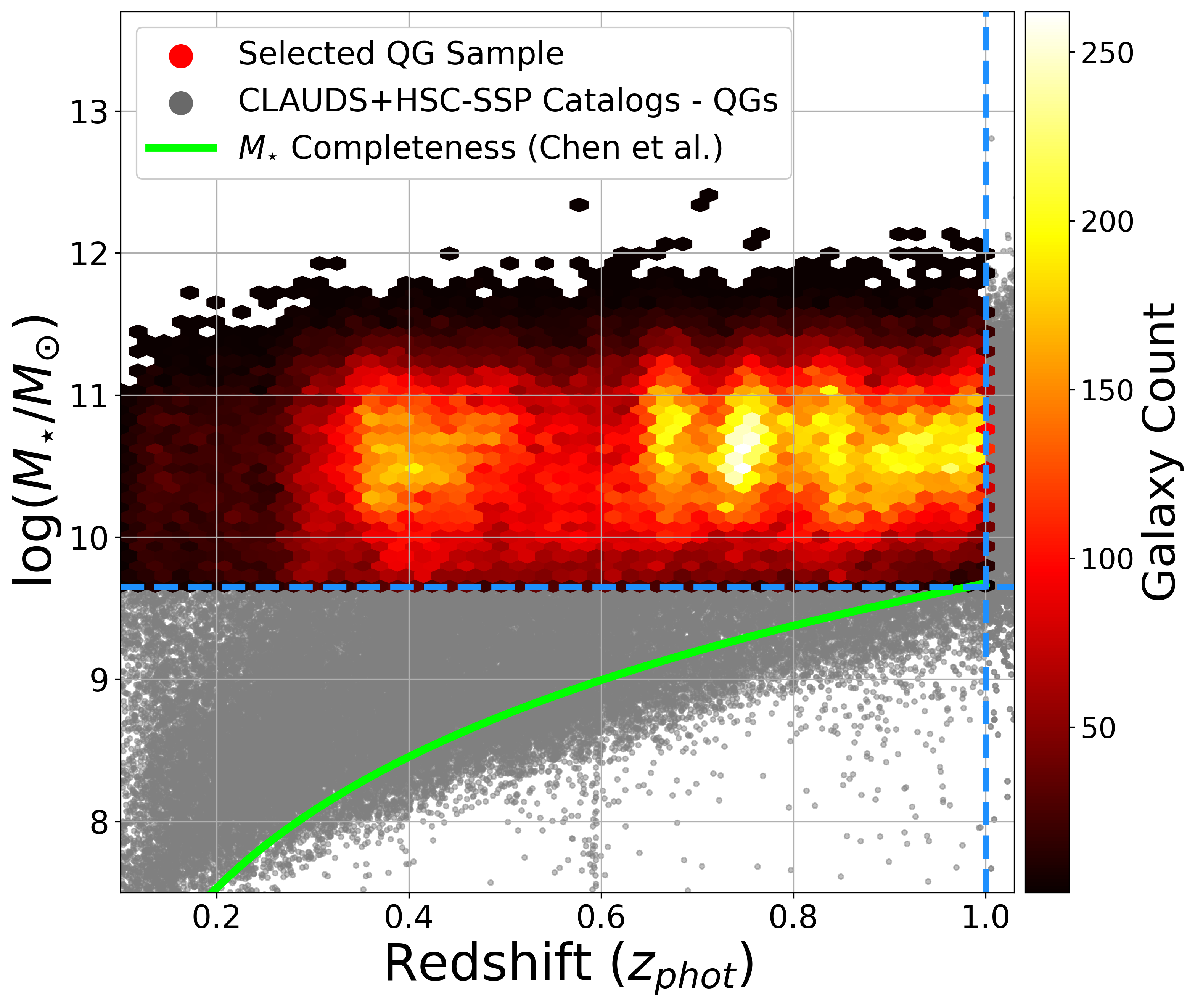
Figure 1: Stellar mass as a function of redshift for the selected QG sample, emphasizing completeness and coverage across the four extragalactic fields.
Cluster Membership Determination
Cluster samples are constructed using an iterative, probabilistic red-sequence method anchored to confirmed BCG positions and calibrated with HectoMAP spectroscopic data, achieving high purity (≲4% contamination) while extending definitions out to 2R200 to probe regions subject to cluster potential.
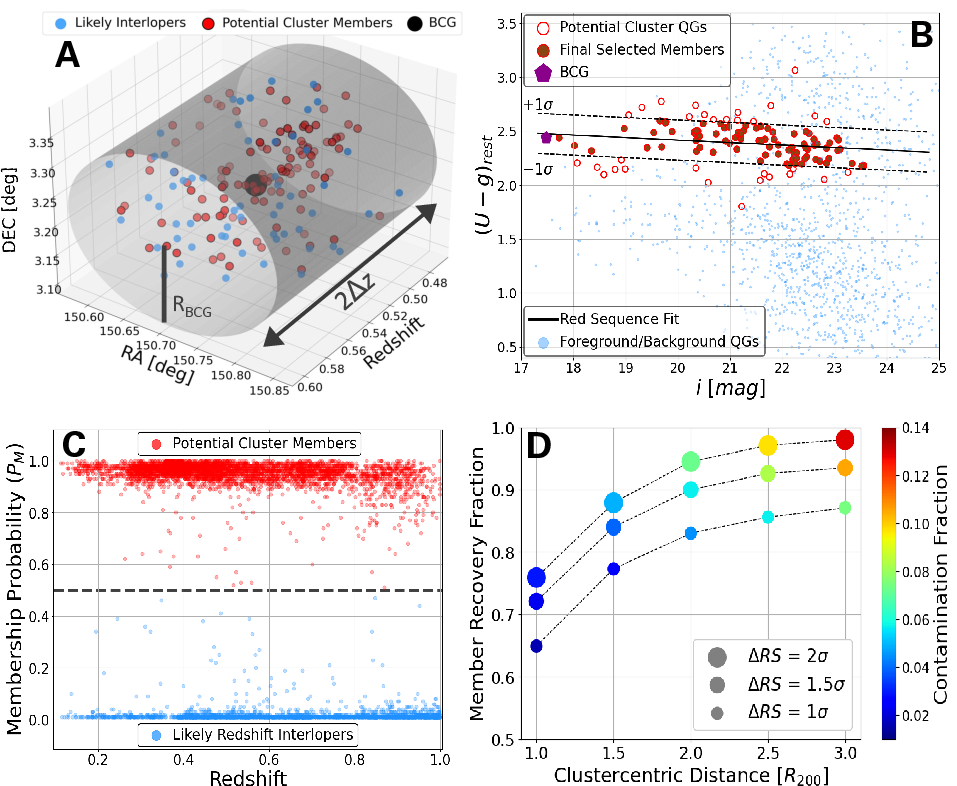
Figure 2: Overview of the cluster member-finding approach, including spatial, color-magnitude, and probability-based selection criteria.
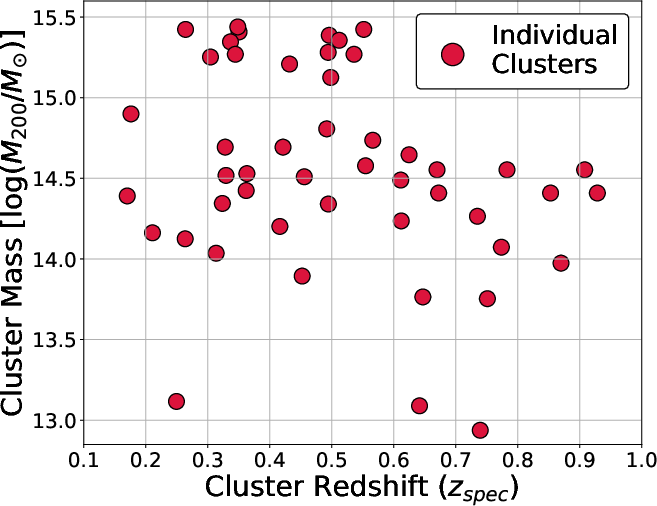
Figure 3: Distribution of cluster DM halo masses as a function of cluster redshift for the 48 clusters hosting QG members.
Light Profile Extraction and Validation
Galaxy light profiles are extracted using the GalPRIME suite, which includes state-of-the-art source masking, background subtraction, and PSF correction routines. Extensive simulated insertion experiments, spanning a diversity of cluster environments, demonstrate systematics in halo luminosity recovery at the percent level.
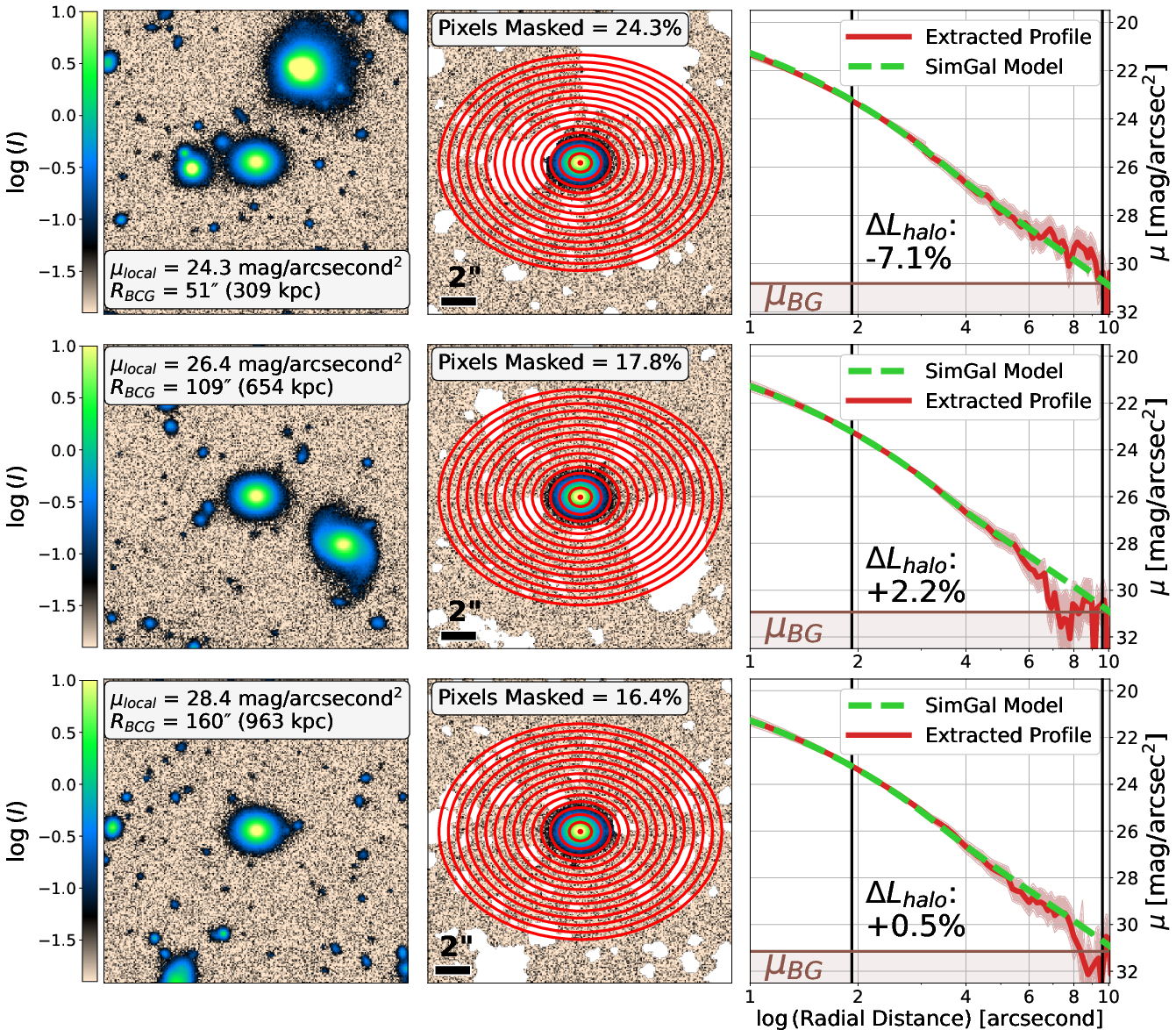
Figure 4: Visualization of the profile extraction pipeline on simulated galaxies inserted in varying cluster environments, highlighting robust background and mask handling.
Defining Stellar Halo Properties
Stellar haloes are measured by integrating rest-frame g-band surface brightness between 2Re and 10Re in median stack profiles, adopting this definition to enable direct comparison with theoretical and observational works on ex-situ assembly.
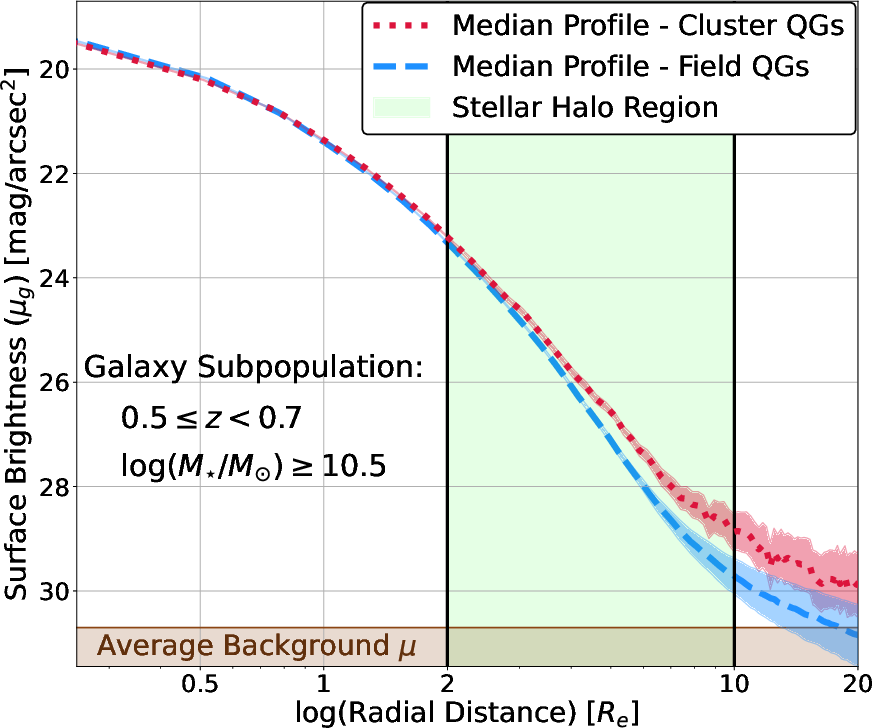
Figure 5: Median g0 profiles for field and cluster QGs, with the stellar halo region demarcated and systematic background uncertainty indicated.
Results: Differential Stellar Halo Growth and Environmental Dependence
Stellar Halo Growth Rates
The cumulative buildup of stellar halo material is compared between cluster and field QGs, with halo luminosities normalized to the highest redshift bin for each mass subsample.
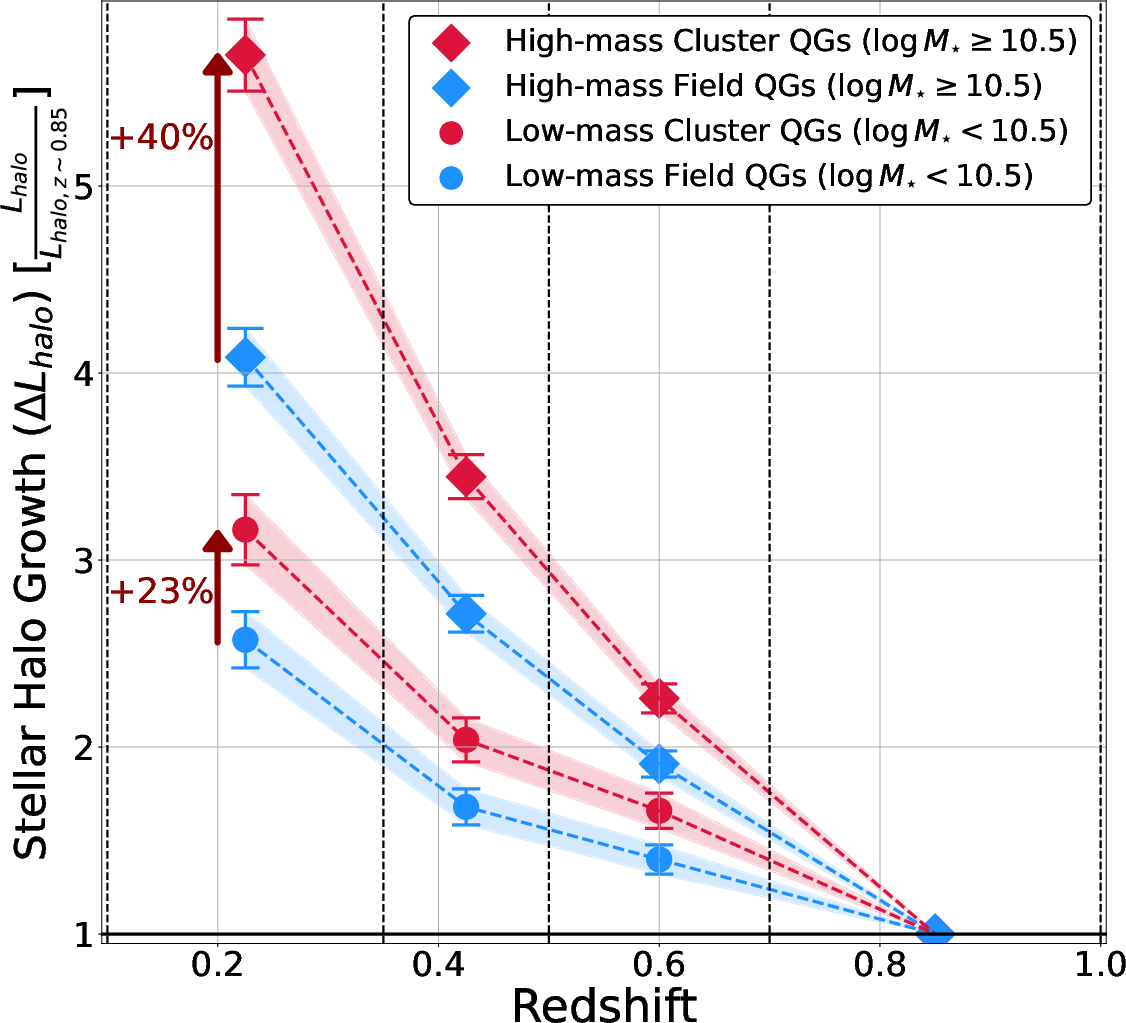
Figure 6: Cumulative stellar halo growth relative to g1, showing more rapid assembly in cluster QGs, especially at higher stellar masses.
Over g2, high-mass cluster QGs exhibit a g3 larger fractional increase in integrated stellar halo luminosity (g4) relative to matched field controls (growth factor g5 vs g6), while low-mass cluster QGs show a g7 excess (growth factor g8 vs g9). This enhancement suggests that external processes prevalent in clusters, notably dry minor mergers, accelerated the accretive mass assembly of QG haloes.
Instantaneous Cluster-Field Contrasts
Comparison of absolute grizy0 at each epoch reveals divergent environmental signatures from the differential growth rates. High-mass cluster QGs maintain more luminous haloes than field QGs at all epochs, with a mass- and redshift-averaged cluster-to-field ratio of grizy1 that increases toward lower redshifts. In contrast, low-mass cluster QGs overwhelmingly show a deficit (average ratio grizy2), with only moderate convergence at the lowest redshift.
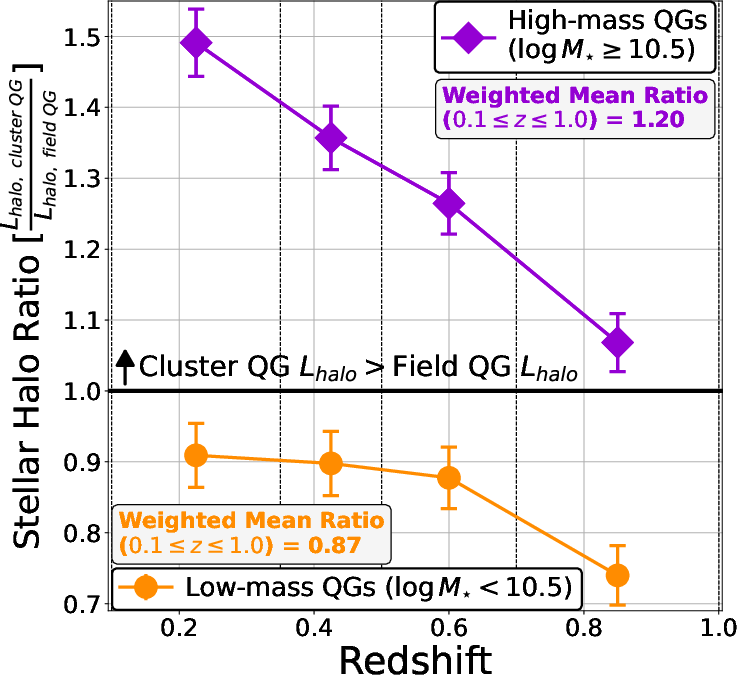
Figure 7: Cluster-to-field grizy3 ratios as a function of redshift for low- and high-mass QGs; note the persistent deficit in low-mass cluster QGs and the steady enhancement in the high-mass regime.
Cluster Mass Dependence
Stellar halo luminosity is further conditioned on host cluster DM halo mass (grizy4), revealing a monotonic increase in grizy5 with increasing grizy6 for high-mass cluster QGs (factor of grizy7 across the full cluster mass range). Crucially, the lowest-mass cluster QGs (grizy8) display the opposite behavior—their grizy9 decreases by 9.66≤logM⋆<10.50 with increasing cluster mass, consistent with stripping or dynamical loss dominating over accretive growth.
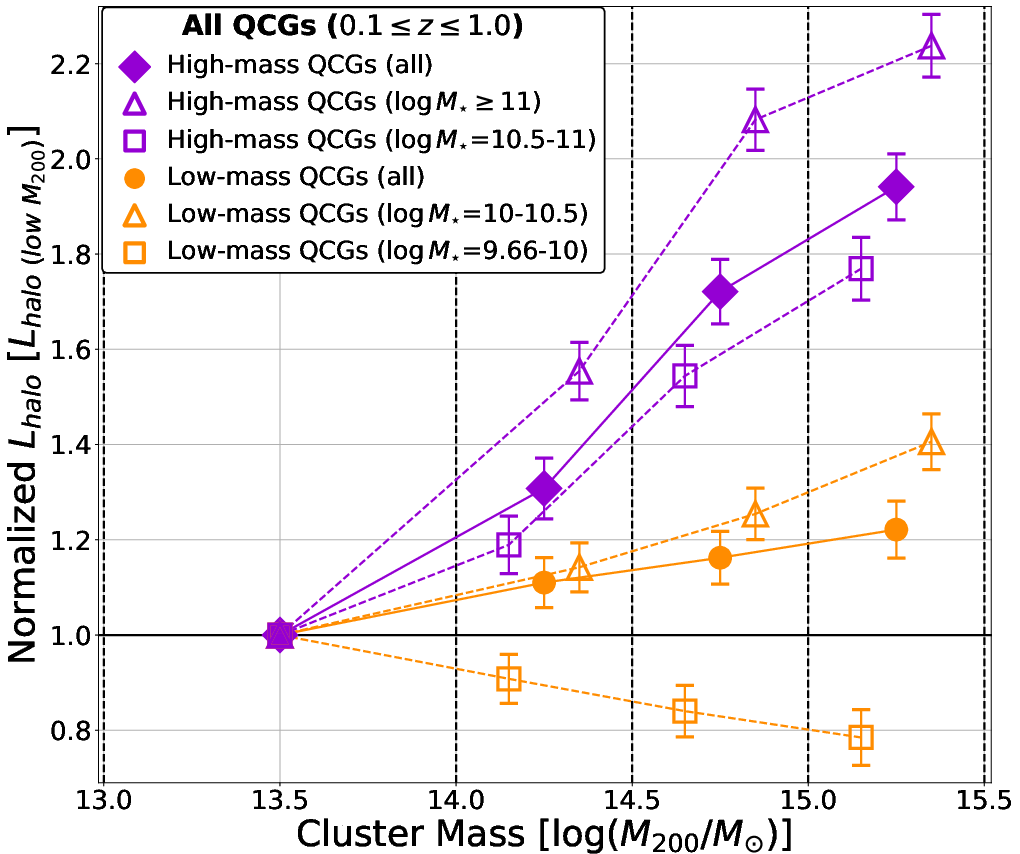
Figure 8: Cluster QG 9.66≤logM⋆<10.51 as a function of host 9.66≤logM⋆<10.52, showing mass-dependent bifurcation: buildup with 9.66≤logM⋆<10.53 for high-mass QGs and suppression for the lowest-mass systems.
Interpretation: Physical Mechanisms and Theoretical Context
High-Mass QGs: Mergers and Halo Growth
Results for high-mass QGs confirm a scenario dominated by ex-situ accretion—primarily dry minor mergers—in denser environments. The environmental enhancement is interpreted as arising from increased merger rates in cluster outskirts or in pre-infall group/filament environments, despite the high-velocity suppression of mergers at cluster centers. Observational and simulation results (e.g., EAGLE, IllustrisTNG) predict similar trends, with halo growth preferentially occurring via accretion of satellites or intracluster debris.
Low-Mass QGs: Stripping and Suppressed Assembly
The suppressed 9.66≤logM⋆<10.54 and negative dependence on 9.66≤logM⋆<10.55 for low-mass cluster QGs is attributed to efficient loss of outer stellar material via tidal stripping, harassment, or cannibalism during minor mergers. This suggests that a regime transition exists near 9.66≤logM⋆<10.56, above which galaxies retain or enhance their haloes in clusters, and below which galaxies are primarily sources of intracluster light and mass loss, consistent with hierarchical assembly models and cosmological predictions for satellite disruption.
Robustness and Systematics
The work includes sensitivity analyses on light profile extraction fidelity, sky background treatment, and stellar halo region definitions. Systematic uncertainties in 9.66≤logM⋆<10.57 recovery remain at the 9.66≤logM⋆<10.58 level across tested conditions, and variations in the adopted integration range (9.66≤logM⋆<10.59 to logM⋆≥10.50) yield negligible changes in qualitative trends between environments.
Broader Implications and Prospects
This study advances the empirical assessment of environmental effects on the late-stage assembly of QGs, demonstrating that dense environments induce both enhanced accretive growth in high-mass systems and mass loss/stripping in low-mass systems. The direct measurement of environmental dependence in the diffuse stellar outskirts constrains models of galaxy evolution, supporting hierarchical cosmological predictions and informing future surveys—especially those targeting the low surface brightness regime at high redshift.
The work establishes a pathway for future multi-wavelength spectrophotometric surveys (e.g., Euclid, DESI, WEAVE, Subaru PFS) to chart stellar halo growth across cosmic web environments, including filaments and voids.
Conclusion
This paper provides quantitative evidence that cluster environments modulate the assembly of QG stellar haloes in a mass-dependent manner: high-mass QGs in clusters not only grow their haloes more rapidly but also achieve systematically higher halo luminosities than field analogs, while low-mass cluster QGs experience net suppression due to enhanced stripping. These trends persist after controlling for stellar mass, redshift, and observational systematics, and are consistent with predictions from cosmological structure formation simulations. The findings substantiate the centrality of environment in late-stage galaxy evolution and motivate future work to unravel the interplay between merger-driven accretion and environmentally-driven stripping at the resolved structural level.