- The paper introduces a Fourier Neural Operator that leverages spectral-domain inversion to enhance image reconstruction fidelity and efficiency.
- The methodology utilizes FFT-based global filtering to overcome the limitations of local CNN kernels, achieving higher PSNR and SSIM compared to U-Net.
- The study validates resolution-agnostic inference by demonstrating accurate reconstructions at varying resolutions with minimal degradation.
Resolution-Agnostic Lensless Imaging via Fourier Neural Operators
Introduction
Lensless computational imaging systems, exemplified by the DiffuserCam architecture, exploit thin diffusers to replace traditional refractive optics, enabling highly compact designs. However, these systems inherently require sophisticated computational methods for image reconstruction, as the point spread function (PSF) of the diffuser multiplexes scene information globally over the sensor. Classical iterative approaches integrating hand-crafted priors are effective but resource-intensive. Recent advances leverage deep convolutional neural networks (CNNs), such as U-Net architectures, for data-driven end-to-end inversion. These methods, while performant, are constrained by the locality of convolutional kernels and fixed input resolutions, presenting challenges in generalization across varying discretizations and modalities with inherently global PSFs.
The discussed work proposes and rigorously evaluates a Fourier Neural Operator (FNO) architecture aligned with the inherent spectral characteristics of the lensless imaging inverse problem. The FNO framework demonstrates significant improvements in both reconstruction fidelity and practical utility, notably supporting resolution-agnostic inference.
DiffuserCam System and Dataset Acquisition
The experimental setup employs a dual-aperture DiffuserCam, where a tablet displays natural-scene images that are simultaneously captured by a standard camera and a diffuser-coated sensor for ground-truth/reference and measurement data, respectively (Figure 1).
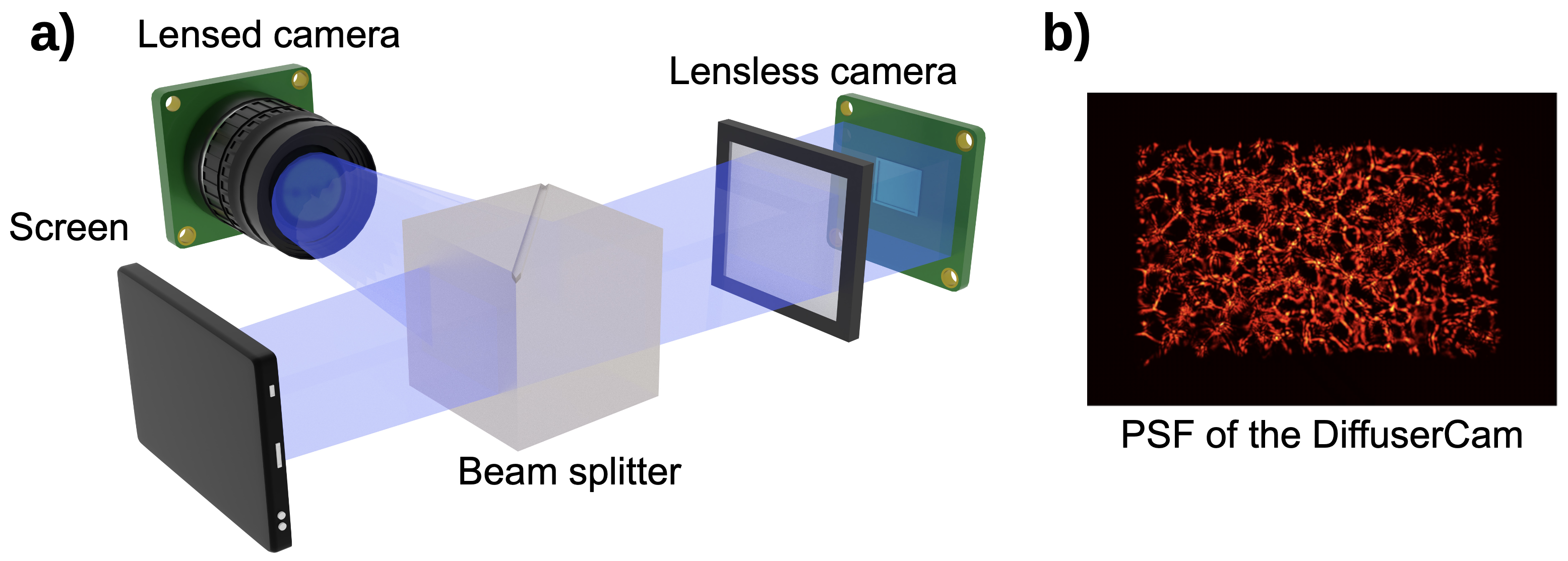
Figure 1: Experimental setup of the DiffuserCam with dual optical paths for simultaneous ground-truth and diffuser-based data acquisition.
This design yields precise alignment between raw lensless measurements and ground-truth reconstructions, ensuring high-quality paired data. A diverse set of 25,000 images from the MIR-Flickr dataset is employed, downsampled to multiple resolutions (512×512, 256×256, 128×128) for evaluating discretization invariance.
Fourier Neural Operator Architecture
The core FNO model comprises an input lifting layer, followed by six sequential Fourier layers and a final projection layer. Each Fourier layer executes a learned spectral filtering operation:
- Input features are lifted to a higher channel dimension.
- A 2D FFT is applied to yield spectral representations.
- Complex-valued learnable filters are multiplied in frequency space, implementing a global convolution.
- An inverse FFT reconstructs spatial domain features.
- A 1×1 convolution bypass preserves local information, and GELU nonlinearity is applied.
This architecture ensures that the convolutional inversion of lensless measurements is conducted through a global operation directly suitable for the system's physics (Figure 2).
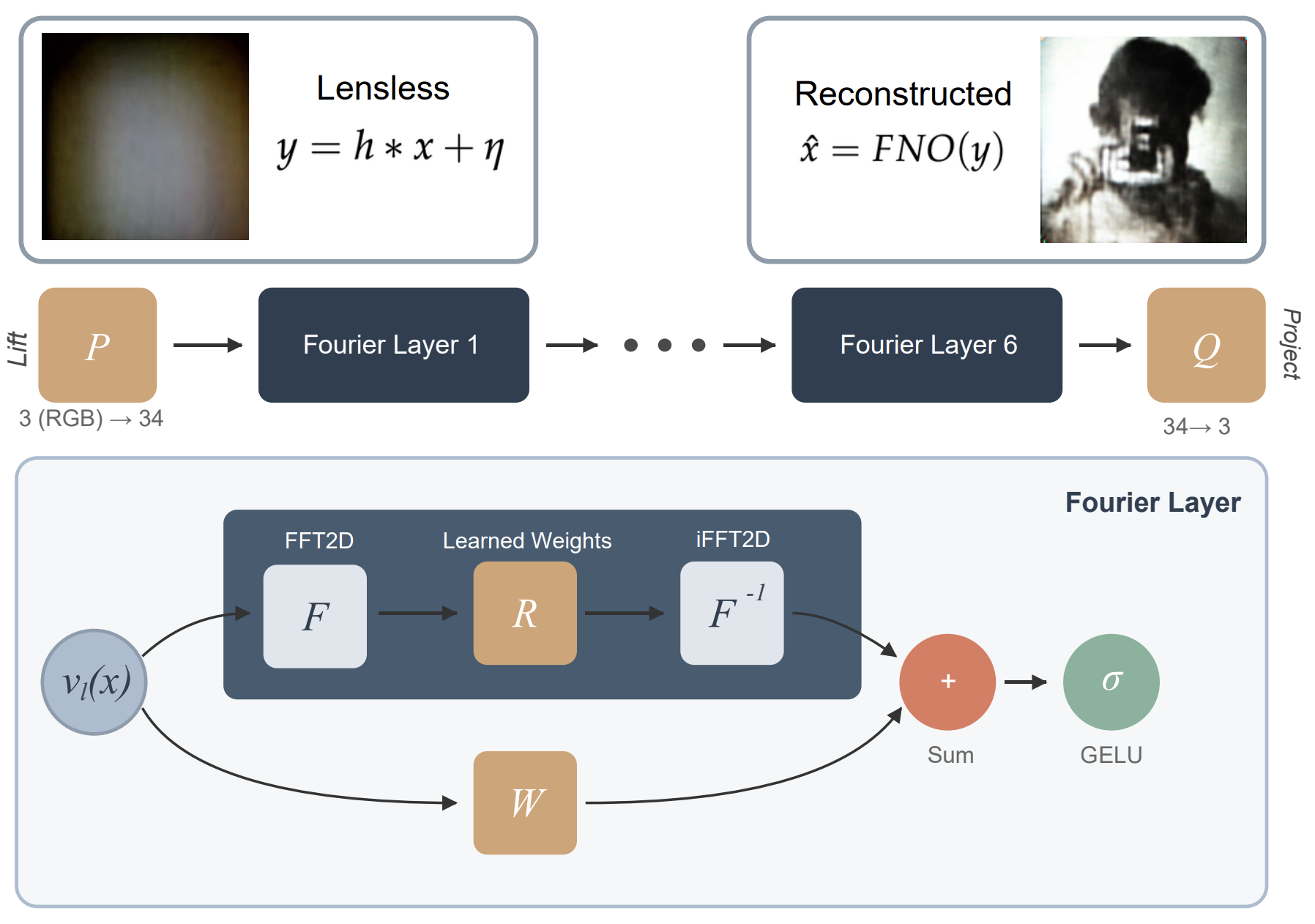
Figure 2: The FNO architecture, processing lensless measurements in Fourier space to capture global dependencies and maintain resolution agnosticism.
In the evaluated instance, the FNO retains 24×24 spectral modes, corresponding to the lowest 37% of the spectrum for 128×128 resolution. This mode selection is calibrated to match the network's parameter count with a baseline U-Net for equitable comparison.
Comparative Evaluation: FNO vs. U-Net
On the 128×128 test set, the FNO surpasses the U-Net baseline by a significant margin: achieving an average PSNR of 22.32 dB (+2.14 dB over U-Net) and an SSIM improvement of 0.11. Additionally, FNO converges more rapidly and with reduced GPU memory consumption.
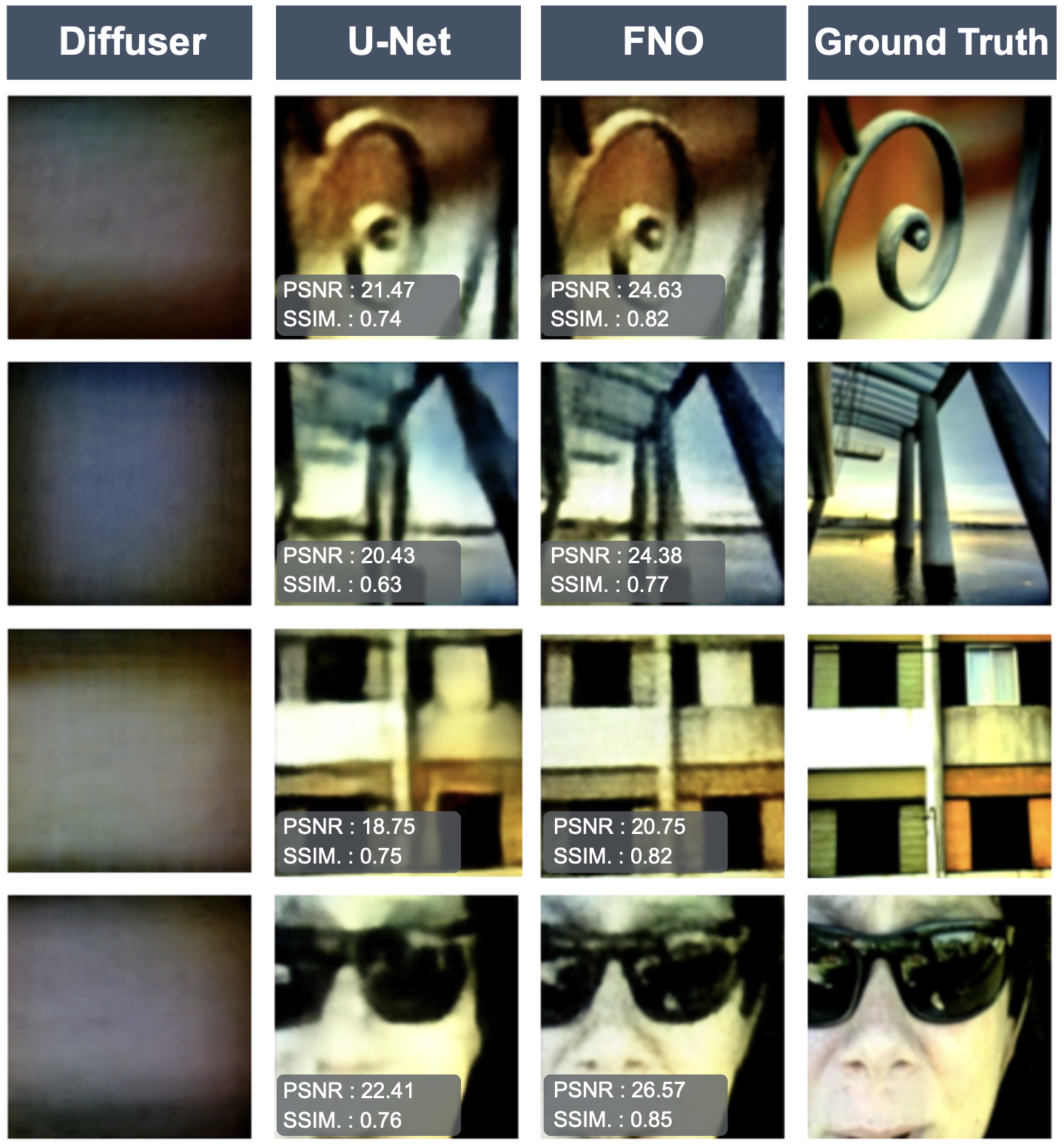
Figure 3: Representative reconstructions where FNO demonstrates consistent advantage in PSNR and SSIM over the U-Net for varying image complexities.
The advantage is attributed to the FNO's ability to globally invert the system's multiplexing PSF, in contrast to the U-Net which relies on increasingly broad receptive fields via local convolutions and skip connections. The experimental results rigorously demonstrate the superiority of operator-theoretic, spectral-domain architectures for lensless imaging governed by linear, shift-invariant global scattering.
Resolution-Agnostic Inference
A central claim is that FNOs, trained exclusively on 128×128 measurements, can natively accept and accurately process higher resolution (256×256 and 512×512) inputs without any architectural modification or retraining. Quantitative metrics indicate less than 1 dB degradation in PSNR (21.35 dB at 256×2560 vs. 22.32 dB at 256×2561), consistently preserving SSIM.
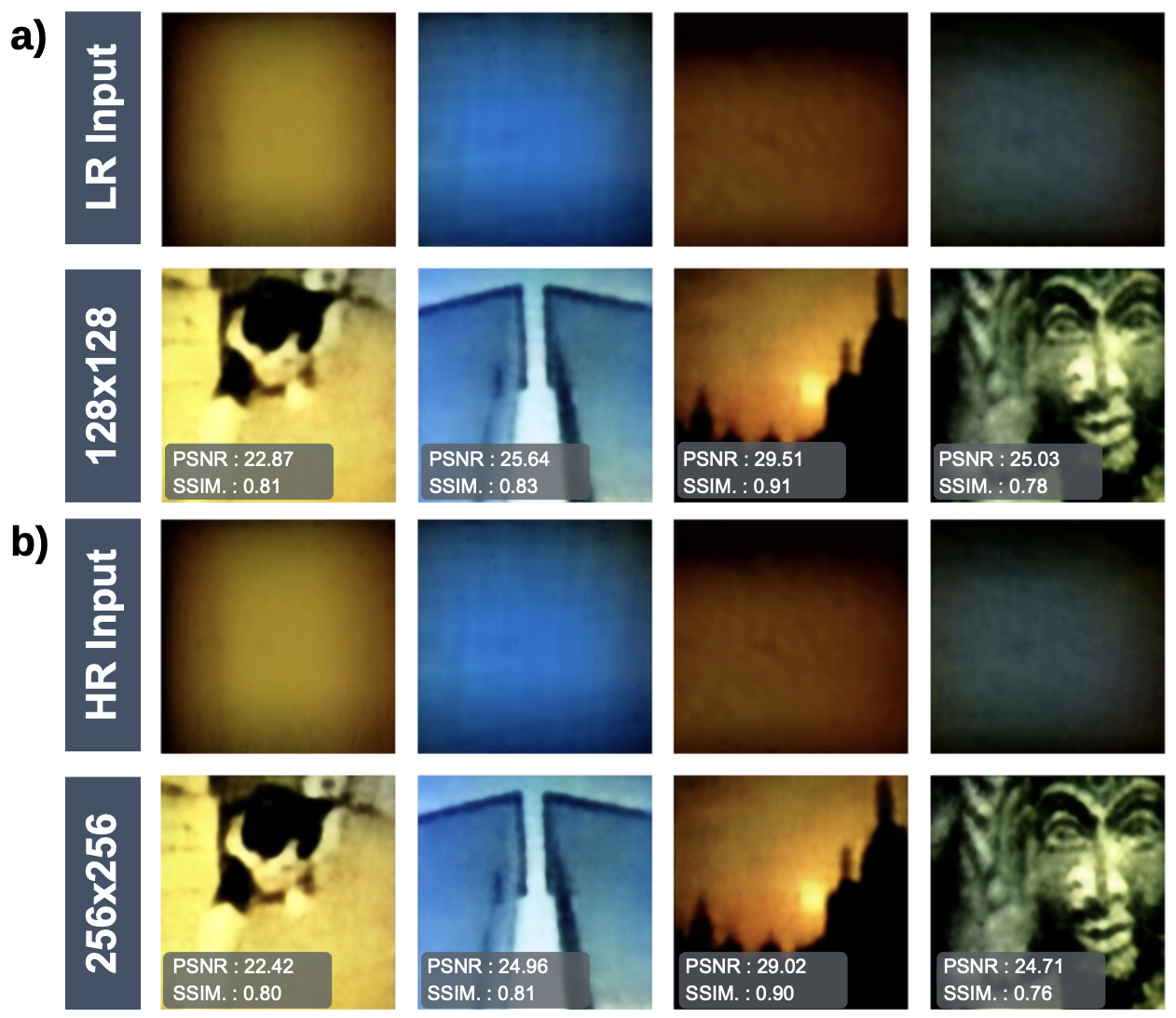
Figure 4: Demonstration of FNO generalization—model trained at 256×2562 infers on 256×2563 inputs without retraining, preserving reconstruction quality despite previously unseen spatial frequencies.
Resolution-agnostic generalization validates that neural operators learn mappings between function spaces rather than discrete arrays, encoding system physics so that sampling density can increase at inference time, unlike conventional CNNs. This property is theoretically underpinned by the alignment of the FNO layer’s action with the convolution theorem and spectral inversion of the PSF.
Broader Implications, Limitations, and Outlook
The success of the spectral-domain approach is not limited to the specific diffuser-based lensless configuration, but extends to any system where the forward operator is a global convolution (including computational microscopy through scattering, multimode-fiber endoscopy, and single-pixel cameras). For practical deployment, the efficiency and memory advantages are pronounced, especially for embedded or resource-constrained imaging devices.
However, the comparison is limited to a purely data-driven U-Net baseline. Hybrid model-based methods incorporating explicit PSF priors (e.g., FlatNet, Le-ADMM-Net) might provide further improvements but were not evaluated side-by-side. The current dataset is based on planar tablet images and may not fully reflect depth-encoded or more complex 3D scenes.
Future directions involve explicit physical PSF incorporation into the neural operator framework, comparison with advanced hybrid models, and comprehensive robustness studies under real-world 3D scenes and noise conditions.
Conclusion
This study demonstrates that Fourier Neural Operators, structurally aligned with the global, shift-invariant nature of lensless imaging PSFs, substantially improve the fidelity and flexibility of lensless image reconstruction. The FNO achieves strong numerical gains over CNN baselines and, critically, supports resolution-agnostic inference—an attribute unattainable by standard pixel-grid neural networks. These advances highlight the efficacy of operator-theoretic deep learning for inverse problems in computational imaging, setting a precedent for physics-aligned, resolution-flexible methodologies in the field.

