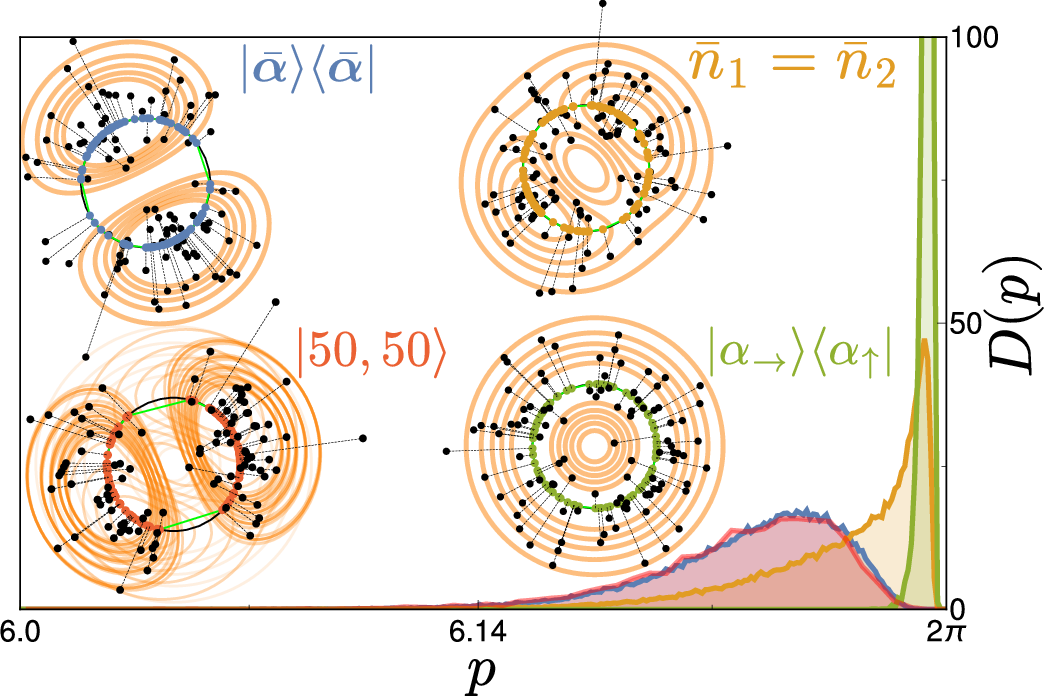
Boson correlations are spurious for classical states
Published 17 Apr 2026 in quant-ph, cond-mat.stat-mech, and physics.optics | (2604.16283v1)
Abstract: We show that boson correlations from quantum states with a Glauber-Sudarshan representation of their density matrix which provides a well-behaved probability distribution -- including coherent states, thermal states, and all states that can be deemed classical -- are a manifestation of the Simpson paradox: they are spurious correlations from statistical (ensemble) averages over uncorrelated measurements made in varying geometries, due to a process of symmetry-breaking as a confounding factor. Bosonic correlations encoded by the wavefunction appear to be formed in the geometry assumed, which however is not that of the statistical ensemble but varies from realization to realization. This calls to distinguish between quantum and statistical averages and sheds new understandings on the fundamental problems of nonclassicality and quantum advantage.
The paper demonstrates that multiphoton correlations in classical states arise from statistical averaging over fluctuating geometries rather than from quantum wavefunction symmetrization.
Monte Carlo simulations and analytical frameworks reveal that single-shot realizations lack intrinsic correlations, exposing a Simpson paradox in photonic measurements.
Results challenge the use of ensemble-averaged boson bunching as evidence for quantum advantage, prompting a re-evaluation of resource theories in photonic systems.
Boson Correlations in Classical States: The Simpson Paradox Manifested
Introduction
The paper "Boson correlations are spurious for classical states" (2604.16283) investigates the canonical interpretation of multiphoton correlations observed in bosonic quantum systems, challenging the prevailing attribution of such correlations to quantum indistinguishability and wavefunction symmetrization. Specifically, it is demonstrated that for quantum states admitting a positive-definite Glauber–Sudarshan P representation (i.e., coherent, thermal, and all classical states), observed bosonic correlations arise solely from statistically-averaged, uncorrelated measurements over ensembles subject to geometry fluctuations—a manifestation of the Simpson (or amalgamation) paradox—rather than from genuine quantum correlations.
Formal Foundations and Analytical Framework
The analysis is structured around spatial correlations between indistinguishable bosons occupying two-mode systems, with detailed focus on the LGp=0ℓ=±1 (Laguerre–Gaussian) vortex modes. The many-body wavefunction formalism encapsulates angular and radial decompositions, with systematic application of the reduced density matrix formalism—integrating the angular wavefunction Θ(N)(θ1,...,θN) and the product radial profile R(r1)...R(rN).
Coherent and thermal states are treated using the Glauber–Sudarshan P representation. For states with positive-definite P, the N-particle reduced density matrix is shown to be an ensemble average over shared geometrical configurations (originating from symmetry breaking), within which particles are sampled independently:
ρ(N)(r1,...,rN)=∫dαQN(α)j=1∏Nρα(1)(rj)
where QN(α) incorporates the statistical weighting of each geometry, and ρα(1) denotes the one-body conditional probability given the sampled geometry.
Single-Shot and Ensemble Correlations: Simpson’s Paradox in Quantum Optics
Monte Carlo Illustrations
Monte Carlo simulations elucidate the absence of intrinsic correlations within single realizations of classical (thermal, coherent, and random-phase coherent) states. Each single-shot realization samples a different geometry, but all particles in that shot are uncorrelated within the underlying geometry.
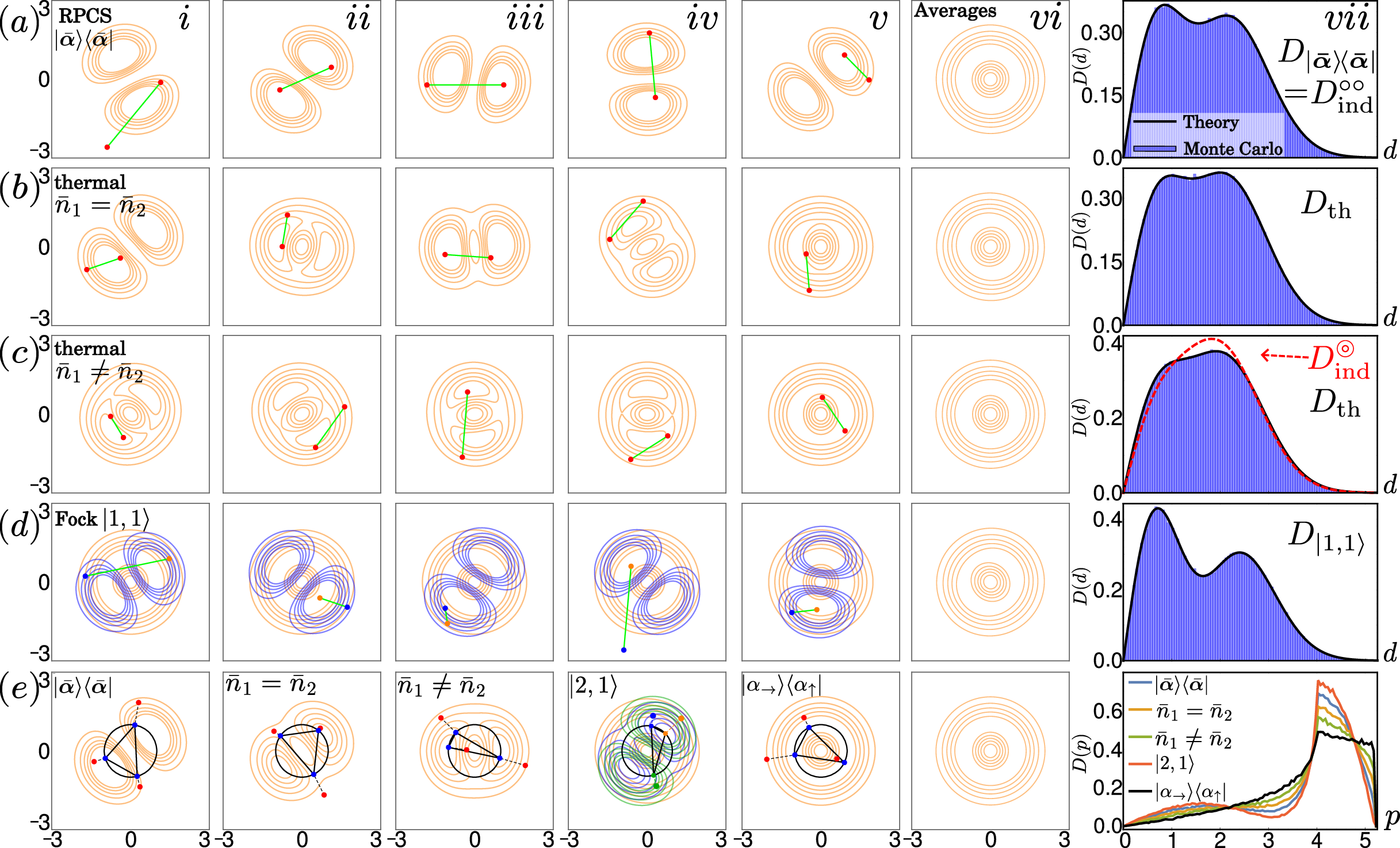
Figure 1: Monte Carlo visualization of two-boson spatial samplings for classical (RPCS, thermal) and quantum (Fock) states, showing that only the Fock case enforces genuine correlations between sampling positions.
Column vi (in the referenced figure) shows that when measurement outcomes from different realizations are aggregated, the overall spatial pattern (the “donut”) appears identical for all classical states. However, the spurious correlations observed in aggregated data do not reflect quantum entanglement or bosonic exchange symmetry but are an artifact arising from neglecting the shot-to-shot geometric variability—a textbook instance of the Simpson paradox.
Pairwise Distance Distributions
Distance distributions between particle pairs p=0ℓ=±10 capture the imprint of true versus spurious correlations. Analytical expressions show that for independent samplings from a fixed geometry, the pairwise distance distribution is unimodal, whereas Fock states imprint true quantum correlations yielding bimodality.
The key observation is that for classical states, computed or experimentally observed bunching is entirely an artifact of the averaging over fluctuating geometries rather than quantum statistics.
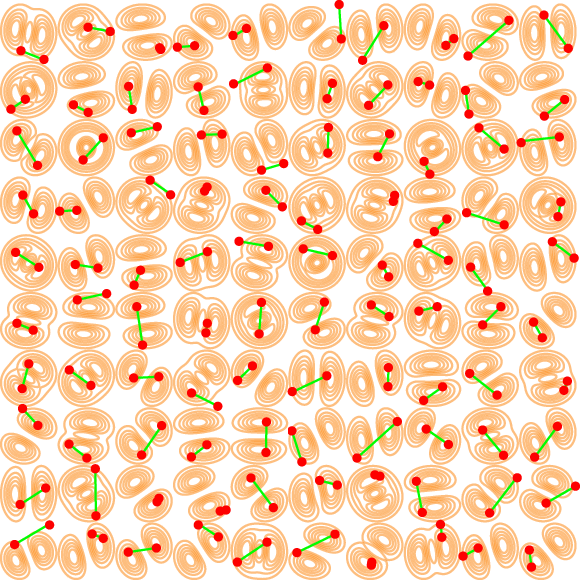
Figure 2: p=0ℓ=±11 grid of balanced thermal state single-shot samplings: sampled positions are independent within each geometry, but aggregated over many shots, the distance distribution mimics boson bunching due to the amalgamation paradox.
Extension to Higher-Order and Multi-Mode Observables
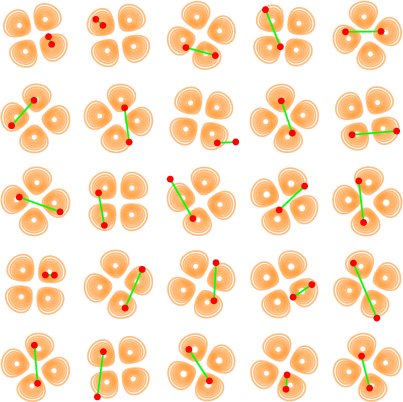
The framework generalizes beyond p=0ℓ=±12 vortices to arbitrary angular momentum, multi-dipole, or mixed-mode settings. For higher multipoles (e.g., LGp=0ℓ=±13), single-shot simulations and calculated distance distributions mirror the qualitative phenomenology established for the dipolar case.
Figure 3: Example single-shot samplings for RPCS in the quadrupolar (p=0ℓ=±14) vortex basis, highlighting geometry variability and independence of sampled positions.
Non-polar symmetric basis sets—e.g., combinations of LGp=0ℓ=±15 and LGp=0ℓ=±16—preserve the fundamental mechanism: spurious correlations emerge in the ensemble, but no state-imposed correlation exists at the level of individual realizations.
Contrasts with Genuine Quantum Correlations
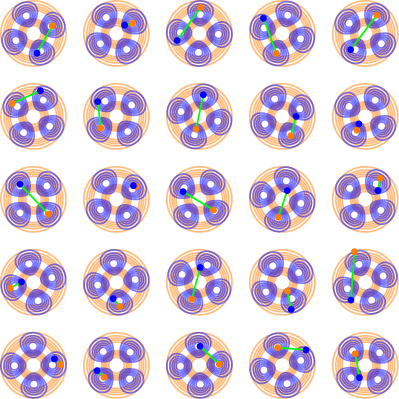
For states lacking a classical probability interpretation (i.e., a non-positive or highly singular p=0ℓ=±17), such as Fock and squeezed states, the sampling protocol inherently introduces dependencies; after the first particle’s position is fixed, the geometry for subsequent particles conditionalizes on those results, imbuing the observable statistics with authentic, irreducible quantum correlations.
As demonstrated, the two-photon Fock state samples the second detection from a geometry pinned by the first, manifesting quantum non-separability not reducible to independent random variables and absent in classical mixtures.
Figure 4: Grid display of Fock state (p=0ℓ=±18) single-shot patterns in the quadrupolar basis, exhibiting intrinsic cross-sample dependencies.
Implications and Theoretical Consequences
Quantum Advantage and Resource Theories
The findings have critical implications for fundamental questions regarding quantum advantage and resource identification. Multiphoton correlational structures observed in ensemble measurements of thermal or classical states cannot serve as evidence for quantum advantage. Quantum coherence as a resource is shown to have minimal operational meaning in this context; states with fixed global phase (e.g., coherent states) are the most classical, giving rise to fully factorizable observables.
Recent works attempting to ascribe resource status to coherence and fixed phase in coherent states must be carefully examined under this insight, as the present work indicates that these features are precisely those that eliminate quantum correlations.
Quantum-to-Classical Transition
The convergence of Fock state high-order correlation statistics to those of random-phase classical states as the particle number increases provides a precise operational picture of the quantum-classical boundary, linked to the stabilization of statistical geometry in the thermodynamic limit.
Figure 5: High-multiphoton limit: for large particle number, single-shot realizations reveal the underlying geometry, illustrating how quantum (Fock) and classical (RPCS) states converge in statistical properties as p=0ℓ=±19 grows.
Photonic Quantum Computing and Measurement Problem
The realization that ensemble-averaged bunching phenomena in, e.g., Hanbury Brown–Twiss and related multi-moded setups, are statistical artifacts challenges interpretations of quantum photonics experiments. For instance, the computational resource separation between using classical (RPCS, thermal) versus genuinely quantum states (Fock, squeezed) in nonlinear photonic devices (e.g., photonic Ising machines) is clarified—statistical geometry averaging cannot substitute for true quantum resource generation.
Future Directions
The presented framework motivates several avenues for further inquiry, including:
Experimental protocols that can distinguish between ensemble-induced spurious correlations and authentic quantum correlations in noisy photonic devices.
Theoretical refinement of resource theories, particularly coherence, in the context of nonclassicality and quantum criticality assessment.
Formulation and experimental tests of quantum advantage benchmarks that are immune to the statistical artifacts identified herein.
Conclusion
The analysis in "Boson correlations are spurious for classical states" provides a rigorous refutation of the notion that observed boson correlations in classical (positive-Θ(N)(θ1,...,θN)0) states have quantum mechanical origin. Such correlations are revealed as artifacts of non-commuting statistical and quantum averages in the presence of symmetry-broken geometric variability—an explicit quantum optical manifestation of the Simpson paradox. Only quantum states lacking a well-behaved Θ(N)(θ1,...,θN)1 admit genuine, measurement-level correlations with potential utility for quantum information processing. These results compel a careful re-examination of the operational meaning of boson bunching, coherence, and quantum advantage in photonic systems, emphasizing the necessity for state-dependent protocols in identifying genuinely quantum phenomena.