Magnetic switchback formation: a review of proposed mechanisms
Published 17 Apr 2026 in astro-ph.SR, physics.plasm-ph, and physics.space-ph | (2604.16166v1)
Abstract: Magnetic switchbacks are large amplitude deflections of the magnetic field within the solar wind. They are Alfvénic in character and so are associated with a spike in velocity and a generally small variation in local plasma density. Early orbits of Parker Solar Probe revealed that the solar wind near the Sun is dominated by these structures, and therefore, they may be playing an important role in the energy budget and acceleration of the young solar wind. In this review, we present an overview of different mechanisms that have been proposed for how switchbacks could be formed. We group the mechanisms by whether they predominantly act in the low solar atmosphere or within the solar wind (in situ). We focus on mechanisms that can create reversals of the ambient magnetic field direction and, thus, account for the most extreme perturbations. The general consensus is that mechanisms in the lower solar atmosphere do not form such reversals on their own but provide the seed perturbations, flows, or particle beams necessary for in situ mechanisms to create switchbacks within the solar wind. Switchback observations thus likely contain an imprint of the coronal source of the seed perturbation or flow, which is evolved further locally by one of several plausible in situ mechanisms. We discuss the strengths and weaknesses of each mechanism and outline future observational and theoretical tests that could help differentiate between them.
The paper reviews mechanisms for switchback formation, emphasizing both low-coronal origins and in situ evolution.
It details how expansion-driven Alfvén wave growth and velocity shear instabilities can produce sharp magnetic field reversals.
The study critically compares simulation results with PSP observations to outline future research directions in solar wind dynamics.
Magnetic Switchback Formation: Mechanisms and Implications
Introduction
Magnetic switchbacks—large-amplitude, Alfvénic magnetic field perturbations observed in the solar wind—are a focus of heliophysics after their prevalence was revealed by Parker Solar Probe (PSP) at distances ≲0.2 AU from the Sun. These structures are characterized by sharp (often >90∘) deflections in the radial field component, high magnetic–velocity correlation, approximately constant ∣B∣, and negligible local plasma density change. The review "Magnetic switchback formation: a review of proposed mechanisms" (2604.16166) provides a comprehensive, critical synthesis of mechanisms proposed for switchback formation, categorized by whether they act primarily in the low solar atmosphere/corona or are in situ processes in the solar wind.
This summary delineates the primary mechanisms, their supporting evidence, limitations, and the current theoretical and observational landscape. The discussion emphasizes the interplay between solar sources and in situ evolution, the implications for solar wind acceleration and turbulence, and outlines directions for future research.
Switchback Properties and Observational Constraints
Switchbacks are defined in this treatment as radial magnetic field deflections >90∘ accompanied by correlated velocity enhancements, generally incompressible (∣B∣ nearly constant), and observed with a patchy, clustered structure. PSP observations indicate fewer such switchbacks within the sub-Alfvénic wind close to the Sun, implying that mechanisms operating primarily at or beyond the Alfvén critical zone are essential for robust reversals. These constraints strongly guide the plausibility of candidate mechanisms.
Mechanisms in the Lower Solar Atmosphere and Corona
Convective and Vortical Motions
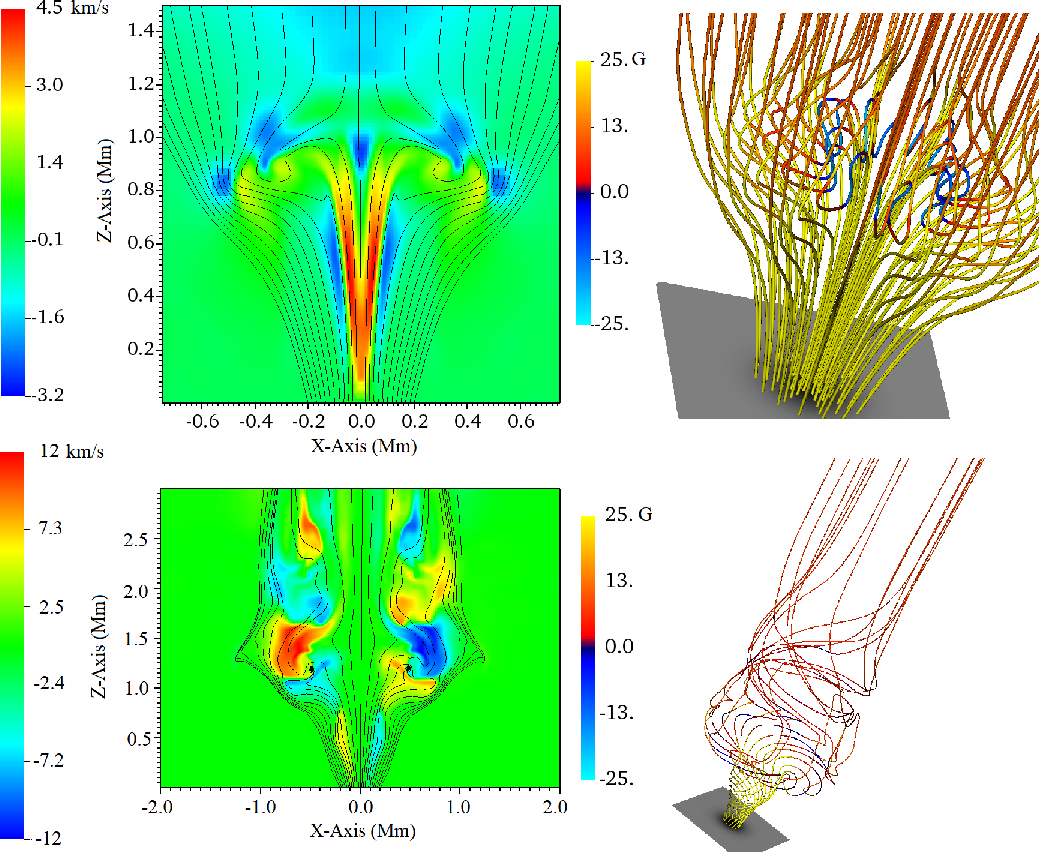
Photospheric convection and vortex flows drive upward-propagating Alfvén waves and torsional motions within chromospheric and coronal flux tubes.
Figure 1: Dynamics at the base of a solar atmospheric flux tube showing magnetic fold formation via strong upflows (top) and vortex flows (bottom).
These can cause significant magnetic deflections and local field folds, but numerical simulations consistently show that only small deflections survive traversal from the chromosphere into the corona, due to rapid expansion and enhanced Alfvén speed.
Magnetic Carpet Turbulence and Component Reconnection
Buffeting at the lower boundary excites quasi-2D turbulence and transverse fluctuations, sustained and amplified in open-field coronal regions mainly through counter-propagating Alfvén waves and component reconnection. However, these produce primarily transverse perturbations and do not generate field reversals of sufficient amplitude to explain switchbacks independently.
Interchange Reconnection
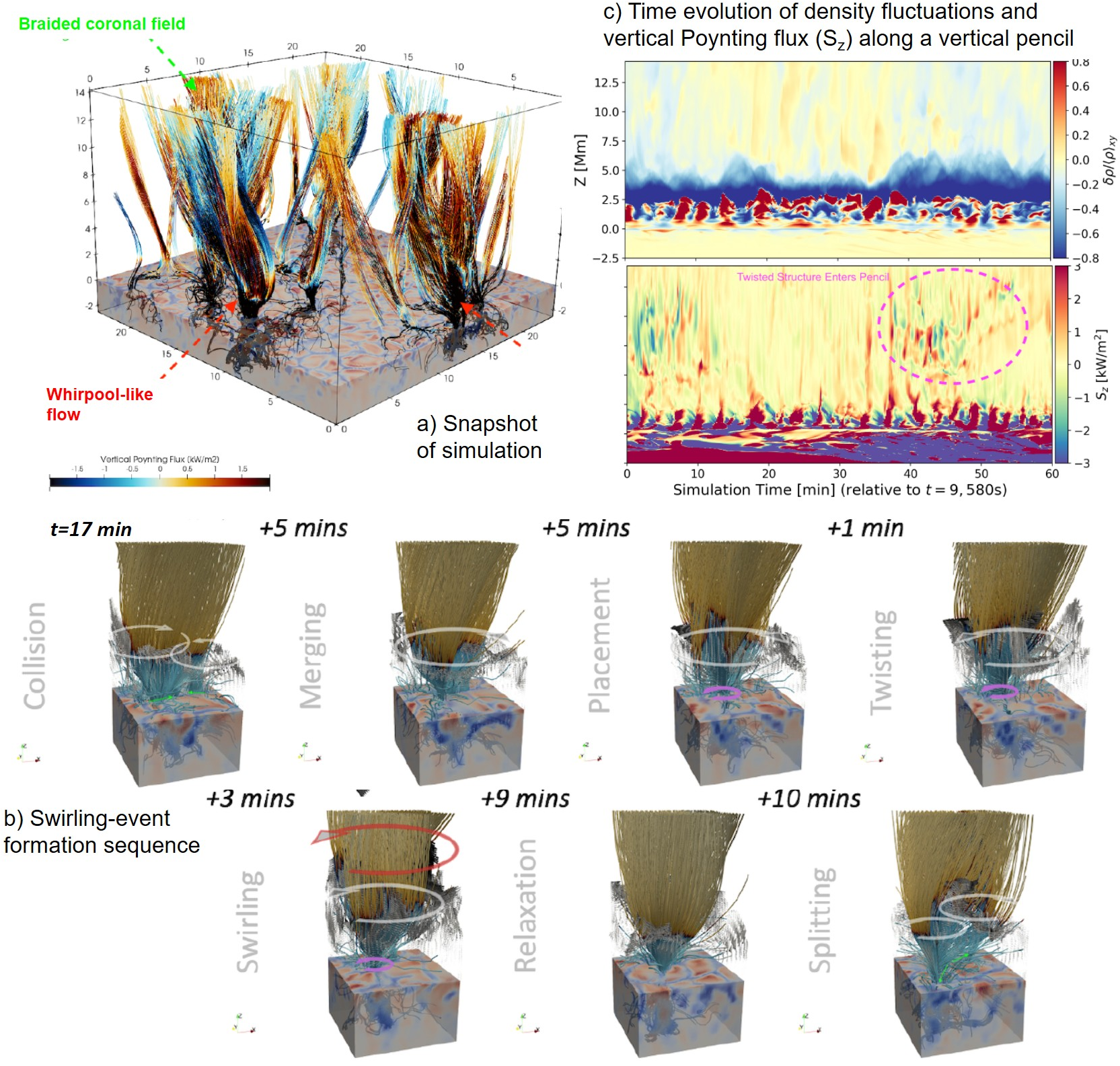
Interchange reconnection at coronal nulls—between open and closed regions, such as coronal bright points—injects jet-like flows and torsional Alfvén waves into open magnetic flux tubes.
Figure 2: Twisting and torsional Alfvén wave formation by photospheric flows and reconnection, visualizing braided coronal structures and merging-induced swirling events.
Simulations show that, while interchange reconnection can create bursts of wave and flow patches consistent with microstream patches and some aspects of switchback patchiness, direct creation of field reversals (Br sign-change) is suppressed: U-loops and field kinks are rapidly erased by wave propagation and alignment. Detailed simulations demonstrate that plasmoid ejection in 3D null-point configurations launches spherically polarized torsional Alfvén wave pulses but not persistent switchbacks.
Jet-Like Events and Untwisting Waves
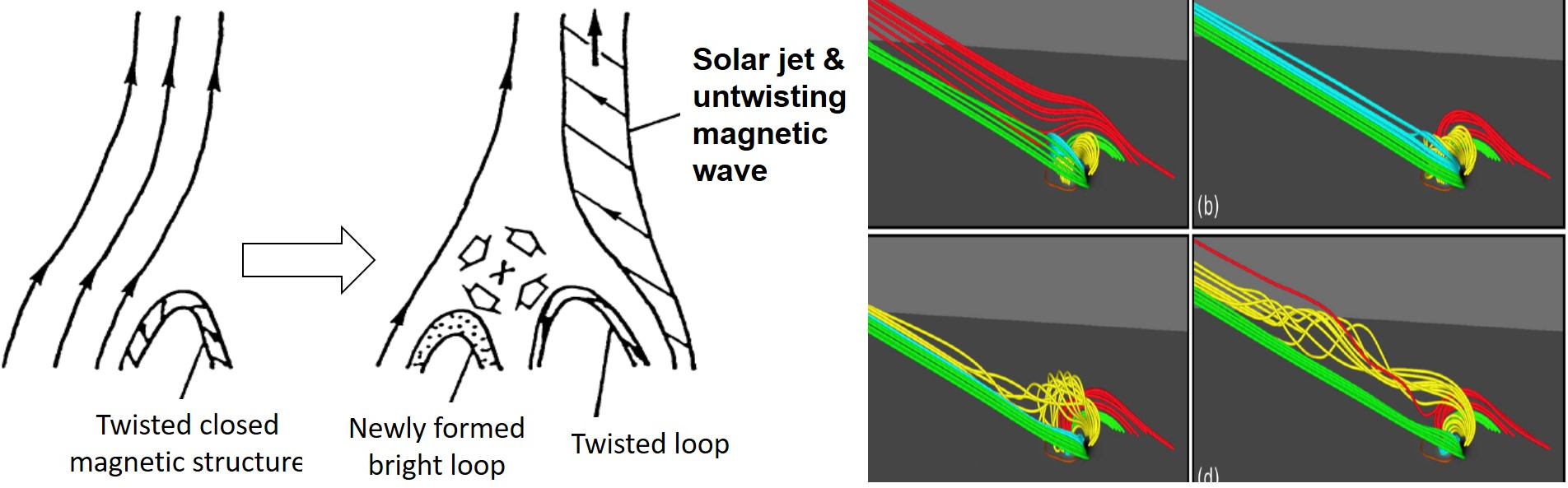
Impulsive jets (including jetlets) with magnetic helicity induce untwisting torsional Alfvén waves upon reconnection with open fields.
Figure 4: Cartoon and simulation snapshot of the untwisting magnetic wave mechanism where release of twist leads to upward propagating nonlinear Alfvénic waves.
Simulations show these wavefronts can propagate several solar radii and contribute to Alfvénic switchback-like deflections in the wind, but the strong Lorentz force in the low-β corona suppresses field reversals; switchbacks are not sustained through propagation.
In Situ Mechanisms in the Solar Wind
Expansion-Driven Alfvén Wave Growth
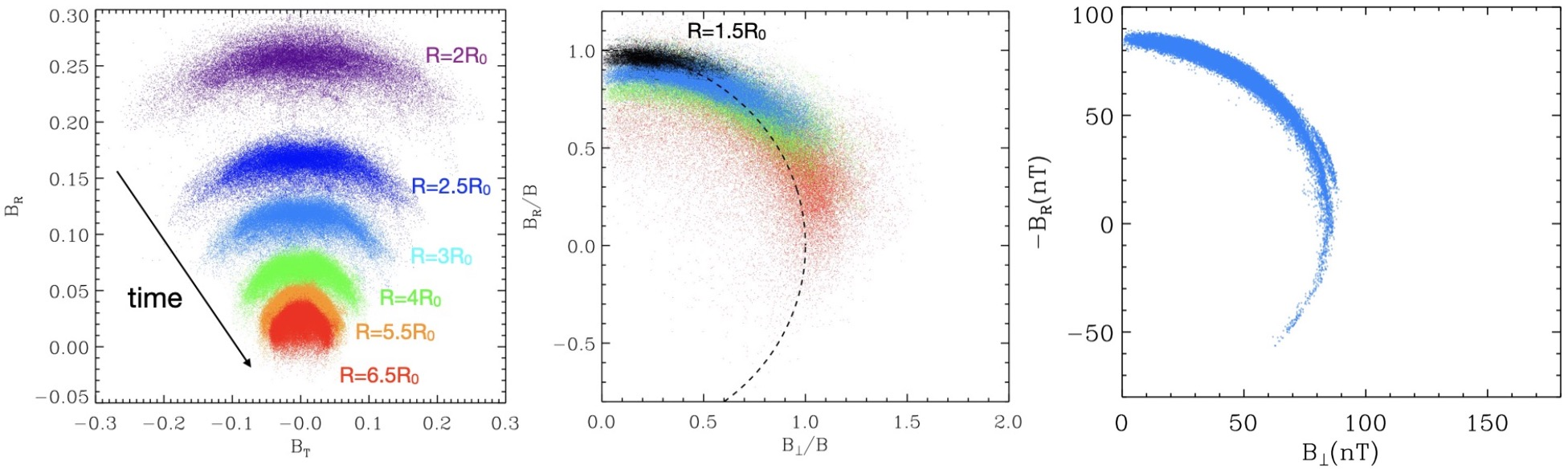
The amplitude of outbound Alfvénic fluctuations grows with decreasing background Alfvén speed in the expanding solar wind (the WKB effect). For sufficiently anisotropic and spherically polarized initial disturbances, this growth leads to ∣δB∣∼B0 and parallel components exceeding the background, forming true field reversals (switchbacks).
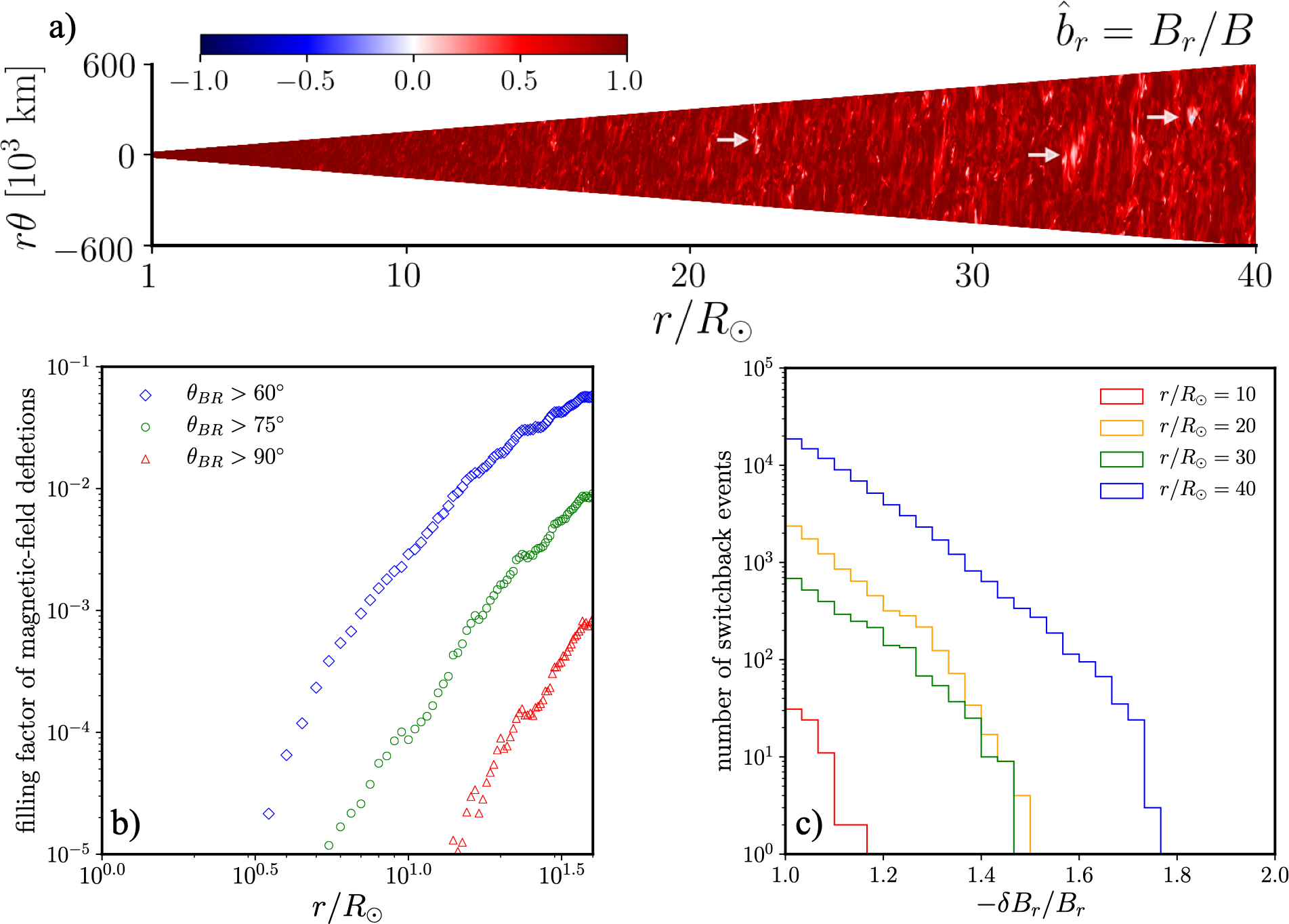
Figure 6: 3D turbulence simulation in the expanding box model showing emergence of constant-∣B∣ switchback structures via expansion-driven amplitude growth.
Figure 8: Radially extended 3D flux tube simulation showing increased filling fraction of strong field deflections (switchbacks) with heliocentric distance.
Hybrid-kinetic and MHD simulations substantiate this process as a robust mechanism provided seed fluctuations are of sufficient amplitude and anisotropy near the coronal base. The fraction of reversed-field volume in simulations is sensitive to initial conditions; while model switchback abundance sometimes under-predicts PSP measurements, inclusion of higher-amplitude or impulsive seeds (e.g., from reconnection or jets) raises correspondence.
Figure 10: Spherical polarization evolution in hybrid simulations, with PSP data showing convergence toward spherical polarization at larger radii.
Velocity Shear and the Kelvin-Helmholtz Instability
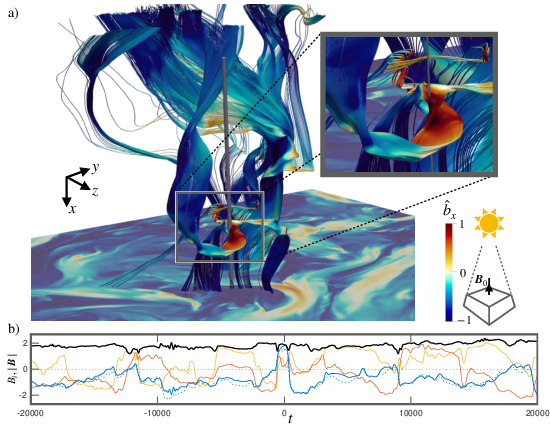
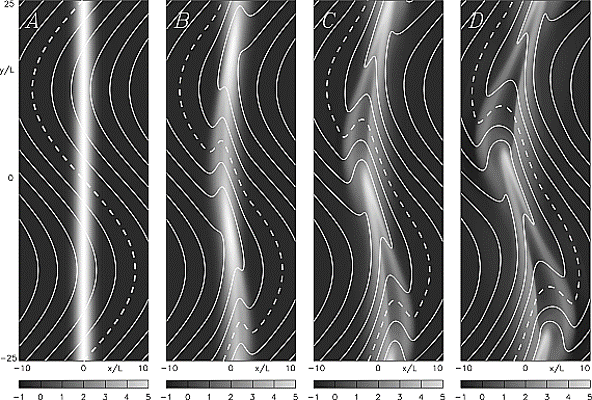
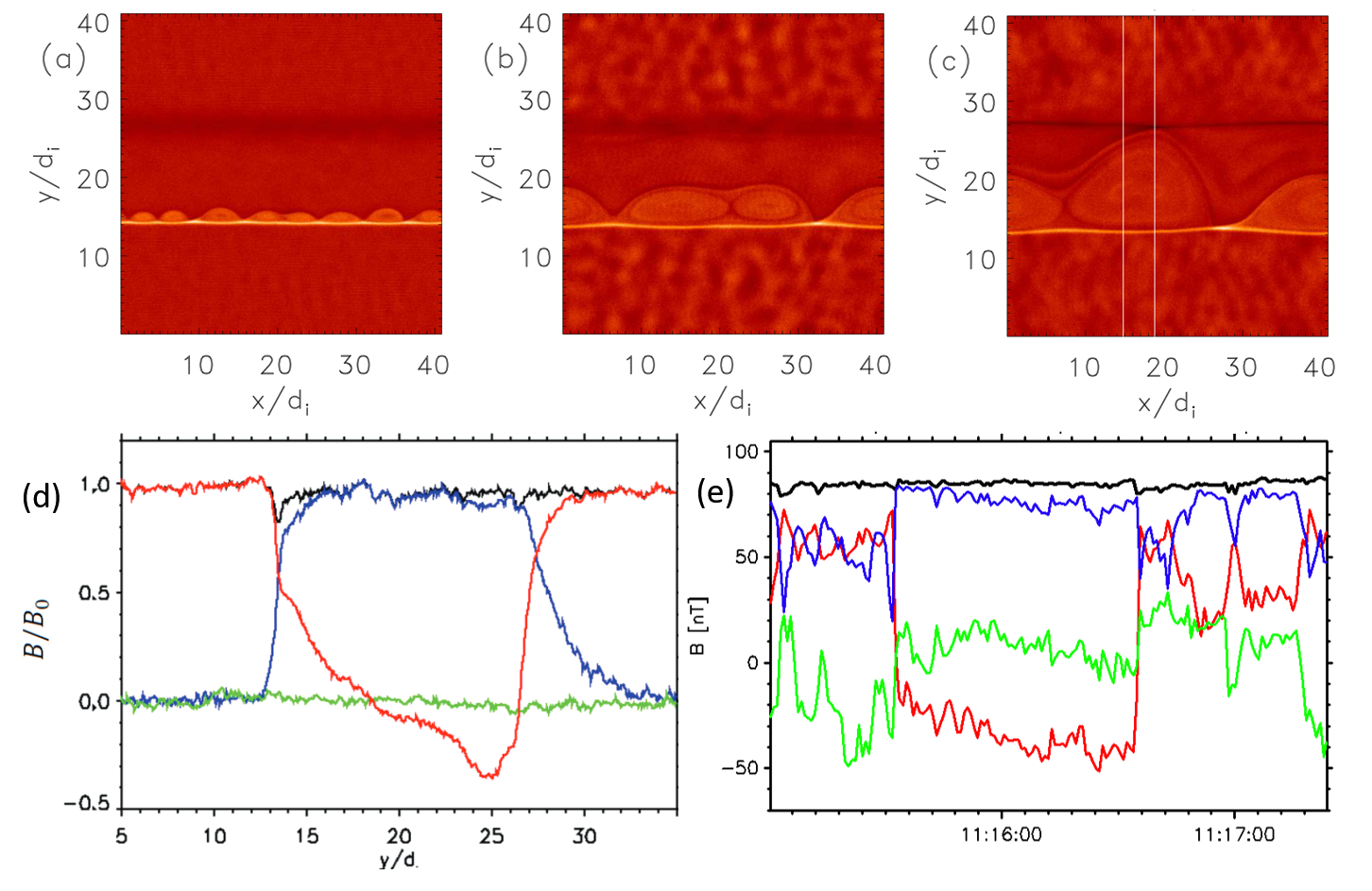
Velocity shear, generated either by adjacent fast/slow streams or via dynamic outflows seeded at lower altitudes, can fold the magnetic field and generate field reversals. The Kelvin-Helmholtz instability (KHI) is particularly relevant in super-Alfvénic regions, where magnetic tension no longer suppresses shear-driven evolutions.
Figure 12: 2D MHD simulation demonstrating switchback formation via rolling-up of field lines through a plasma jet-induced velocity shear.
Observationally, the transition from striated to flocculated density structures in the outer corona (by remote imaging) and the prevalence of switchbacks just beyond the Alfvén point support the action of post-coronal instabilities, with KHI and turbulent mixing layers producing elongated, complex switchbacks.
Magnetic Field Distortion by Stream Shear
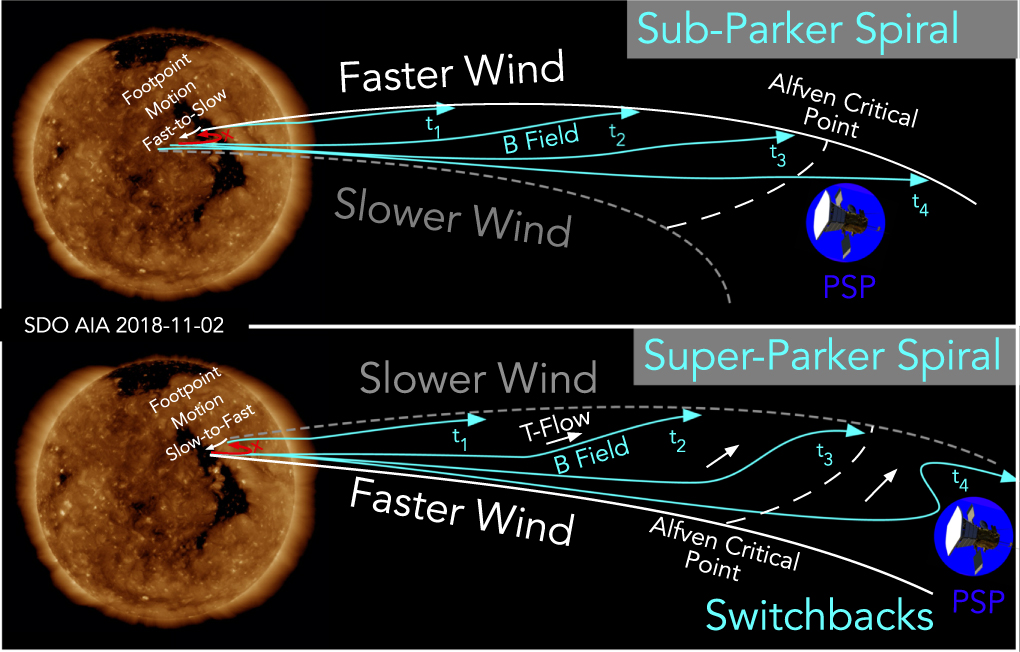
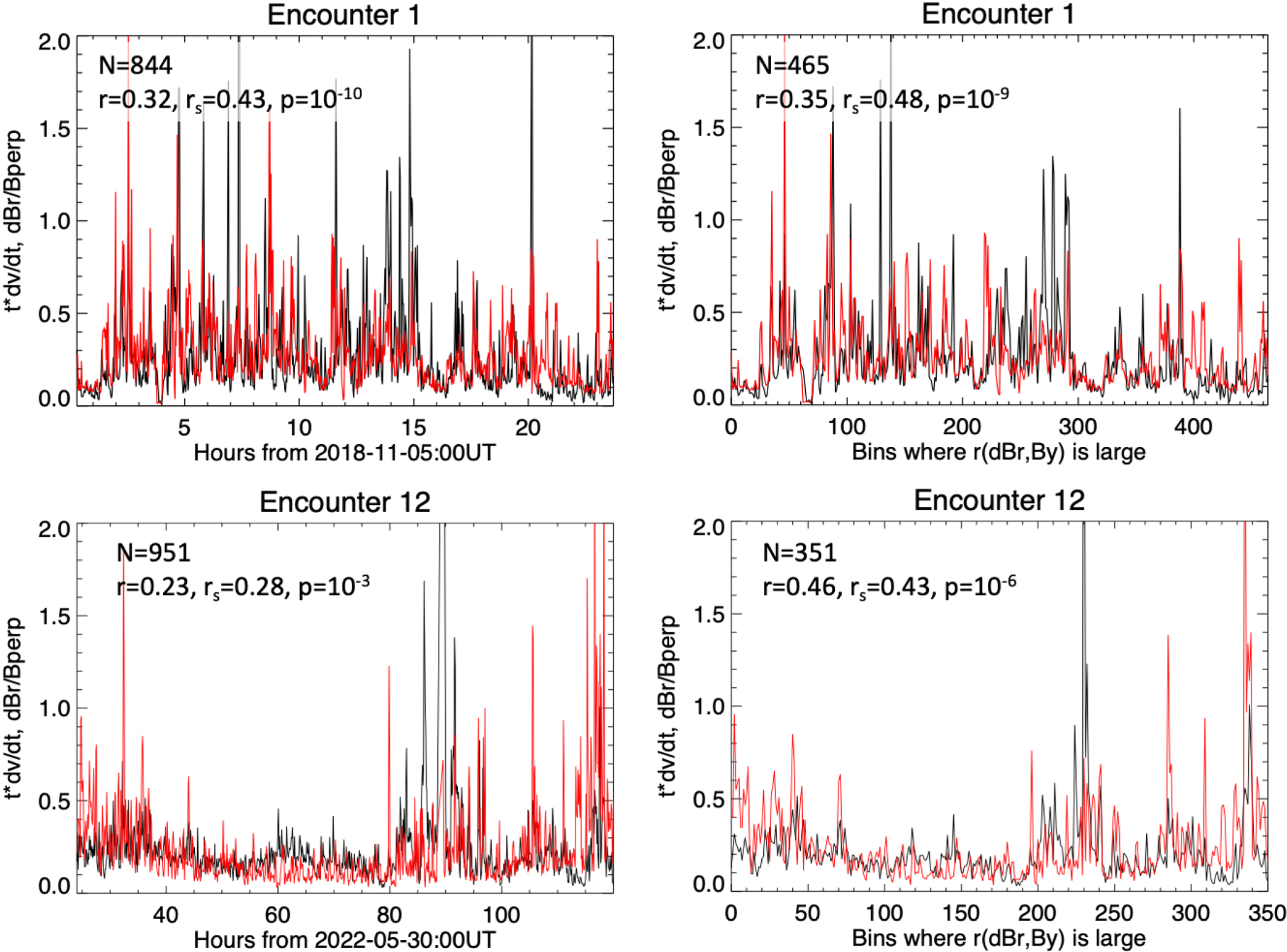
Transverse velocity gradients distort Alfvénic fluctuations and background fields, twisting and rolling up field lines into switchback configurations. This is supported both by analytic solutions and by MHD simulations with imposed shear profiles, and is consistent with correlations in PSP data between magnetic field deflections and predicted velocity shear signatures.
Figure 3: Sub-Parker and super-Parker spiral schematic, showing how footpoint-driven transverse flows produce distorted field lines and super-Parker field reversals.
Compressive Wave Growth and Nonlinear Fast Modes
Interchange reconnection in the mid-to-upper corona or pseudo-/helmet streamer regions can also launch compressive, fast-magnetosonic modes that, via WKB growth, may become large-amplitude perturbations resembling field reversals at several tens of solar radii. These, however, tend to be compressive and do not typically maintain constant ∣B∣, rendering them a subdominant candidate for the majority of Alfvénic, incompressible switchbacks.
Flux Rope Merging
Small-scale flux ropes, formed by reconnection or KHI-induced turbulence, may merge and elongate in the outflowing wind, evolving from wrapped (magnetic island) topology to dominantly axial field with reversals—consistent with observational features of some switchbacks.
Figure 15: Time-series snapshots from PIC simulations showing the merging and elongation of flux ropes into switchback-like structures.
The relevance of this mechanism is sensitive to the ubiquity and spatial distribution of seed flux ropes and their subsequent dynamics.
Numerical, Observational, and Theoretical Synthesis
The ensemble of existing mechanisms suggests that although low-coronal dynamics (jetlets, interchange reconnection, convective driving) set the initial fluctuation and flow landscape, direct survival of field reversals from low altitudes into the observed PSP domain is highly unlikely. Instead, in situ evolution—via expansion, turbulence, shear, and nonlinear instabilities—transforms seed perturbations into switchbacks with the observed properties.
Numerical and hybrid-kinetic simulations reproduce many but not all details of switchback morphology and abundance, indicating that further work is needed for quantitative reconciliation. Notably, simulations highlight the requirement for seed fluctuations to be both adequately strong and anisotropic at the coronal base and show that processes like stream shear and KHI, commonly observed in 3D MHD settings, can yield sharp reversals and complex patch structures.
Future Directions and Implications
The review underscores that no single mechanism is sufficient; combinations of solar and in situ processes are required to explain the spectrum of observed switchback properties. Theoretical models must account for the interplay of initial fluctuation amplitude, anisotropy, and local wind conditions, as well as kinetic-scale processes that may shape the boundaries and energetics of switchbacks. Observational programs, leveraging upcoming PSP epochs, must test predictions on radial dependence, patch scales, degree of Alfvénicity, compositional signatures, and three-dimensional structure.
Figure 17: PSP observations correlating radial magnetic field perturbations with transverse velocity shear predictors, in alignment with predictions from shear-driven models.
The prevalence of switchbacks in the young solar wind links their dynamical role to fundamental questions in solar wind acceleration, heating, and the nature of turbulence onset. Whether they contribute significantly to energy partition or particle acceleration remains an open research direction. Theoretical frameworks describing switchback formation and evolution will inform not only heliospheric plasma physics but also the broader understanding of astrophysical turbulence in expanding, magnetized environments.
Conclusion
This review establishes that switchback formation is a multistage process: seed Alfvénic or compressive fluctuations, injected in the solar lower atmosphere and corona via jetlets, reconnection, or convective driving, are transformed primarily through expansion-driven amplitude growth, nonlinear turbulence, velocity shear instabilities, and possibly flux rope merging into switchbacks with properties matching those observed by PSP (2604.16166). Limitations of direct coronal origins are empirically and numerically supported—field reversals are rarely injected intact into the super-Alfvénic wind, and in situ transformation is required. Continued theoretical, numerical, and PSP-driven observational effort is essential to resolve the dominant pathways, constrain their relative prevalence, and illuminate their contribution to solar wind dynamics.