- The paper presents clear evidence that multiple Fe Kα components originate from distinct AGN regions (BLR and torus) with a concave emissivity profile.
- It employs high-resolution microcalorimeter spectroscopy and advanced multi-zone modeling to constrain accretion disk structure and ionized wind properties.
- The study reveals multi-phase, ultra-fast outflows and warm absorbers, advancing our understanding of AGN feedback and dust-driven wind scenarios.
XRISM/Resolve Observations of NGC 4151: Accretion Structure, Emission and Feedback
Observational Overview and Data Reduction
The paper presents a comprehensive analysis of the 0.9~Megasecond XRISM/Resolve summed spectrum of NGC 4151, spanning 14 exposures and almost 900~ks total exposure. The observation sequence includes epochs with both random and regular cadence, enhancing sensitivity to persistent features and sampling the spectral variability in the central AGN.
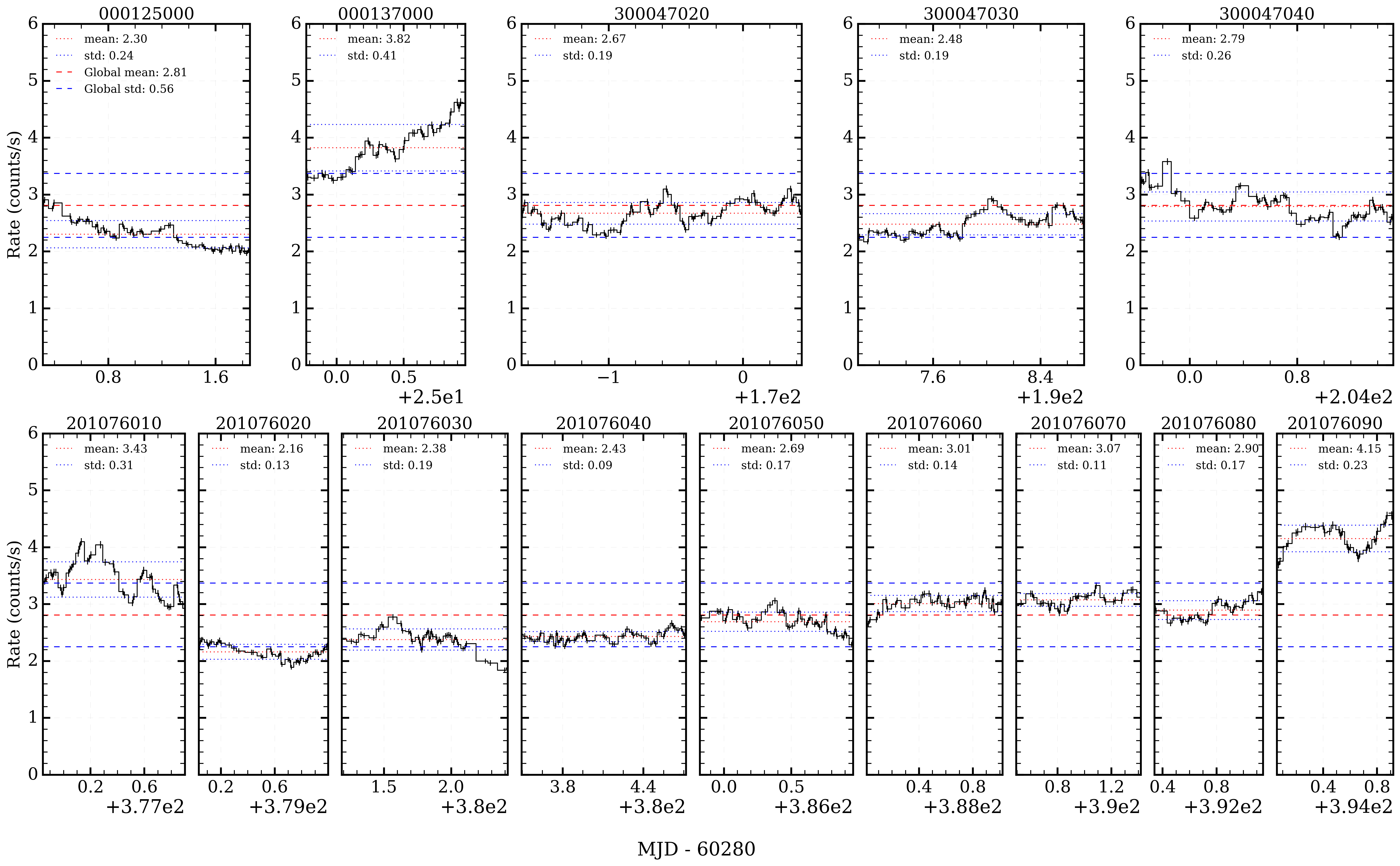
Figure 1: Light curves for the 14 XRISM/Resolve exposures of NGC 4151, covering the 2.2–17.4~keV band with 1024~s bins.
In spectral analysis, the approach leverages high-resolution microcalorimeter data, optimal binning algorithms, and advanced multi-zone modeling frameworks for both continuum and discrete emission/absorption components—distinctly emphasizing photoionized plasma and radiative transfer kernels tailored for AGN environments.
Fe Kα Emission: Accretion Geometry and Compton Scattering
A primary numerical result is the unambiguous requirement of multiple Fe~Kα line components associated with both the broad line region (BLR) and the molecular torus. The preferred emissivity profile (q=2) deviates from canonical flat-disk expectations (q=3), strongly suggesting a concave ("bowl") geometry. The BLR and torus inner radii are robustly constrained: rBLR=1.9−0.5+1.3×10³ GM/c2 and rtor=2.8−1.0+2.0×10³ GM/c2; the data do not require additional intermediate emission (r∼100 GM/c2) as previously inferred. The inclination measures (θtorus=9±1∘, $\theta_{BLR}=48^{+38}_{-9}^\circ$) also reinforce vertical structure sensitivity.
A smooth red shoulder underlying the Fe~Kα line wings is attributed to Compton scattering in a medium with bound electrons, likely dusty, rather than relativistically broadened emission. The column densities (α0, α1) render these regions nearly optically thick in X-rays.
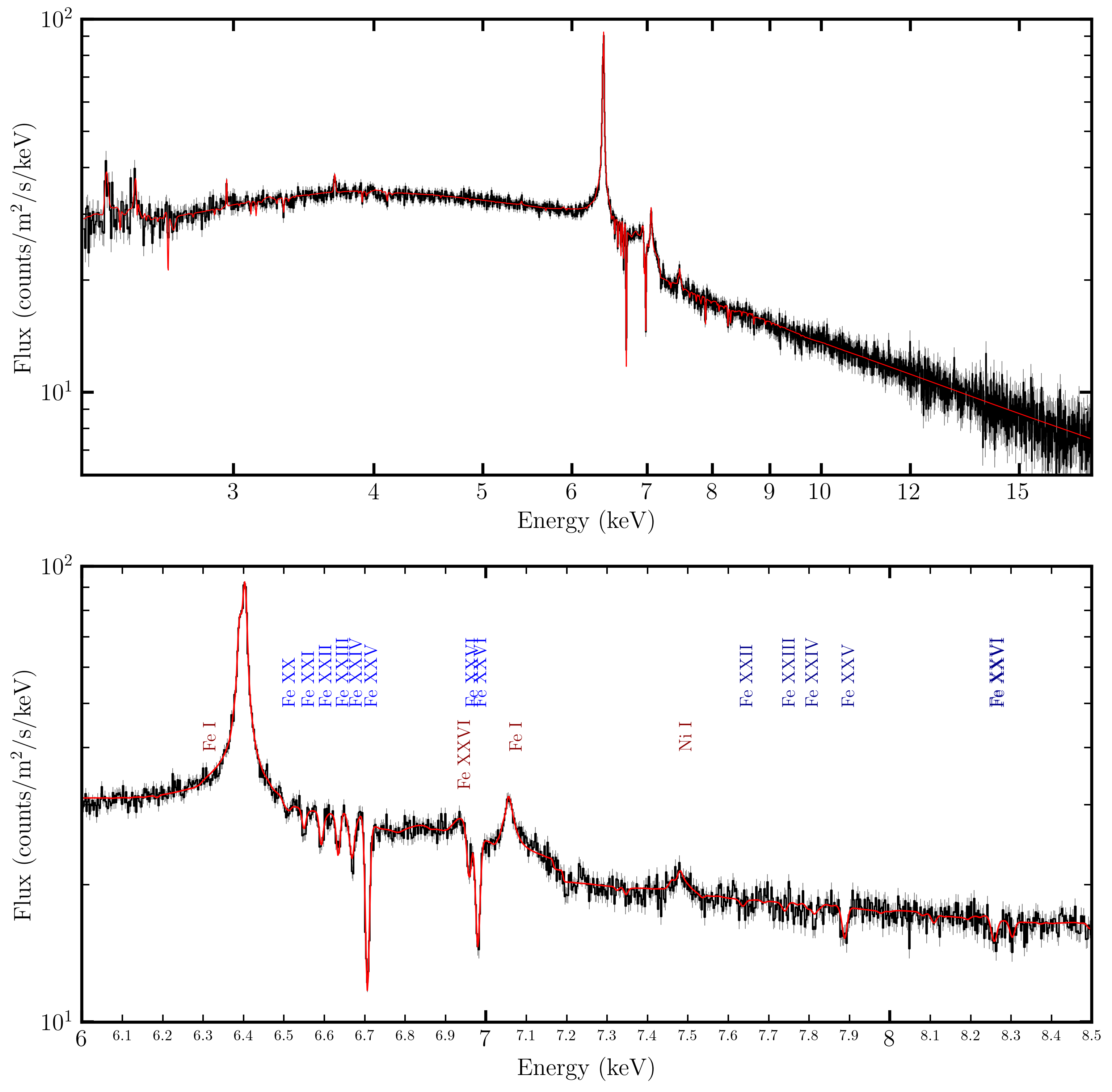
Figure 2: The 0.9~Ms XRISM/Resolve spectrum and fitted model, highlighting Fe~K emission and zones of ionized absorption.
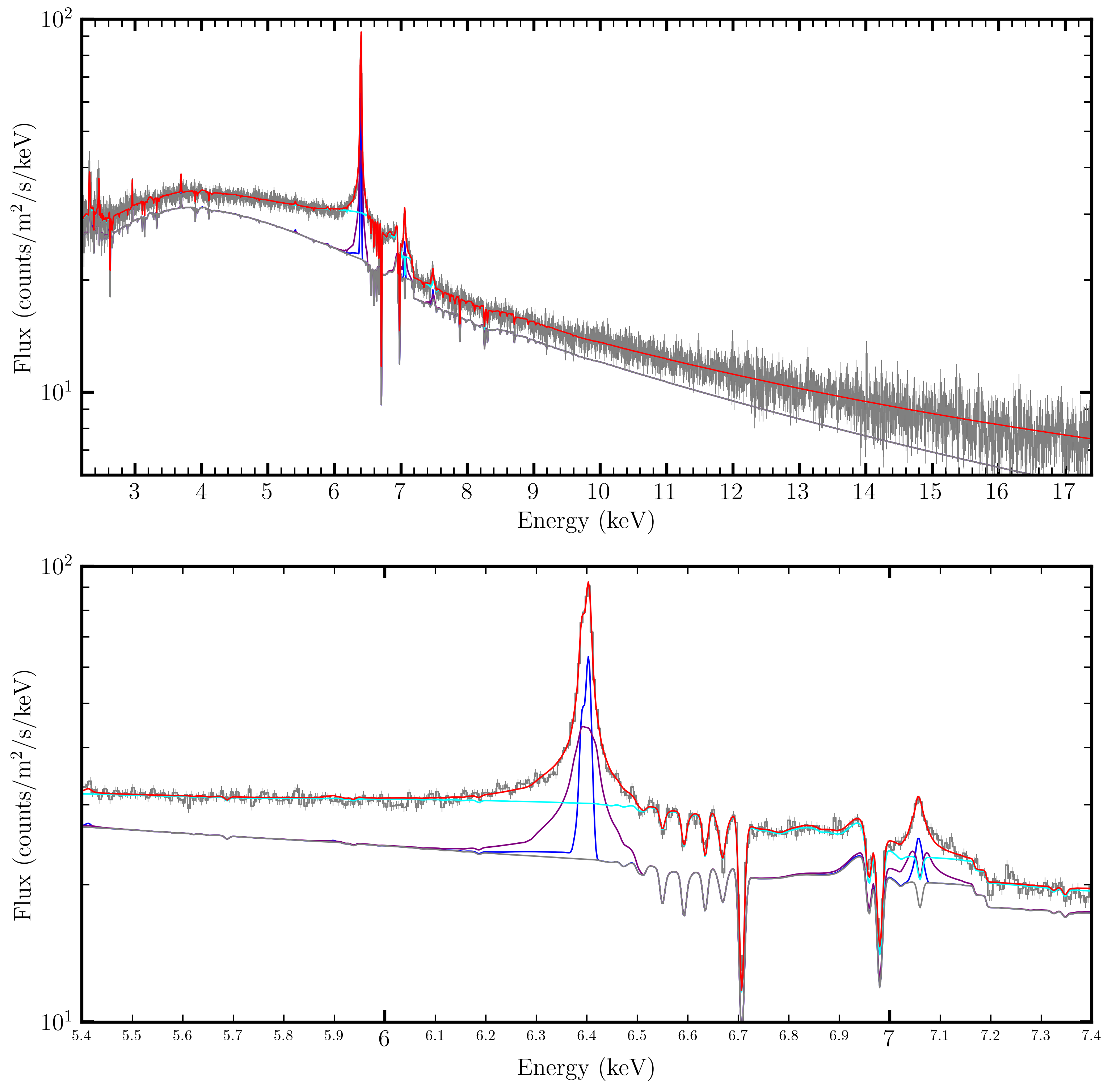
Figure 3: Spectral decomposition; Fe~K band emission separated into inner disk, BLR, and torus contributions.
Exclusion experiments demonstrate the necessity of these line components for accurate spectral modeling. The BLR and torus contributions also display evidence for dust reprocessing, compatible with models invoking radiation pressure-driven dusty winds.
Relativistic Reflection and Inner Disk Structure
The broad, relativistic Fe~Kα2 component demands inclusion of blurred reflection from the accretion disk, modeled via α3 and α4~deg. However, spin constraints remain weak, and the observed curvature could partly arise from spectral summation artifacts or scattered continuum emission—contradicting lag studies that find no evidence of relativistic reflection in NGC~4151.
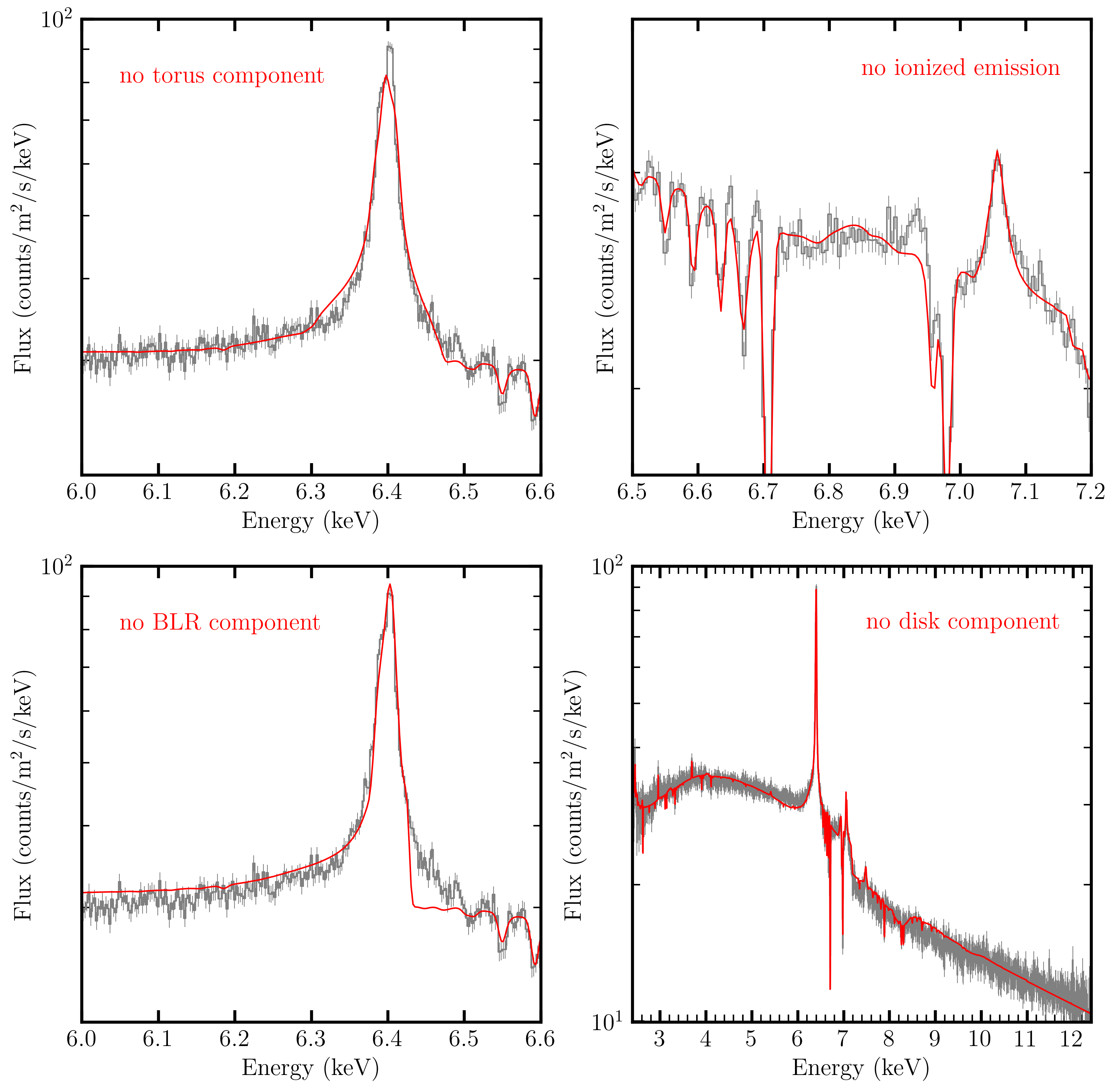
Figure 4: Model fits after removal of emission components; each panel illustrates spectral deficiency when omitting torus, BLR, warm absorber emission, or relativistic reflection.
Ionized Outflows: Warm, Very Fast, and Ultra-Fast Components
The spectrum reveals a complex layering of ionized outflows: warm absorbers (WA), very fast outflows (VFO), and ultra-fast outflows (UFO). Statistical removal and velocity-ionization analysis confirm:
- UFO-1: α5, α6, α7~cmα8, α9~km~sq=20. For unity filling factor, the kinetic power exceeds the bolometric luminosity and accretion rate, but for conservative q=21 this outflow falls below the threshold for galaxy-quenching feedback (q=22).
- UFO-2: q=23, q=24, q=25~cmq=26, q=27~km~sq=28.
- VFO-1: q=29~km~sq=30, q=31, q=32~cmq=33.
- Warm Absorbers: Multiple co-spatial phases with similar velocities, moderate ionization, and filling factors approaching unity.
A prominent result is the detection of a warm absorber emission component, producing a P~Cygni profile, with redshifted (q=34~km~sq=35) and broadened (q=36~km~sq=37) features. Dynamical radius estimates (q=38) situate these flows exterior to the BLR/torus. Ionization parameter and column constraints yield direct measurements of gas density (q=39~cmrBLR=1.9−0.5+1.3×10³ GM/c20) and high filling factor.
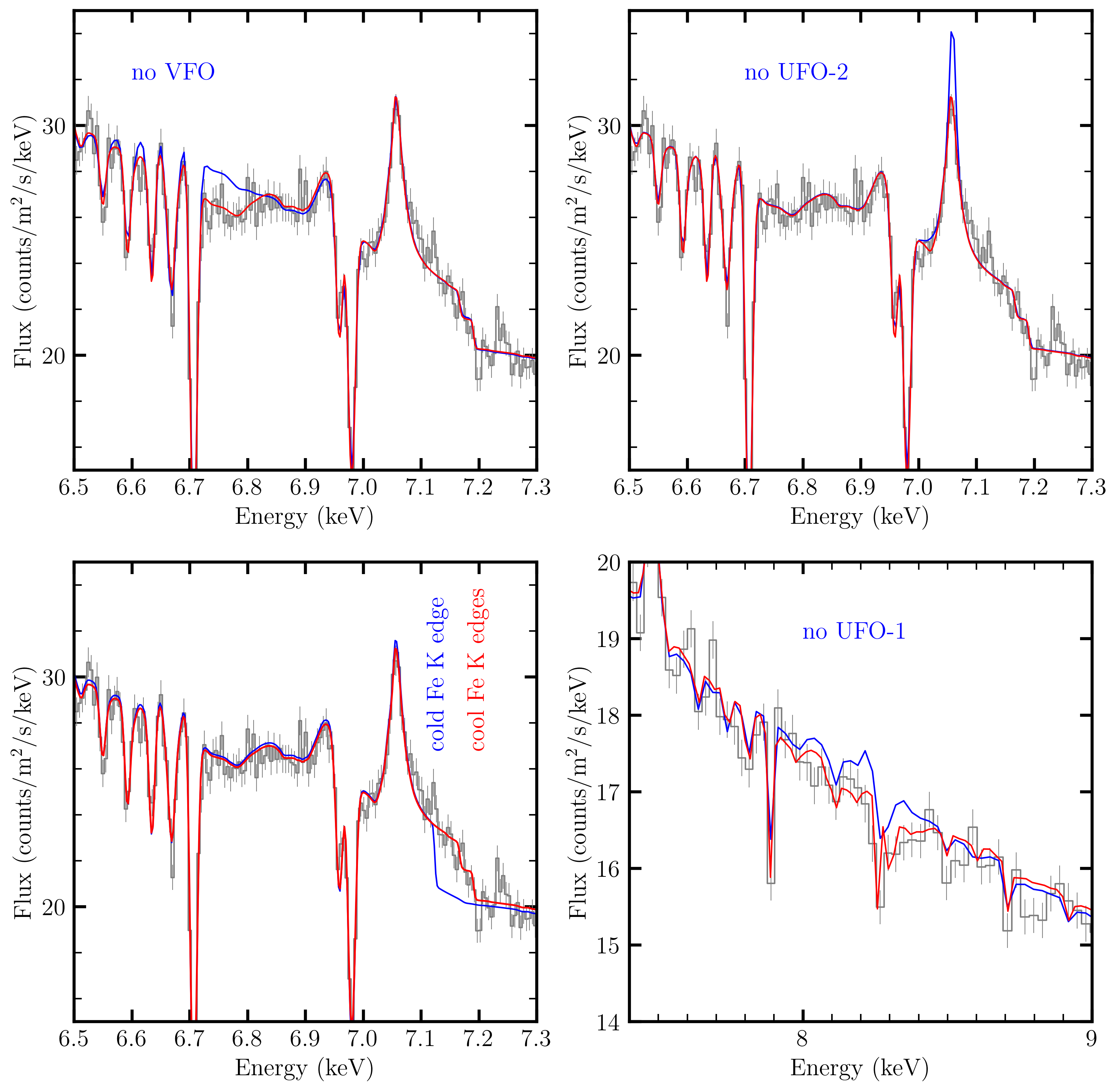
Figure 5: Impact of removing key absorption components; the spectrum fails to reproduce Fe XXV/XXVI features without VFO/UFO components and exhibits sharp, unresolved Fe K edge if modeled as neutral absorption.
Fe K Edge and Partial-Covering Absorption
A critical claim is the modeling of the Fe~K edge as a composite of multiple charge states in cool (rBLR=1.9−0.5+1.3×10³ GM/c21~eV) gas, rather than as a sharp, neutral edge. Dust contributions (e.g., olivine) are not statistically required, and their inclusion would necessitate implausible molecular outflow velocities. The partial-covering absorber modulates broad X-ray character and may reside near the central engine, potentially as an elevated disk atmosphere.
Theoretical and Practical Implications
The inferred vertical structure and emissivity for the BLR and torus establish strong constraints on AGN unified models and reverberation mapping methodologies. The indication of dusty, Compton-thick BLR and torus geometries supports dust-driven wind scenarios and transition-zone concepts between gas and dust-dominated disk regimes.
The inner disk reflection properties, subject to degeneracies, suggest future work should combine spectral and timing analysis to disentangle contributions from relativistic reflection and scattered continuum.
The characterization of multi-phase ionized winds, with direct measurements of radius, density, and filling factor, substantiates scenarios wherein warm absorbers are failed, bound outflows. The time-averaged kinetic power of UFOs may not routinely quench star formation but could achieve episodic feedback under moderate filling factors and variability.
The Fe~K edge structure and absence of robust dust absorption signatures indicate that dust may be confined to the BLR/torus, and not strongly present in higher-scale-height or ionized wind components.
The modeling approach advocates for development of public spectral models explicitly parameterizing accretion geometry and wind launching mechanisms, enabling AGN population studies via microcalorimeter X-ray spectroscopy.
Conclusion
This analysis of the XRISM/Resolve 0.9~Ms spectrum for NGC~4151 demonstrates:
- Fe~KrBLR=1.9−0.5+1.3×10³ GM/c22 line structure is rigorously attributable to neutral gas in the BLR and torus, with strong numerical evidence for rBLR=1.9−0.5+1.3×10³ GM/c23 emissivity and concave geometry.
- The red shoulder is best modeled as Compton scattering by bound electrons, likely in dusty gas.
- Relativistic reflection is required in the summed spectrum, but spin remains unconstrained and alternative explanations such as scattered continuum are plausible.
- The warm absorber emission component is robustly detected and characterized, revealing high-volume filling factor and failed wind dynamics.
- Ultra-fast and very fast outflows are confirmed, with episodic, moderate feedback potential depending on volume filling factor.
- Fe K edge structure requires multi-charge-state cool gas; dust is not directly detectable in absorption.
- Modeling advances open pathways for parameterizing AGN structure and feedback in future spectroscopic and theoretical work.
The results are impactful for AGN accretion theory, feedback mechanisms, and reverberation-based mass determinations, and will inform strategies for microcalorimeter-driven spectral model development and AGN population synthesis in the XRISM era (2604.16148).