- The paper demonstrates a dual-wavelength Brillouin laser system that cancels dispersion-induced phase noise over a 38 km fiber link.
- It uses dual-channel round-trip frequency tagging to achieve ≥3 orders of magnitude phase noise reduction, reaching sub-femtosecond timing stability.
- The experimental setup maintains spectral purity across THz carriers by compensating both path-length and group delay fluctuations in real-time.
Dual-Wavelength Cancellation of Dispersion-Induced Phase Noise in Opto-Terahertz Fiber Links
Introduction and Motivation
Efficient, phase-coherent dissemination of opto-terahertz (opto-THz) carriers over long fiber links is increasingly vital for precision synchronization, radio astronomy, and next-generation radio-over-fiber systems, especially where carrier frequencies reach the hundreds of GHz regime. Although traditional optical fiber offers attractive attenuation and electromagnetic isolation properties, encoding THz carriers as differences between optical frequencies exposes the link to severe phase noise through chromatic dispersion. The resulting differential group delay fluctuations, if uncompensated, significantly degrade spectral purity and timing stability. Addressing this, the paper demonstrates a dual-wavelength Brillouin laser (DWBL) and a dual-channel round-trip cancellation architecture capable of real-time suppression of both Doppler-type (path-length) and dispersion-induced phase noise over a 38 km SMF-28 fiber link.
Theory of Differential Phase Noise in Dual-Wavelength Transmission
When two optical wavelengths, ω1 and ω2, propagate simultaneously over a long fiber, differential chromatic dispersion causes phase fluctuations at the heterodyne (THz) frequency. The key relationship governing the phase of the opto-THz carrier is
ϕTHz=L[β(ω2)−β(ω1)],
which, to first order, depends linearly on the group velocity dispersion and the frequency separation between optical lines. Environmental fluctuations in temperature and strain modulate both the fiber length and the group index ng, with the latter—due to its significantly larger thermally induced fractional change—dominating the resultant phase noise. Theoretical analysis indicates that, for silica fiber, group velocity fluctuations induced by environmental perturbations exceed those from thermal expansion by more than an order of magnitude. Therefore, both path-length and group delay noise components must be addressed to preserve the stability and spectral purity of the transmitted THz carrier.
Experimental Architecture
The experiment employs a dual-wavelength Brillouin laser (DWBL) as a highly stable, widely tunable source, with two separated optical frequencies forming the basis for the opto-THz carrier (150, 300, or 600 GHz spacing). Frequency control is implemented with acousto-optic modulators (AOMs) for each wavelength, while independent channel readouts and round-trip frequency tagging (using a third AOM at the remote station) enable extraction of the accumulated phase perturbations for each wavelength.
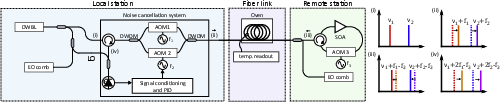
Figure 1: Schematic depiction of the dual-wavelength, dual-channel round-trip noise-cancellation system for stable opto-THz frequency transfer over 38 km fiber.
The two optical channels are separated, independently frequency-shifted, recombined, and injected into the fiber link. At the remote station, a portion is used for measurement while the remainder is amplified, frequency-tagged, and returned. At the local station, the heterodyne products between LO and returned signals are processed electronically to isolate the differential phase noise between the two wavelengths. A digital control system then applies real-time correction to maintain phase coherence.
Results
Free-Running Instability and Noise Analysis
In the absence of active noise cancellation, the fiber link exhibits a flicker-frequency floor in the modified Allan deviation (MDEV) at the 10−14 level (averaging times 100–102 seconds), consistent across all measured THz carrier frequencies (150, 300, 600 GHz). This instability is attributed to environmentally-induced group index fluctuations as predicted theoretically.
Effectiveness of Dual-Wavelength Noise Cancellation
Upon activation of the dual-wavelength round-trip servo, the system demonstrates a ≥3-order-of-magnitude reduction in instability, reaching residual MDEV values below 10−17 for all measured THz carriers at 10,000-second averaging. The residual instability exhibits a characteristic τ−1 scaling—indicative of white phase noise and confirming the suppression of both path-length and dispersion-induced group delay fluctuations within the servo bandwidth.
The experimental results robustly confirm that noise cancellation achieves sub-femtosecond timing jitter and detects no flicker floor down to 10−17 MDEV, preserving the intrinsic phase stability of the DWBL over the full 38 km link.
Temperature Ramp and Environmental Robustness
The fiber link's sensitivity to temperature perturbations was characterized by programmed temperature ramps. In free-running configuration, frequency offsets of ~1 Hz at 600 GHz (fractional shift ω20) are observed during modest (ω21C) ramps—much larger than the steady-state noise floor, further emphasizing the importance of real-time compensation. When noise cancellation is engaged, negligible frequency deviation is seen even for rapid (ω22C) shocks, demonstrating the system's robustness to realistic environmental fluctuations.
Spectral Characteristics of Residual Phase Noise
Controlled measurements using a uni-traveling carrier photodiode and phase noise analyzer reveal that:
- The residual phase noise added by the 38 km fiber above 10 Hz Fourier frequency follows a ω23 spectrum, characteristic of phase flicker.
- The link contributes ~2.9 fs of integrated timing jitter (10 Hz–10 MHz) under typical laboratory conditions—quantitatively, 0.25 as/GHz/km.
- Vibration-induced spurs, while present, are secondary compared to the broadband flicker.
The system bandwidth is ultimately constrained by the round-trip delay (368 μs here), limiting the servo's effective correction range to below ~2.7 kHz. Above this, forward and backward noise lose correlation, setting the ultimate performance bound.
Implications and Future Prospects
The demonstrated scheme proves that dual-wavelength, round-trip noise cancellation enables transfer of ultra-stable THz carriers across long fibers, with phase stability limited only by the optical source itself and not the transmission medium. The implications for high-precision synchronization in distributed networks, radio telescopes, and future communication systems are substantial.
Practical extensions include:
- Deployment on existing telecommunication fiber using wavelength-division multiplexing.
- Scaling to longer links with in-line bidirectional amplification.
- Adaptation to alternative multi-wavelength or frequency-comb sources for increased flexibility.
From a theoretical perspective, results reinforce that dispersion management and group velocity noise, not merely path-length noise, will be central to achieving attosecond-level synchronization as networks expand and environmental challenges grow.
Conclusion
This work establishes dual-wavelength, dual-channel round-trip noise cancellation as a highly effective strategy for phase-coherent opto-THz dissemination over substantial fiber distances. By compensating both Doppler-like and dispersion-induced group velocity fluctuations, the architecture maintains the intrinsic source stability at the remote end, achieving sub-femtosecond timing and fractional frequency instability ω24 at 10,000 s averaging. The cited experimental and theoretical methodologies are directly extensible to more complex or environmentally variable deployments, underlining their potential as a key technology for precision time-frequency transfer in advanced photonic infrastructures.