- The paper demonstrates the first experimental observation of strong-to-weak spontaneous symmetry breaking (SW-SSB) in a dephased 2D Fermi gas using nonlinear density matrix correlators.
- It employs quantum gas microscopy and a machine-learned Gaussian reference model to efficiently extract Rényi-1 and Rényi-2 correlators that reveal robust long-range order.
- The study uncovers a sharp SW-SSB transition at the metal–insulator boundary, offering a novel diagnostic framework for decoherence-driven phase transitions in mixed quantum states.
Observation of Strong-to-Weak Spontaneous Symmetry Breaking in a Dephased Fermi Gas
Introduction and Theoretical Framework
This work establishes the first experimental observation of strong-to-weak spontaneous symmetry breaking (SW-SSB) in mixed quantum states, realized in a dephased 2D Fermi gas and detected via quantum gas microscopy (2604.16137). Traditional symmetry-breaking (SB) paradigms in quantum statistical mechanics are built on pure-state off-diagonal long-range order (ODLRO), which is connected to phenomena like BEC and superconductivity. These paradigms have been generalized to encompass mixed quantum states under strong decoherence and open quantum dynamics, leading to a distinction between "strong" and "weak" symmetry sectors [buca2012, degroot2022, lessa2025, weinstein2025, gu2025]. SW-SSB refers to phase transitions where ODLRO remains invisible to linear observables of the density matrix and is instead only accessible to observables nonlinear in the density matrix—namely, Rényi-1 (fidelity-type) and Rényi-2 (replica) correlators.
The principal theoretical tool for diagnosing SW-SSB is the family of Rényi-k correlators,
C(k)(x)=Tr(ρ^k)Tr[ρ^k/2c^0c^x†ρ^k/2c^0†c^x],
which measure the indistinguishability, in the occupation basis, of number distributions under single-particle displacements. C(1)(x) is the Bhattacharyya coefficient, and C(2)(x) maps, in the Choi doubled Hilbert space, to inter-replica Cooper-pair correlators, giving a rigorous connection to ODLRO in the Choi representation. SW-SSB manifests as non-decaying long-range values of C(k)(x) at large ∣x∣, i.e., an order invisible to linear density matrix probes but robust under decoherence [hauser2026]. This symmetry structure unifies quantum memory decodability transitions and the emergence of hydrodynamics in open systems.
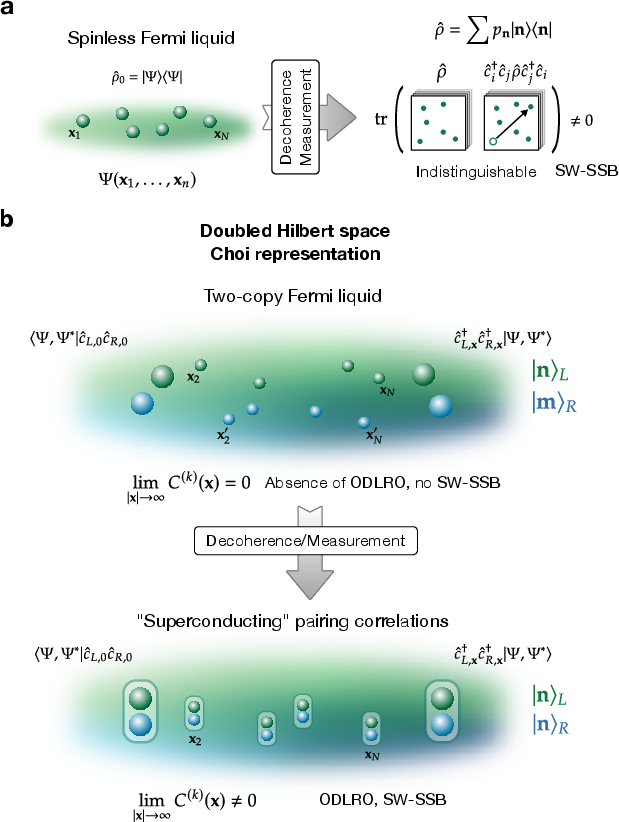
Figure 1: Schematic of SW-SSB as ODLRO of nonlinear density matrix correlators in the dephased ensemble and its mapping to Cooper pairing in the Choi representation.
Experimental Design and Methodology
The experimental platform consists of a weakly-interacting degenerate 6Li Fermi gas loaded into a 14×14 square optical lattice under quantum gas microscopy [gross2021]. Experiments are performed on single-spin projections, achieving effective spinless fermion dynamics. To implement dephasing, local site-resolved fluorescence measurements are performed, converting the state to a diagonal density matrix in the occupation basis.
Extraction of the nonlinear correlators is enabled by an efficient estimator that combines quantum snapshot data with a machine-learned Gaussian (non-interacting) reference model. The Green's function of the Gaussian model is optimized to minimize the Kullback–Leibler divergence to the empirical occupation distribution, ensuring high-fidelity classical surrogates for cross-correlator measurements between experiment and theory. This protocol allows efficient evaluation of C(1)(x) and C(2)(x), whose computational complexity would otherwise be prohibitive due to the exponential snapshot space [humeniuk2021, garratt2023, zhang2025probing].
Observation of SW-SSB in the Dephased Fermi Liquid
The key experimental signature is the persistence of finite C(1)(x) and C(1)(x)0 for large C(1)(x)1 in the dephased ensemble, establishing SW-SSB. The measured nonlinear correlators agree quantitatively with those from the reference Gaussian model (QC ≈ CC), confirming the accuracy of the estimator and the weakly correlated nature of the system in this regime.
Both C(1)(x)2 and C(1)(x)3 grow with increasing temperature, approaching the expected value C(1)(x)4 for an infinite-temperature random mixture. In the dephased Fermi liquid at low filling and low temperature (C(1)(x)5), the condensate fractions C(1)(x)6 and C(1)(x)7 saturate with system size, indicating true long-range order due to SW-SSB; the undephased case shows a reduction by more than an order of magnitude, demonstrating that dephasing is essential for this nonlinear symmetry-breaking.
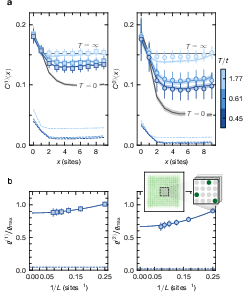
Figure 2: (a) Distance dependence of dephased Fermi liquid Rényi-1 and Rényi-2 correlators for various temperatures, with finite long-range order. (b) Scaling of condensate fractions with subsystem size, demonstrating saturation for C(1)(x)8.
By imposing a commensurate superlattice modulation and tuning the potential difference C(1)(x)9, a controlled metal–insulator transition is realized in the underlying Hamiltonian [chalopin2025]. In the dephased ensemble at fixed density (one fermion per supercell), this transition manifests as an abrupt collapse of long-range off-diagonal order in the nonlinear Rényi correlators—an SW-SSB transition.
For C(2)(x)0, the system is metallic, and C(2)(x)1 displays LRO; for C(2)(x)2, band insulation localizes particles, and C(2)(x)3 decays rapidly, vanishing in the thermodynamic limit. This sharp transition is quantified by the abrupt drop in C(2)(x)4 at C(2)(x)5; in contrast, C(2)(x)6 vanishes more gradually with C(2)(x)7, consistent with theoretical expectations for density localization.
The observed transition aligns with the theoretical understanding that SW-SSB in the dephased state is dual to the appearance of inter-replica ODLRO in the doubled space, present only in metallic states or gapless Fermi liquids but absent in insulators.
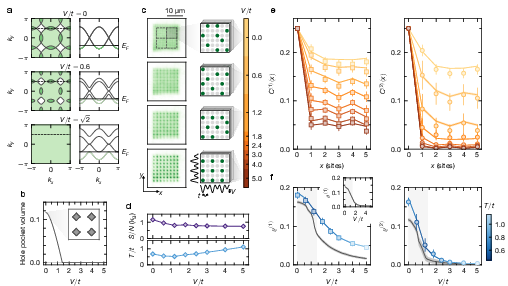
Figure 3: (a) Fermi surface evolution and experimental density maps across the metal-insulator transition (C(2)(x)8 sweep). (e-f) Nonlinear correlators and condensate densities showing SW-SSB transition.
Thermometric Calibration and Entropy Control
Accurate knowledge of temperature is essential for quantifying the phase diagram and differentiating between thermal and dephasing-induced order. The work leverages subsystem number fluctuation-based thermometry, calibrated via canonical-ensemble density-density correlators [dixmeriasFluctuationThermometryAtomresolved2025]. This enables extraction of both temperature and entropy per particle over a broad range, confirming low-entropy initial states and quasi-adiabaticity for C(2)(x)9 ramps. At high C(k)(x)0, the amplitude of Rényi correlators becomes largely insensitive to C(k)(x)1.
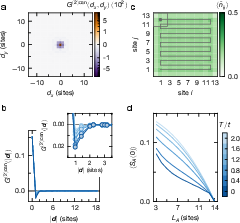
Figure 4: Theoretical calibration of connected density–density correlations and subsystem fluctuation thermometry curves.
Theoretical and Practical Implications
The results provide compelling empirical support for the universality of SW-SSB as a concept governing transitions in mixed-state quantum matter. Several salient implications follow:
- Universal framework: SW-SSB serves as a rigorous diagnostic and theoretical unifier for information-theoretic phenomena such as quantum memory decodability, error correction thresholds [kim2024, lee2023, fan2024], and the onset of classical hydrodynamics in decohered dynamics [hauser2026].
- Quantum information: SW-SSB transitions delineate recoverable from unrecoverable information in open quantum systems, with immediate relevance for topological quantum memory and the interpretation of measurement-induced phase transitions.
- Choi-representation mapping: The Choi-doubled space perspective relates SW-SSB to ODLRO of inter-replica Cooper pairs, suggesting avenues for realizing and testing exotic phases such as algebraic Choi-spin liquids [su2024], and mapping decohered SPT order to superconducting/dimerized orders in the doubled language.
- Nonlinear benchmarks for quantum simulators: Rényi correlators and SW-SSB diagnostics provide robust, experimentally-accessible probes of quantum simulator output, complementing fidelity and entanglement measures for characterizing noisy intermediate-scale devices [weinstein2025, zhang2025probing].
Future Directions
Follow-up work should address the universality class of the SW-SSB transition—potentially related to gauged superconductor-insulator transitions and deconfined quantum criticality—using both precise analytical theory [sarma2026] and controlled numerics. The extension of these methods to strongly-correlated regimes (e.g., Fermi-Hubbard or fractional quantum Hall states [wang2025a, kiely2025]), interacting decohered bosons, and higher-form symmetries [zhang2025b] is expected to reveal additional mixed-state orders beyond the Landau paradigm. Dynamical measurement protocols tracking the time evolution of nonlinear correlators could elucidate the kinetics and scaling of SW-SSB, directly informing the emergence of classical hydrodynamics and real-time quantum-to-classical crossovers.
Conclusion
This study provides the first experimental realization and comprehensive characterization of strong-to-weak spontaneous symmetry breaking in a quantum matter system (2604.16137). By monitoring nonlinear Rényi correlators under projective dephasing and leveraging advanced machine-learned estimators, it confirms both the existence of a robust SW-SSB phase and its sharp transition at the metal-insulator point in dephased fermions. The results broaden the modern symmetry framework to encompass mixed-state quantum matter and offer tools for diagnosing information-theoretic topology, quantum memory, and hydrodynamic emergence in open, noisy, and decohered quantum platforms.
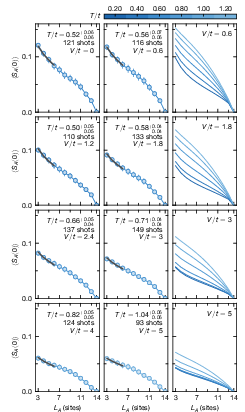
Figure 5: Extraction of temperatures via subsystem fluctuation analysis for varying C(k)(x)2, validating thermometric protocols and entropy control across the phase diagram.
References:
- (2604.16137) Observation of Strong-to-Weak Spontaneous Symmetry Breaking in a Dephased Fermi Gas
- buca2012, lessa2025, weinstein2025, gu2025, hauser2026, chalopin2025, gross2021, sarma2026, zhang2025probing, d ixmeriasFluctuationThermometryAtomresolved2025, kim2024, kiely2025, su2024
- Additional references as cited in the main text

