- The paper introduces a novel embedding framework using the Wiener–Hopf method and operator theory to compute modified directivities for lattice diffraction problems.
- It demonstrates that a finite set of auxiliary solutions can reconstruct the full far-field scattering response, significantly reducing computational effort.
- Numerical validation and rank analysis confirm the robustness of the method for various lattice geometries, with implications for inverse scattering applications.
Overview and Motivation
The paper "Embedding formulae for diffraction problems on square lattices" (2604.16050) presents a rigorous theoretical and numerical framework for embedding formulae in the context of discrete wave diffraction on Z2 square lattices. By leveraging both the Wiener–Hopf method and operator theory, the authors produce explicit embedding relations for Dirichlet boundary value problems associated with arbitrary lattice obstacles. These relations enable the computation of directivities—far-field scattering amplitudes—for any incident angle from a finite set of auxiliary solutions, a key distinction from the continuous case. The work is situated at the intersection of analytic lattice wave theory, computational methods for discrete media, and inverse scattering.
Discrete Helmholtz Problem and Directivity
The fundamental setting is the discrete Helmholtz equation on a square lattice: Δ(m,n)[u]+k2u(m,n)=0,
where the difference operator Δ approximates the continuous Laplacian. Obstacle boundaries are modeled by Dirichlet conditions on selected subsets, and scattering is excited by plane waves whose parameters are intrinsically linked to the lattice geometry (using rational “angles” via β=cotθ). The principal object of study is the directivity S(β,βin), defined analogously to the continuous case but requiring modifications to account for lattice-specific analytic properties.
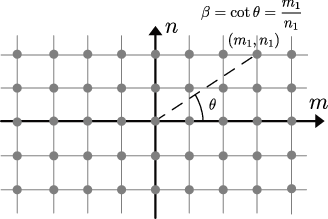
Figure 1: Geometry of the square lattice with integer-indexed nodes, representing the ambient medium for the discrete Helmholtz equation.
A key distinction is the use of a modified directivity,
S~(β,βin)=(sβ+sβ−1−sin−(sin)−1)S(β,βin),
where sβ is related to the outgoing lattice wave in direction β. This reparameterization is crucial for algebraic manipulations and for ensuring analytic continuability across the relevant parameter domains.
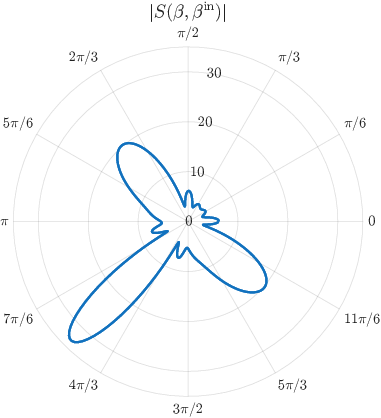
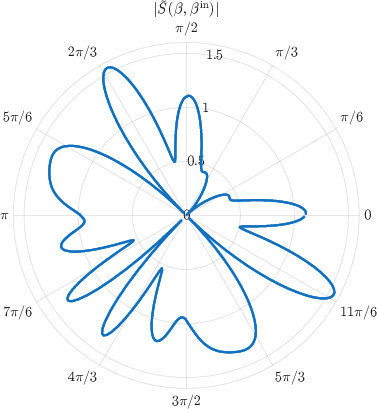
Figure 2: Left: Absolute value of directivity for diffraction by a square obstacle. Right: Absolute value of the modified directivity with smoother behavior facilitating algebraic embedding relations.
Embedding formulae allow the reduction of the solution for arbitrary incident directions to known auxiliary solutions. The core result is that, for a system of N degrees of freedom (typically N=2× number of corners in the obstacle), the modified directivity at any parameter pair is an explicit linear combination: Δ(m,n)[u]+k2u(m,n)=0,0
where the coefficients Δ(m,n)[u]+k2u(m,n)=0,1 depend on the desired incidence and are determined by reciprocity constraints.
The derivation employs the Wiener–Hopf factorization. For canonical geometries (half-plane, strip, right-angled wedge), explicit embedding formulae are given. For the half-plane, a direct analog of the continuous plane wave embedding is obtained; for the wedge, additional poles in the denominator correspond to the richer functional structure induced by multiple boundaries.
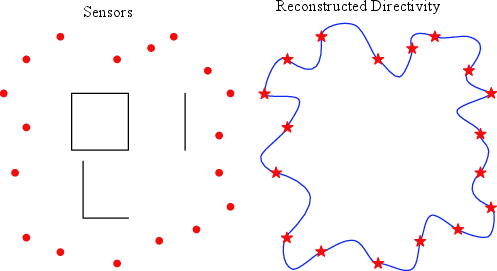
Figure 3: Left: Physical layout for directivity measurements at Δ(m,n)[u]+k2u(m,n)=0,2 discrete sensor positions. Right: Demonstration that the entire directivity profile can be reconstructed from these Δ(m,n)[u]+k2u(m,n)=0,3 points via embedding.
More generally, using operator theory, the embedding operator Δ(m,n)[u]+k2u(m,n)=0,4 transforms the field so that the residual satisfies the Helmholtz equation away from a finite set of locations. These locations correspond to features such as corners and edges in the obstacle, and the associated Green’s functions serve as an auxiliary basis for reconstructing the total solution via their far-field signatures.
Numerical Demonstration and Rank Analysis
The authors develop and employ a finite element-based solver for the lattice Helmholtz equation, implementing a version of the method of boundary algebraic equations (BAE) adapted to discrete problems. They validate the embedding formula numerically for various geometries (squares, right angles) and demonstrate the precise agreement between direct computation and embedding-based reconstruction of modified directivities.
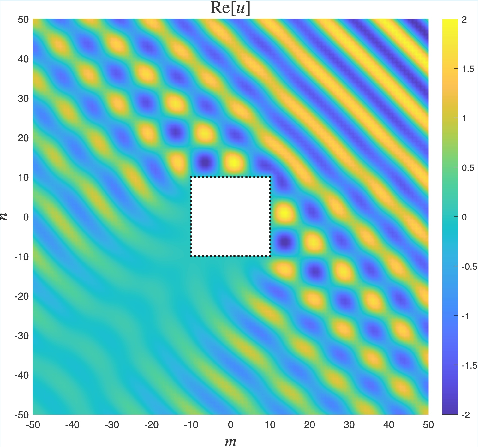
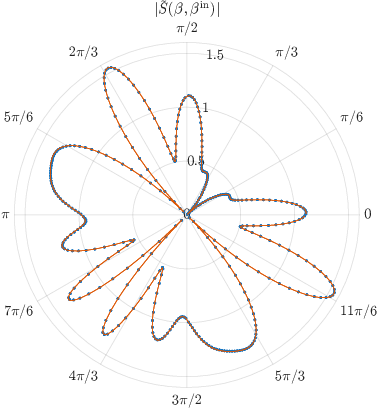
Figure 4: Left: Real part of the scattered field due to a square obstacle. Right: Absolute value of modified directivity computed directly (solid) and via the embedding formula (dotted), demonstrating their equivalence across the angular domain.
In addition, the study exploits the finite-rank property of the embedding relation: the rank of the matrix formed by evaluating Δ(m,n)[u]+k2u(m,n)=0,5 for a sufficiently large set of Δ(m,n)[u]+k2u(m,n)=0,6 pairs reveals the minimal number of auxiliary solutions Δ(m,n)[u]+k2u(m,n)=0,7 required to fully characterize the scattering behavior.
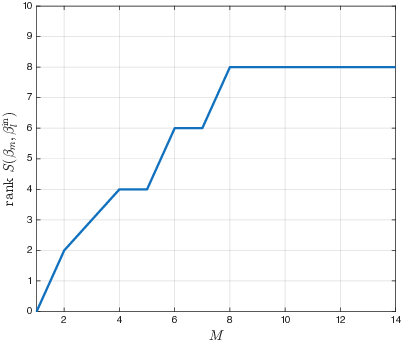
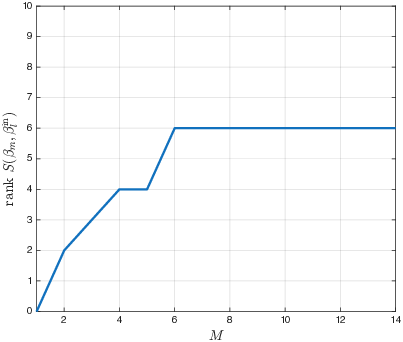
Figure 5: Matrix rank analysis of sampled directivities for square and right-angle scatterers, clearly plateauing once the sufficient set size Δ(m,n)[u]+k2u(m,n)=0,8 is reached.
Implications, Extensions, and Future Work
Practical implications: The reduction in computational cost is substantial. Once the Δ(m,n)[u]+k2u(m,n)=0,9 auxiliary problems are solved, all remaining incident angles are accessible without additional PDE solves, facilitating large-scale parameter studies and rapid inversion in experimental or design settings. The ability to reconstruct the full angular response from partial data is especially relevant for sensor-limited or inverse scattering regimes.
Theoretical significance: The derivation of a general embedding formula for arbitrary discrete Dirichlet obstacles is not yet paralleled in the continuous domain, reflecting the algebraic tractability of the lattice setting. The operator-theoretic approach clarifies the relationship between geometric singularities and the necessary auxiliary basis.
Extensions and open questions: Systematic strategies for auxiliary parameter selection, conditioning improvements, and extensions to Neumann/impedance (mixed) boundary conditions and other lattice topologies are suggested as natural next steps. The strong connection to inverse problems — particularly, recovering obstacle count or arrangement from rank-deficient scattering data — is highlighted by the ability to extract Δ0 from the data itself.
The generalization of these embedding relations to other spectral problems, defect engineering, and active control contexts is feasible, leveraging the explicit operator approach and the inherent modularity of the Wiener–Hopf technique.
Conclusion
This work establishes the analytic and computational foundations for embedding formulae in discrete diffraction on square lattices, moving beyond canonical templates to arbitrary geometries via an overview of Wiener–Hopf analysis and operator embedding. The strong numerical validation and the method's implications for forward and inverse scattering position it as a robust tool in discrete spectral theory, with likely impact on lattice photonics, mechanical metamaterials, and the design of complex discrete media.
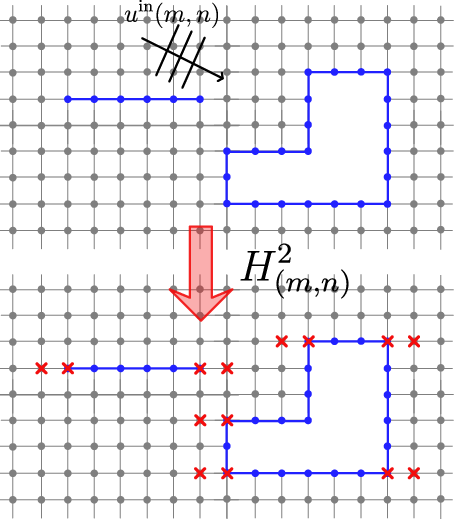
Figure 6: Schematic of a general boundary value problem for the lattice Helmholtz equation, illustrating the versatility of the embedding approach for arbitrary configurations.