- The paper shows that the modular cryogenic link design bridges separate dilution refrigerators over up to 30 m, enabling high-coherence quantum networks.
- It employs thermal shields, pulse-tube cooling, and optimized materials to maintain sub-50 mK stability and achieve minimal quantum channel loss.
- Experimental validation with extensive sensor data confirms the design’s scalability and robust thermal performance for future quantum network expansions.
Modular Cryogenic Links for Microwave Quantum Communication over Tens of Meters
Introduction
The paper "A Modular Cryogenic Link for Microwave Quantum Communication Over Distances of Tens of Meters" (2604.15971) details the design, engineering, thermal modeling, and experimental validation of a modular cryogenic infrastructure intended for scalable, high-coherence quantum networks using superconducting microwave systems. Classical scalability approaches in quantum information processing based on superconducting circuits are limited by the necessity for mK-temperature operation and the commensurate thermal management challenges. The described system bridges independent dilution refrigerators over distances up to 30 meters, offering a robust, extensible solution for low-loss, cryogenic microwave quantum communication, and sets benchmarks for future modular quantum networking architectures.
System Architecture and Modular Design
At the core of the work is a modular, vacuum-insulated, thermally shielded cryogenic link operating at sub-50 mK along its full length, with integrated support for both superconducting qubit nodes and high-fidelity waveguide-based quantum channels. The system comprises a sequence of specialized modules—adapter modules for interfacing dilution refrigerators, thermally optimized link modules for the bulk cryogenic path, braid modules to compensate for thermal contraction and mechanical misalignment, and a strategically placed mid-link cooling unit based on a pulse-tube cryocooler. The cryogenic link houses a rectangular WR90 aluminum waveguide used as the low-loss quantum communication channel, thermalized via copper braids at regular intervals to ensure minimal thermal gradients and negligible photon loss.
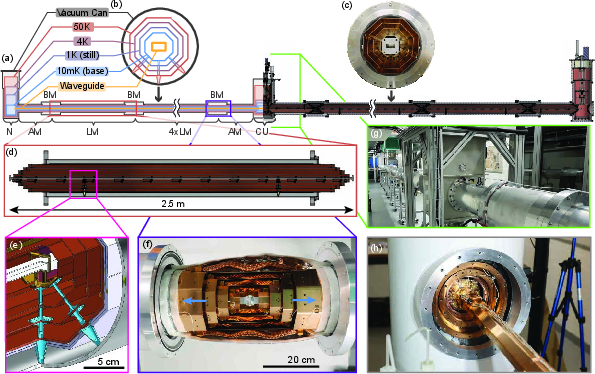
Figure 1: Longitudinal schematic and 3D representation of the 30-meter modular cryogenic link, indicating module composition and staging.
The modularity is reflected not only in the mechanical assembly and maintenance, but also in the system's scalability for greater link lengths, provided adequate cooling insertion and thermal optimization. Mechanical support for radiation shields is realized using thin-walled, 3D-printed Bluestone composite posts, chosen for their optimal yield strength to thermal conductivity ratio and machinability, further reducing conductive heat loads.
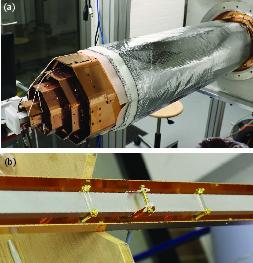
Figure 2: Adapter module attached to the cooling unit, showing installed multi-layer insulation on the 50K shield.
Thermal Engineering, Materials, and Optimizations
Detailed heat transfer modeling integrates radiative flux between temperature stages, conductive leakage via supports, and thermal path resistance at each interface (including mechanical joints and flexible braids). Essential to the robust operation over tens of meters is the use of high-purity oxygen-free electronic (OFE) copper for shields and thermalization elements, as established through bespoke RRR-characterization measurements. Special attention is paid to contact resistance minimization, surface preparation, and torque calibration to preserve interface integrity after repeated thermal cycling and to counteract differences in thermal contraction among assembly materials.
A significant innovation is the application and characterization of double-layer, 15-sheet multi-layer insulation (MLI) wrapping the 50K shield stage, resulting in a dramatic reduction of effective radiative heat load from ~6.4 W/m² to ~1 W/m². This directly enables the stable operation of the 30-meter link, with all 50K shields remaining below the 77 K cold-trap threshold, despite aggregate radiative loads in excess of 200 W for unprotected shield geometries. Key design metrics, including shield thickness, post geometry, and support spacing, are co-optimized to balance mechanical stability with minimized heat leaks.
Experimental Characterization and Thermal Model Validation
Temperature profiles across multiple systems of different lengths (5, 10, and 30 meters) were extensively instrumented with up to 48 temperature sensors per deployment, and post-cooldown steady-state gradients were matched to a finite element thermal model with sub-Kelvin agreement. The thermal performance indicates a convex profile with minima at cooling nodes and a mid-link cooling unit, and all base plate regions across the full 30-meter length remain below 50 mK.
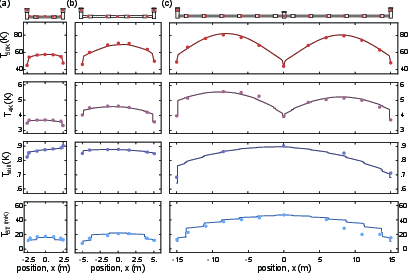
Figure 3: Measured and simulated steady-state temperature distributions for 5, 10, and 30-meter cryogenic link systems, showing sensor positions and thermal gradients per stage.
Cool-down to base temperature scales from 2 to 6.5 days for 5 to 30-meter systems, respectively, with system hold times of approximately 6 months before gradual MLI degradation due to O-ring permeation. Time-evolution dynamics reveal long tail equilibration of the 50K stage but fast base-plate cooling, consistent with the modeled interplay between shielded radiation and copper's anomalous thermal diffusivity at cryogenic temperatures.
Contact resistances (especially across braid modules and mechanical interfaces) were shown to scale as T−2 below 10 K, with bulk and interface contributions systematically characterized. These empirical findings now serve as authoritative parameters for future model-based design extrapolation.
Quantum Channel Loss and Scaling Implications
The waveguide channel exhibits a loss coefficient below 1 dB/km, yielding sub-0.03 dB attenuation across the full 30-meter link; the dominant sources of insertion loss in quantum experiments are the node interfaces, including PCB transitions and non-superconducting adapter elements. This performance supports high-fidelity photon transmission needed for remote entanglement generation and loophole-free Bell tests.
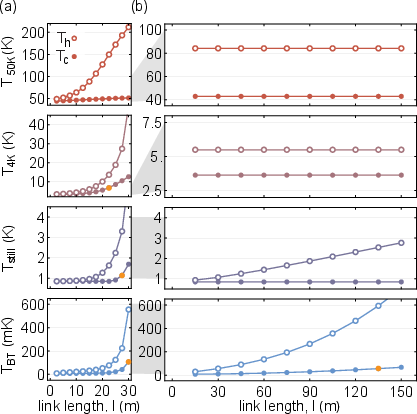
Figure 4: Extrapolated node and mid-link temperature maxima vs. system length, with and without intermediate cooling units, indicating practical scaling breakpoints.
Thermal analysis and simulation establish that, without additional mid-link cooling units, the system can be extended to ∼20 meters before exceeding dilution refrigerator operational limits due to rising 4K-stage temperatures (>5.2 K). Incorporating pulse-tube coolers every 15 meters allows for modular scaling up to approximately 120 meters while keeping all operational thresholds for superconducting quantum nodes within specification. Longer distances are in principle feasible by interspersing additional dilution units.
Materials, Mechanics, and Post Design
The use of Bluestone composite for mechanical support yields posts with high compressive yield strength (∼120 MPa) and low thermal conductivity (<1 mW/(K·m) at 1 K), outperforming stainless steel, Macor, PEEK, and reinforced Nylons in this application. The posts' ratio of yield strength to thermal conductivity is the highest among considered candidates, supporting robust, lightweight, and minimally invasive cryogenic supports.
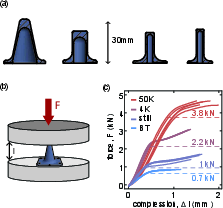
Figure 5: CAD cross-sections of Bluestone posts; tabulated mechanical test results and thermal characterization are also presented.
A detailed analysis of radiative and conductive heat loads across posts at all temperature stages establishes quantitative models for link-wide thermal budgeting, directly informing shield and post geometry for future designs.
Practical and Theoretical Implications
The demonstrated platform enables fast, reliable construction and operation of quantum local area networks based on microwave photonic links. Practically, this system was already used to facilitate distributed device-independent quantum experiments—including loophole-free Bell tests and randomness amplification—between superconducting qubits housed in separate dilution refrigerators. The modularity, validated thermal model, and characterized material properties lay the groundwork for the development of larger quantum networks, and open new routes towards non-Markovian quantum optics in engineered waveguides. Further engineering advances (e.g., widespread use of MLI at 4K, annealed copper shields, or improved sealants against gas permeation) will raise the feasible length and performance ceiling for such links, potentially enabling hundred-meter to kilometer-scale cryogenic quantum networks.
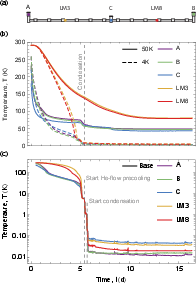
Figure 6: System-wide cooldown dynamics for the full 30-meter link, with base, 4K, and 50K stage readings from spatially distributed sensors during system initialization.
Conclusion
This work constitutes a comprehensive and authoritative benchmark for the mechanical, thermal, and operational aspects of large-scale, modular cryogenic microwave links for quantum communication between superconducting circuits. By systematizing modular design, characterizing all critical thermal and mechanical parameters, and validating a predictive model over multiple scales, the study provides an engineering and physical foundation for robust, extensible, and low-loss quantum networks operable at millikelvin temperatures. The modular approach and quantitative modeling are directly extensible to future architectures and anticipated developments in quantum information networks, large-scale entanglement distribution, and nonlocal quantum devices.