- The paper introduces a posted-price procurement model that demonstrates how platforms can suppress wages while meeting service-level constraints.
- It reveals that under dispersed worker valuation distributions, platform costs can drop to as low as O(1) while maintaining linear wait times.
- It shows that only targeted vertical collective organization effectively forces platforms to pay fair wages, unlike broad-based horizontal efforts.
Introduction
The paper "Stochastic wage suppression on gig platforms and how to organize against it" (2604.15962) introduces a formal framework for understanding wage suppression in digital labor markets such as data annotation, content moderation, ride-sharing, and delivery services centralized via gig platforms. The central technical contribution is the posted-price procurement model, wherein the platform sequentially posts task prices to workers who have private, noisy cost estimates for completing work across multiple categories. A pivotal result is the demonstration that platforms can achieve coverage of all M tasks with expected linear wait time while paying only a O(logM) or even O(1) fraction of the total labor cost under natural assumptions about uncoordinated worker cost distributions. The paper further assesses the effectiveness of collective action among workers—distinguishing between horizontal (random) and vertical (targeted) collectives—to counteract wage suppression and offers prescriptive results on organizing strategies.
Theoretical Model and Characterization of Wage Suppression
The proposed model assumes workers' valuations for tasks, drawn i.i.d. from possibly heterogeneous distributions with support [0,1], accurately encode the uncertainty and heterogeneity observed in empirical gig labor studies. The platform (principal) aims to complete M distinct tasks, posting task prices sequentially and waiting until a worker accepts at each step. The process continues until all tasks are completed. The platform is constrained by a linear expected wait time, formalizing practical service-level requirements.
By exploiting only partial order-statistics (e.g., left quantiles) of workers' valuation distributions, the platform can implement a stochastic wage suppression (SWS) strategy that posts prices at the O(1/M) quantile for each remaining task category (i.e., for step t, the posted price is the maximum over categories of the θ/∣At∣ quantile, where ∣At∣ is the number of active categories). Critically, this strategy ensures a constant lower bound on the probability of task completion in each round, ensuring a wait time in O(M) with high probability.
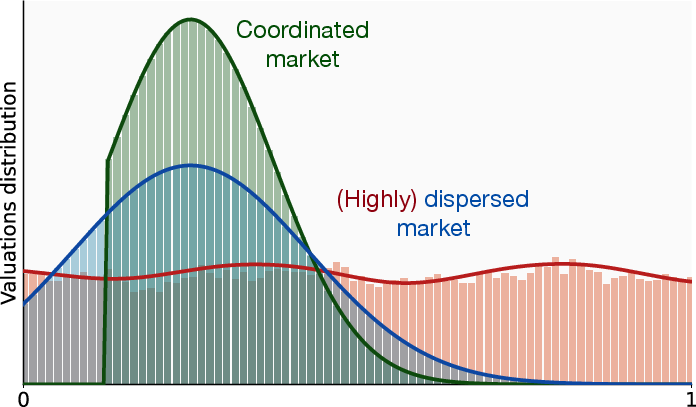
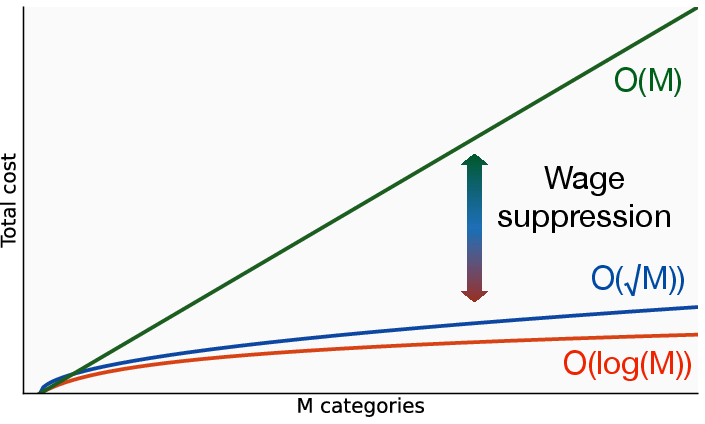
Figure 1: Illustration of market regimes under SWS; dispersed markets without a price floor (blue/red) allow platforms to achieve sublinear or even logarithmic costs, while coordinated markets with a collective price floor (green) force linear costs.
The cost regime realized under SWS is determined by the tail properties of workers' valuation distributions:
- Coordinated Markets (Price Floor): If every distribution has a positive lower bound, total payout is O(logM)0—the platform must pay a fixed minimum wage per task.
- Logarithmic Cost Regime: If the distributions are highly dispersed with linear left tails (e.g., uniform or exponential), total cost becomes O(logM)1.
- Constant Cost Regime: If there is a heavy mass near zero (e.g., right-skewed Beta distributions), total cost can be as low as O(logM)2, even for arbitrarily large O(logM)3.
The implication is that in the absence of coordination or regulatory wage floors, platforms can dramatically suppress total labor costs by algorithmically “waiting out” higher-valued workers, exploiting the stochastic presence of workers willing to accept arbitrarily low wages.
Collective Action: Horizontal vs. Vertical Strategies
The second core contribution is the analysis of collective action as a countermeasure. The paper distinguishes two organizing doctrines:
- Horizontal Collective Action: A random O(logM)4-fraction of workers across all task categories coordinate to only accept tasks above a fixed price floor.
- Vertical Collective Action: A specifically targeted set of the lowest-cost workers in a subset of categories coordinate on a price floor.
Horizontal organizing, even at scale, is shown to be essentially ineffective unless nearly all workers participate: the stochastic wage suppression strategy still exposes non-participating workers, preserving the possibility for the platform to achieve sublinear costs with only an increased constant in wait time and payments.
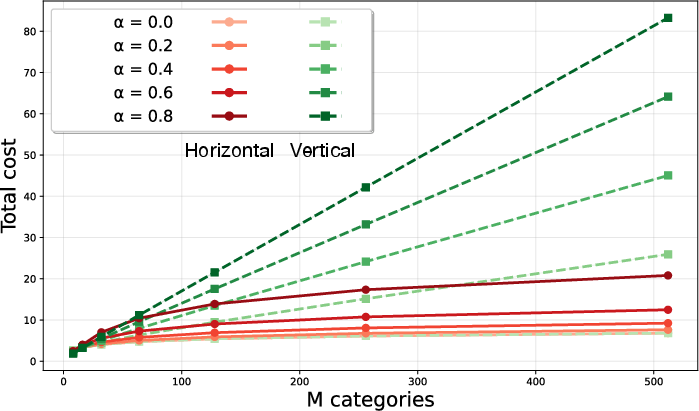
Figure 2: Comparison of total cost for horizontal vs. vertical collectives under SWS with a small budget O(logM)5—only targeted (vertical) organizing shifts the cost regime from sublinear to linear.
Conversely, vertical organization—removing the lowest O(logM)6-mass of the valuation distribution (i.e., explicitly targeting and collectively lifting the bottom of the market)—restores linear total cost even with modest resources, provided the target set includes all zero- or near-zero valuation workers.
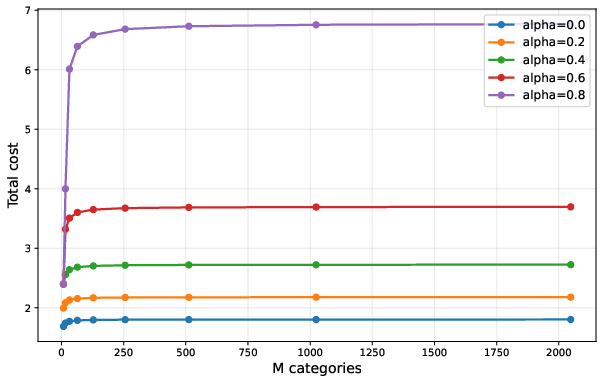
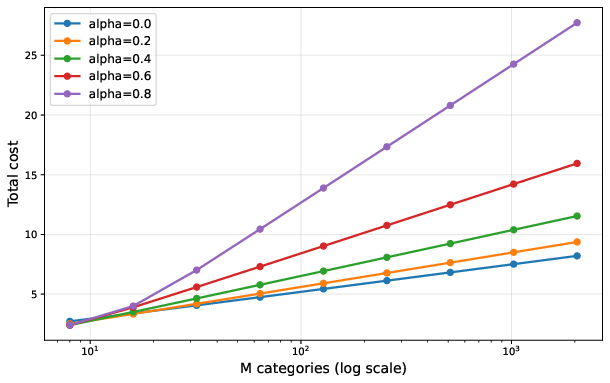
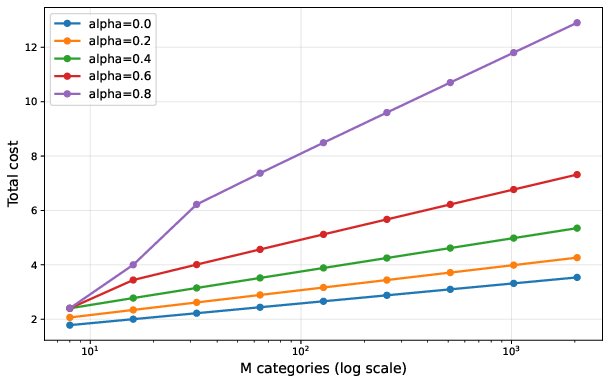
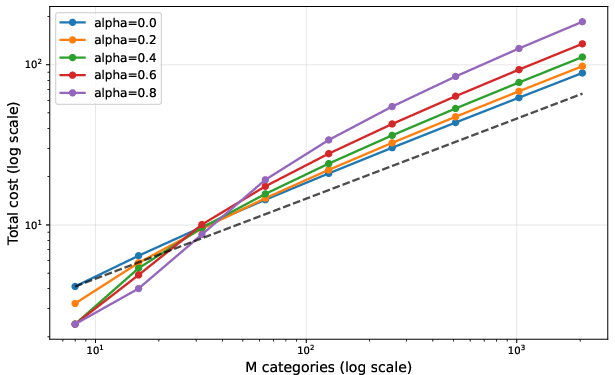
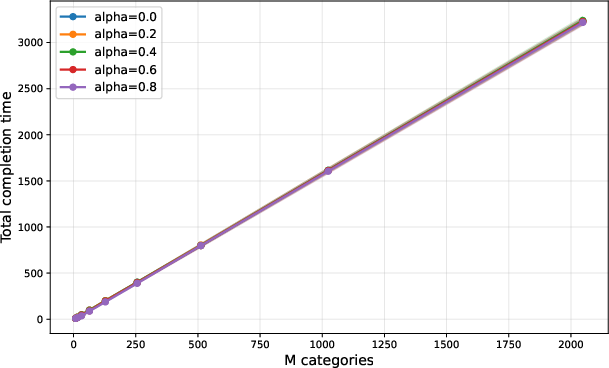
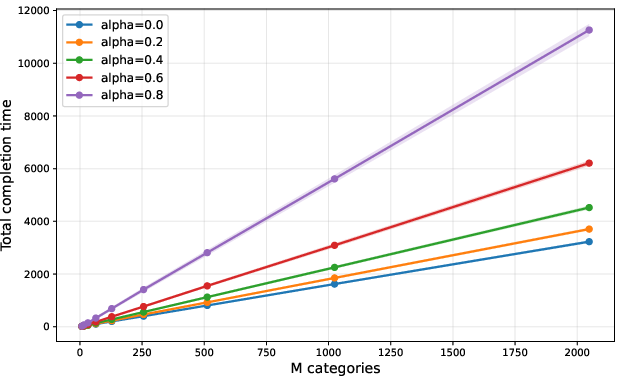
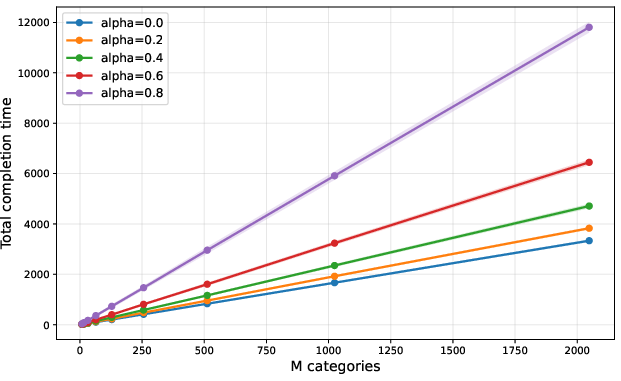
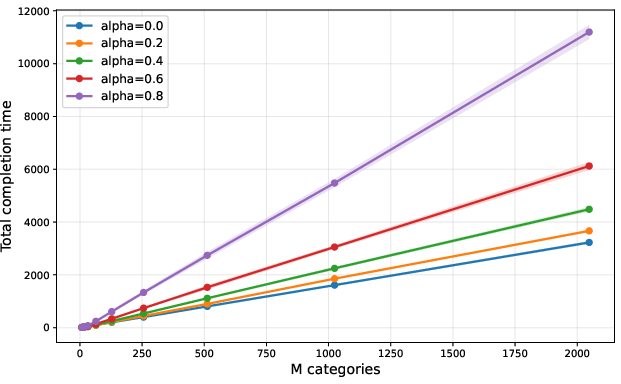
Figure 3: Total cost (top) and total wait time (bottom) for SWS under varying O(logM)7 (degree of vertical coordination) and different valuation distributions. Only vertical targeting can eliminate the sublinear cost regimes.
Synthetic Results
Monte Carlo simulations on synthetically generated market regimes empirically confirm theory:
- In uniform and exponential markets, horizontal collectives thin the arrival of low-cost acceptances, increasing costs by a constant, but do not change the asymptotic regime (O(logM)8).
- When a price floor is implemented even in a fraction of categories through vertical targeting, costs become tight O(logM)9, matching those under full collective coordination.
Implications and Future Directions
This model provides policy- and strategy-relevant insight into the mechanisms and robustness of platform wage suppression:
- In digital labor markets with high worker cost uncertainty and uncoordinated offers, platforms can achieve arbitrarily low average payouts per task, even when maintaining service times.
- Horizontal organizing or information-only campaigns are insufficient unless they reach essentially all low-wage participants.
- Successful worker-side interventions require targeted vertical coordination to “lift the tail” of valuations (i.e., organize those most vulnerable to exploitation).
- The analysis sharpens the focus for empirical data-collection—accurate modeling of valuation distributions and tracking the evolution of tails under platform strategies is critical.
Theoretically, extensions to interactive/dynamic learning of valuation distributions, multi-principal competition, and endogenous coalition formation remain open. Practically, the results indicate that even limited but well-targeted organizing can force platforms into the regime of fairer wage outcomes, raising total labor compensation by orders of magnitude.
Conclusion
The study establishes that stochastic wage suppression is a natural outcome on gig platforms under standard procurement models without wage floors or coordination, with costs possibly as low as O(1)0 per O(1)1 tasks. While naive or broad-based collective action has little bite, vertical, targeted organizing against the lower tail is both necessary and sufficient to compel platforms to pay prevailing market rates. The model provides a theoretical foundation for both regulatory interventions and the strategic allocation of organizing resources in algorithmic labor markets.