- The paper introduces FP-ANet, a fixed-point network integrating dual-attention to improve channel estimation in hybrid-field THz UM-MIMO systems.
- It combines a linear estimator inspired by OAMP with a non-linear dual-attention module to exploit channel sparsity and ensure rapid convergence.
- Numerical results show up to a 1.5 dB NMSE gain over state-of-the-art methods in a 1024-antenna THz system, confirming its practical efficacy.
FP-ANet: Attention-Augmented Fixed-Point Network for Hybrid-Field THz UM-MIMO Channel Estimation
Introduction
The proliferation of terahertz (THz) frequencies in 6G wireless systems has enabled ultra-massive multiple-input multiple-output (UM-MIMO) architectures, which leverage high antenna densities to compensate for severe propagation losses. However, ultra-massive array sizes expand the near-field region, creating hybrid near- and far-field propagation conditions. This hybrid environment presents significant challenges for channel estimation, chiefly due to model mismatch and high-dimensionality, which compromise the accuracy and efficiency of conventional compressive sensing and deep unfolding approaches.
Existing iterative channel estimation approaches in the THz UM-MIMO regime often fail to fully exploit channel structural sparsity, especially when treating hybrid-field scenarios as unified fields. Additionally, convergence guarantees in deep unfolding frameworks remain dubious, causing potential instability. Fixed-point network-based estimators such as FPN-OAMP provide convergence assurance but treat all channel features isotropically, limiting their adaptability to nuanced sparsity patterns.
This work proposes FP-ANet, a fixed-point attention network that integrates fixed-point theoretical guarantees with dual-attention mechanisms, targeting hybrid-field THz UM-MIMO channel estimation with improved structural exploitation and convergence rate.
FP-ANet is designed for an uplink THz UM-MIMO environment with a base station (BS) featuring a uniform planar array-of-subarrays (AoSA) structure. The hybrid field emerges due to the interplay between substantial array aperture and sub-millimeter wavelengths. The channel is characterized by both spherical (near-field) and planar (far-field) wavefronts, with path types determined by the Rayleigh distance.
Pilot signals from multiple user equipments (UEs) are aggregated over T time slots with random analog beamforming phase quantization (one-bit), and the received signal is transformed to a real-valued domain for algorithmic efficiency. The channel estimation task thus requires reconstruction of h from noisy measurements y and known matrix M, in a regime where conventional uni-field approaches suffer from structural mismatches.
FP-ANet Architecture and Algorithm
FP-ANet leverages fixed-point theory for iterative channel estimation, ensuring linear convergence to a unique equilibrium. Each iteration involves two modules:
- Linear Estimator (LE): Provides a coarse update via OAMP-inspired logic, delivering inputs uncorrelated with prior estimation errors.
- Non-Linear Estimator (NLE): Implements a learned dual-attention mechanism, exploiting both channel and spatial sparsity via dual-attention residual blocks (DARBs).
The dual-attention module synergistically refines both "what" (channel attention) and "where" (spatial attention), thus identifying significant sparse components in the angular-distance domain and amplifying salient features for improved estimation accuracy.
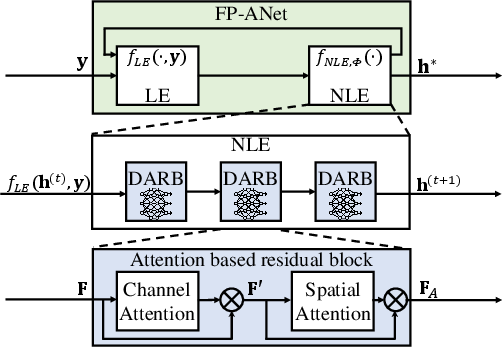
Figure 1: Network architecture of the FP-ANet.
The iterative FP-ANet deployment can be summarized as:
- Initialize channel estimate h(0).
- Repeat until convergence: h(k+1)=fΦ(h(k);y), where fΦ combines LE and NLE modules.
- Convergence is enforced by controlling the Lipschitz constant of the composite mapping via normalization schemes when necessary.
Complexity analysis reveals FP-ANet requires O(logϵ1(4N2NˉT+s)) operations per estimation, comparable to state-of-the-art approaches.
Numerical Evaluation
Extensive simulations in a 1024-antenna, 4-RF chain THz UM-MIMO system with mixed five-path hybrid fields demonstrate FP-ANet's superior channel estimation performance. The normalized mean squared error (NMSE) serves as the primary metric. Results across a range of SNRs indicate FP-ANet consistently outperforms all baselines, including FPN-OAMP, with a typical NMSE gain of 1.5 dB.
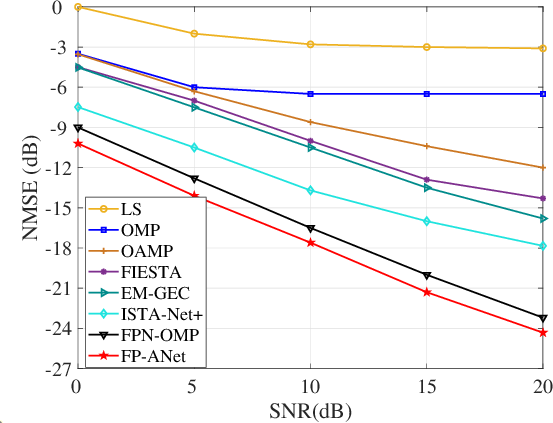
Figure 2: NMSE of channel estimation with various SNR levels.
The attention mechanism, especially effective at low SNRs, robustly differentiates weak channel paths from noise. Convergence analysis at 15 dB SNR confirms rapid attainment of lower NMSE floors, with near-optimal performance achieved within a few iterations, validating both architectural and theoretical claims.
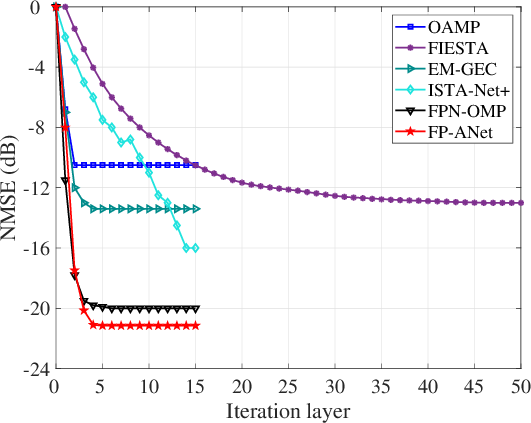
Figure 3: NMSE versus the number of iterations at an SNR of 15 dB.
An ablation study further demonstrates that the dual-attention module within NLE is the source of performance enhancement, not mere inclusion of attention. Replacement with standard self-attention leads to marked NMSE degradation, while enlarging the self-attention block incurs prohibitive computational costs for marginal gains. FP-ANet achieves an optimal trade-off between accuracy and computational efficiency.
Theoretical and Practical Implications
The integration of fixed-point analysis with dual-attention mechanisms adds convergence rigor and adaptive structural exploitation to channel estimation in THz UM-MIMO systems. FP-ANet's linear rate convergence, demonstrable NMSE improvements, and preserved computational complexity suggest its suitability for practical 6G deployments in scenarios with large antenna arrays and hybrid propagation fields.
Algorithmic guarantees via Lipschitz normalization enable deployment in real-time environments, while attention-driven sparsity modeling opens avenues for further research into adaptive neural architectures tailored to high-dimensional, hybrid-structured wireless channels.
Future Directions
Potential future developments include:
- Extension to wideband and multi-user scenarios with dynamic channel sparsity.
- Exploration of more complex attention modules or deeper residual networks for increased representational power.
- Integration with joint channel estimation and signal detection pipelines.
- Hardware acceleration and quantization techniques to further reduce computational overhead.
Conclusion
FP-ANet presents a technically substantiated advance in hybrid-field THz UM-MIMO channel estimation, achieving enhanced NMSE performance and convergence guarantees via fixed-point theory and dual-attention mechanisms. The demonstrated accuracy and efficiency position FP-ANet as a robust candidate for deployment in next-generation wireless systems, with promising directions for further refinement and application in adaptive communications and signal processing architectures.

