- The paper extends the KK-IPT framework to nonequilibrium steady states for the Anderson impurity model away from half filling using a novel two-parameter self-consistency approach.
- It accurately benchmarks spectral functions and transport properties against the AMEA method, demonstrating robust performance from weak to strong coupling regimes.
- The method reliably captures key features like the Kondo resonance and Hubbard bands, offering a computationally efficient tool for nonequilibrium DMFT studies.
Extension of KK-IPT to Nonequilibrium Steady States at Arbitrary Filling
Introduction
This work introduces a nonequilibrium extension of the Kajueter-Kotliar iterated perturbation theory (KK-IPT) framework for the Anderson impurity model (AIM), formulated to operate away from half filling and under steady-state bias. The approach is realized within the Keldysh Green's function formalism, enabling the efficient computation of spectral and transport properties for interacting quantum impurities out of equilibrium. The reliability of the scheme is systematically benchmarked against the auxiliary master equation approach (AMEA), a numerically accurate method in and out of equilibrium.
The nonequilibrium KK-IPT construction generalizes the self-energy (SE) Ansatz originally proposed by Kajueter and Kotliar for equilibrium arbitrary filling to finite bias and applies it within the steady-state Keldysh framework. The formulation is based on a two-parameter self-consistency involving the auxiliary chemical potential and filling, under the IPT-n0 closure. The practical choice of matching the impurity and Weiss-field occupations avoids ambiguities in the absence of a nonequilibrium Friedel sum rule and yields robust numerical performance in transport regimes.
The impurity problem is defined by the generic AIM, with the interacting site coupled to two biased reservoirs. The theory is designed to interpolate correctly between weak- and strong-coupling limits by explicit inclusion of the second-order contribution to the SE. All necessary Keldysh components are incorporated, and the approach supports arbitrary hybridization functions.
Equilibrium Validation
Benchmarking against AMEA in equilibrium, both near and well away from half filling, demonstrates that nonequilibrium KK-IPT provides high-fidelity results for spectral functions, Keldysh Green's function components, and occupation numbers across a range of interaction strengths.
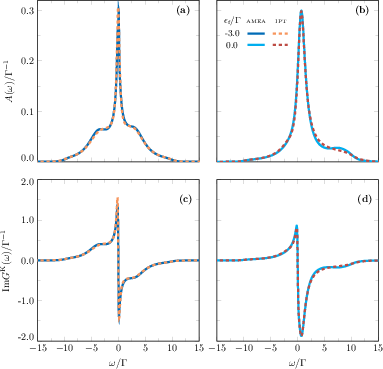
Figure 1: Spectral functions for two equilibrium impurity fillings, revealing close quantitative agreement between AMEA and KK-IPT across both lower and upper Hubbard bands and the central quasiparticle resonance.
Key features such as the lower and upper Hubbard bands and Kondo resonance structures are resolved with quantitative precision. The SE profiles obtained from KK-IPT closely follow those generated by AMEA near the chemical potential.
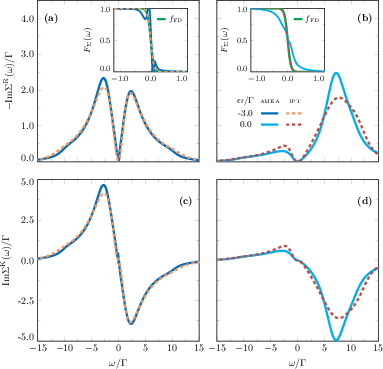
Figure 2: Imaginary part of the retarded self-energy under equilibrium conditions, with insets showing the generalized SE distribution function FΣ, highlighting the agreement between approaches and exact recovery of Fermi-Dirac statistics by KK-IPT.
Deviations between AMEA and KK-IPT can be traced to the finite auxiliary-bath discretization in AMEA, whereas KK-IPT remains free from such artifacts by directly utilizing the physical hybridization.
Nonequilibrium Transport and Spectral Functions
In steady-state transport at finite bias, the current and differential conductance were computed using the Meir-Wingreen formalism. Both AMEA and KK-IPT predictions were compared across a broad span of interaction strengths, temperatures, and impurity fillings.
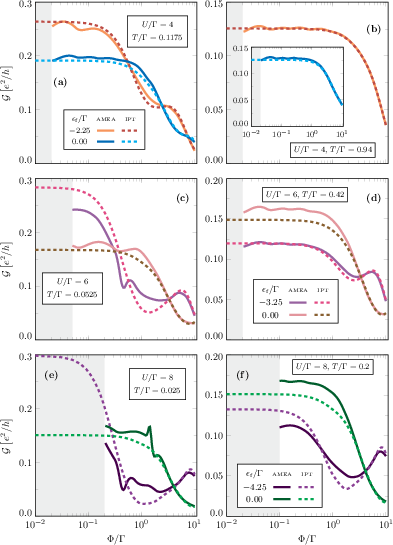
Figure 3: Nonequilibrium differential conductance as a function of bias voltage for several interaction strengths U and fillings, where KK-IPT and AMEA demonstrate quantitative agreement except in voltage/temperature regions where AMEA is numerically unstable.
KK-IPT reproduces the main conductance features observed in AMEA within its regime of reliability. An important finding is that at low temperatures and low biases—where AMEA convergence falters due to fitting limitations—KK-IPT maintains stability and produces smooth, physically consistent results.
Analysis of nonequilibrium spectral functions provides additional insight into the SE Ansatz's accuracy. Near half filling, KK-IPT captures the three-peak structure (Kondo resonance and Hubbard bands) and follows the bias-driven evolution and eventual splitting of the Kondo peak.
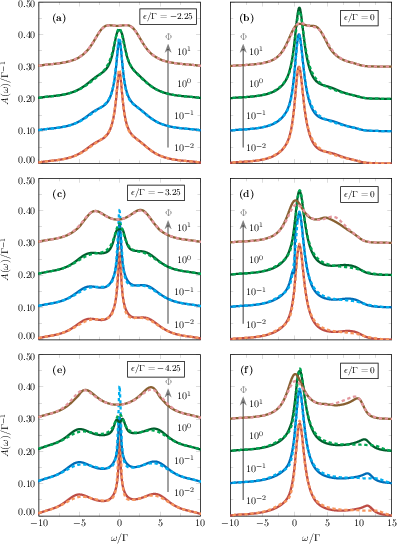
Figure 4: Nonequilibrium spectral function evolution versus bias and interaction strength U, demonstrating the emergence and suppression of Kondo and upper/lower Hubbard features, consistently modeled by KK-IPT relative to AMEA.
Further from half filling, KK-IPT accurately models the merging of the Kondo and lower Hubbard bands, though it can underestimate the upper Hubbard weight for high U. The transfer of spectral weight at large bias is also captured.
Thermodynamic Observables
The impurity occupation and double occupancy under bias were also computed. KK-IPT shows strong agreement with AMEA for weak to moderate correlations; systematic deviations appear for strong U and far-from-half-filling cases, primarily at large biases.
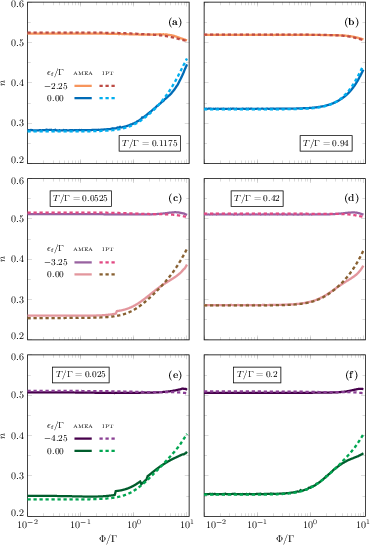
Figure 5: Particle number as a function of applied bias for different interaction strengths and fillings, showing the trend and close agreement between AMEA and KK-IPT at moderate U.
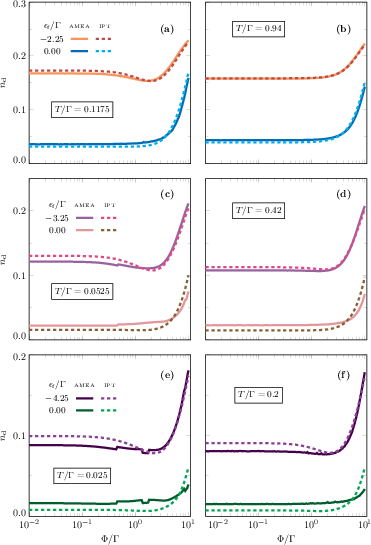
Figure 6: Double occupancy under steady-state bias as measured by AMEA and KK-IPT; the agreement persists up to moderate U, with both approaches revealing anticipated increases at large bias.
Implications and Future Perspectives
The demonstrated stability and computational efficiency of nonequilibrium KK-IPT render it a viable impurity solver for nonequilibrium dynamical mean-field theory (DMFT) studies. Its ability to deal with arbitrary filling and steady-state bias extends the toolkit for modeling realistic correlated heterostructures, transport devices under drive, and time-dependent strongly correlated phenomena with minimal computational overhead.
On the theoretical side, the approximation's accuracy in the most demanding regimes (low temperature, strong nonequilibrium) highlights the strengths of physical interpolative schemes, motivating more systematic studies of analytic SE constructions. However, the non-uniqueness of nonequilibrium generalizations remains, and no direct counterpart to exact equilibrium constraints like the Friedel sum rule can be invoked; alternative closures may be investigated in future work. Extension to multiorbital systems, incorporation of spin-polarized leads, or the analysis of systems with structured hybridization functions are immediate directions for further development.
Conclusion
The nonequilibrium KK-IPT framework for arbitrary fillings, as constructed in this work, provides a computationally inexpensive, stable, and quantitatively reliable method for out-of-equilibrium quantum impurity problems in both equilibrium and steady-state nonequilibrium regimes. Its close agreement with numerically exact benchmarks in relevant regimes, numerical stability in challenging conditions, and ease of extension make it a promising tool for the study of strongly correlated electron transport and for integration into nonequilibrium DMFT workflows. Further exploration of closure schemes and formal comparisons to numerically exact methods in more complex physical settings will clarify the boundaries of validity and utility of this formalism.