- The paper introduces a two-stage framework that combines physics-guided shadow synthesis with penumbra-aware restoration to address shadow distortions in aerospace imagery.
- Utilizing PDSS-Net and PCDS-Net, the method models spatially-varying illumination decay and incorporates dynamic attention mechanisms for precise shadow recovery.
- Experimental results demonstrate superior generalization, higher fidelity in penumbra transitions, and effective artifact suppression compared to existing approaches.
Physics-Guided Shadow Synthesis and Penumbra-Aware Deshadowing for Aerospace Imagery
Introduction
High-resolution aerospace imagery (ASI) is foundational to numerous geospatial applications, yet is persistently challenged by the presence of cast shadows arising from elevated terrain, infrastructure, and atmospheric conditions. These shadows induce substantial spectral distortion, texture loss, and boundary ambiguities, impairing downstream vision tasks. Existing shadow removal methods, particularly those rooted in deep learning, face critical limitations when directly ported to ASI: the acute scarcity of paired training data and the inadequacy of homogeneous shadow region assumptions due to prevalent broad and spatially heterogeneous penumbra transitions. This paper introduces AeroDeshadow, a two-stage framework that systematically addresses these obstacles by integrating physically-constrained shadow synthesis and penumbra-aware restoration, yielding robust generalization from synthetic to real-world ASI.
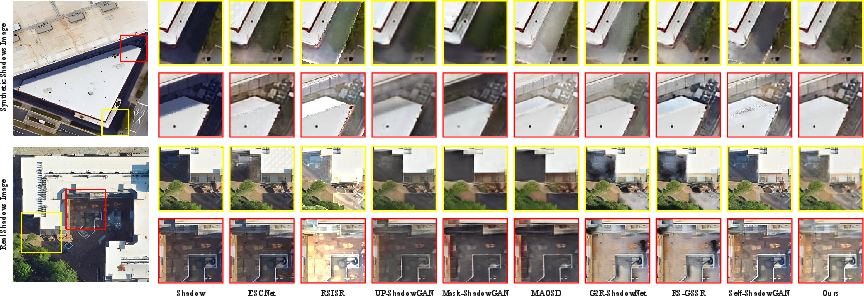
Figure 1: Comparison of shadow removal results; AeroDeshadow shows fewer artifacts at boundaries and superior color consistency in penumbra, on both synthetic and real images.
AeroDS Benchmark and Dataset Construction
Real-world, pixel-level paired shadow/shadow-free imagery is effectively unattainable in ASI, necessitating physically motivated dataset synthesis. The AeroDS benchmark is proposed, encompassing AeroDS-Syn—a large-scale, physically plausible paired dataset for supervised training—and AeroDS-Real, an out-of-distribution test set for evaluation in challenging, real-world ASI environments. Both datasets feature multi-temporal, high-resolution imagery spanning diverse global geographic distributions.
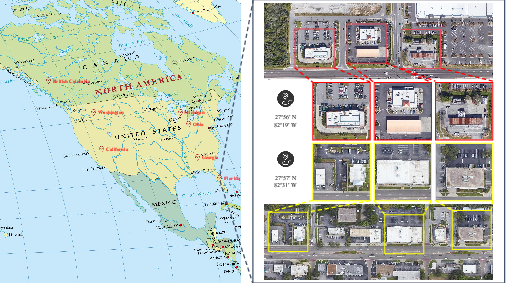
Figure 2: Diverse global geographic distribution and representative samples from the AeroDS dataset.
Paired data synthesis is underpinned by a physics-based model of solar and diffuse atmospheric illumination attenuation. Leveraging this, authentic pseudo-shadow masks and physical statistical priors are applied to shadow-free images, creating realistic, soft-boundary shadowed imagery critical for method development and benchmarking.

Figure 3: Samples from AeroDS-Syn (synthetic) and AeroDS-Real (real-world) datasets.
Physics-Aware Degradation Shadow Synthesis Network (PDSS-Net)
To bridge the synthetic-real domain gap in ASI, PDSS-Net is introduced, encoding the physical process of shadow formation. The pipeline initiates with the extraction of spatially-varying illumination decay parameters—channel-wise scaling and bias—directly from real ASI, distinguishing umbra from neighboring lit pixels via morphological operations. Next, a physics-guided linear degradation process, modulated by edge-preserving soft masks, creates coarse, physically faithful synthetic shadows.
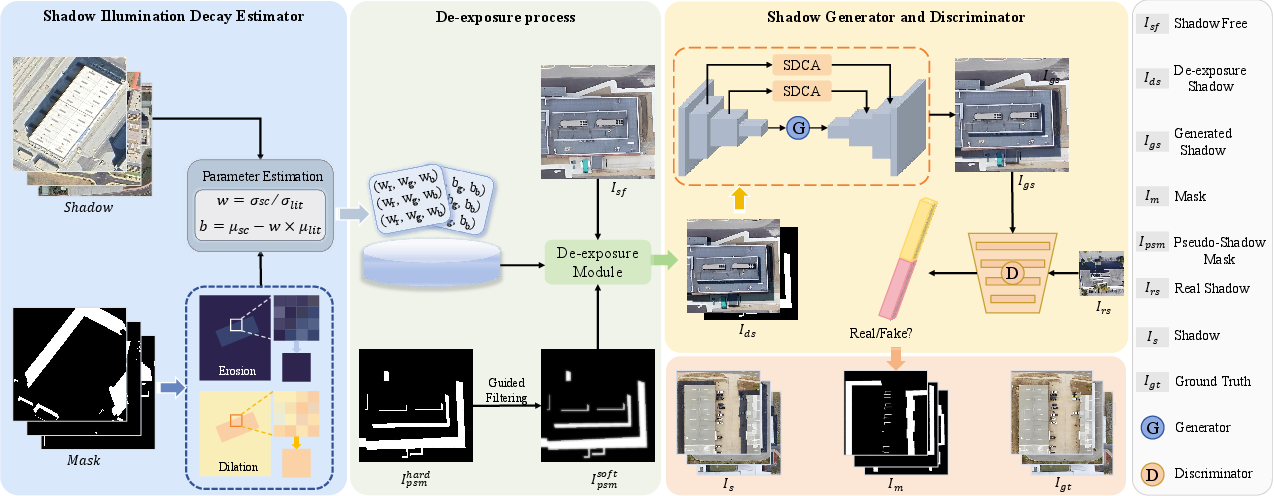
Figure 4: Dataset synthesis pipeline: extraction of physical priors, initial physics-guided synthesis, and GAN-based refinement with SDCA for penumbra modeling.
A refinement stage is implemented using a CycleGAN-based generator enhanced by a novel Spatial-Decay Coordinate Attention (SDCA) module. SDCA explicitly decouples local sharpness (to model umbra edges) and the non-linear attenuation characteristic of the penumbra. This dynamic, multi-branch attention efficiently parameterizes spatial decay, ensuring that the generated shadows preserve core geometric structure while gradually transitioning in regions of variable illumination.
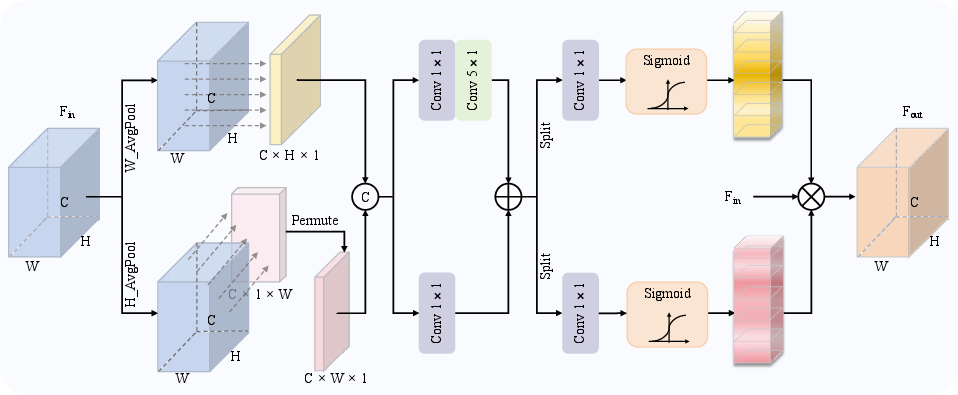
Figure 5: The SDCA module separates local perception (umbra) and decay simulation (penumbra) branches within feature extraction.
Penumbra-Aware Cascaded DeShadowing Network (PCDS-Net)
Conventional binary or patch-based restoration strategies are systematically inadequate for ASI, leading to over-correction, color inconsistency, and edge artifacts. PCDS-Net addresses this by explicitly decoupling umbra and penumbra streams via mask-guided morphological operations. The architecture comprises three components: a two-stream encoder for specialized feature extraction, an Attention Feature Fusion (AFF) module for dynamic integration, and a cascaded decoder for progressive refinement.
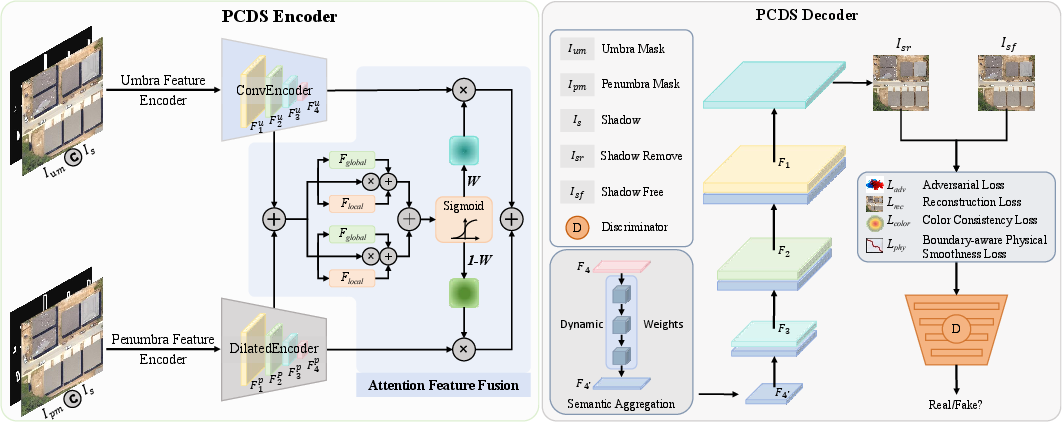
Figure 6: PCDS-Net’s cascaded architecture separates input into umbra and penumbra branches, combining features with dynamic attention and progressive reconstruction.
Umbra decoding focuses on high-frequency texture preservation, while the penumbra stream leverages dilated convolutions for receptive field expansion, capturing local boundary context. The AFF module learns pixel-wise, non-linear weights for selective feature integration, surpassing naive channel-concatenation and mitigating feature interference. The cascaded decoder reconstructs the shadow-free output hierarchically, ensuring semantic and spatial consistency across scales.
Experimental Results
Shadow Synthesis
Quantitative evaluation against strong baselines on AeroDS-Syn demonstrates that PDSS-Net achieves an SLR (shadow-to-lit ratio) distribution closest to real references, with the broadest coverage of underlying physical illumination variance. Many competing GAN and diffusion-based approaches (e.g., Mask-ShadowGAN, G2R-ShadowNet, UP-ShadowGAN) suffer from global color drift, intensity oversimplification, or step-like transitions.
Qualitative profile analysis across shadow boundaries corroborates this: PDSS-Net uniquely yields non-linear, physically consistent attenuation in penumbra, largely eliminating sharp discontinuities or spurious coloration.
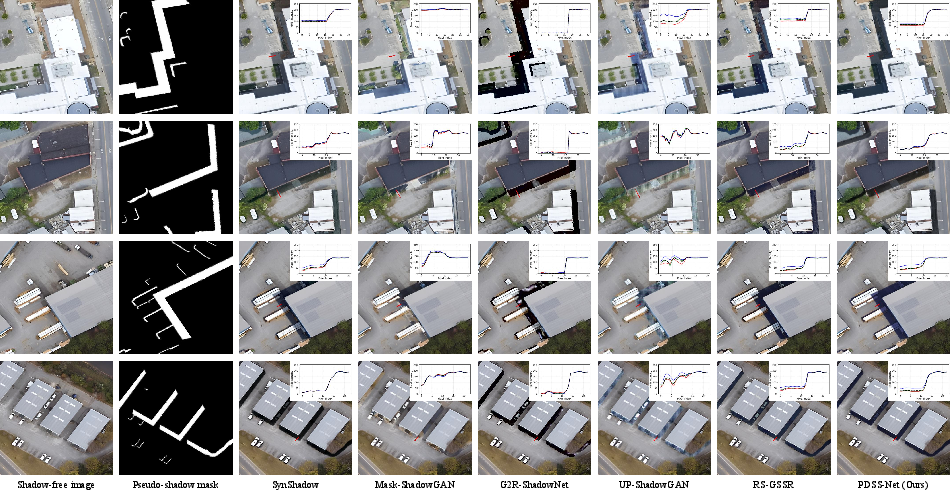
Figure 7: Comparison of shadow synthesis methods; only PDSS-Net displays physically realistic, smooth attenuation in penumbra boundary profiles.
Shadow Removal
On AeroDS-Syn and SRGTA, PCDS-Net achieves the highest PSNR (21.91 dB), SSIM (0.79), and lowest RMSE (11.35), surpassing strong GAN, CNN, and transformer-based baselines. Evaluation on real sets (AeroDS-Real, AISD) using entropy and BRISQUE metrics demonstrates robust cross-domain generalization, with minimal spectral distortion and effective artifact suppression, even for shadows superimposed on complex textures or environmental structures.
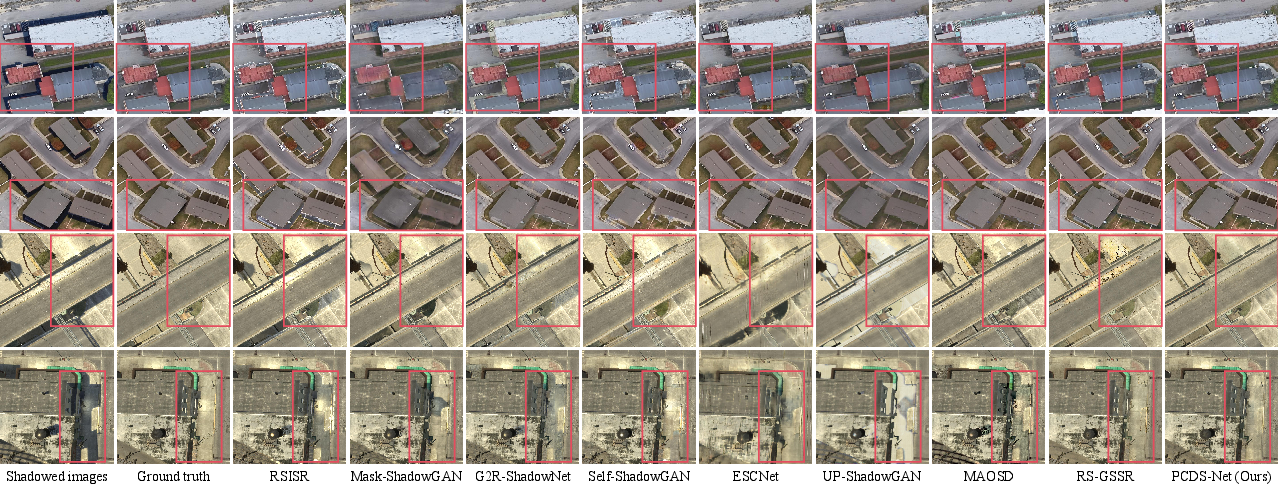
Figure 8: Qualitative comparison on synthetic datasets; PCDS-Net demonstrates seamless penumbra transitions and high-fidelity detail recovery.
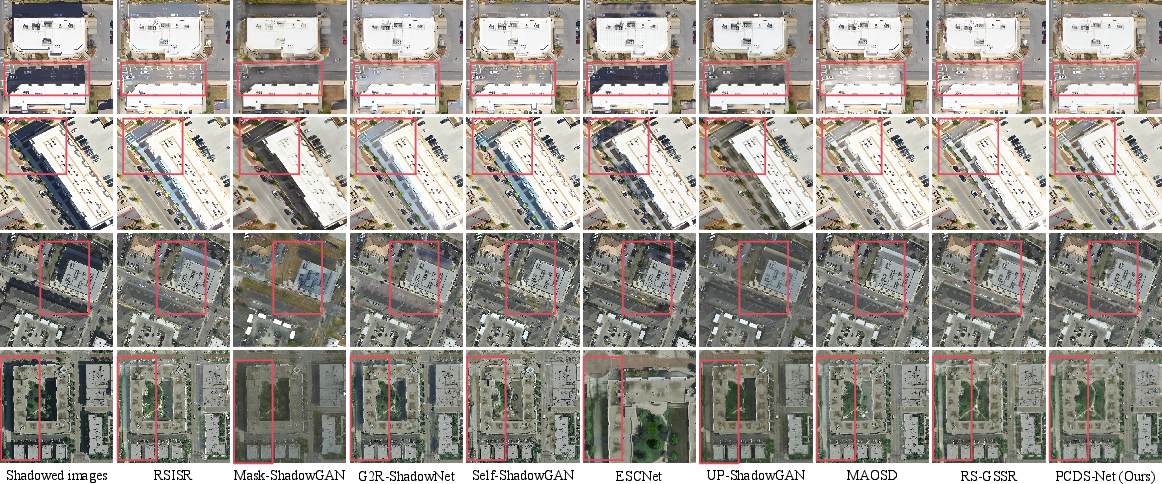
Figure 9: Shadow removal on real ASI (cross-domain); PCDS-Net uniquely suppresses blue-green color distortions and structurally fractures evident in other methods.
Ablation Studies
Removal of the de-exposure process or SDCA module in PDSS-Net significantly degrades physical fidelity and produces unnatural shadow boundaries—validating the necessity of these components.
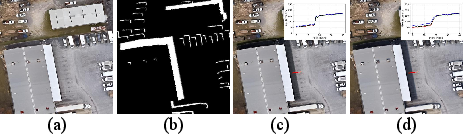
Figure 10: Ablation: omission of SDCA causes boundary artifacts and intensity ringing; full PDSS-Net precisely models penumbra attenuation.
Ablations on PCDS-Net reveal that single-stream (umbra/penumbra only) architectures fail to simultaneously recover texture and illumination transitions; integrating both with AFF yields optimal perceptual and structural metrics. Replacing AFF with simple concatenation also results in substantial performance degradation and the re-introduction of visual artifacts.
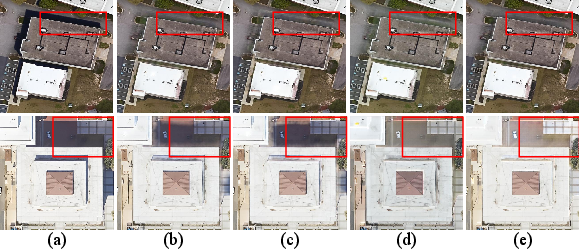
Figure 11: Qualitative ablation of PCDS-Net; only the full framework achieves both sharp textural reconstruction and physically consistent illumination gradients.
Theoretical and Practical Implications
The adoption of physical modeling in the synthesis pipeline provides robust priors for effective network training when paired data is infeasible. The explicit penumbra-aware, decoupled architecture confers critical advantages in handling spatially heterogeneous degradation, directly addressing longstanding limitations of homogeneity in existing approaches. These contributions facilitate significant advances in realistic shadow removal, thereby enhancing the integrity of downstream tasks such as target detection and scene analysis in ASI. Furthermore, the modular design of AeroDeshadow permits adaptation to more complex forms of occlusion (e.g., clouds) and facilitates expansion to more advanced physical priors or domain adaptation strategies.
Conclusion
AeroDeshadow unifies physical illumination modeling and modern attention-driven feature extraction to simultaneously address the paired-data bottleneck and domain-specific degradation complexity in ASI shadow removal. Comprehensive quantitative and qualitative analysis establishes clear advantages over both statistical and deep learning alternatives. Future directions include the integration of these advances with end-to-end pipelines for critical geospatial interpretation tasks and the extension of the physical forward model to capture atmospheric and environmental complexity beyond cast shadows.