- The paper introduces JFinTEB, the first benchmark specifically designed for evaluating Japanese financial text embeddings across multiple realistic tasks.
- It utilizes rigorous evaluation protocols including macro-F1, NDCG@10, and V-measure to compare both specialized and multilingual models.
- Results demonstrate the advantages of domain adaptation and model scaling, offering practical guidelines for deploying NLP in Japanese finance.
JFinTEB: A Comprehensive Benchmark for Japanese Financial Text Embeddings
Motivation and Context
The development and deployment of robust text embedding models has become critical for information retrieval and natural language understanding in industry-specific domains. Finance, as a domain where textual data (regulatory filings, disclosures, market news, survey responses) is central, has seen significant evolution of specialized benchmarks in English and Chinese, such as FinMTEB. However, the Japanese financial sector—a major world market—lacked a systematic evaluation suite tailored for its unique linguistic and domain-specific phenomena. General embedding benchmarks (e.g., MTEB, MMTEB, JMTEB) either neglect finance altogether or focus on general-purpose language understanding, leaving a substantial gap for Japanese language applications.
The authors address this gap with JFinTEB, the first focused benchmark for Japanese financial text embedding, offering structured and realistic task design, public datasets, replicable evaluation code, and strong baselines. This suite targets both the development of domain-adapted models and critical analysis of cross-lingual embedding transfer in the financial context.
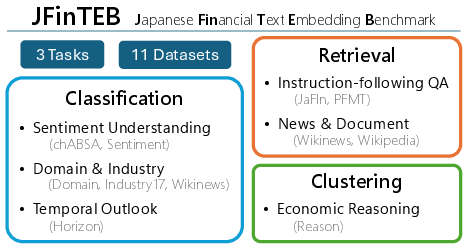
Figure 1: Overview of JFinTEB benchmark, illustrating the broad coverage of classification, retrieval, and clustering tasks in Japanese financial text understanding.
Benchmark Design and Task Structure
JFinTEB comprises 11 validated tasks, stratified across classification, retrieval, and clustering, with careful curation to reflect realistic finance-specific use cases in Japan. Task selection emphasizes genuine operational scenarios (e.g., market surveys, regulatory Q&A, corporate information retrieval) over artificially difficult constructs. The benchmark includes:
- Classification: Sentiment analysis (chABSA, Economy Watchers Survey subsets), domain categorization, economic horizon prediction, news and industry classification.
- Retrieval: Financial FAQ retrieval (JaFIn), multi-turn regulatory Q&A (PFMT), news headline-document matching, Wikipedia-based corporate information access.
- Clustering: Economic reasoning category induction from survey comments.
All datasets are either derived from authoritative public sources (Wikipedia, Wikinews, Economy Watchers Survey) or constructed de novo with high-quality, script-driven pipelines and controlled label assignments. Two constructed datasets—Industry 17 and Industry 33—enable fine- and coarse-grained evaluation of corporate sector classification, leveraging Tokyo Stock Exchange listings.
Rigorous quality assurance removes tasks exhibiting model size instability or significant validation-test set divergence, operationalized through evaluation across diverse model families.
Evaluation Protocol and Model Coverage
JFinTEB follows established protocols for task-specific evaluation—macro-F1 for classification, NDCG@10 for retrieval, V-measure for clustering—facilitating direct comparability with previous Japanese (JMTEB) and multilingual (MTEB/MMTEB) benchmarks. Evaluation code closely tracks open-source frameworks to guarantee replicability.
Fourteen embedding models are benchmarked, encompassing:
- Japanese-specialized models: Ruri (contrasted across scales), Sarashina (1.2B, SOTA on JMTEB), GLuCoSE (LUKE-based).
- Multilingual models: E5 (large/base/small), Jina, OpenAI text-embedding-3 (commercial, API-based).
- Domain adaptation baselines: BERT and FinBERT, with FinBERT pre-trained on Japanese financial corpora.
This selection allows for detailed analysis of the impact of domain adaptation, model scale, and language specialization.
Results and Numerical Findings
Performance analysis reveals several salient points:
- Specialization advantage: Japanese-specialized models attain the highest average scores (Sarashina, 80.9; Ruri_310M, 79.4), narrowly outperforming top multilingual models (E5_large, 79.3; Jina, 79.0; OpenAI_large, 79.0).
- Task category breakdown:
- In classification, Sarashina and E5_large are leading.
- In retrieval, Jina, Sarashina, and OpenAI_large converge at the top.
- Task sensitivity: Retrieval tasks (especially JaFIn, Wikipedia retrieval) exhibit the largest model-type performance gaps, indicating higher sensitivity to training regimen and pretraining corpus.
- Model scale correlation: A consistent trend is observed where larger models outperform their smaller counterparts within both Japanese-specialized and multilingual families—demonstrating the benefit of scaling.
- Domain adaptation efficacy: FinBERT outperforms generic BERT, validating the value of further pretraining on domain-specific corpora for Japanese financial language, in line with outcomes from FinMTEB for English and Chinese.
Practical and Theoretical Implications
JFinTEB’s results have direct operational import for both academic research and production deployment in the financial sector:
- Model selection: For resource-unconstrained settings, Sarashina is optimal; for intermediate compute, Ruri_310M is preferable; for API-based or non-local deployment below 100M parameters, OpenAI_large or Ruri_30M are recommended.
- Retrieval task maturation: High retrieval metrics reflect the maturity of embedding-based retrieval for well-demarcated queries in Japanese finance. However, this also exposes the need for future, more complex retrieval tasks (e.g., cross-document inference, long-context retrieval) to meaningfully differentiate model capabilities.
- Data contamination: Superior performance of commercial models on certain tasks possibly results from exposure to public source material during pretraining—underscoring the complexity of ensuring “clean” evaluation and the value of JFinTEB's transparency regarding dataset provenance.
- Domain adaptation research: The advantage of FinBERT suggests further gains are available by extending domain pretraining to other Japanese architectures, and that lessons from high-resource language adaptation generalize to Japanese.
Resource Availability, Limitations, and Future Directions
JFinTEB offers full transparency and accessibility: datasets, baseline scripts, and evaluation code are released under clear licensing on GitHub. The benchmark is free from personally identifying information and constructed entirely from public or anonymized sources, with known provenance and potential biases (e.g., survey respondent composition, Wikipedia topical coverage) disclosed.
Several avenues for further work are identified:
- Expansion to long-document retrieval and generative or RAG-based financial tasks, to better simulate operational finance pipelines.
- Incorporation of human-centric or judgment-based evaluation, particularly for tasks reliant on nuanced financial reasoning.
- Ongoing maintenance and curation to track evolving needs of Japanese financial NLP applications and to support cross-lingual transfer studies.
Conclusion
JFinTEB establishes a new standard for evaluating Japanese financial text embeddings, bringing the ecosystem on par with English and Chinese counterparts. Empirical results demonstrate a narrowing performance gap between specialized and multilingual models, but also reinforce the value of large-scale, domain-adapted architectures for nuanced financial tasks. The benchmark both satisfies immediate evaluation needs for Japanese financial NLP and provides a scalable template for future extension into more complex, realistic, and cross-lingually robust embedding evaluation.
JFinTEB acts as both a foundation for scientific rigor and a catalyst for innovation—facilitating reproducible research, systematic analysis, and practical deployment in Japan's dynamic financial information landscape (2604.15882).

