- The paper demonstrates that integrating SVGD with EDA mitigates premature convergence by leveraging kernel-induced repulsion among agents.
- It applies a variational EDA perspective with quantile-based fitness transformations to enable robust, diversity-preserving updates.
- Experimental results show superior performance on rugged, high-dimensional NK landscapes, validating scalability and sample efficiency.
Stein Variational EDA for Discrete Black-Box Optimization
Problem Setting and Motivation
Black-box combinatorial optimization involving expensive fitness queries demands a search paradigm that balances broad exploration with rapid convergence to high-performing regions. Traditional Estimation-of-Distribution Algorithms (EDAs) frame optimization as iterative, population-based density estimation over solution spaces, but suffer from premature distributional collapse and mode-seeking limitations, particularly in high-dimensional or rugged multimodal landscapes. Attempts to improve this, notably via bio-inspired multi-agent schemes, offer heuristics but lack a unifying, theoretically-grounded mechanism for sustaining diversity and covering multiple optima.
This work introduces Stein Variational Gradient Descent (SVGD) as a formal mechanism to regularize population diversity in EDAs, leveraging kernel-induced repulsion between agent distributions. SVGD has established theoretical underpinnings for variational inference in the continuous setting. Here, it is transposed to combinatorial, non-differentiable problem domains by acting in the parameter space of generative probabilistic models for solutions.
Methodology
Variational EDA Perspective
The proposed framework interprets EDA as maximizing the expectation of f(x) under a generator πθ, regularized via entropy, thus approximating a Boltzmann distribution in parameter space:
p(θ)∝exp(γ1Ex∼πθ[f(x)])
This perspective enables sampling-based multi-agent variational inference, where each "agent" parameterizes a discrete probability model, typically independent Bernoulli or categorical for pseudo-Boolean and NKD-type landscapes.
Stein Variational Gradient Descent
SVGD evolves a set of particles (parameter vectors) to minimize the KL divergence to the Boltzmann target, via a transport mapping informed jointly by the gradient of the target's log-density and a kernel repulsion term:
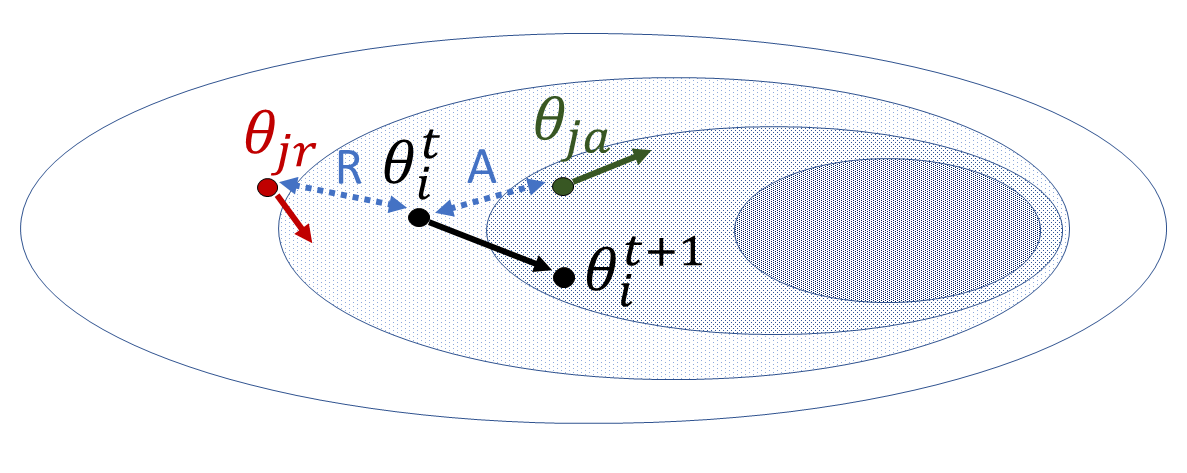
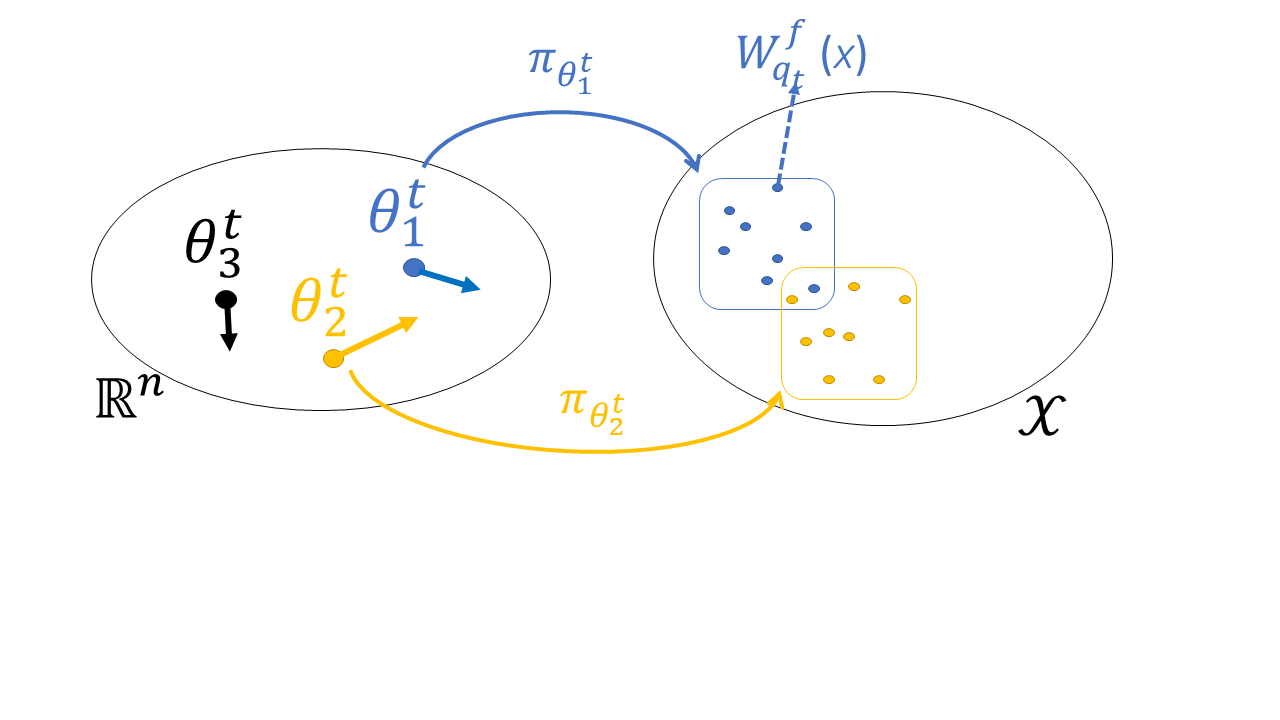
Figure 1: SVGD particle update, showing the interplay of attraction towards high-density regions and repulsion for diversity preservation.
The update for each particle θi incorporates:
- Attraction towards modes via functional gradients of logp(θ), estimated through Monte Carlo sampling over the agent's policy.
- Population diversity preservation through RKHS-kernel repulsion in parameter space.
Monotonic Objective Invariance
To address the sensitivity of direct objective-based updates to fitness scale, the framework applies a quantile-based transformation (inspired by CMA-ES, PBIL, and IGO) to each sampled fitness, ensuring invariance under strictly monotonic transformation of f(x). The agent updates maximize a transformed probability of outperforming current-agent populations, formally:
Jtf(θ)=Ex∼πθ[Wqtf(x)]
Practical Implementation
Each agent models a univariate Bernoulli (for binary) or categorical (multi-class) probabilistic generator. Parameter updates use SVGD with adaptive RBF kernels in logit/parameter space, parallelized efficiently in modern tensor frameworks.
Experimental Results
Benchmark Landscape Validation
SVGD-EDA was benchmarked against 83 algorithms (including classical EDAs and numerous baselines from Nevergrad) on pseudo-Boolean and categorical NK/NK3 landscapes, varying size (n=64,128,256) and ruggedness (K=1,2,4,8). The multi-agent SVGD-EDA secures 1st place in 17 of 24 tested configurations and consistently attains superior or near-best ranks as problem size and combinatorial complexity increase.
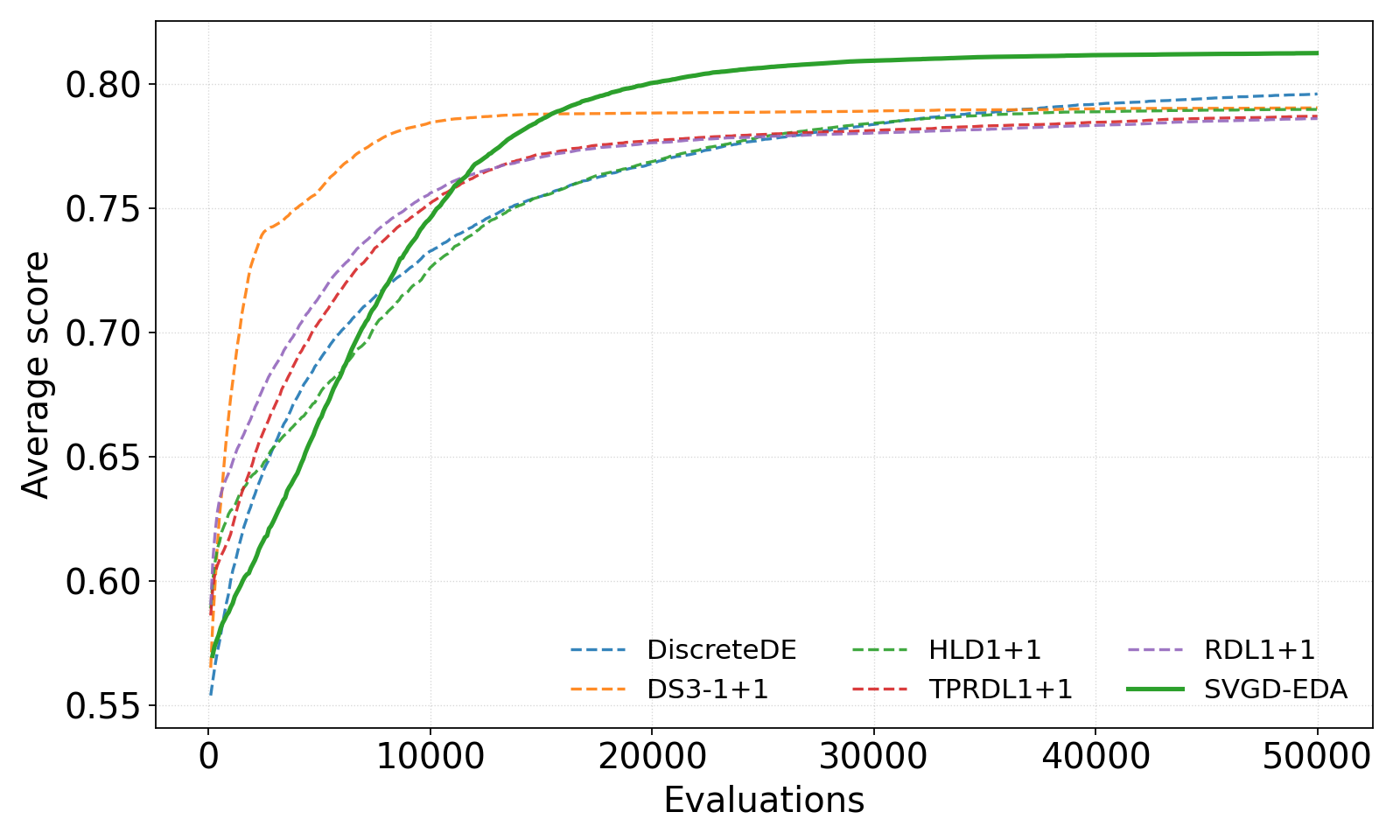
Figure 2: Left: SVGD-EDA exhibits a sustained increase in best-found fitness over 50,000 evaluations, outperforming its closest competitors. Right: SVGD-EDA yields a consistently higher and narrower distribution of final scores.
Notably, SVGD-EDA dominates as n increases (πθ0) and in more rugged landscapes, where alternative EDAs and evolutionary heuristics stagnate due to early convergence. The population-level diversity imparted by SVGD repulsion is central to this scalability and robustness.
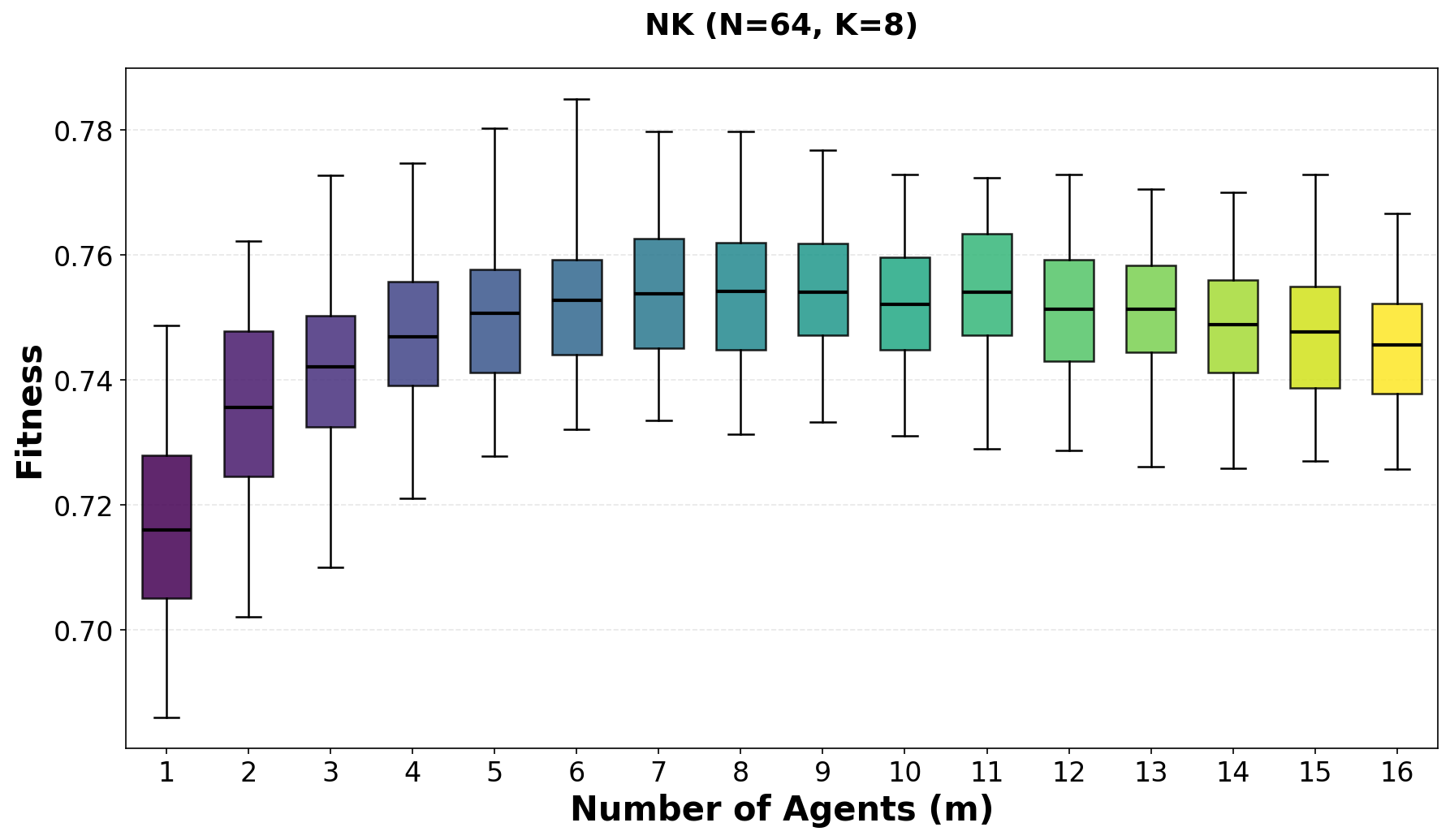
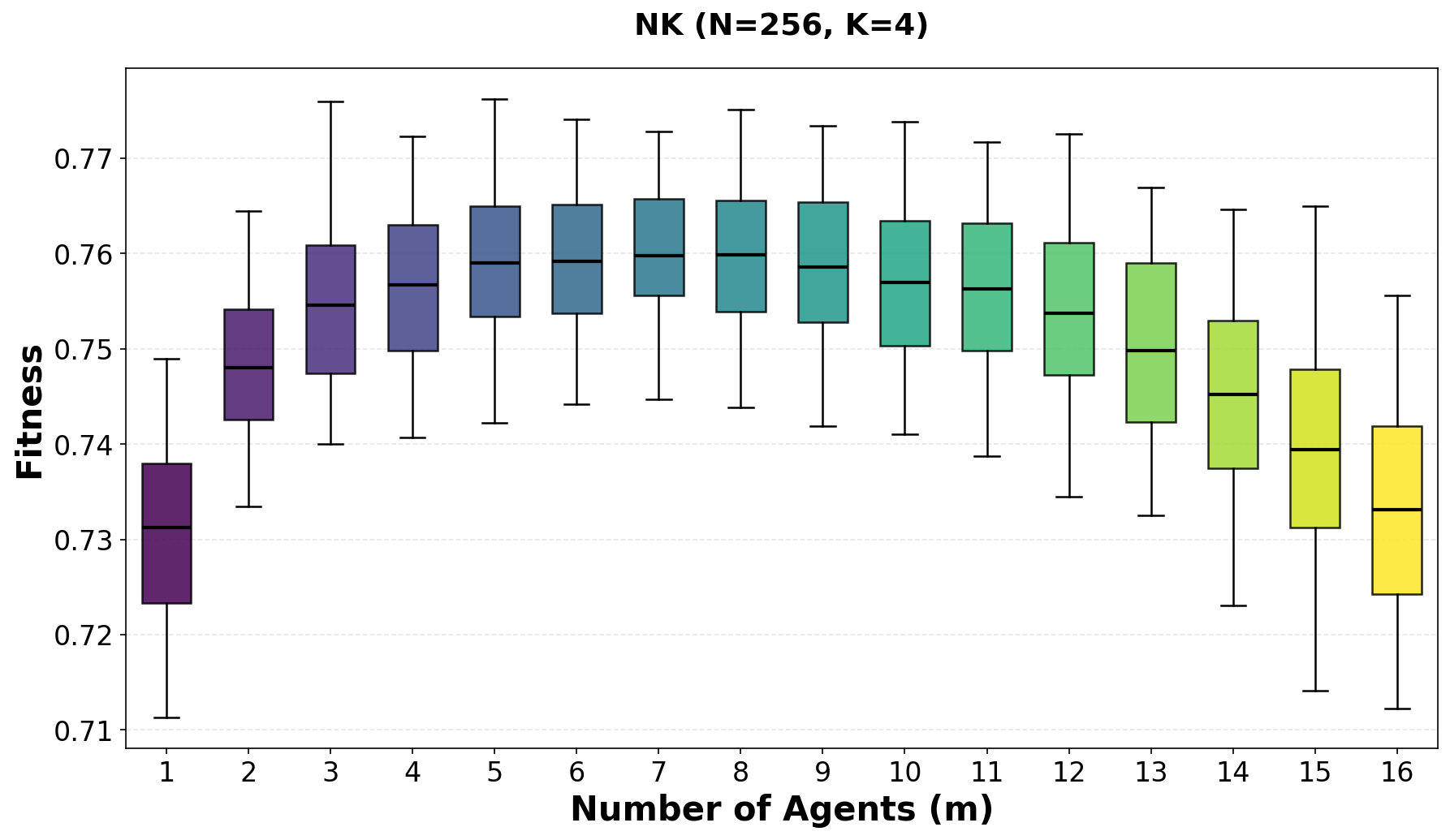
Figure 3: Distribution of fitness over independent runs on a rugged NK instance; SVGD-EDA exhibits higher median and reduced variance relative to standard EDAs.
Mechanistic Ablations
Ablation studies isolate the effect of kernel-induced inter-agent repulsion. Without this interaction, parallel EDAs (no kernel term) exhibit rapid stagnation in complex landscapes, converging to sub-optimal basins from which escape is rare—demonstrating that kernel-based diversity maintenance is fundamental for effective high-dimensional search.
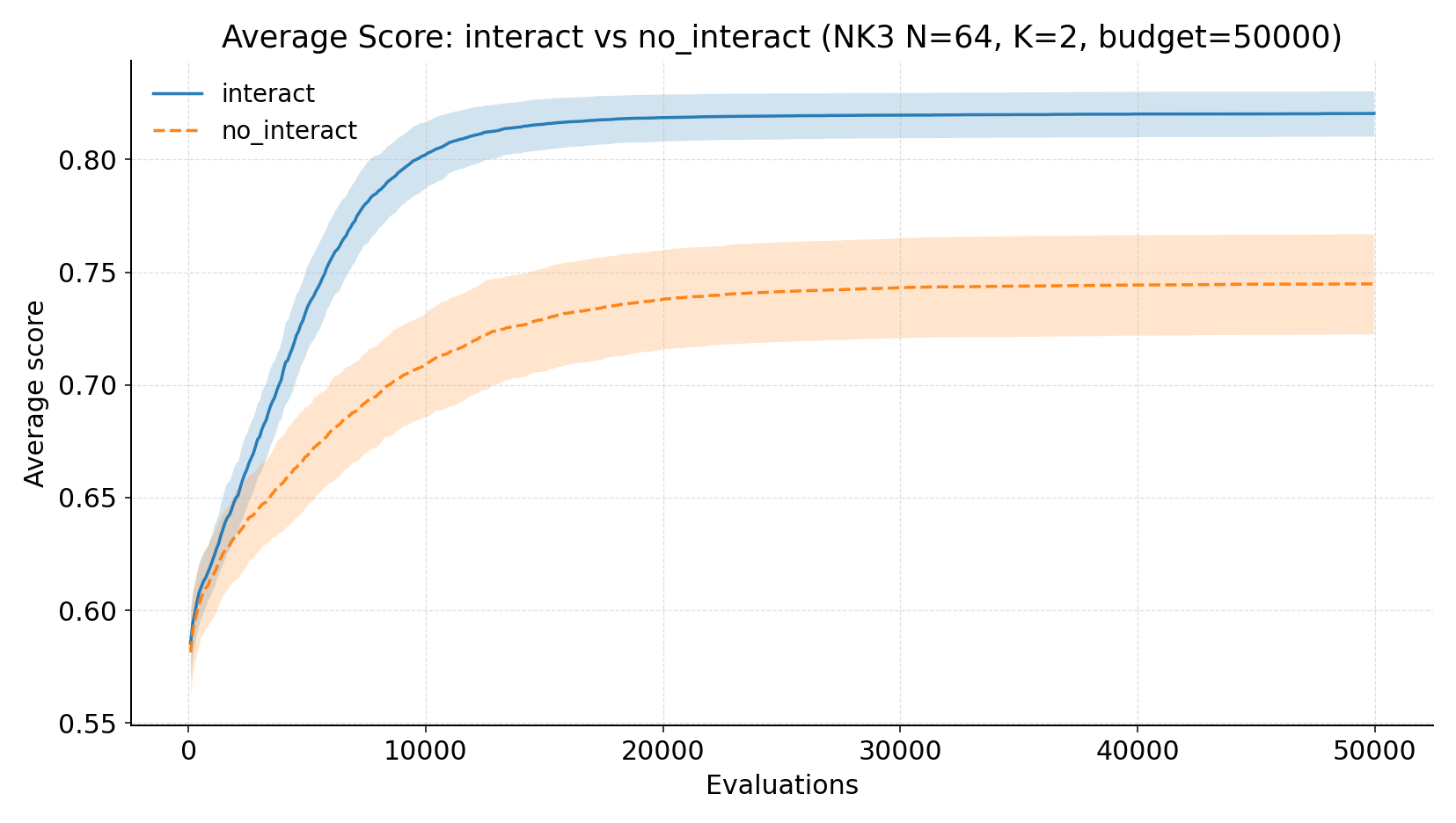
Figure 4: Cooperative (blue) SVGD-EDA continues to improve whereas independent agents (orange) stagnate, highlighting the essential role of repulsive interaction forces.
Implications and Future Directions
This work provides compelling evidence that kernelized particle-based variational inference frameworks, such as SVGD, are highly competitive for discrete black-box combinatorial optimization, extending principles from continuous Bayesian inference and entropy-regularized learning to combinatorial model classes. Practically, SVGD-EDA reduces the need for problem-specific exploration–exploitation balancing, requiring minimal tuning and leveraging high-throughput hardware.
The positive empirical results suggest multiple directions for future research:
- Information-geometric kernels: Move beyond Euclidean RBFs to Fisher-Rao or Jensen-Shannon kernel measures for population repulsion directly in probabilistic model space, amplifying semantically meaningful diversity.
- Population management: Explore asynchronous and sparse-update regimes to further balance exploration, mitigate evaluation budget dilution, and support even larger scales.
- Integration with richer models: Substitute univariate models with richer graphical or autoregressive structures, capturing variable dependencies without sacrificing tractability.
These directions are likely to yield further gains, particularly in black-box AI research and real-world combinatorial application domains where sample efficiency, population resilience, and global optimization are paramount.
Conclusion
By introducing SVGD as a multi-agent, diversity-preserving mechanism for EDA in discrete, non-differentiable black-box optimization, this work rigorously addresses the mode-seeking and premature convergence limitations of existing heuristics. The approach is computationally efficient, theoretically grounded, and supported by strong empirical dominance on large-scale combinatorial benchmarks. The repulsive mechanism between agents is essential for performance in high-dimensional, multimodal spaces. This SVGD-based population approach lays the foundation for principled, scalable, and adaptive combinatorial EDA methods and highlights new avenues for population-based optimization in AI (2604.15837).