- The paper demonstrates that WriteFlow’s voice-based interaction effectively scaffolds goal articulation and metacognitive regulation in academic writing.
- The qualitative study with HCI experts revealed enhanced writer agency, reduced goal drift, and improved alignment between evolving intentions and final text.
- The research highlights that iterative goal refinement and transparent AI feedback can transform conventional LLM tools towards reflective, goal-driven composition.
AI-Supported Goal Setting in Academic Writing: A Critical Analysis of WriteFlow
Introduction
The paper "From Intention to Text: AI-Supported Goal Setting in Academic Writing" (2604.15800) presents WriteFlow, an AI-driven, voice-based writing assistant embedded in Google Docs. The system aims to scaffold metacognitive self-regulation in academic writing by supporting continuous goal articulation, refinement, textual alignment, and self-evaluation. The study addresses the limitations of mainstream LLM-based writing tools, which typically prioritize efficiency but underemphasize support for writer agency and metacognition. Through a combination of a formative study and an expert user evaluation, the paper elucidates both the pedagogical and practical implications of aligning AI writing support with reflective, goal-driven processes.
Motivation and Background
The cognitive process theory of writing treats academic writing as a recursive, intention-driven activity, not a mere linear transcription task. While expert writers dynamically manage abstract and concrete goals throughout the writing process, many students struggle to articulate, revise, and monitor evolving intentions. The advent of LLMs like ChatGPT has transformed writing practices, providing surface-level fluency but often encouraging cognitive offloading and diminishing self-regulation, as noted in recent critical works [fan2025beware, kosmyna2025your, duenas2024risks]. Current AI writing tools rarely facilitate recursive goal-setting or the ongoing maintenance of alignment between emergent text and writer intentions—a gap this work seeks to address.
System Architecture and Workflow
WriteFlow is engineered as a multimodal add-on for Google Docs, consisting of a conversational voice agent and a sidebar panel organizing the writing process into goal-focused activities: Writing Task, AI Chat, and My Goals. Users engage with the voice agent to externalize intentions, which are then formalized into explicit writing goals. These goals become actionable objects within the interface, allowing for progress monitoring, self-evaluation, and iterative refinement. The system incorporates features for linking goals to outline sections and textual segments, as well as tools for evaluating the alignment between completed drafts and established goals.
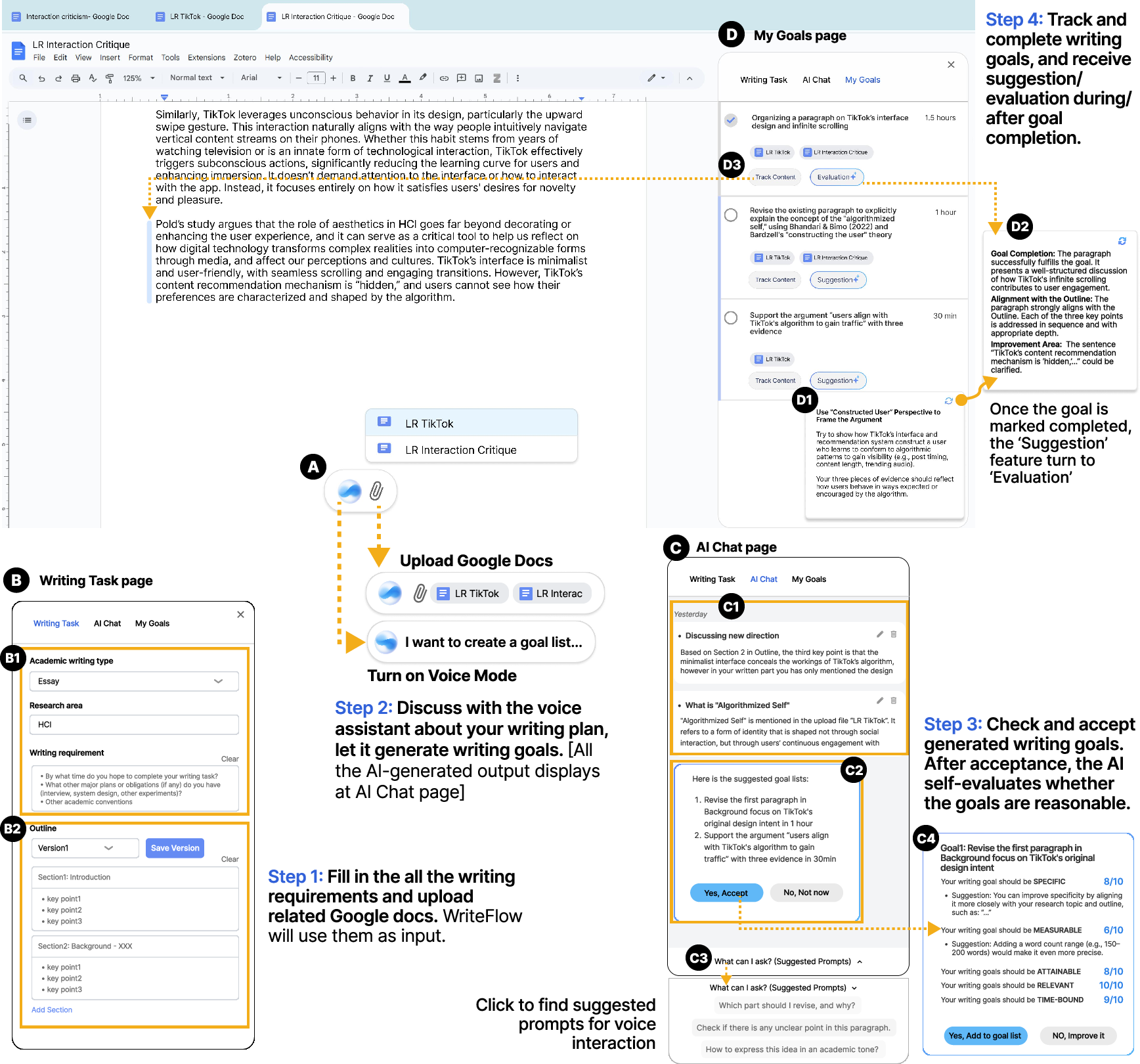
Figure 1: The WriteFlow Google Docs add-on architecture, illustrating how goal-oriented interaction complements drafting and revision via a dialogic AI agent and sidebar instrumentation.
This architecture foregrounds flexible, hierarchical goal management and supports the recursive nature of academic writing, addressing deficiencies in linear, text-generation paradigms.
A preliminary survey involving 17 adult academic writers surfaced three principal challenges: (1) evolving writing goals, (2) difficulties in goal articulation, and (3) preserving authentic authorship amidst AI assistance. Thematic analysis of open-ended responses also highlighted divergent strategies for managing goal drift and reconciling human-in-the-loop versus automated ideational support. Resultant design requirements emphasize goal articulation, iterative refinement, flexible organization, authorial control, and transparent, intentional AI feedback.
User Study: Expert Evaluation of WriteFlow
A Wizard-of-Oz study with 12 HCI-experienced participants entailed longitudinal interaction with a high-fidelity WriteFlow prototype during authentic academic writing tasks. The procedure involved initial goal generation with AI, active drafting, confrontation with misalignments (via comparing text and outlines), and reflective evaluation.

Figure 2: Sequential protocol for the expert user study, encompassing goal setting, drafting, and post-task interviews to triangulate self-regulatory processes.
Data from think-aloud sessions and semi-structured interviews underwent inductive, thematic analysis, with coding organized around the five derived design requirements.
Key Findings
Facilitated Goal Articulation: The voice-based modality enabled writers to clarify vague ideas, catalyze divergent perspectives, and externalize tacit intentions—benefits unattainable with static prompt-based generators.
Iterative Goal Refinement and Tracking: Users leveraged WriteFlow to continuously adapt writing plans with minimal cognitive overhead, maintaining directional focus during revision cycles. The ability to navigate goal-linked text segments was especially valuable for complex tasks (e.g., reviewer-driven updates).
Metacognitive Awareness and Goal-Text Alignment: The system’s Goal Completion Evaluation nudged writers toward reflexive assessment of content-goal congruence, countering the tendency of LLMs to drift from initial intentions. Visualization and hierarchical mapping of goals were requested for reducing cognitive load and enhancing goal networks.
Preservation of Agency and Authorship: Participants reported enhanced authorial control versus mainstream LLM tools, with AI functioning as a responsible partner rather than an authoritative content provider. Explicit accept/reject points and transparency in AI reasoning promoted informed decision-making and critical scrutiny.
Demand for Multi-Perspective Feedback: Users preferred alternative or multiple suggestions over single authoritative outputs, as multiplicity was seen as critical for maintaining epistemic openness and supporting deeper exploration.
Implications and Contrasts with Prior Work
Unlike previous AI writing assistants that limit metacognitive interventions to planning (VISAR [zhang2023visar]) or revision (Friction [zhang2025friction], ALure [neshaei2025leveraging]), WriteFlow uniquely scaffolds goal alignment throughout drafting. Its explicit support for recursive goal monitoring and adjustment fills a notable gap in SRL-based AI tool design. Participants’ nuanced feedback challenges a one-size-fits-all approach, emphasizing the necessity for adaptive prompting and customizable feedback modalities to mediate cognitive load and maintain reflective depth.
The results also underscore that AI explainability and traceability are not solely trust-building devices but serve as catalysts for productive reflection, enabling writers to verify automated judgments against human intentions (see [liao2021human, hoque2024hallmark]).
Numerical Results and Claims
The study is primarily qualitative; however, several strong claims are asserted:
- All expert participants articulated that WriteFlow improved their metacognitive regulation of goals during writing, compared to their prior experiences with mainstream LLM-based tools.
- Participants emphasized enhanced agency and critical engagement, reporting that explicit decision points (accept/reject/refine) led to higher perceived control over AI outputs.
- Writers noted a reduction in goal drift and increased ability to maintain alignment between intentions and final text, especially during complex, multi-stage writing tasks.
These findings, while interpretive, are grounded in comprehensive qualitative data (12 expert user sessions, 18 hours of interaction, 6 hours of interviews).
Limitations and Future Directions
The evaluation leverages a high-fidelity Wizard-of-Oz protocol with HCI-domain experts, restricting generalizability across broader populations and writing domains. The setup prioritized interactional depth over the evaluation of final textual outputs—a tradeoff that limits claims about downstream writing performance. The findings advocate for adaptive, context-aware prompting and further integration of multi-perspective, workflow-aware feedback into human-AI writing partnerships.
Longitudinal studies with diverse, self-directed writing contexts, as well as integrations with domain-specific rubrics and peer-oriented evaluation paradigms, are critical for advancing this research agenda. Additionally, computational augmentation for customizable goal network visualization and refinement is a promising direction.
Conclusion
WriteFlow exemplifies a move toward AI writing assistants that prioritize reflective, goal-driven writing rather than content production efficiency. By integrating dialogic interaction, iterative goal management, and transparent feedback mechanisms, the system foregrounds writer agency and metacognitive awareness throughout the drafting process. These design affordances contrast with conventional LLM-based tools and address emergent challenges in the epistemic authenticity of AI-assisted academic writing. The implications extend to the development of next-generation AI writing systems that scaffold intentional engagement, support self-regulated learning, and maintain alignment with dynamic human goals.

