- The paper demonstrates that a long-baseline mechanical gradiometer can amplify gravitational wave signals by leveraging the geometric D/L ratio.
- It employs double-arm balances with suspended masses and interferometric readouts to achieve a two-orders-of-magnitude signal gain while mitigating environmental noise.
- The design delivers competitive sensitivity in the critical 0.05–1 Hz band, promising new avenues for observing astrophysical phenomena.
Differential Gradiometer Design for Low-Frequency Gravitational Wave Detection
Introduction
This paper proposes a novel mechanical gravitational wave detector, focusing on frequencies between $0.05$–$1$ Hz—a gap not addressed by future space-based missions (such as LISA) or next-generation terrestrial interferometers (like Einstein Telescope and Cosmic Explorer). The design leverages long-baseline, vertically oriented differential gradiometers composed of double-arm balances, where each arm suspends a substantial mass with a long wire and counterweight at the opposite end. This geometric and mass distribution sharply enhances response to gravitational wave (GW) strains by amplifying tilt signals relative to conventional torsion pendulum architectures.
The detector aims to utilize current advances in precision mechanical balances, low-noise suspensions, and interferometric angular readouts, as recently demonstrated in instruments such as tiltometers and the Archimedes experiment.
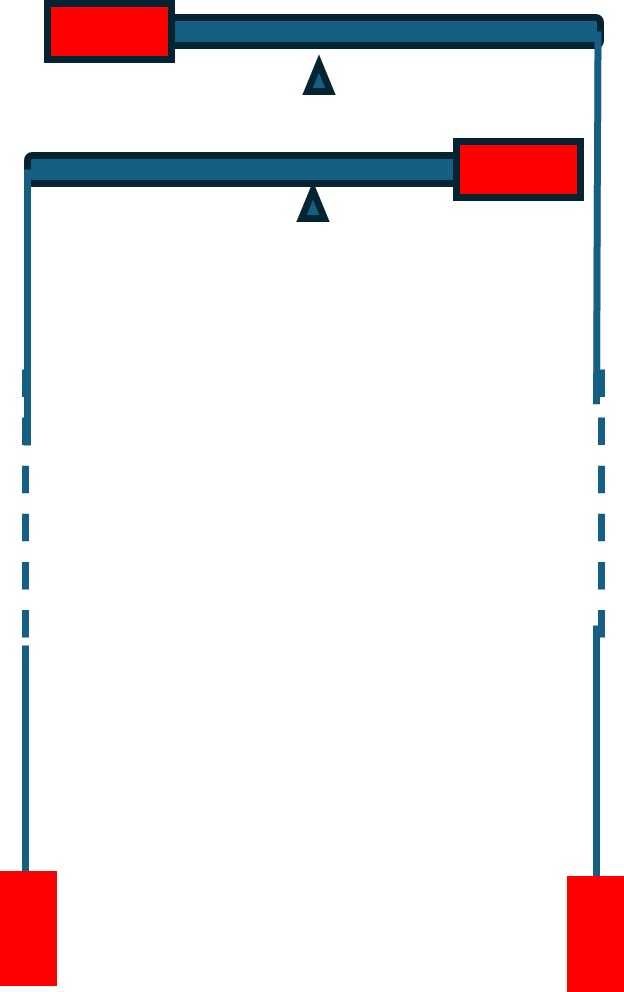
Figure 1: Schematic of the proposed differential gradiometer detector: two vertically oriented arms, each forming a gradiometer, produce a differential rotation signal measured via interferometry.
Operating Principle and Signal Response
The interaction of a GW with a suspended test mass generates a time-dependent force, expressible in the detector’s proper frame as
Fi=2mh¨ijTTξj
where ξj denotes the mass position vector and hijTT is the transverse traceless GW tensor. For "+" polarization and optimal orientation relative to the GW, the signal of interest becomes the differential rotational response of the balance arms.
Key to the proposed configuration is that the suspended mass hangs from a wire of length D, while the arm length is L, with D≫L. The arm’s tilt angle θ then contains a component proportional to h(D/L), enhancing the GW-induced signal by the geometric lever arm ratio. This fundamentally distinguishes the gradiometer from conventional torsion pendula, which achieve only $1$0 for comparable mass distributions.
The detailed equations of motion demonstrate that, for a realistic implementation, the effective moment of inertia remains relatively small (dominated by the suspended masses at $1$1), ensuring that the gain factor $1$2 in GW coupling does not entail an unacceptably large inertial penalty. For a practical model—$1$3 m, $1$4 m, $1$5 kg—the gain factor approaches two orders of magnitude.
Feasibility: Realistic Implementation
The paper delineates a practical gradiometer setup based on demonstrated technologies:
- Test masses of $1$6 kg (comparable to Einstein Telescope payloads)
- Suspension wires or elastic joints with lengths $1$7 m
- Arms of $1$8 m with $1$9 kg mass
- Sapphire joints of 150 mm width, 0.1 mm thickness, and 30 mm height
The mechanical parameters yield a fundamental suspension resonance at Fi=2mh¨ijTTξj0 mHz and mechanical loss angle Fi=2mh¨ijTTξj1. Finite element analyses validate the structural and vibrational integrity.
Importantly, two gradiometers are operated in a differential configuration, with arms displaced vertically by tens of cm. This not only doubles the GW signal but significantly suppresses common-mode environmental and Newtonian noise, given systematic vertical seismic gradients.
Noise Analysis and Sensitivity
Thermal, seismic, and Newtonian noise sources form the sensitivity floor across the targeted band. The angular sensitivity, as projected from the modeled parameters and state-of-the-art noise limits, is displayed in Figure 2.
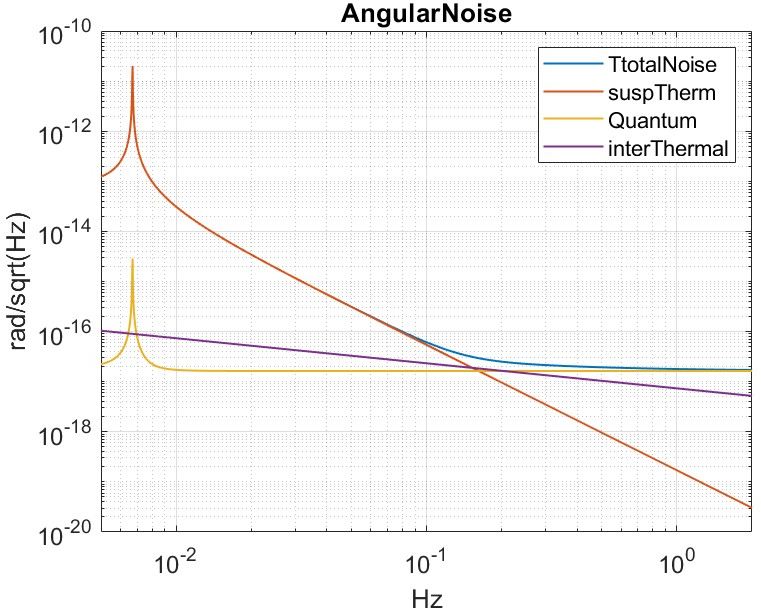
Figure 2: Angular sensitivity of the detector, including thermal, seismic, and Newtonian noise projections, delineating fundamental performance constraints.
The corresponding strain sensitivity in dimensionless GW amplitude Fi=2mh¨ijTTξj2 (Figure 3) demonstrates that the proposed differential gradiometer delivers competitive performance relative to existing atomic interferometry and mechanical detectors in the Fi=2mh¨ijTTξj3 Hz region. The limiting noise below Fi=2mh¨ijTTξj4 Hz is Newtonian, with the model predictive based on the Peterson New Low Noise Model and assuming an underground Sardinian site (Sos Enattos).
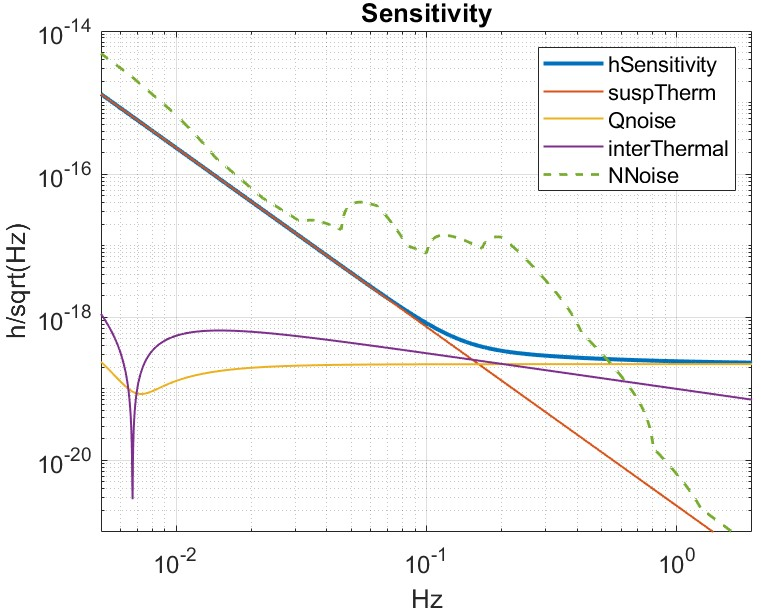
Figure 3: Projected strain sensitivity for the differential gradiometer, showing the impact of Newtonian noise in the relevant frequency band.
No currently operating instrument has achieved the absolute angular noise floor required (at or below Fi=2mh¨ijTTξj5 at 1 Hz), but continuous advancements in interferometric readout, low-loss materials, and suspension engineering suggest practical attainability of the presented limits.
Implications and Outlook
The approach embodies a mechanically straightforward, scalable concept, allowing large physical GW coupling without the practical constraints of kilometer-scale interferometers or the seismic decoupling limitations of classical torsion bars. The enhanced response (scaling as Fi=2mh¨ijTTξj6) puts meaningful GW sensitivity in the previously inaccessible Fi=2mh¨ijTTξj7–Fi=2mh¨ijTTξj8 Hz regime, contingent on continued mitigation of Newtonian noise through site selection, depth, and advanced subtraction/array methods [harms1, harms2, harms3, harms4].
The theoretical implications include the possibility of extending the GW observation window to intermediate-mass black hole binaries, galactic binaries, and exotic sources whose mergers and inspirals fall in this band, potentially overlapping and cross-verifying signals with atomic interferometry and nascent space observatories.
Deployment of a network of such detectors, with site-optimized noise cancellation and coordinated data analysis, would importantly complement ground-based and space-based GW observatories, improving sky localization, signal confirmation, and astrophysical reach.
Conclusion
This differential long-baseline mechanical gradiometer design rigorously addresses the low-frequency gap in gravitational wave detection, leveraging geometric signal amplification, modern suspension, and interferometric technologies. With projected strain sensitivity at the level of atomic interferometry platforms and prospects for further noise reduction, the approach stands as a complementary probe for the Fi=2mh¨ijTTξj9–ξj0 Hz GW window. The concept is poised for rapid experimental development, with theoretical and practical implications for the future landscape of GW astronomy.

