- The paper introduces a framework that utilizes finite-size tensor-network flows to extract universal conformal data with high precision.
- It systematically separates universal CFT scaling from non-universal lattice effects by leveraging transfer matrix spectra and spin quantization.
- Benchmarks on the Ising and 3-state clock models demonstrate errors as low as 10⁻⁶, offering a robust diagnostic for tensor network RG algorithms.
Introduction and Context
The paper proposes and analyses a comprehensive framework for extracting universal conformal data from 2D critical classical lattice models via finite-size tensor-network flow. The motivation arises from both the efficacy and limitations of fixed-point-tensor-based approaches, which require accurate identification of RG fixed points but suffer from controlled and uncontrolled non-universal features such as corner double line (CDL) structures and bond-dimension-induced truncation effects. There is presently no rigorous universally-accepted lattice definition of tensor-network fixed points or of their universal eigenspectra, motivating a more robust procedure for extracting CFT data without such dependence.
This work shifts focus to the finite-size scaling of transfer matrix spectra constructed via tensor-network renormalization, leveraging physical insight from CFT finite-size scaling and using symmetry and spin quantization to isolate conformal data. The operational definition enables high-precision extraction of the central charge, scaling dimensions, and conformal spins, with explicit, systematic control of the finite-size and finite-entanglement regimes.
Framework and Estimators
Transfer Matrix Spectra and CFT Scaling
The transfer matrix T(Ly) for a 2D lattice model on a torus is constructed using tensor-network renormalization (HOTRG, PTMRG, and CTRG methods). Its low-energy spectrum encodes the operator content of the underlying CFT, with finite-size scaling governed for eigenenergies Ei(Ly) as
LyEi(Ly)=f∞+Ly22π(Δϕi−c/12)+O(1/Ly4)
and excitation gaps determining
Xi(Ly)=2π[Ei(Ly)−E0(Ly)]Ly→Δϕi
at large Ly, where c is the central charge and Δϕi the scaling dimension.
The symmetry generator (translation operator) TP—incorporated directly into the tensor network—permits extraction of conformal spins Si(Ly)→Sϕi, which label each state within the conformal tower.
Central Charge Estimators
Two independent estimators for c are formulated:
- From ground state energy finite-size corrections,
Ei(Ly)0
- From bipartite entanglement entropy scaling (using the dominant transfer matrix eigenvector as a quantum state),
Ei(Ly)1
Both approach the true Ei(Ly)2 as Ei(Ly)3 in the CFT regime.
Numerical Procedure and Spin-Based Self-Consistency
Tensor-network RG (HOTRG, PTMRG, CTRG) enables construction of transfer matrices to large Ei(Ly)4, controlled by bond dimension Ei(Ly)5, and stacking number Ei(Ly)6 for increased block size. For each observable, a self-consistency window in system size is established by monitoring the quantization of Ei(Ly)7—only data where the extracted conformal spin remains within a threshold of an integer is accepted as physical.
Within this window, all finite-size effects are universal and the scaling dimensions, central charge, and degeneracies can be systematically identified. The flow is then disrupted at a crossover Ei(Ly)8, beyond which finite-entanglement effects (from bond-dimension truncation) drive the system away from CFT; this scale is determined via a minimum of the logarithmic derivative Ei(Ly)9, where LyEi(Ly)=f∞+Ly22π(Δϕi−c/12)+O(1/Ly4)0.
Results: Ising and 3-State Clock Models
The framework is benchmarked on the critical 2D Ising and 3-state clock models, for which exact CFT data are available. HOTRG with LyEi(Ly)=f∞+Ly22π(Δϕi−c/12)+O(1/Ly4)1 and LyEi(Ly)=f∞+Ly22π(Δϕi−c/12)+O(1/Ly4)2 achieves robust resolution of conformal towers up to high scaling dimensions, with numerical convergence for both the scaling dimensions and conformal spins (Figures 1 and 2).
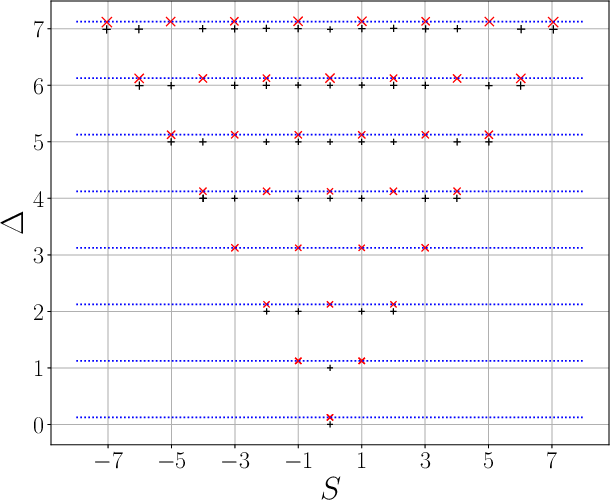
Figure 1: Conformal tower of the Ising model, showing the spectrum of scaling dimensions and integer conformal spins up to high levels, extracted using HOTRG with LyEi(Ly)=f∞+Ly22π(Δϕi−c/12)+O(1/Ly4)3, LyEi(Ly)=f∞+Ly22π(Δϕi−c/12)+O(1/Ly4)4.
Finite-size flows and the splitting of nearly-degenerate multiplets by conformal spin are visible, with the spin quantization acting as a crucial identifier for operator multiplets. Lower conformal levels achieve relative errors in LyEi(Ly)=f∞+Ly22π(Δϕi−c/12)+O(1/Ly4)5 of order LyEi(Ly)=f∞+Ly22π(Δϕi−c/12)+O(1/Ly4)6–LyEi(Ly)=f∞+Ly22π(Δϕi−c/12)+O(1/Ly4)7. The accuracy degrades systematically with increasing scaling dimension or density of states (as in the 3-state clock model), tracking the shrinkage of the self-consistency window due to stronger finite-bond-dimension effects.
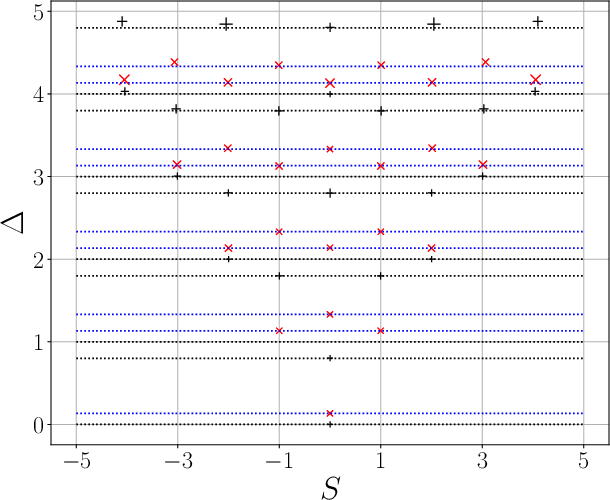
Figure 2: Conformal tower of the 3-state clock model, illustrating correct identification of operator content, conformal spins, and multiplicities within the resolution window for HOTRG at LyEi(Ly)=f∞+Ly22π(Δϕi−c/12)+O(1/Ly4)8.
Method and Parameter Dependence
Increasing bond dimension LyEi(Ly)=f∞+Ly22π(Δϕi−c/12)+O(1/Ly4)9 or stacking number Xi(Ly)=2π[Ei(Ly)−E0(Ly)]Ly→Δϕi0 systematically improves the size of the accessible scaling regime Xi(Ly)=2π[Ei(Ly)−E0(Ly)]Ly→Δϕi1 and accuracy at a fixed conformal level; Xi(Ly)=2π[Ei(Ly)−E0(Ly)]Ly→Δϕi2 exerts an even stronger influence on accessible Xi(Ly)=2π[Ei(Ly)−E0(Ly)]Ly→Δϕi3. Benchmarks against PTMRG and CTRG confirm the universal features within the pre-crossover regime but with smaller Xi(Ly)=2π[Ei(Ly)−E0(Ly)]Ly→Δϕi4 and larger errors for these algorithms at fixed computational cost.
Spin-Resolved Subgroup Analysis
In both models, the spin-resolved analysis accurately reconstructs the conformal tower—including correctly identifying degeneracy patterns, level crossings, and conformal spin assignments. At the high end of the scaling dimension window, last accessible multiplets still achieve errors below Xi(Ly)=2π[Ei(Ly)−E0(Ly)]Ly→Δϕi5 in the Ising model and Xi(Ly)=2π[Ei(Ly)−E0(Ly)]Ly→Δϕi6 for the denser 3-state clock model.
Both Xi(Ly)=2π[Ei(Ly)−E0(Ly)]Ly→Δϕi7 and Xi(Ly)=2π[Ei(Ly)−E0(Ly)]Ly→Δϕi8 estimators are shown to be effective, converging with small (Xi(Ly)=2π[Ei(Ly)−E0(Ly)]Ly→Δϕi9) errors to their universal CFT values at Ly0. HOTRG consistently outperforms PTMRG and CTRG at fixed computational resources.
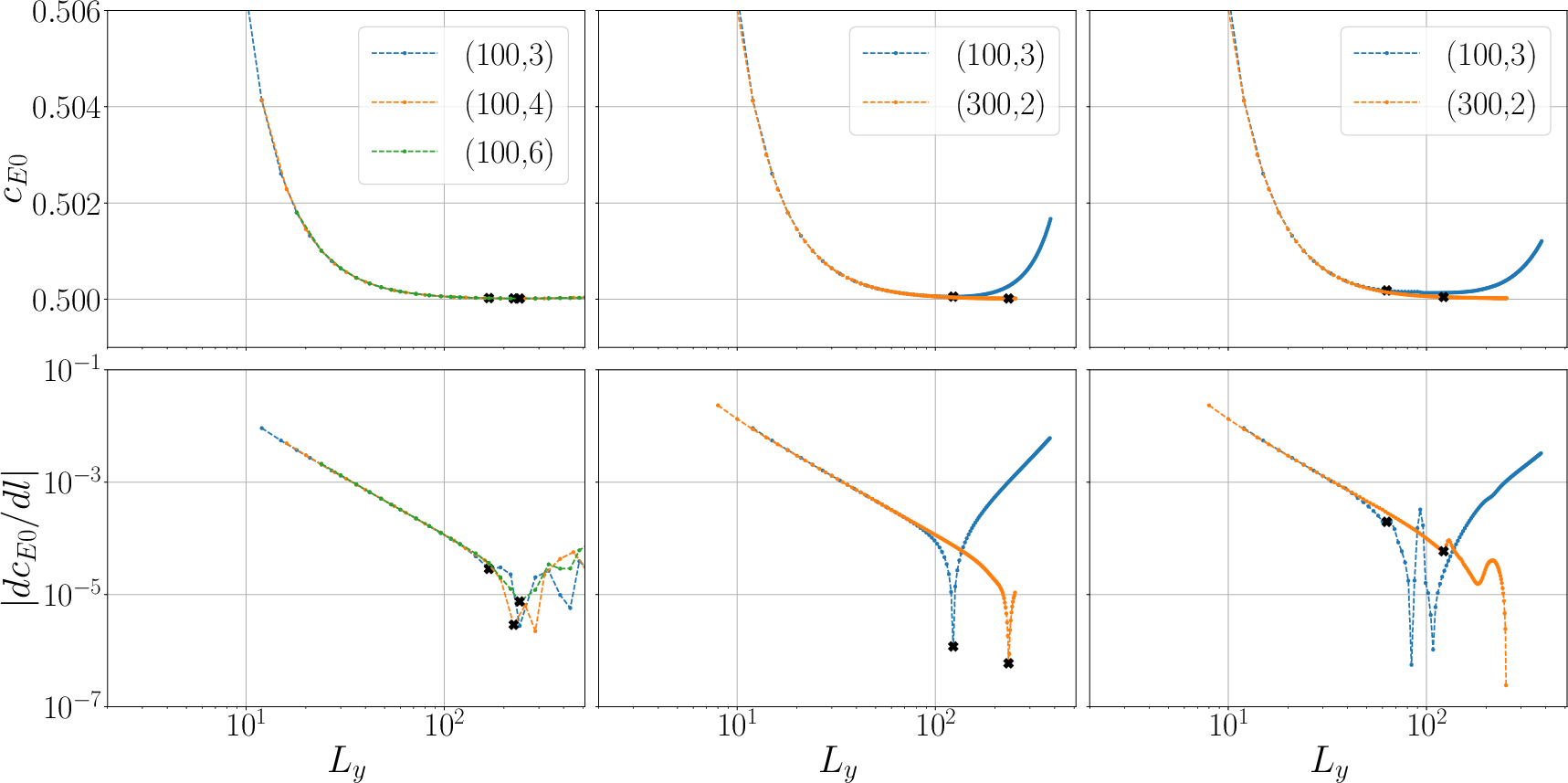
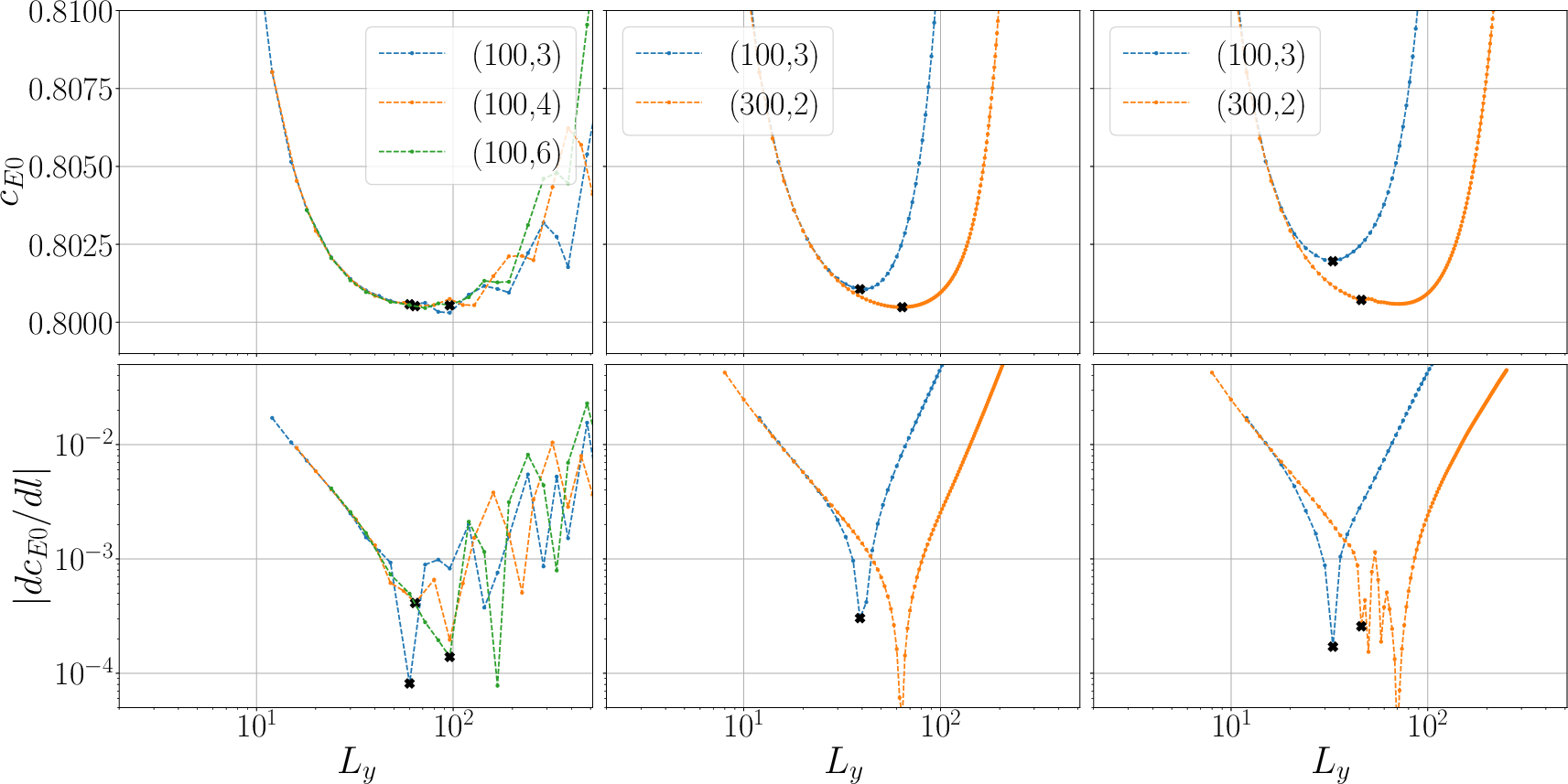
Figure 3: Flow of the central charge estimator Ly1 for Ising and 3-state clock models using HOTRG and other RG schemes, with operational determination of Ly2.
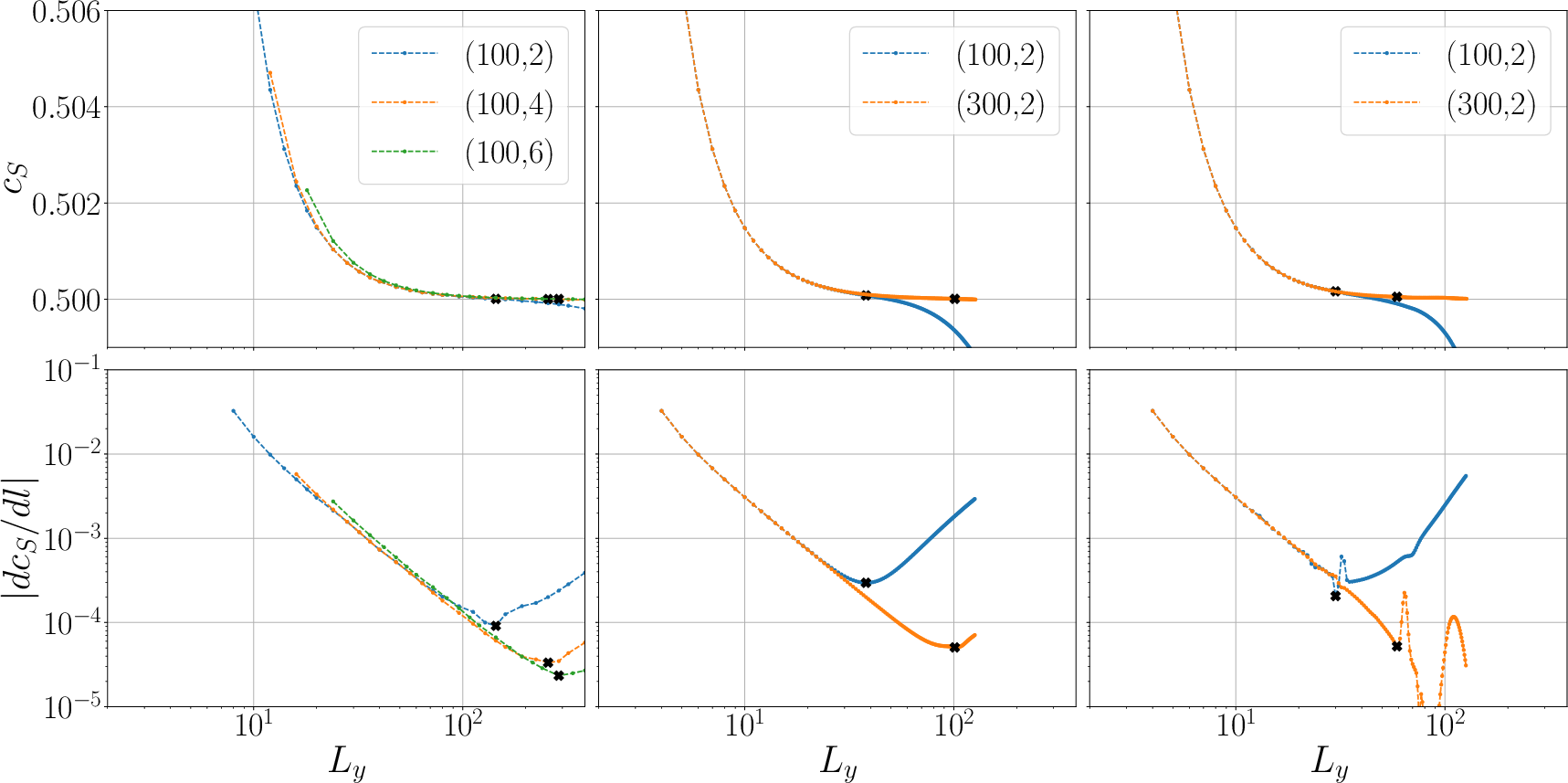
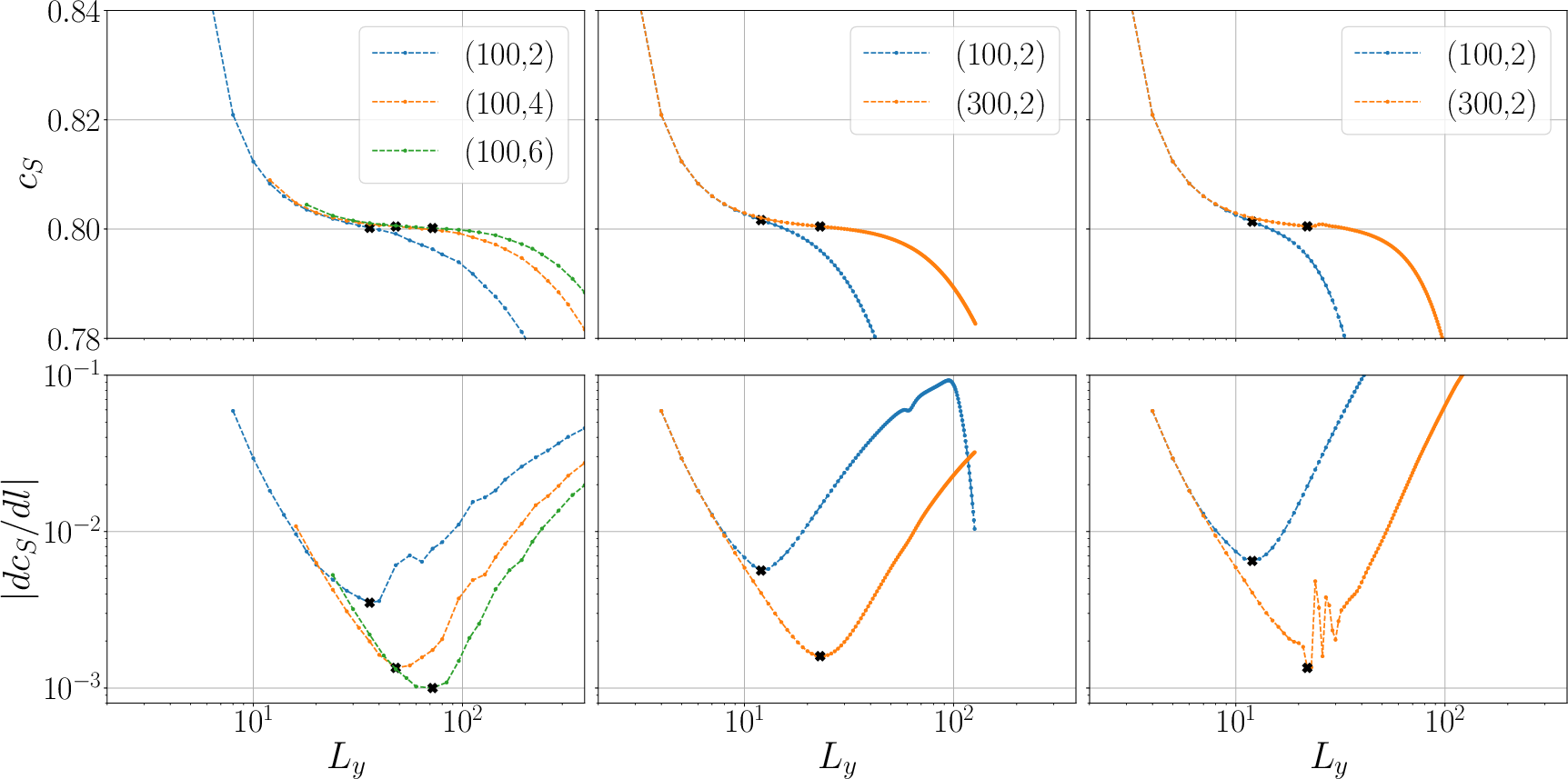
Figure 4: Entropy-based central charge estimator Ly3, corroborating the main results and demonstrating internal consistency with the energy-based estimator.
Practical and Theoretical Implications
The presented framework robustly separates universal CFT scaling from non-universal lattice and truncation effects, establishing a rigorous, method-agnostic protocol for conformal data extraction. The operational notion of the crossover scale Ly4 and spin-based self-consistency window provides a physically-motivated and automatable stopping criterion useful for high-precision applications and for benchmarking new tensor-network RG schemes.
- Extension to Other Models: The protocol is generically applicable to other 2D critical models, including those with more intricate symmetry structures or non-unitary spectra, where direct identification of fixed-point tensors is inaccessible.
- Algorithmic Benchmarking: Because the universal pre-crossover regime is accessible to any correctly implemented tensor RG capable of constructing transfer matrices, the method provides a strong benchmarking and diagnostics tool across tensor-network algorithms.
- Limitations and Bond Dimension Scaling: The method characterizes exactly how the finite bond dimension imposes an effective relevant perturbation, providing both practical guidance for numerical studies and theoretical insight into entanglement-induced finite-size corrections.
Future Developments
Potential extensions include:
- Applications to models exhibiting logarithmic corrections, lines of critical points, or those with marginally irrelevant operators.
- Systematic exploration of entanglement scaling as characterized by the entropy-based central charge estimator within classical tensors.
- Integration with recent advances in the analytical and computer-assisted construction of RG maps and fixed points [Ebel.20251iu].
- Extension to spectrum and operator product expansion (OPE) coefficient extraction in more complex geometries, boundaries, or with topological defects.
Conclusion
This work establishes a universal, robust, and quantitatively precise framework for extracting conformal data from 2D classical critical models using finite-size tensor-network flow. The method's clear delineation of the universal window, operator assignment via conformal spins, and dual central-charge estimators set a standard for future CFT data extraction in lattice systems and tensor network studies.