- The paper derives exact strong-field asymptotics for normalized differential resistance using an extended two-harmonic DOS framework.
- It introduces a novel Toeplitz-type integral representation that enables efficient numerical and analytic evaluation of mixed scattering kernels.
- The analysis identifies odd-harmonic (m=1,3) responses as precise diagnostics for disorder anisotropy in ultra-high-mobility 2DEG systems.
Amplitudes of Hall Field-Induced Resistance Oscillations in the Two-Harmonic DOS Regime
Overview
This paper presents a comprehensive analytic and numerical investigation of Hall field-induced resistance oscillations (HIRO) in two-dimensional electron gases (2DEGs), with an explicit focus on the amplitude structure in the presence of a Landau-quantized density of states (DOS) including both the first and the second harmonics. The work extends the kinetic theory of HIRO, originally developed by Vavilov, Aleiner, and Glazman (VAG), by deriving exact strong-field asymptotics for the normalized nonlinear differential resistance, systematically analyzing how the oscillatory amplitudes depend on microscopic scattering rates and disorder parameters. The two-harmonic extension is particularly crucial for ultra-high-mobility materials, where higher DOS harmonics are experimentally accessible and yield new handles on disorder characterization.
Kinetic Theory and Disorder Modeling
The kinetic framework is based on the VAG model, incorporating both displacement and inelastic mechanisms of nonlinear magnetoresistance. The magnetic field (B) and the dc Hall field (E) drive cyclotron motion and impurity-assisted transitions between orbits separated by 2Rc, leading to oscillations in the magnetoresistance as a function of the dimensionless parameter εdc=eE(2Rc)/(ℏωc). The theoretical description splits the disorder potential into short-range (sharp) and long-range (smooth) components, parameterized by a smoothness index χ.
The scattering rates are decomposed in terms of angular harmonics to yield explicit Bessel-weighted sums, which encode the probabilities for different scattering angles. For the single-harmonic DOS, the relevant sum over squared Bessel functions with angular-harmonic-dependent weights admits a closed-form solution via Newberger's identity, linking the kernel directly to the full backscattering rate 1/τπ.
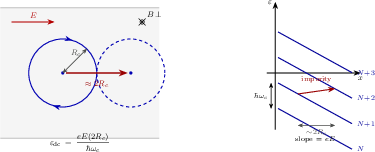
Figure 1: HIRO geometry illustrating impurity-assisted guiding-center hops of order 2Rc and the field-induced resonance condition in Landau levels.
Exact and Asymptotic Results: Single-Harmonic Case
The exact evaluation of the disorder kernels leads to compact, analytic expressions for the amplitude and phase of HIRO. Crucially, the strong-field asymptotics clarify that the dominant m=2 oscillation in the normalized differential resistance is entirely fixed by 1/τπ, with the explicit prefactor 4/(πζ) in the displacement contribution. Subleading corrections account for both the smooth-disorder contribution (exponentially suppressed in pure GaAs) and inelastic effects, such as the quantum lifetime E0 and inelastic time E1.
The analysis revisits the envelope approximation of VAG, identifying and quantifying corrections that become significant for softer disorder or alternative material systems with large E2. The analytic structure of the one-harmonic kernel reveals that the experimental extraction of the E3 amplitude serves as a direct probe of E4, while the Dingle analysis extracts E5.
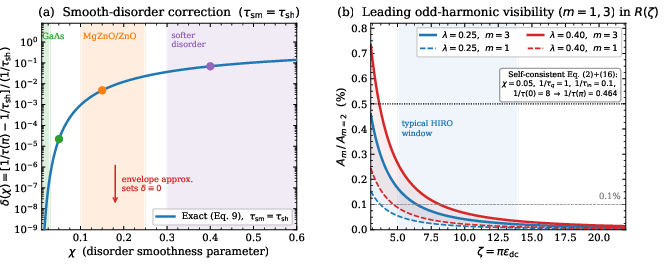
Figure 2: (a) Smooth-disorder correction E6 to the leading HIRO amplitude, indicating the parameter regimes where the correction is appreciable; (b) Odd-harmonic (E7) visibility as a function of E8, demonstrating the critical role of disorder smoothness in higher-harmonic accessibility.
Two-Harmonic DOS and Off-Diagonal Kernels
The main technical advance is the extension to a two-harmonic DOS, which naturally leads to the appearance of a mixed kernel E9 involving Bessel functions of different arguments. Unlike the single-harmonic case, closed-form product formulas are not generally available. The paper overcomes this limitation by deriving a single-integral (Toeplitz-type) representation for 2Rc0, enabling both analytic asymptotics and efficient numerical evaluation.
The stationary phase analysis of this integral in the strong-field regime isolates the leading oscillatory behaviors at 2Rc1 and 2Rc2, whose amplitudes are set by the forward- and backscattering rates, 2Rc3 and 2Rc4, respectively. These odd harmonics do not renormalize the dominant 2Rc5 amplitude, but instead provide new, phase-resolved constraints on the disorder landscape, notably the anisotropy ratio 2Rc6. This result has direct implications for experimental disorder diagnosis, as the appearance and relative weights of the 2Rc7 and 2Rc8 components serve as indicators of forward-scattering processes.
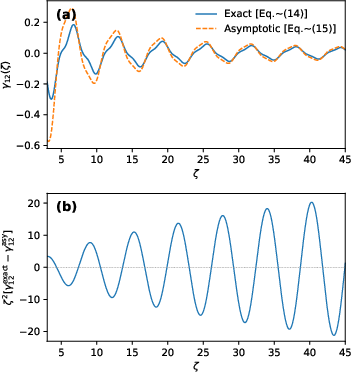
Figure 3: Validation of the mixed kernel 2Rc9, showing excellent agreement between the exact numerical integral and the stationary-phase asymptotic form in the relevant field regime.
Extraction Protocol and Synthetic Validation
Building upon the analytic and numerical kernel evaluations, the paper articulates a five-step protocol for extracting the full set of relevant scattering times from dc HIRO data. This protocol leverages Fourier analysis of the measured HIRO signal, using the εdc=eE(2Rc)/(ℏωc)0 amplitude for εdc=eE(2Rc)/(ℏωc)1 extraction, the Dingle plot for εdc=eE(2Rc)/(ℏωc)2, and exploiting the εdc=eE(2Rc)/(ℏωc)3 odd-harmonic content for joint constraints on εdc=eE(2Rc)/(ℏωc)4 and residual disorder models.
The utility and precision of this protocol are demonstrated on synthetic data generated with the exact numerical kernels, showing sub-percent accuracy in the recovery of εdc=eE(2Rc)/(ℏωc)5, εdc=eE(2Rc)/(ℏωc)6, and εdc=eE(2Rc)/(ℏωc)7 when εdc=eE(2Rc)/(ℏωc)8 harmonics are accessible. This establishes the practical viability of the analytic theory as an experimental fitting tool.
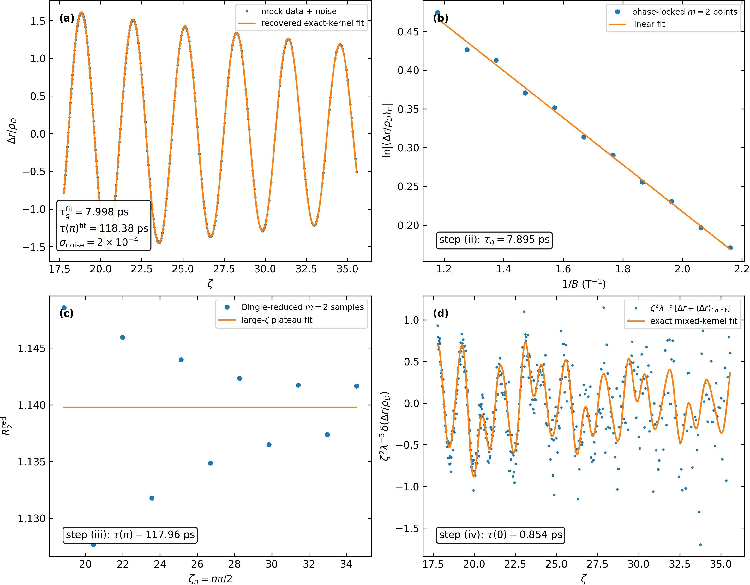
Figure 4: Synthetic recovery test, showing accurate extraction of scattering parameters from mock data via the full protocol, including Dingle and odd-harmonic fitting.
Broader Implications and Outlook
The analytic completeness of the approach opens avenues for systematic studies of disorder in high-mobility 2DEG platforms, especially where the second DOS harmonic is experimentally visible (e.g., in state-of-the-art GaAs/AlGaAs and MgZnO/ZnO heterostructures). The explicit identification of odd-harmonic content as a diagnostic for disorder anisotropy is particularly relevant for disorder engineering and for separating the roles of different scattering mechanisms in nonlinear transport.
The framework is readily generalizable to higher DOS harmonics, although their weight is dictated by powers of the Dingle factor and is expected to be experimentally suppressed in conventional systems. The method also has implications for the interpretation of related phenomena, such as MIRO in parabolic and Dirac materials, nonlocal optical resonances in 2DEGs, and high-order cyclotron features.
The direct mapping between measured HIRO features and microscopic scattering parameters provided here will facilitate the design and interpretation of experiments aiming to disentangle elastic and inelastic processes, benchmark sample quality, or probe collective effects beyond the Boltzmann paradigm.
Conclusion
Through a rigorous analytic extension and numerical validation of the HIRO kinetic theory, this paper delivers exact strong-field asymptotics and practical extraction formulas for the amplitude structure of HIRO in the presence of a two-harmonic DOS. The odd-harmonic response emerges as a new spectroscopic probe of angular disorder correlations, deepening the experimental toolbox for microscopically characterizing high-mobility 2DEG systems. The kernel integral techniques and asymptotic analysis developed here are expected to impact a range of nonlinear transport measurements in quantum Hall and related platforms.

