- The paper identifies new intermediate stationary wind solutions in B supergiants that seamlessly bridge classical fast and δ-slow regimes.
- It employs a time-dependent m-CAK framework with ZEUS-3D to reveal critical velocity profile kinks influenced by stellar rotation and line-force parameters.
- Synthetic spectral diagnostics across UV, optical, and IR confirm that subtle differences in wind structure significantly affect observable line profiles.
Hydrodynamic Structure of Radiation-Driven Winds at the Fast–Slow Transition in B Supergiants
Introduction
The structure and stability of radiation-driven winds in massive stars are critical for understanding both the evolution of individual objects and their feedback on galactic scales. This study systematically investigates the region of parameter space in modified CAK (m-CAK) theory where stationary solutions have hitherto been absent—specifically, the fast–δ-slow transition in B supergiant winds. Leveraging the time-dependent capacities of ZEUS-3D, the work overcomes known numerical deficiencies in steady-state solvers and characterizes new families of solutions. In parallel, detailed non-LTE synthetic spectra are computed for diagnostic lines to demonstrate how the wind regime transitions are manifested observationally.
Time-Dependent m-CAK Framework and ZEUS-3D Approach
The authors approach the hydrodynamic modelling of radiation-driven winds using the full time-dependent equations, as opposed to reliance on stationary critical point analysis. The key parameters in this context are the line-force multipliers (k, α, δ) which encode the distribution and ionization sensitivity of radiative acceleration. In the m-CAK regime, depending on rotation rate Ω and δ, classical fast and δ-slow (high δ) solutions exist with markedly different asymptotic velocities and mass-loss characteristics.
Historically, integration of the wind equations using codes such as Hydwind leaves a region of the (k, α, k0) manifold inaccessible where neither fast nor k1-slow solutions can be enforced with regular critical point crossing. By utilizing ZEUS-3D, initial conditions are allowed to self-adjust via time evolution, which proves crucial in identifying physically acceptable stationary profiles within this "gap" region.
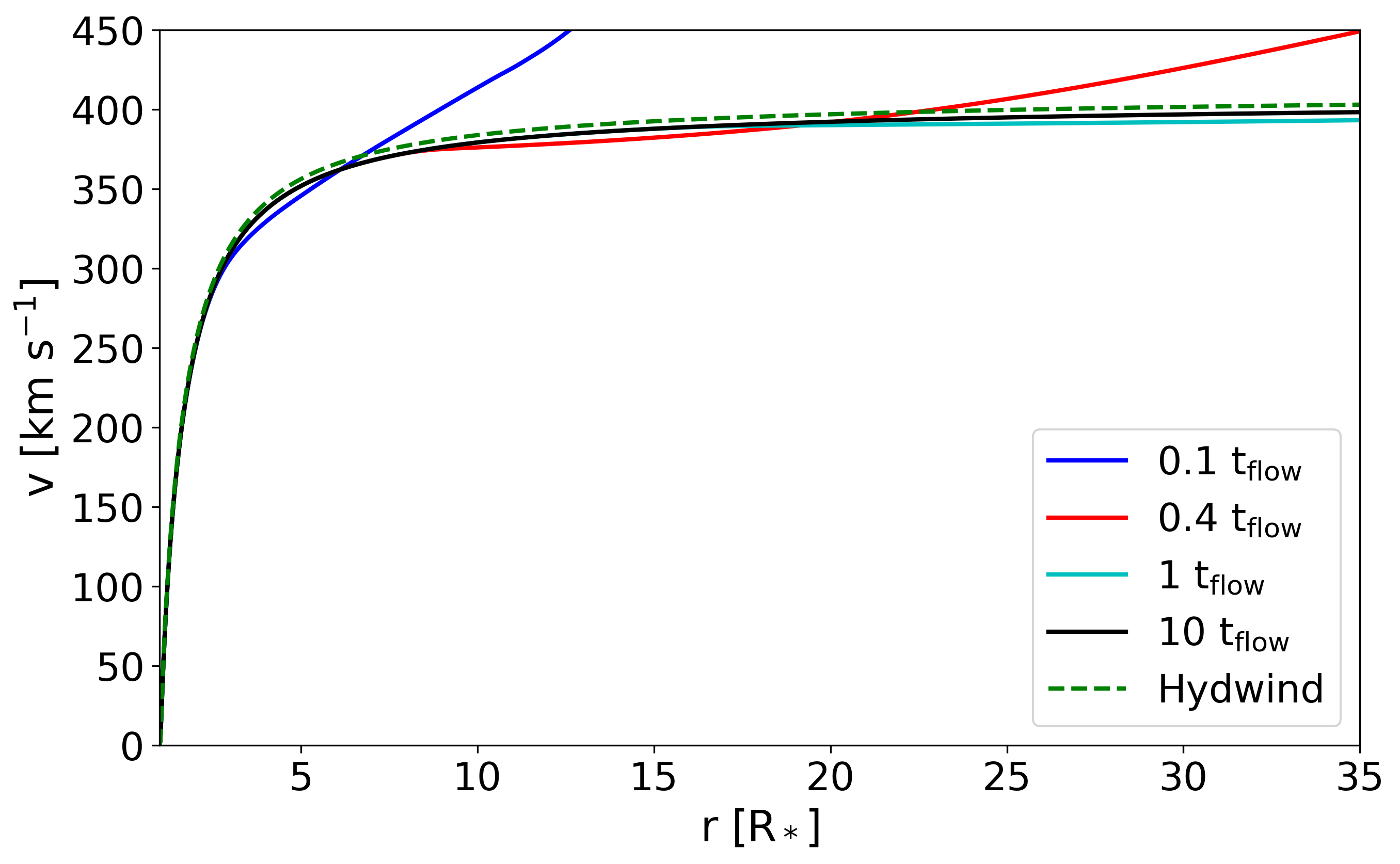
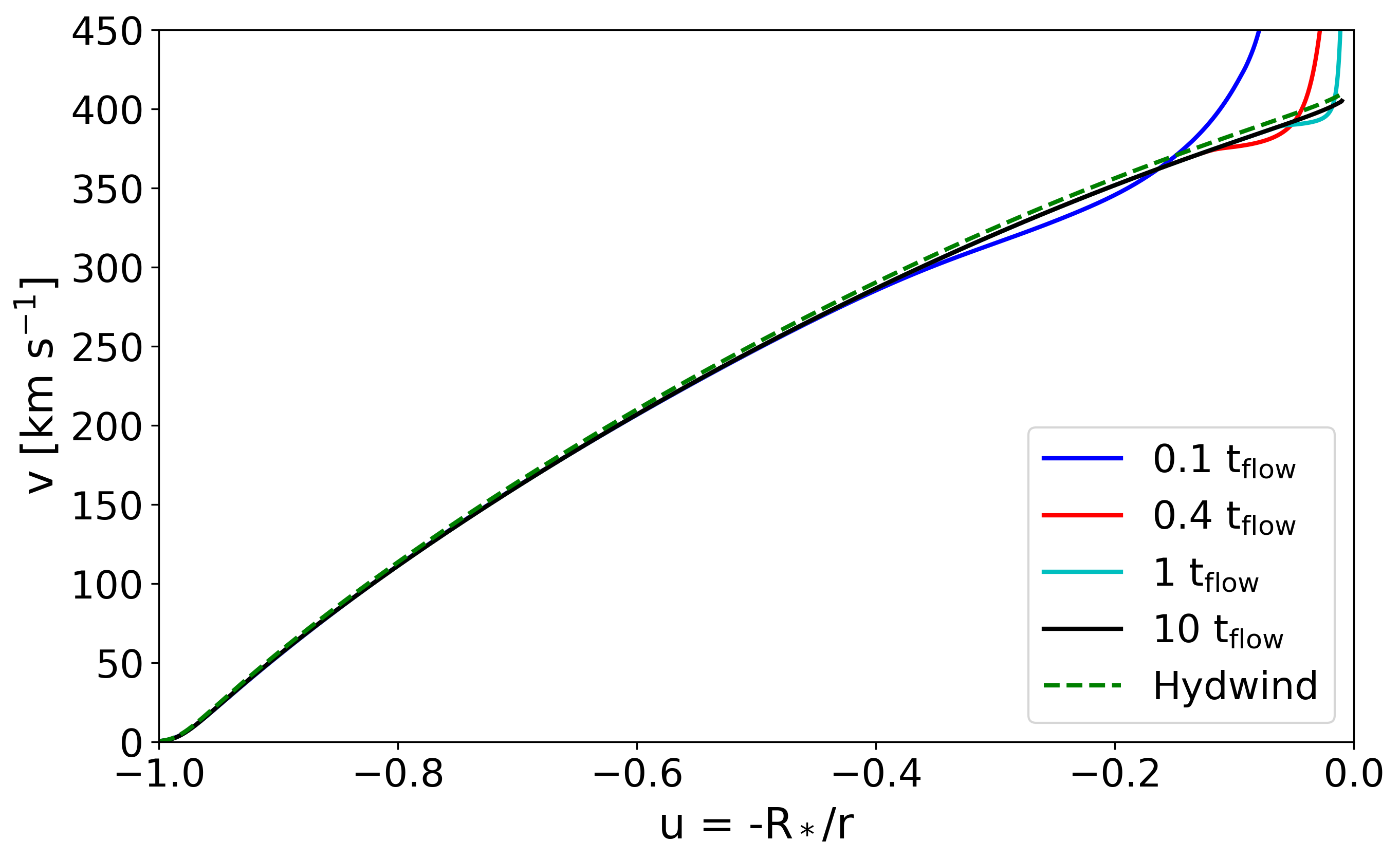
Figure 1: Temporal evolution of the wind velocity field in ZEUS-3D, demonstrating convergence from different initial guesses to stable stationary flows.
Gap Solutions: Structure and Properties
By exploring B supergiant models (e.g., k2 K, k3), the study delineates the solution topology as a function of k4 and k5. The classical regimes are clearly reproduced at extreme k6, but ZEUS-3D identifies previously unattainable, stable stationary profiles interpolating between the two. These "gap" solutions are neither abrupt nor pathological; rather, they exhibit a continuous morphing of velocity and density structures.
A distinctive feature of several intermediate solutions is a pronounced "kink" in the radial velocity profile, whose location and steepness are k7-dependent and modulated by rotation. These inflection points appear robust under extended temporal evolution, suggesting they are physically admissible and not numerical artifacts.
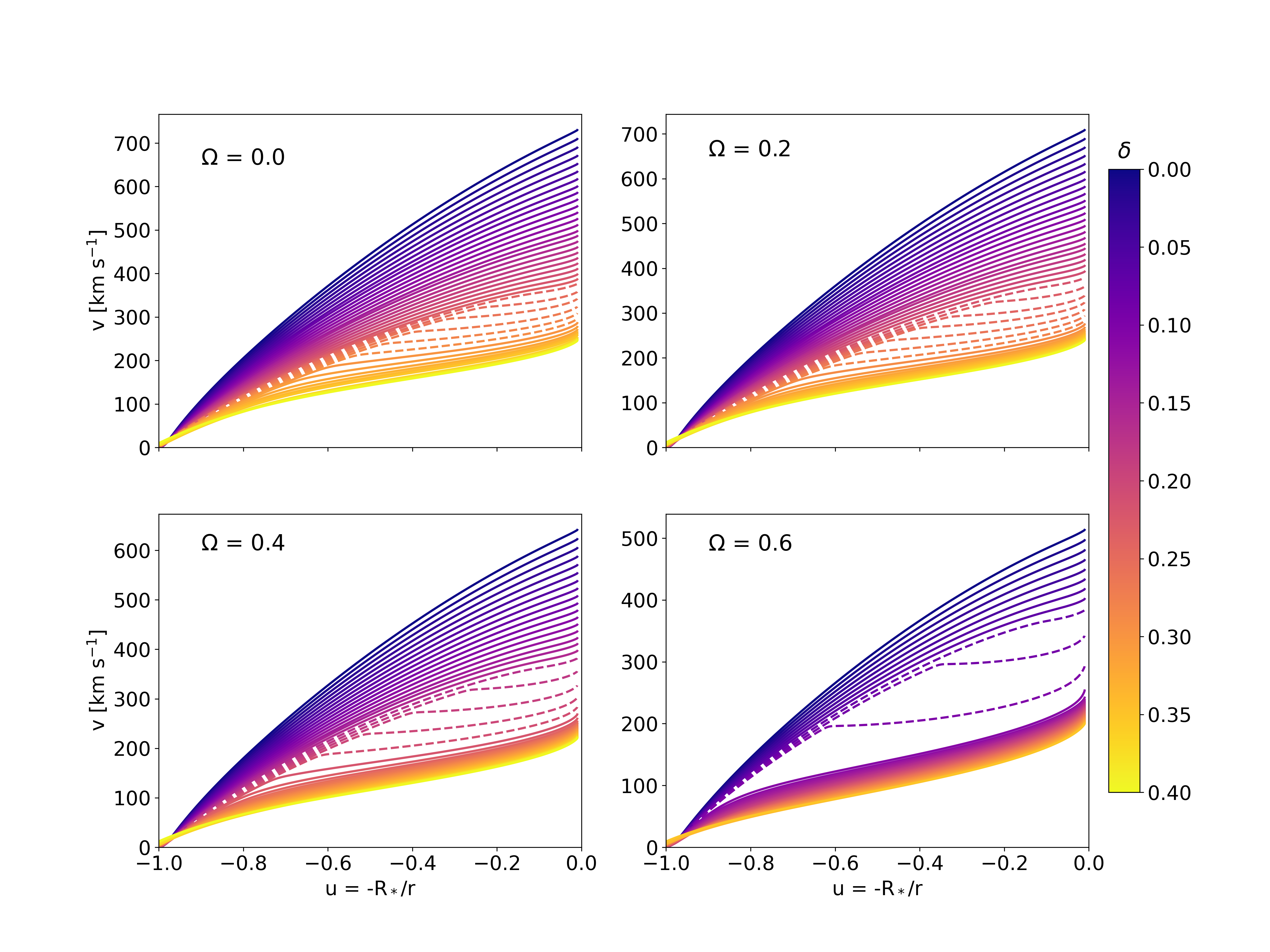
Figure 2: Hydrodynamic solutions for the T19 model, illustrating the continuous transition in wind structure with increasing k8 and rotation.
The corresponding mass-loss rates and terminal velocities show a monotonic progression across the transition, with the intermediate solutions partially bridging the gap between fast and k9-slow regimes in both observables.
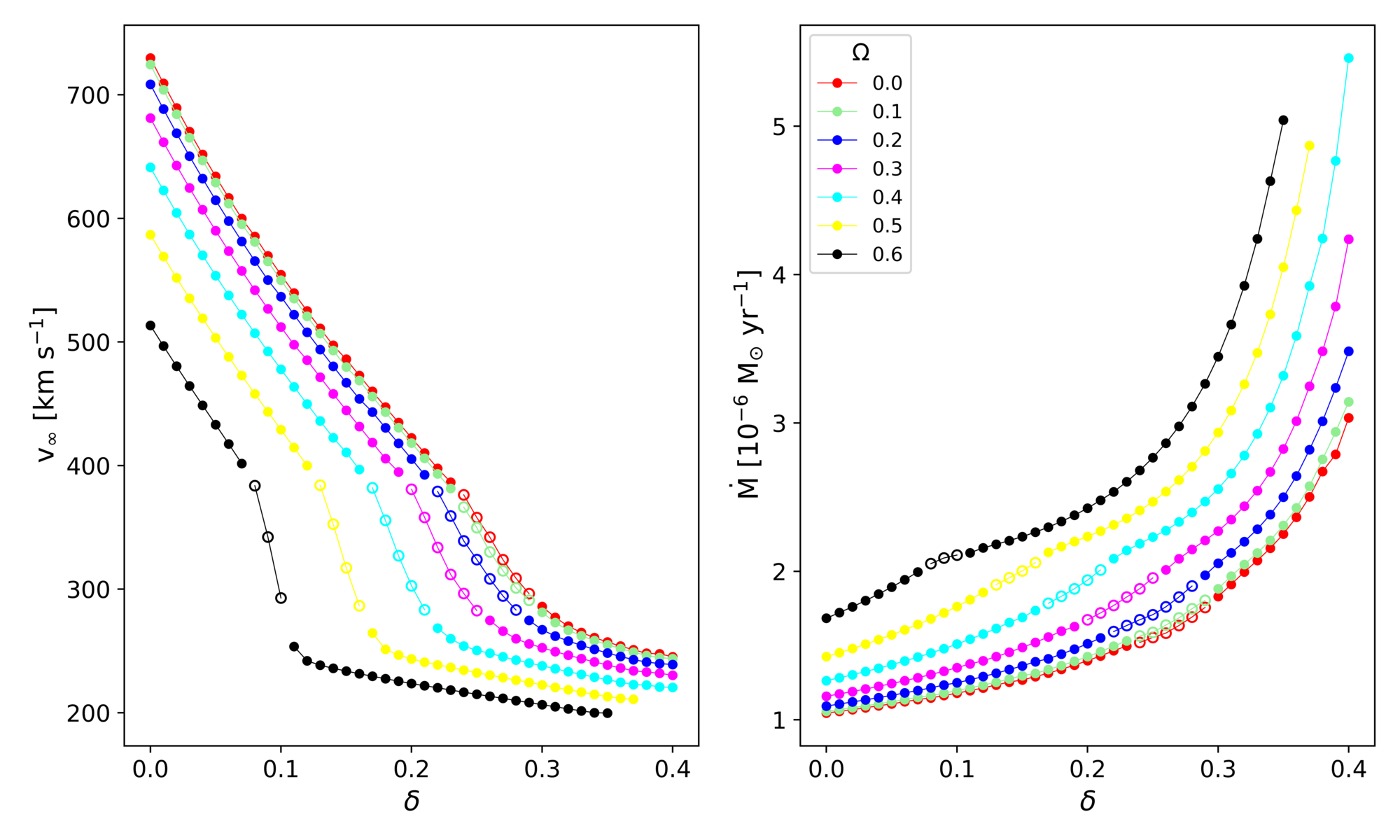
Figure 3: Terminal velocity and mass-loss rate as functions of α0 for varying rotation, highlighting the location of new solutions in the former "gap" region.
Synthetic Line Profiles and Spectroscopic Diagnostics
Synthetic spectra were computed via NLTE radiative transfer solutions in the comoving frame, including detailed models for H, He I, and Si IV. Across UV, optical, and IR transitions, line profile morphologies reflect the underlying wind regime. As the wind transitions from fast to α1-slow, the blue absorption component of P Cygni profiles in the UV narrows and emission weakens, while Balmer and He I lines develop enhanced emission characteristics consistent with increased mass loss.
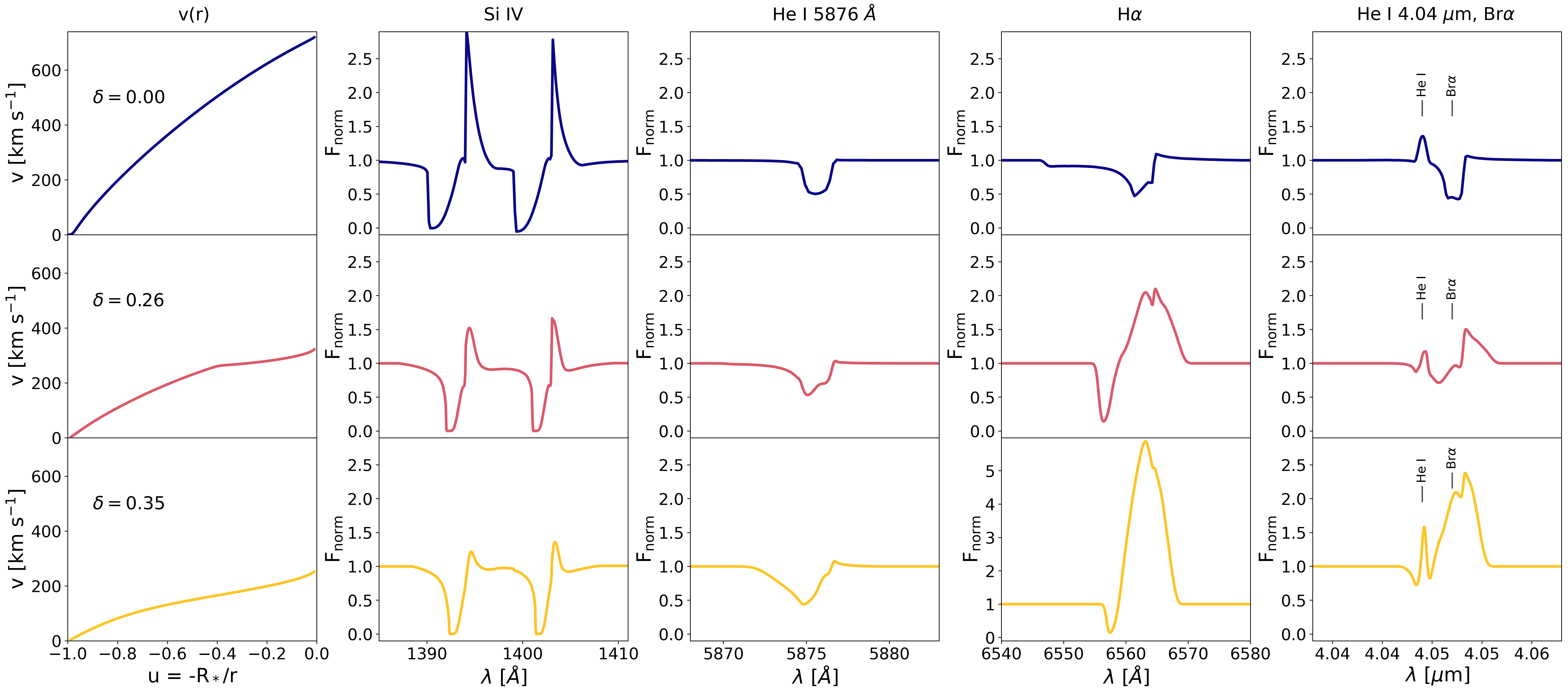
Figure 4: Synthetic profiles for Si IV, He I 5876 Å, Hα2, and He I+Brα3 for representative fast, transition, and α4-slow hydrodynamic solutions.
The intermediate "gap" solutions generate line morphologies that interpolate smoothly between the classical cases. This establishes that spectroscopic observations can potentially distinguish subtle underlying changes in wind hydrodynamics—especially when multiwavelength diagnostics are considered.
α5-Law Prescriptions Versus Hydrodynamic Solutions
By comparing synthetic spectra computed with both direct hydrodynamic solutions and phenomenological α6-law velocity structures (with equivalent global wind parameters), degeneracies are found in the predicted line profiles. Notably, Hα7 profiles with high α8 can mimic those produced by α9-slow or intermediate solutions, but the velocity stratification is markedly different. However, lines such as IR He I 4.049 μm are more sensitive to the underlying wind structure, revealing diagnostic leverage in disentangling the physical wind regime from spectroscopic observations.
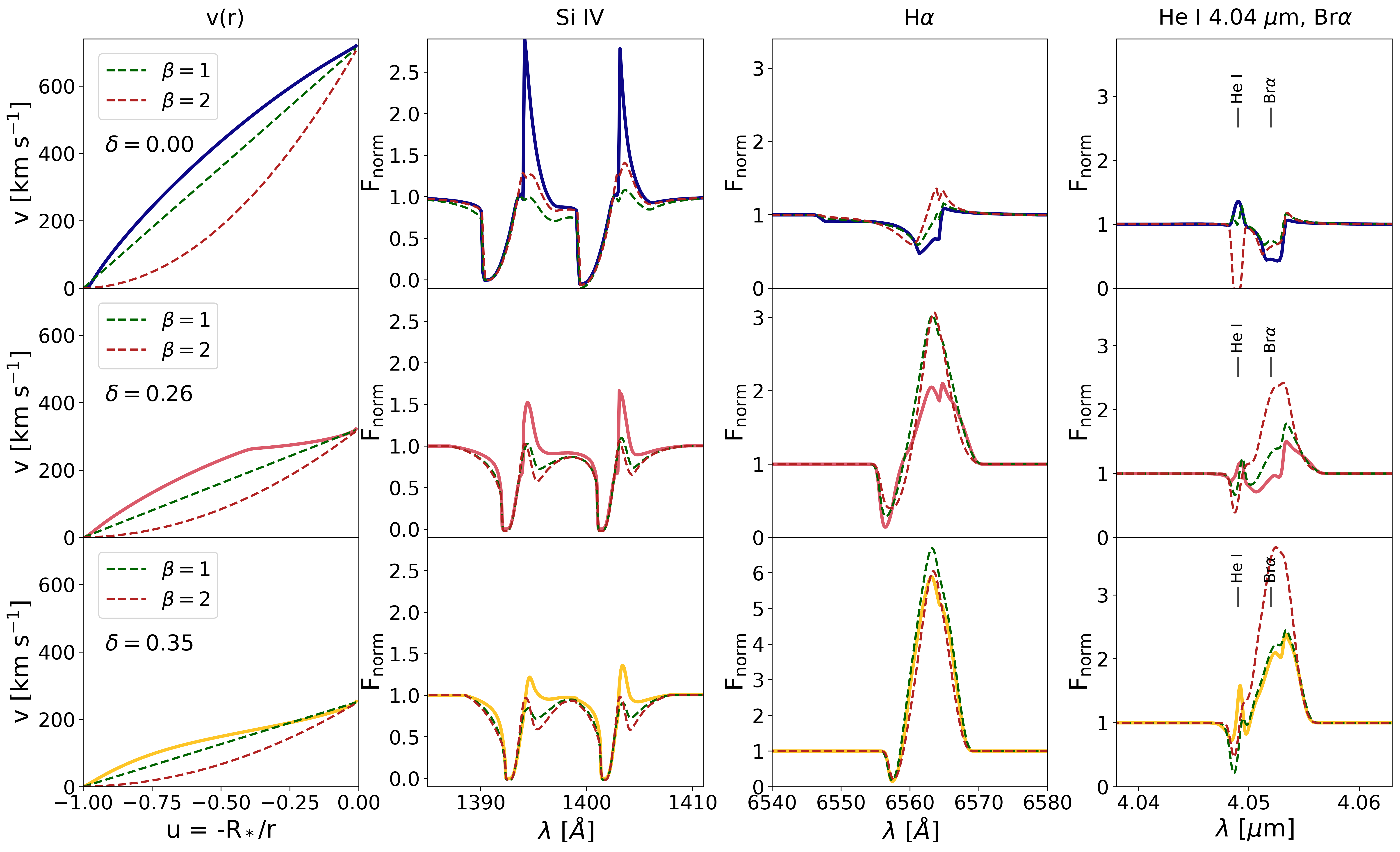
Figure 5: Comparison of synthetic line profiles from hydrodynamic models and δ0-type laws, demonstrating degeneracies (for Hδ1) and distinctions (for He I+Brδ2).
Implications and Future Prospects
A key implication of this work is that the supposed absence of stationary solutions in the gap region is an artifact of prior stationary-state numerical schemes. In reality, the wind properties—terminal velocity, mass-loss rate, velocity profile—vary continuously as a function of δ3 and stellar rotation. The localized kinks in the velocity profile may be observationally linked to wind variability and the development of discrete absorption components, phenomena already observed in OB stars.
The demonstrated sensitivity of line profiles to the exact hydrodynamic regime (and not just to global parameters) justifies the use of time-dependent hydrodynamic simulations in future analyses. It is suggested that time-variable ionization, which can modify effective δ4, may drive regime changes in unstable or clumpy winds. More realistic non-isothermal and multidimensional models are needed to fully exploit upcoming UV/optical/IR spectroscopic facilities for wind diagnostics.
Conclusion
By implementing time-dependent, physically self-consistent hydrodynamics with ZEUS-3D, the longstanding gap between fast and δ5-slow wind solutions in B supergiants is shown to be filled by a continuous succession of stationary flows. These intermediate solutions possess distinctive velocity stratifications, impact all major observational diagnostics, and their discovery resolves previous ambiguities in the interpretation of spectroscopic variability and mass-loss measurements. The methodology and insights provided by this study are broadly applicable to wind models of luminous early-type stars and form the foundation for more comprehensive time-dependent and multidimensional investigations into stellar wind physics.