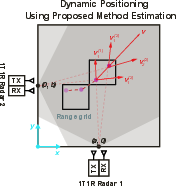
- The paper presents a novel velocity synthesis-assisted (VSA) fusion algorithm that integrates Doppler-derived velocities, achieving up to 48% improvement in tracking accuracy.
- It leverages coordinated commercial SISO FMCW radars to enable high-precision localization with a mean RMSE as low as 6 cm under challenging indoor conditions.
- Experimental and simulation results validate the system’s robustness in multi-target tracking and its resilience to multipath, low SNR, and synchronization errors.
Multi-site Radar Systems for High-Precision Indoor Positioning and Tracking
Introduction and Motivation
The paper "Multi-site Radar Systems for High-Precision Indoor Positioning and Tracking" (2604.15688) addresses the longstanding challenge of accurate, tag-free human tracking in indoor environments, proposing a robust, low-cost methodology based on multi-site single-input single-output (SISO) frequency-modulated continuous-wave (FMCW) radars. Traditional solutions frequently rely on vision or radio-frequency identification technologies with significant limitations—privacy concerns, tag requirements, or complex multi-input multi-output (MIMO) radar arrangements. The proposed approach eliminates the need for expensive MIMO transceivers and strict phase-level hardware synchronization, instead leveraging coordinated, commercially available SISO modules. The central contribution is a velocity synthesis-assisted (VSA) fusion algorithm, which exploits Doppler-derived radial velocities as geometric constraints, enabling highly accurate, low-latency multi-perspective localization and trajectory estimation even under severe multipath, low-SNR, and non-ideal synchronization conditions.
Review of State-of-the-Art and Problem Definition
Conventional indoor positioning comprises either tag-based approaches or passive methods, the latter including both vision and various RF modalities (WiFi, UWB, mmWave radar). Vision-based systems provide high accuracy but suffer from privacy and lighting/environmental concerns. RF-based schemes—specifically mmWave radars—offer high resolution and privacy benefits but are typically hampered by hardware complexity or the need for statistical learning-based data fusion prone to generalization errors.
Single-radar MIMO configurations are limited by aperture and practical array size (Figure 1), resulting in restricted angular resolution and poor scalability. Multi-site radar systems, while promising, introduce synchronization and data fusion complexity (Figure 2). Existing data fusion techniques can be categorized as direct-machine learning or geometry-based. Learning-based fusers are data-hungry and non-interpretable; geometry-based approaches, such as trilateration from distance-only measurements, are prone to ambiguity, high GDOP, and are sensitive to environmental non-idealities (Figure 3).
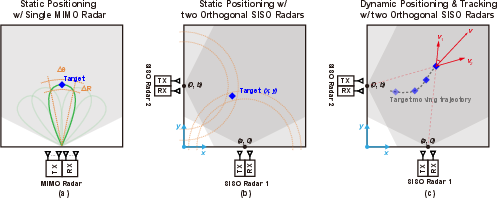
Figure 1: Indoor high-precision target single positioning alternatives, comparing MIMO single-site and SISO multi-site architectures.
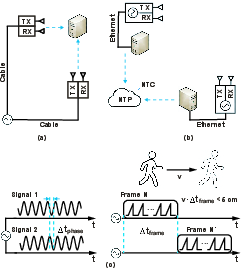
Figure 2: Synchronization strategies in multi-site radar configurations, illustrating hardware/phase-based (a) and non-coherent/software-based NTP-triggered approaches (b).
The solution space therefore requires a method that—without recourse to dense arrays or intricate cabling—achieves high spatial resolution, robust tracking, and cost-effective deployment using commercial hardware.
Proposed System and VSA Algorithm
The authors introduce a distributed, non-coherent, NTP-triggered pair of SISO mmWave radars—each deploying FMCW waveforms and leveraging Doppler-derived radial velocities alongside range estimates. The principal innovation is the VSA fusion algorithm, which, through a discrete-grid search, fuses instantaneous Doppler (velocity) information from each node to resolve position and motion states with significantly increased geometric constraints. The VSA method proceeds as follows (Figure 4):
Crucially, the VSA acts as a pre-filtering mechanism, enforcing physical constraints before feeding measurements to the dynamic tracker, resulting in marked improvements during rapid maneuvers or under non-ideal signal conditions.
Numerical Results and Simulation Analysis
Monte Carlo simulations benchmark VSA against conventional trilateration and EKF-based tracking. In single-target localization, VSA achieves a mean RMSE of 6 cm, a 48% improvement over conventional methods (Figure 5). Robustness analyses demonstrate persistent advantages under:
- Low SNR: At 0 dB SNR, VSA yields a position RMSE of 14 cm vs. 25 cm for EKF-only (Figure 6a).
- Multipath/Outlier Proportion: With 20% outlier measurement rate, VSA errors remain at the centimeter-level, while EKF errors accumulate linearly (Figure 6b).
- Synchronization Latency: With up to 50 ms inter-radar alignment error, VSA maintains low RMSE, validating tolerance to NTP synchronization errors (Figure 6c).
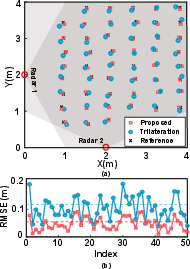
Figure 5: Monte-Carlo simulations—(a) spatial distribution of VSA/range-only estimates; (b) histogram of positioning errors across trials.
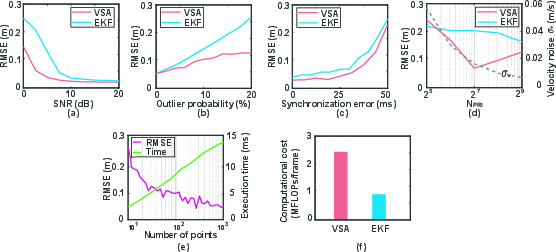
Figure 6: Monte-Carlo trajectory tracking robustness—(a) SNR sweep; (b) multipath/interference; (c) inter-radar latency; (d) pulses-in-frame; (e) grid granularity; (f) system throughput versus computational load.
Tracking performance was further interrogated via a suite of complex trajectories (rhombus, circular, star-shaped). VSA consistently outperforms baseline EKF, particularly on highly nonlinear/star paths (Figure 7), and suppresses sharp error spikes that coincide with trajectory discontinuities. Absolute RMSE is reduced from 28 cm to 13 cm on the star-shaped trajectory—a >50% error reduction—and the distribution of instantaneous error is substantially more concentrated.
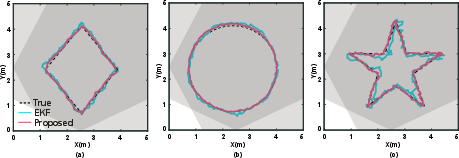
Figure 7: Tracking results for (a) rhombus, (b) circular, and (c) star-shaped standard trajectories highlighting VSA advantages.
Experimental Verification
Physical deployment in a 9m×9m space using COTS AWR6843ISK radars validated these findings. The system accurately tracked both single and dual human targets. Compared to direct point-cloud fusion or state-of-the-art fusion algorithms, the VSA system delivered:
- Reduced RMSE: e.g., for rhombus trajectory, 10.5 cm (VSA) vs. 20.4 cm (point cloud) or 16.5 cm (SAV-PF).
- Complex Scenarios: For star-shaped motion, errors were consistently lower (16.3 cm vs. 22.5 cm).
- Multi-target Capability: Demonstrated error of 11.4 cm in face-to-face dual tracking.
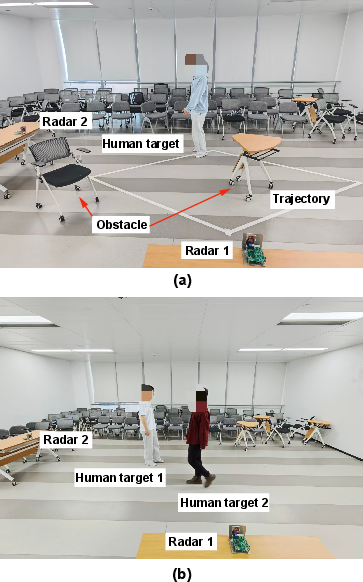
Figure 8: Physical experiment setup for single and multi-target tracking with SISO radars.
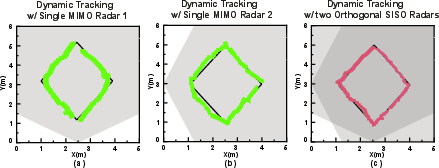
Figure 9: Experimental trajectory tracking results comparing single MIMO and multi-site SISO systems.
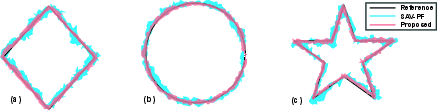
Figure 10: Empirical tracking performance for standard trajectories using the proposed system.
Direct cross-comparison with published systems (see Table IV in paper) demonstrates that the multi-site SISO-VSA approach attains comparable or superior accuracy to MIMO or IR-UWB based platforms, without recourse to expensive or onerous synchronization hardware.
Implications, Limitations, and Future Directions
The findings show that multi-site SISO radar systems, coupled with rigorous Doppler/velocity-informed fusion, offer a scalable and privacy-preserving alternative to camera-based or massive-MIMO indoor positioning. The VSA algorithm's resilience to multipath, SNR degradation, and synchronization error enables practical deployment in consumer-grade environments.
Practically, this opens the field to widespread smart-home, healthcare, and industry applications where low-cost, passive, and privacy-respecting real-time tracking is required. Theoretical implications revolve around the efficacy of physical-constraint-informed fusion layers as robust pre-filters for dynamic state estimation, especially under high maneuverability and ambiguous measurement conditions. The method’s grid-based search, while optimal for accuracy, comes with moderate increases in computational demand; real-time application is achieved but would benefit from parallelization or approximate search strategies.
For future research, comprehensive multi-target separation in highly cluttered environments remains an open problem. Integrating advanced motion models, real-time calibration, or unsupervised learning for dynamic thresholding and anomaly rejection may further enhance reliability.
Conclusion
This work rigorously establishes velocity synthesis-assisted multi-site SISO radar as a strong candidate for high-precision, cost-effective, and robust indoor positioning. Its physically constrained grid fusion architecture demonstrably outperforms both classic range-based and particle filter methods in simulation and experiment, with performance on par with or exceeding state-of-the-art MIMO/IR-UWB platforms. The demonstrated resilience to multiplicity of environmental and hardware artifacts underlines its suitability for scalable deployment. Future work should address computational scaling for multi-target tracking and deeper integration with environmental learning for dynamic environments.