Linear and nonlinear vibrational excitation driven by molecular polaritons
Published 17 Apr 2026 in physics.chem-ph | (2604.15685v1)
Abstract: Following our recent numerical study [arXiv:2601.16299 (2026)], we investigate vibrational excitation induced by transient optical driving in molecular ensembles strongly coupled to a cavity mode using the field-driven Holstein--Tavis--Cummings model. We analyze how pulsed excitation redistributes energy among electronic, photonic, and vibrational degrees of freedom in molecular polaritons. Vibrational dynamics are examined over a broad range of pulse durations and intensities within both the single-excitation approximation and a mean-field description of collective light--matter coupling. Despite their distinct formulations and microscopic descriptions, these two approaches yield consistent scaling relations for vibrational excitation. In particular, we disentangle linear and nonlinear contributions to vibrational excitation, which are reflected in distinct quadratic and quartic scaling behaviors with respect to the driving field amplitude (that is, linear and quadratic dependence on the incident pulse intensity). The microscopic origin of the nonlinear component is identified as a polariton-mediated intrapulse stimulated Raman-like process, enabled by a pulse spectral bandwidth large enough to overlap both upper and lower polaritons (rather than a conventional multi-pulse scheme). These results establish a unified framework for understanding vibrational excitation under pulsed polariton driving and provide guidance for the interpretation and control of ultrafast polariton experiments. Discrepancies between the mean-field and single-excitation approaches under certain pulsed conditions are identified and analyzed.
The paper demonstrates resonant vibrational excitation driven by polaritonic Rabi beating under ultrashort pulsed excitation.
It contrasts quantum single-excitation dynamics with mean-field results, highlighting quantum coherence effects absent in MF.
Nonlinear intensity scaling reveals quadratic and quartic dependencies in excited electronic and ground vibrational states, respectively.
Linear and Nonlinear Vibrational Excitation Driven by Molecular Polaritons
Introduction
This work presents a comprehensive theoretical and computational analysis of vibrational excitation dynamics in molecular ensembles strongly coupled to cavity modes, with a particular focus on the mechanisms of both linear and nonlinear vibrational activation mediated by molecular polaritons (2604.15685). The framework employed is the Holstein–Tavis–Cummings (HTC) model, capturing the essential collective light–matter coupling, local vibronic structure, and their interplay under pulsed optical driving. Both quantum (single-excitation subspace, SE) and semiclassical (mean-field, MF) treatments are systematically contrasted, elucidating the limitations of mean-field approaches for polariton-induced vibronic phenomena and clarifying the resonance mechanisms underlying collective vibrational activation.
Holstein–Tavis–Cummings Model and Mean-Field Reduction
The HTC Hamiltonian incorporates N identical molecules, each described as a two-level system (TLS) coupled to a local intramolecular vibration, coherently interacting with a single cavity photon mode. The Hamiltonian is symmetry-adapted to collective bright and dark excitonic manifolds, and their coupling to photonic and vibronic degrees of freedom is explicitly treated. The key technical advance is a detailed derivation of the mean-field equations of motion for such many-body HTC systems, exploiting collective permutation symmetry and closed-form reduction to a self-consistent set of equations for the cavity amplitude and the reduced single-molecule density matrix.
Linear and Nonlinear Polariton-Induced Vibronic Dynamics
Exciton–Photon Representation of Dynamics
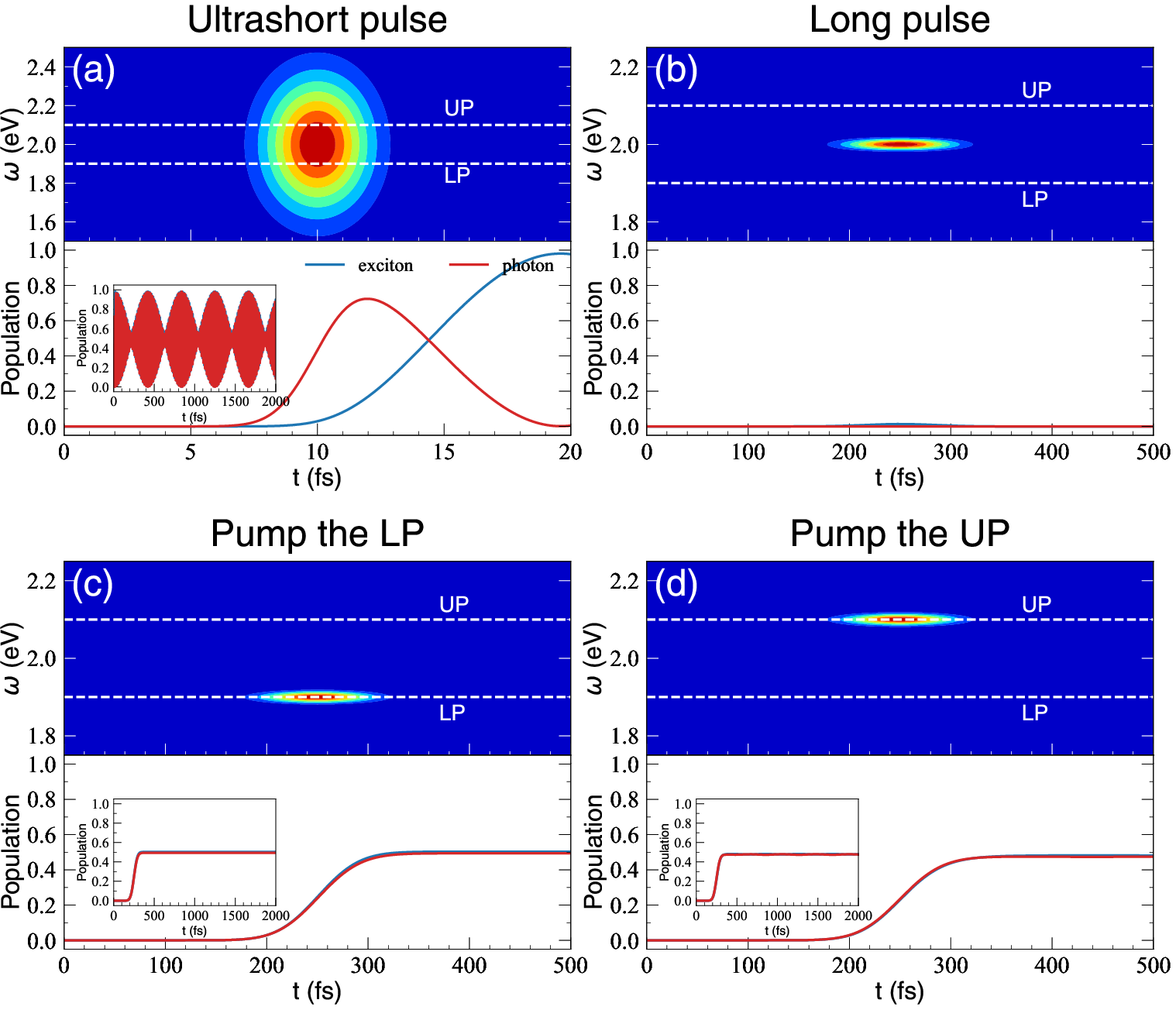
The paper benchmarks SE and MF descriptions by projecting the population dynamics onto the exciton–photon number basis under pulsed excitation.
Figure 1: Exciton and photon number resolved representation of polariton dynamics, facilitating direct comparison between quantum and mean-field treatments.
In the MF regime, coherent population oscillations between the lower and upper polariton branches are interpreted as normal-mode beating, with a frequency given by the collective Rabi splitting Ω=2gcN on resonance. The SE dynamics reveal additional long-timescale UP-LP coherence effects that are absent in MF. Ultrafast, broadband excitation leads to simultaneous population of both polariton branches and results in nontrivial population revivals, evidencing explicit many-body quantum coherence.
Vibrational Response and Resonance Conditions
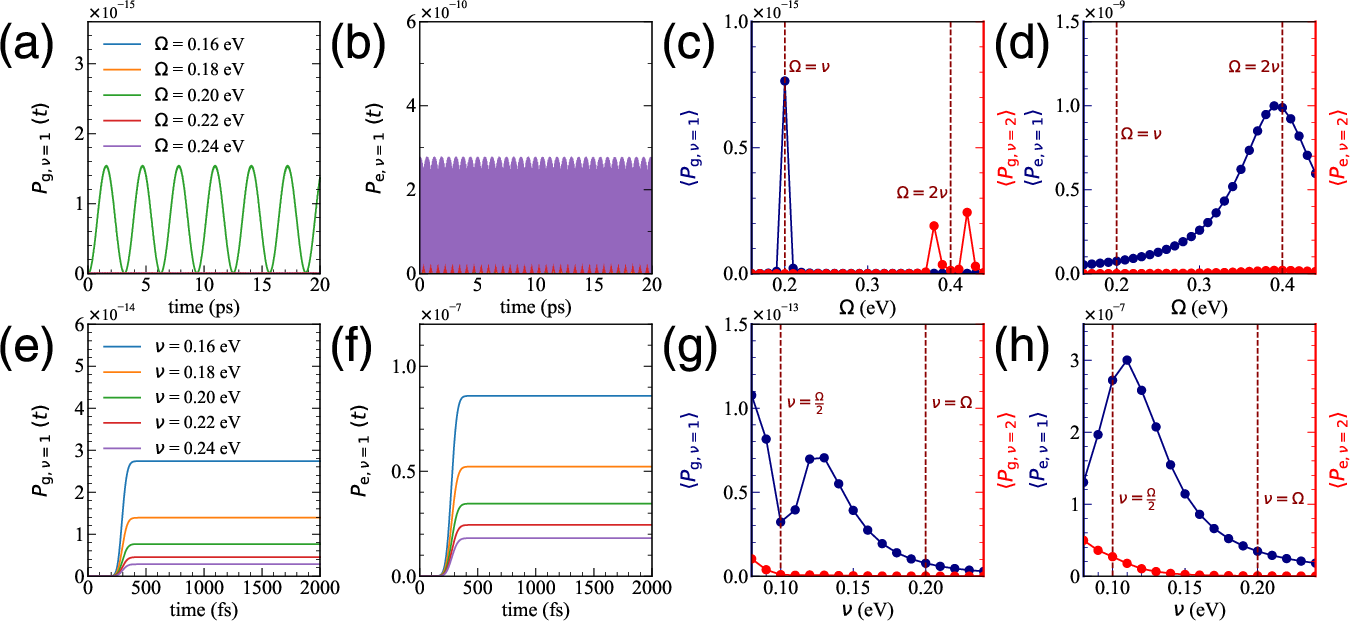
Under ultrashort pulsed excitation, both quantum (SE) and mean-field (MF) approaches reveal a sharp resonance in the ground-state vibrational population when the collective Rabi splitting matches the intramolecular vibrational quantum, i.e., Ω≈ν. In the MF picture, this is interpreted as classical driving of local vibrational oscillators by the time-dependent excited-state population, which exhibits oscillations at Ω. The underlying equation is a driven oscillator, and maximal vibrational activation is achieved at resonance.
Figure 2: Resonant enhancement of the ground-state vibrational population under broadband excitation, correlated with the Rabi splitting Ω.
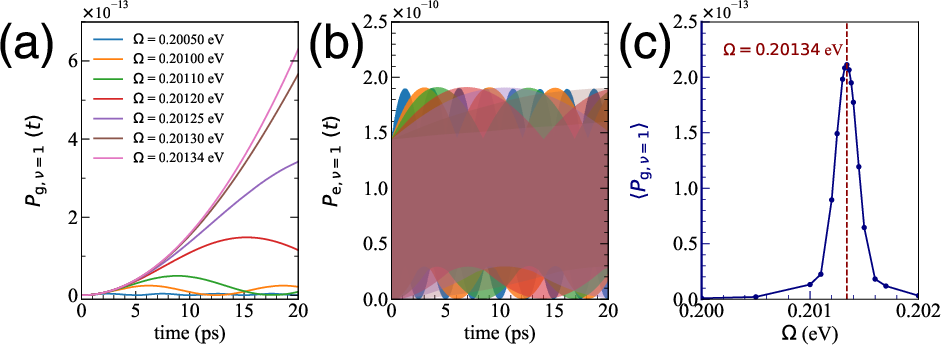
The resonance condition is subject to vibronic-induced frequency renormalization. The effective Rabi frequency Ωeff accounting for self-energy corrections from virtual coupling to vibronic sidebands shifts the resonance peak, which is evidenced numerically:
Figure 3: Fine-tuning of collective Rabi splitting to reach the renormalized resonance, demonstrating sustained vibrational growth at exact resonance and detuned modulation away from it.
The resonance is highly selective for rapid (broadband) excitation where both mean-field normal modes are accessed. Under quasi-adiabatic, narrowband excitation, only one mode is populated, beating is suppressed, and resonant vibrational activation is not observed.
Nonlinear and Intensity Dependence
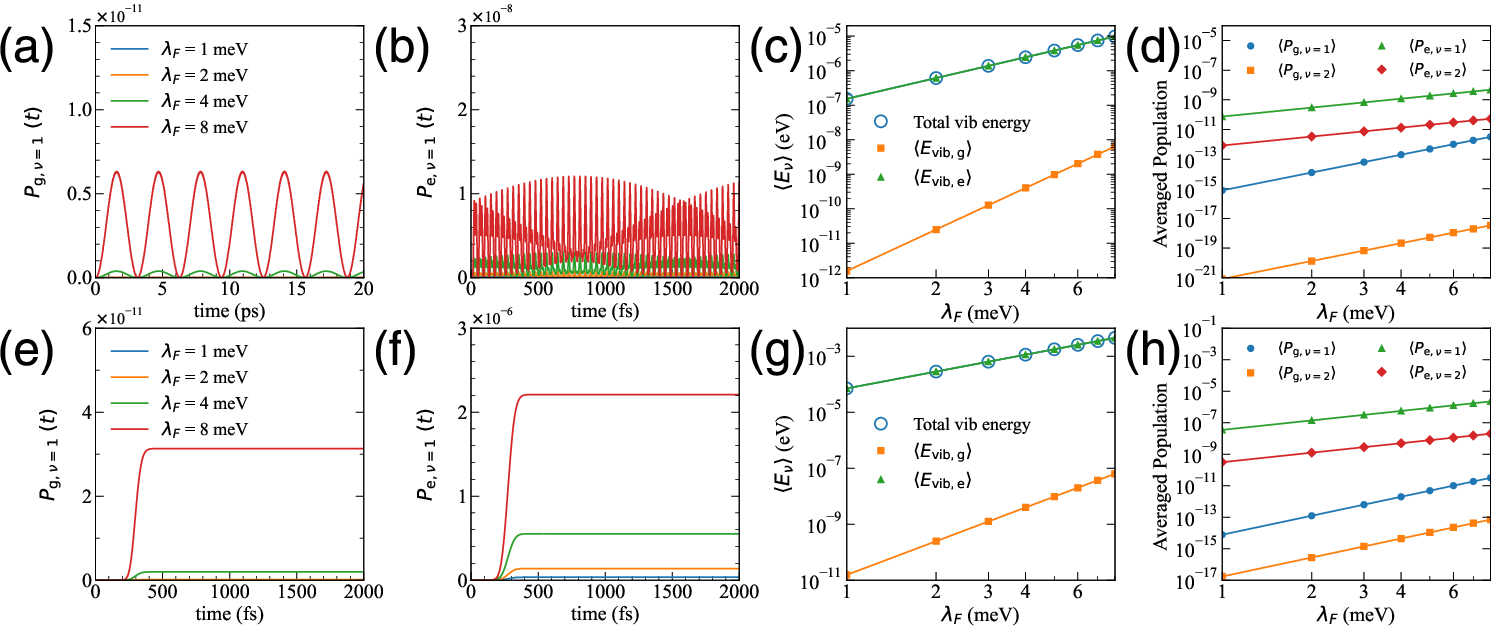
Comprehensive field amplitude scans reveal strict power-law scaling:
Vibrational excitation in the excited electronic manifold scales quadratically (∝λF2) with the driving field amplitude.
Figure 4: Scaling of vibrational energies and state-resolved populations with the driving field amplitude, confirming analytic power laws for both ultrashort and long-pulse regimes.
Comparison of Quantum and Mean-Field Approaches
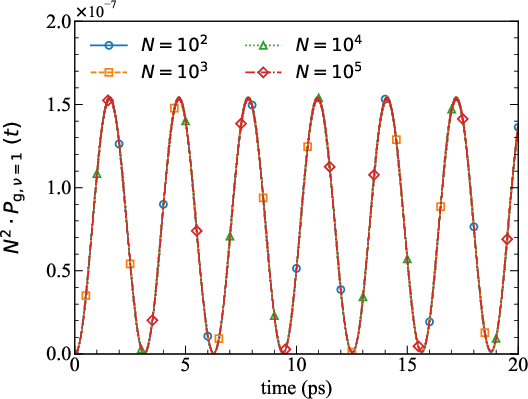
The MF approach fails to capture true light–matter entanglement and state-to-state coherences inherent to polariton physics. In particular, the vibrational resonance in MF emerges from classical beating rather than quantum superpositions, and the oscillatory population dynamics (period, amplitude) are found to be independent of ensemble size N in the MF regime (contrasting the N-dependent behavior in the SE quantum regime).
Figure 5: Demonstration of Ω=2gcN0-independence of the vibrational population oscillation period in mean-field dynamics for varying ensemble sizes.
Cavity Loss Effects
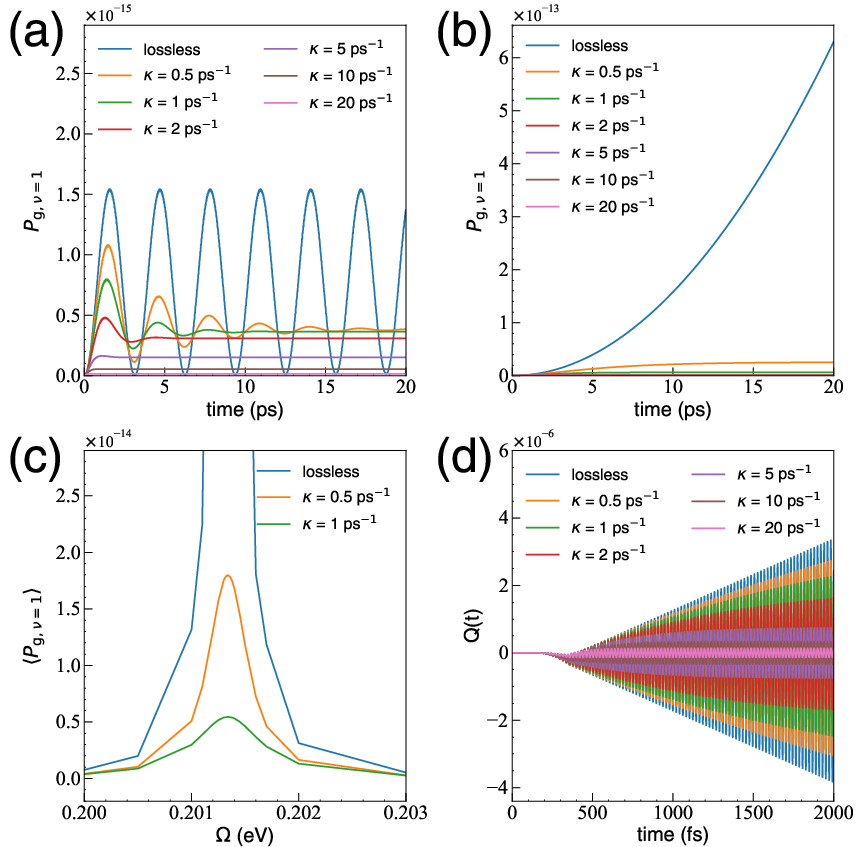
The inclusion of photon loss (cavity decay) systematically suppresses vibrational activation by damping polariton coherence. The resonance peaks are broadened, shifted closer to the bare condition as losses increase, and excitation becomes bounded with increasing dissipation.
Figure 6: Effect of cavity photon loss on polariton-driven vibrational excitation under different descriptions of nuclear dynamics.
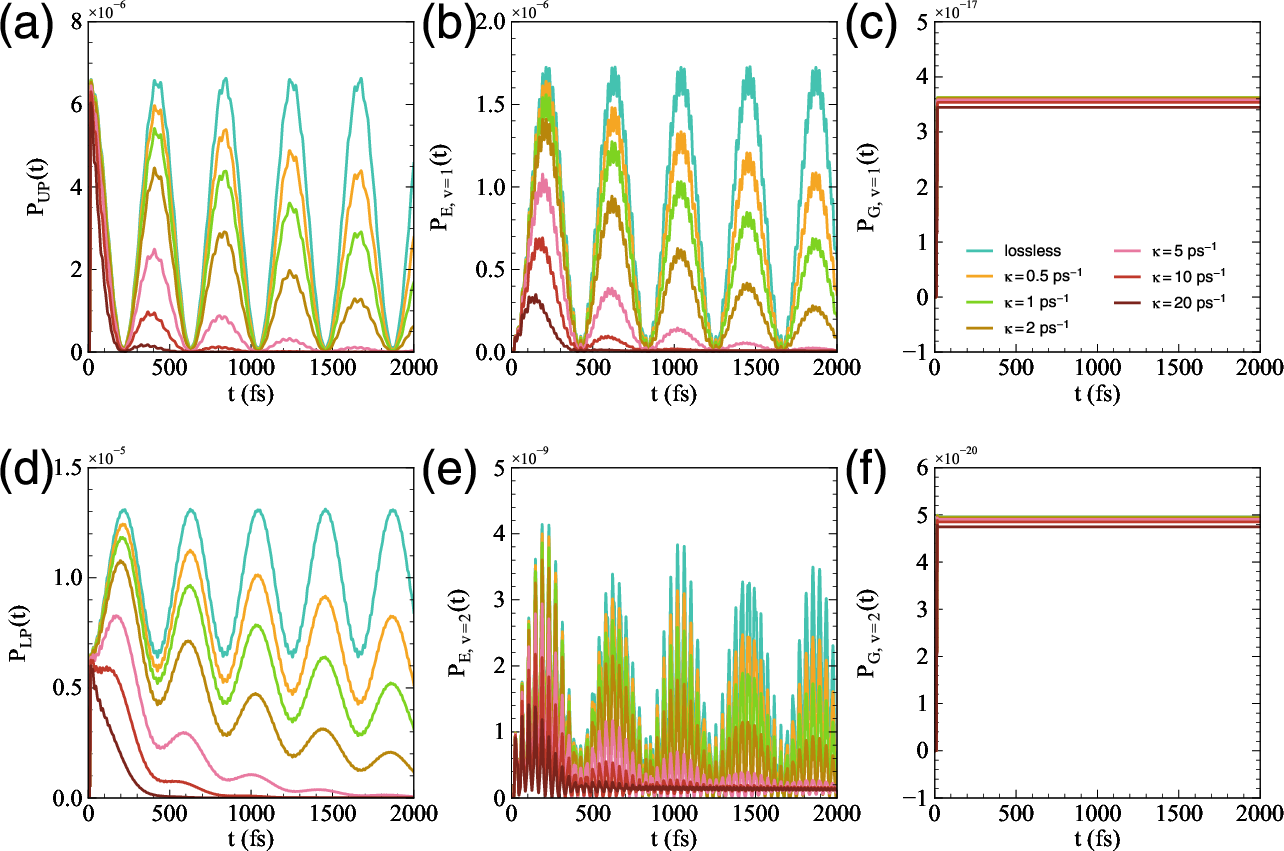
At the SE level, cavity loss suppresses population in all bright (polariton) states and vibronic levels, while the ground-state vibrational manifold remains essentially unpopulated in the absence of explicit non-radiative decay channels.
Figure 7: Cavity loss dependence of time-resolved polariton and vibrational populations under ultrashort excitation at the SE quantum level.
Classical versus Quantum Nuclei
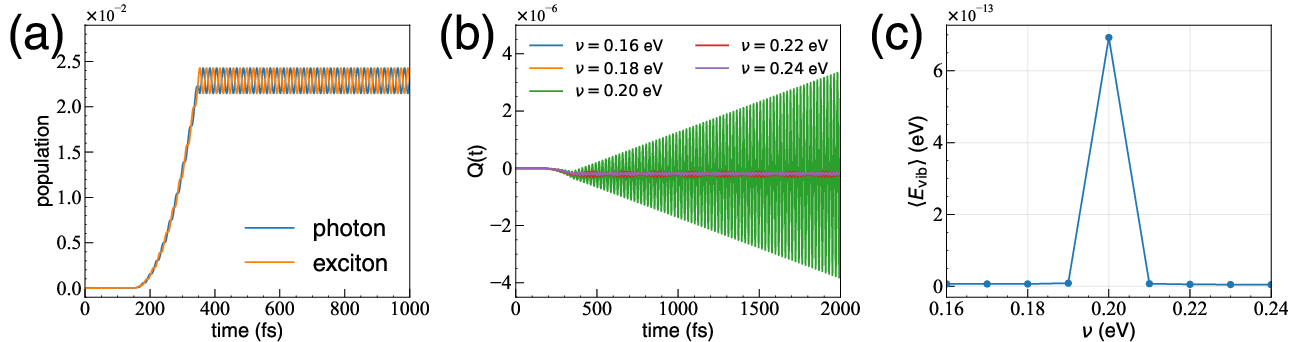
The resonance mechanism is confirmed to be robust against the quantum or classical treatment of nuclear DOF: the essential requirement is resonant, time-dependent electronic population modulating the vibrational coordinate. Classical nuclei subject to the same driving condition display the same sharp resonance and scaling phenomenology.
Figure 8: Classical MF vibrational dynamics, confirming equivalence of classical and quantum nuclear treatments for driven vibronic resonance.
Implications and Outlook
This work definitively links polariton-driven vibrational resonance to explicit dynamical beatings between collective light–matter normal modes. It establishes that semiclassical (mean-field) treatments capture collective Rabi-driven vibrational activation but cannot account for quantum correlation or true polariton coherence phenomena. The resonance mechanism has direct implications for controlling local vibrational excitation under strong collective coupling, for both nonlinear spectroscopy and cavity-modified chemistry. The demonstration of extreme resonance selectivity and its suppression by loss informs rational design of cavity architectures for targeted vibrational manipulation and control of molecular processes.
Future theoretical work should probe the interplay of polariton-induced vibronic activation with dissipative molecular environments, dark-state-mediated dynamics, and the extension to multimode or spatially inhomogeneous cavities. Incorporation of nuclear quantum effects beyond the mean-field ansatz and detailed exploration of higher-excitation manifolds will further clarify the role of quantum coherence and correlation in vibrational polariton chemistry.
Conclusion
The paper provides an authoritative, technically rigorous analysis of resonant and nonlinear vibrational excitation in collective molecular polariton systems. It unambiguously demonstrates the limitations of mean-field approaches for true polaritonic coherence phenomena, while clarifying the conditions for efficient vibrational activation via collective Rabi beating. These findings inform both spectroscopic and quantum control applications and guide the ongoing refinement of theoretical protocols needed for predictive modeling of polariton-assisted molecular dynamics (2604.15685).