- The paper shows that neutral-induced recombination significantly boosts bulk resistivity, which is essential for triggering benign termination.
- Simulations reveal that increased resistivity shifts MHD mode competition from core to edge, expanding the relativistic electron wetted area by about 2.8 times.
- The study establishes a device-agnostic framework to guide neutral injection control and optimize RE beam mitigation in fusion devices.
Mechanistic Origin of the Recombination Requirement for Benign Termination of Relativistic Electron Beams
Introduction
The mitigation of relativistic electron (RE) beams, particularly during tokamak disruptions, is critical for protecting plasma-facing components in magnetic confinement fusion devices. The benign termination scenario—where the RE heat flux is redistributed over a broad wall area via induced magnetohydrodynamic (MHD) instabilities—renders localized damage avoidable. However, the empirical requirement that the bulk plasma must undergo sufficient recombination prior to benign termination has lacked a robust first-principles explanation, hindering reliable extrapolation to next-step devices (e.g., ITER, SPARC).
Kinetic Modeling: Recombination, Neutral Injection, and Resistivity Enhancement
The study demonstrates that neutral-induced recombination drives a pronounced increase in bulk resistivity (η), which fundamentally alters MHD stability and the spatial topology of RE loss. In the recombination window, neutral densities become orders of magnitude greater than free electron densities, and standard Spitzer resistivity models (which neglect electron-neutral collisions) become invalid. Instead, the resistivity becomes
η∼vTe(σei+nen0σen)
where the neutral term dominates in the low-ionization regime. This enhancement of η by up to an order of magnitude coincides with the observed window for benign termination across devices.
(Figure 1)
Figure 1: Kinetic modeling shows that as neutral pressure increases and recombination occurs, there is a sharp increase in bulk resistivity, peaking at the benign termination access window.
This result explicitly clarifies why partial recombination, not simply reduction of ne, is required: the efficacy of benign termination is controlled by η, determined non-monotonically by the ratio of neutrals to electrons. This resolves the observed upper and lower density bounds on benign termination and explains why benign scenarios are inaccessible at intermediate densities absent sufficient recombination.
Resistive MHD Dynamics and Mode Competition
Using nonlinear extended-MHD simulations (JOREK+STARWALL), with realistic geometric, current, and q-profile parameters, the study tracks the coupled evolution of the IK (1/1) and tearing modes (2/1, 3/2) that shape the field topology during RE beam deconfinement. The resistivity η is varied while holding ne fixed to isolate its effect on nonlinear MHD physics. The key result is that increased η (from electron-neutral collisions) shifts the balance of nonlinear mode growth: higher η preferentially amplifies the edge 2/1 TM over the core 3/2 TM.
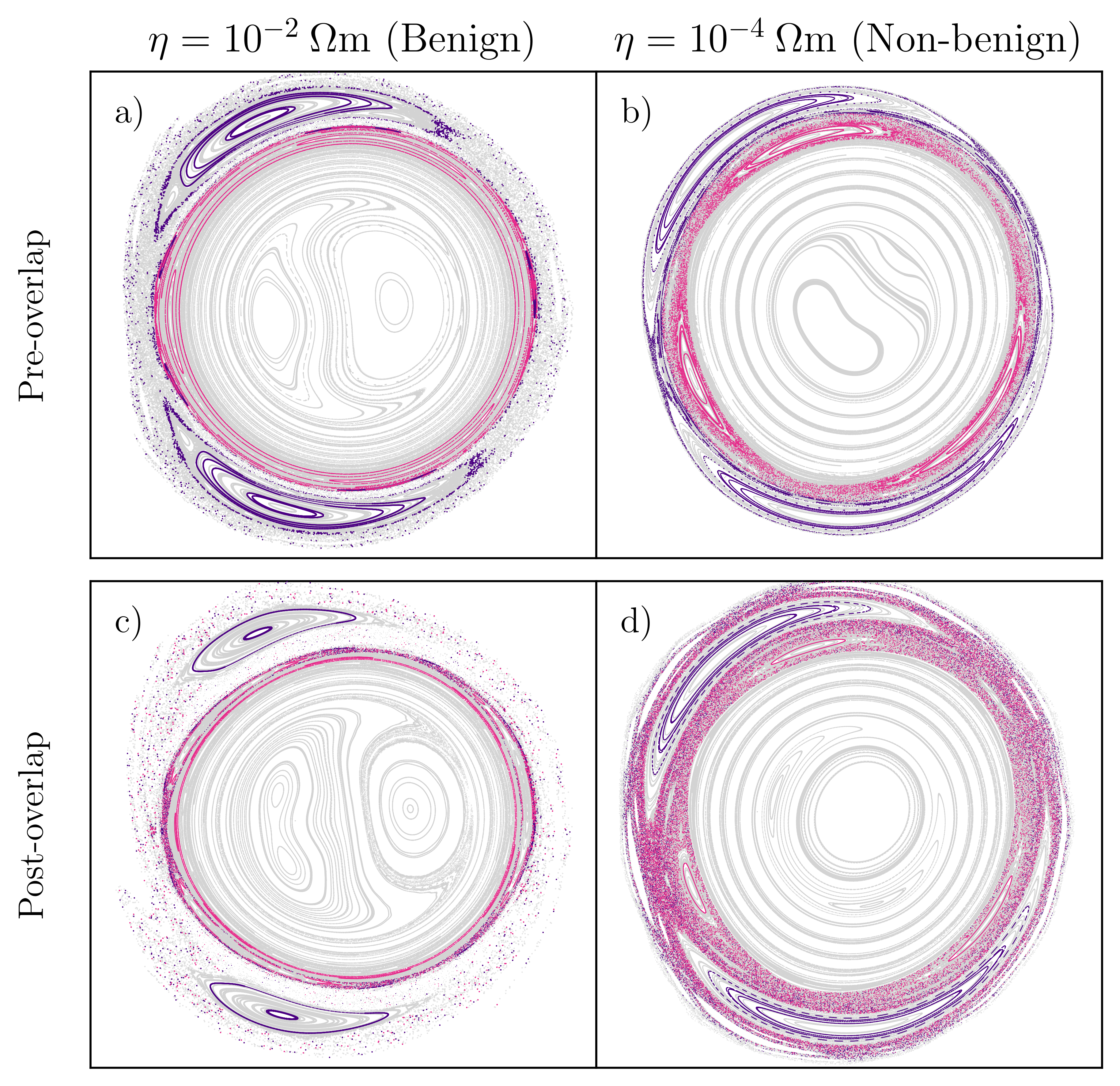
Figure 2: Poincaré plots show that in the high-resistivity regime, the edge (purple, 2/1 TM) becomes strongly stochastic before global overlap, while in the low-resistivity regime, the core (pink, 3/2 TM) dominates.
This produces a transition in the directionality of stochasticization: from inside-out (localized edge stochasticity, focused heat loads) at low η, to outside-in (robust edge stochasticity, spatially broad deconfinement) at high η. The stochasticity at the edge, present prior to full mode overlap, directly determines the RE wetted area on the wall. This is substantiated using metrics such as the connection length ne0.
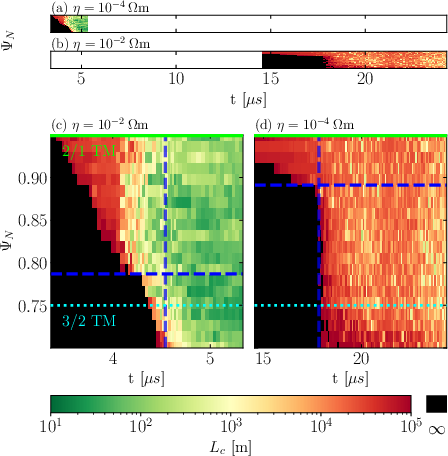
Figure 3: Time-evolution of the poloidally averaged field-line connection length demonstrates much lower ne1 (i.e., greater stochasticity) in the edge region for high ne2, indicating broader RE depletion and wetted area.
Quantification of Wetted Area and the Transition to Benign Termination
By tracking the final wall intersections of deconfined field-line bundles after the onset of global stochasticity, the study quantifies how the RE wetted area increases across the resistivity transition. For multiple values of ne3, the poloidal distribution transitions from twin-spiked (focused) at low ne4 to smooth/broad at high ne5. The wetted fraction of the wall increases by a factor of ~2.8 across the transition, in agreement with experimental observations in DIII-D and TCV.
(Figure 4)
Figure 4: The wetted poloidal surface fraction as a function of ne6 shows a rapid increase at the resistivity values associated with benign termination. The effect of ne7 is secondary compared to ne8.
Notably, at fixed ne9, increasing η0 by an order of magnitude (non-recombined case) reduces the wetted area modestly (~3%), confirming that resistivity—not density—is the critical parameter for scenario access.
Implications for Scenario Extrapolation and Control
By establishing η1 as the principal control knob, the work enables extrapolation rules for future high-current devices. The mechanism is independent of device size or RE beam energy as long as the neutral/electron ratio and induced η2 reach appropriate values. Moreover, operational levers such as current profile shaping (η3), avoidance/timing of the IK, and external perturbations can be used to optimize for maximal edge stochasticity conducive to benign termination.
The framework also accounts for observed variability between devices (e.g., JET vs. DIII-D), the lack of a sharp density threshold, and enables rational design of mitigation protocols with precise neutral injection control. Additionally, the use of resonant magnetic perturbations to enhance edge stochasticity is motivated as a control strategy for resistant or high-stored-energy plasmas.
Conclusion
This study provides the first self-consistent, device-agnostic explanation for the recombination requirement underlying benign RE beam termination. Neutral-induced enhancement of bulk resistivity is identified as the controlling parameter that sets MHD mode competition, edge stochasticity, and ultimately the spatial dispersion of RE energy deposition. The findings are quantitatively validated against experiment and support robust extrapolation to future high-stakes fusion devices, with broad relevance for the predictive control of energetic electron populations in burning plasma operations.
Reference:
"Mechanism Behind the Recombination Requirement for Benign Termination of Relativistic Electron Beams" (2604.15575)