- The paper extends CBF theory by rigorously generalizing Nagumo's theorem to guarantee forward invariance for sets defined by an infinite number of constraints.
- It introduces optimal-decay control barrier functions (OD-CBFs) that enable the synthesis of continuous and smooth controllers through semi-infinite quadratic programming.
- The work bridges theory and practice by reducing infinite constraint sets to tractable finite approximations, improving backup safety filtering in autonomous systems.
Safety Filtering with Infinite Constraint Control Barrier Functions
Introduction
This paper addresses the foundational challenge of extending control barrier function (CBF) theory to safe sets defined by an infinite number of constraints, a regime that arises in applications such as backup CBFs, collision avoidance, and uncertainty-aware safety. While CBF-based techniques have achieved substantive empirical success in enforcing safety under finite constraints, the literature lacked a comprehensive theoretical treatment of infinite-constraint invariance, especially with regards to necessary and sufficient conditions, controller regularity, and tractable design methods.
The core technical contribution is a rigorous extension of Nagumo’s theorem for forward invariance to sets described as intersections of infinitely many superlevel sets, specifically,
S={x∈Rn∣h(τ,x)≥0, ∀τ∈T}
where h is continuous in τ and T is a compact index set. The paper establishes a generalized boundary structure and introduces a "well-posedness" assumption for the active constraint set at any boundary point. Under this assumption, necessary and sufficient conditions for forward invariance are derived as follows: for all x∈∂S and all active constraints τ∈Act(x),
∂x∂h(τ,x)F(x)≥0.
This result strictly generalizes the single-constraint barrier invariant set results and is proven via a construction of smooth ascent directions and boundary-localized perturbations, as formalized in Lemma 1 and Theorem 1.
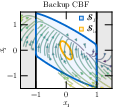
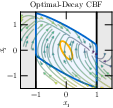
Figure 1: Closed-loop vector field for the double integrator under the backup CBF controller with infinite constraints.
Optimal-Decay Control Barrier Functions and Controller Synthesis
A central challenge in the infinite constraint regime is feasibility and regularity of controllers synthesized via (semi-)infinite quadratic programming. The paper introduces the class of optimal-decay control barrier functions (OD-CBFs), where, rather than requiring a uniform class-K decay rate, pointwise variable decay is permitted via an auxiliary variable. OD-CBFs are shown to provide necessary and sufficient certificates for invariance. Furthermore, the problem of synthesizing continuous or smooth controllers satisfying infinite collections of affine constraints is addressed. The authors leverage infinite-dimensional generalizations of Artstein's Theorem and lower semicontinuity properties of set-valued maps, establishing that, under interior-point (Slater) conditions, smooth feedback satisfying all constraints exists.
For tractable computation, a reduction result is presented: strict feasibility enables replacement of infinite collections by finite subsamples with robustification via Lipschitz constants, strengthening the connection to practical, grid-based optimization.
Implications for Backup Control Barrier Functions
The developed theory is applied to the backup CBF framework, where safety is guaranteed by a fallback invariant set, and a larger safe set is constructed using the flow induced by a backup controller. The resulting implicit set is indexed by all times on a finite horizon, thus defining an uncountably infinite constraint family. The paper demonstrates that previous literature on backup CBFs—which enforced constraints at sampled points—can now be justified by a precise reduction analysis, closing the theoretical-practical gap. Furthermore, integration of optimal-decay variables is shown to recover feasibility where fixed decay rates result in controller infeasibility and undefined closed-loop dynamics.
In Figure 1, the difference in vector field coverage between the standard backup CBF formulation and the OD-CBF approach is visible: regions where standard constraints fail (and thus yield no defined control) are eliminated by the flexible, feasibility-guaranteeing OD approach.
Theoretical and Practical Impacts
This work has several major implications for safe control synthesis:
- Invariance for Infinite Constraints: Set invariance properties for infinite intersections are now provided with necessary and sufficient, rather than simply sufficient, boundary conditions. This enables application to measure-theoretic and function space–indexed safety problems.
- Controller Regularity: Under mild assumptions, continuous and even smooth controller synthesis for semi-infinite programs is theoretically justified, which is critical for physical implementation and robust performance.
- Tractable Numerical Methods: The reduction from infinite to finite constraint sets is formalized with explicit dependence on Lipschitz constants and interior-point margins, offering a principled approach to grid design in practical safety filters.
- Backup CBF Formulation: Limitations of fixed-class K backup CBFs are resolved, providing robust feasibility even under non-convexities or ill-posedness arising from time-indexed constraints.
Future Directions
This framework opens several avenues for research:
- Extension to Nonsmooth and Hybrid Systems: While the results cover continuously differentiable parametrizations, generalizing to Lipschitz and set-valued h (for example, in hybrid systems and collision avoidance) is a promising direction.
- Compositional Control Synthesis: Integration with logic-based and hierarchical specifications, where each atomic constraint may itself generate an infinite family, will amplify the reach of the framework.
- Learning-Based Approaches: Data-driven discovery of OD-CBFs or parameterizations where constraints are indexed by function spaces (e.g., distributional robustness) may leverage these results for safety guarantees.
- Scalability: For high-dimensional h0, efficient sampling and reduction schemes, potentially using active-set or adaptive meshing methodologies, remain a critical computational challenge.
Conclusion
This paper rigorously extends CBF theory to infinite constraint regimes, precisely characterizing forward set invariance and guaranteeing controller regularity and constructibility. These foundational results elevate both theoretical understanding and practical synthesis in safety-critical control, with broad-reaching implications for robust autonomous systems, hierarchical composition, and real-world implementation of safety filters.
Reference: "Safety Filtering with an Infinite Number of Constraints" (2604.15477)

