- The paper shows that introducing a soft Z3 breaking term in the I(2+1)HDM splits the inert scalar masses, resolving dark matter candidate degeneracy.
- Detailed parameter scans and relic density calculations demonstrate that both single- and two-component dark matter scenarios can satisfy stringent detection constraints.
- Loop-induced A1 decays produce distinctive collider signatures, including displaced vertices and multi-lepton events, which offer promising experimental tests.
Theoretical Framework and Motivation
The paper "The Z3 soft breaking in the I(2+1)HDM and its cosmological probes" (2604.15425) investigates a specific extension of the Standard Model (SM) Higgs sector: a three-Higgs-doublet scenario known as the I(2+1)HDM, containing two inert doublets and one active Higgs doublet. Imposing a Z3 discrete symmetry ensures stability of neutral scalars from the inert doublets, providing viable dark matter (DM) candidates. The study focuses on the consequences of introducing a soft breaking term for the Z3 symmetry, which generates distinctive phenomenology in both cosmological and collider contexts.
The motivation is grounded in the well-recognized limitations of the SM to explain dark matter, baryogenesis, and neutrino masses, with extended scalar sectors offering solutions without violating experimental constraints such as ρ=1 at tree level. The Z3 symmetry classifies the three doublets by their charges and, in its exact form, leads to a "Hermaphrodite DM" scenario: two degenerate DM candidates of opposite CP parities. However, degeneracy complicates experimental identification, and direct detection limits are stringent due to unsuppressed ZH1A1 couplings. The soft breaking of Z3 removes this degeneracy and allows for only one stable DM candidate (or two, if the heavier CP-odd scalar is sufficiently long-lived), relaxing constraints and enabling unique collider signatures.
Model Structure and Parameter Constraints
The scalar potential consists of Z3-symmetric terms and a soft-breaking term of the form −μ122(ϕ1†ϕ2)+h.c. This term, localized in the inert sector, introduces explicit mass splittings between the CP-even (H1) and CP-odd (Z30) scalars. The physical eigenstates' mass matrices and couplings, including mixing angles and vertices relevant for DM annihilation and scattering, are explicitly parameterized. The paper details the constraints imposed by perturbativity, unitarity, boundedness from below, LEP and LHC searches, as well as direct and indirect DM detection data.
Notably, the coupling Z31 vanishes at tree-level by enforcing Z32, a condition leading to Z33. This nullifies dangerous direct detection rates, with loop-induced effects parametrized and evaluated. The scan of parameter space yields viable DM scenarios only in regions with small Z34 and narrow mass splittings, tightly respecting current DD and ID bounds.
Dark Matter Phenomenology and Relic Density
The analysis distinguishes between two regimes:
- Two-component DM scenario: For Z35 GeVZ36, both Z37 and Z38 are cosmologically stable (or Z39 is effectively stable due to its lifetime exceeding the universe's age), contributing to the relic density.
- Single-component DM with unstable Z30: For Z31 of a few GeVZ32, Z33 undergoes slow decay to Z34 and SM particles via loop-induced vertices.
Relic density calculations utilize micrOMEGAs, incorporating all relevant annihilation and co-annihilation channels, including Higgs-portal and gauge interactions. The paper demonstrates that viable parameter points exist satisfying Planck satellite constraints, with the relic density saturating at Z35 or shared by Z36 and Z37 depending on Z38 and the mass splitting Z39.
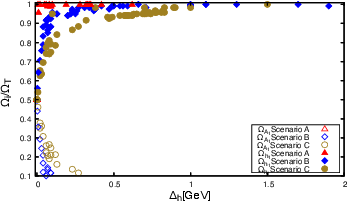
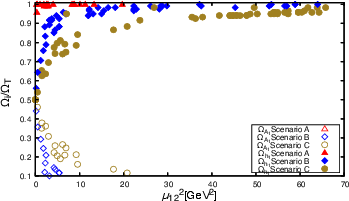
Figure 1: Ratio of the contribution from ρ=10 and ρ=11 to the total relic density, illustrating two-component and single-component DM regimes as controlled by the lifetime of ρ=12.
Comprehensive parameter scans highlight that only extremely small mass splittings avoid DD bounds, and larger values rapidly suppress ρ=13 relic density. The dependence of lifetime on ρ=14 is directly calculated, with BPs provided for each scenario.
Loop-Induced Decay and Collider Signatures
A distinctive element is the loop-induced decay of ρ=15, mediated by ρ=16 and other neutral scalar loops. The decay width is computed using FeynCalc and LoopTools, producing explicit Passarino-Veltman expressions for the effective coupling. This decay can yield observable displaced vertices at colliders, introducing phenomenological opportunities for scenarios where ρ=17 is unstable but long-lived.
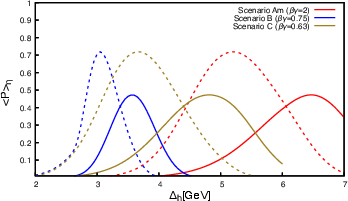
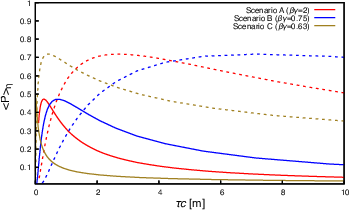
Figure 2: Average decay probability of the scalar ρ=18 for the three scenarios (A, B, and C); continuous and dashed lines correspond to different detector regions relevant for displaced vertex searches.
Numerical simulations at the International Linear Collider (ILC) are conducted for representative BPs, incorporating realistic beam polarization and luminosity. Processes such as ρ=19 and Z30 are calculated at parton level, including both direct production and secondary decays of Z31.
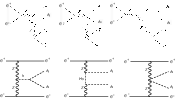
Figure 3: Feynman diagrams for the processes Z32, illustrating dominant production and decay channels leading to multi-lepton final states.
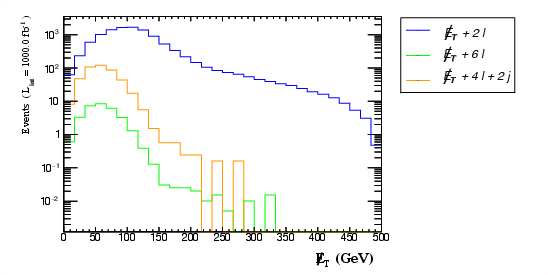
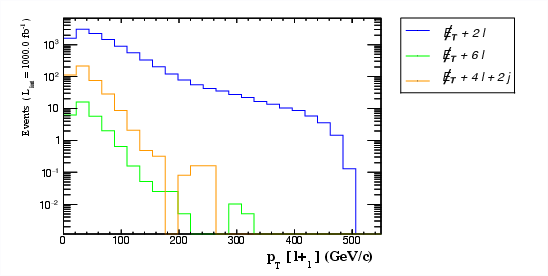
Figure 4: Spectra in missing transverse energy (left) and lepton transverse momentum (right), demonstrating characteristic kinematic features for signal separation.
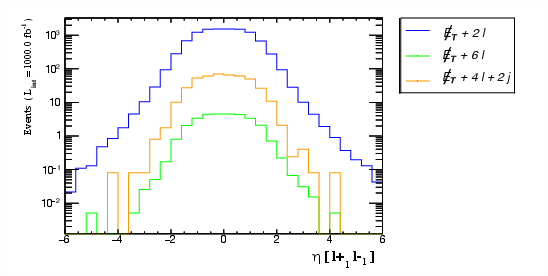
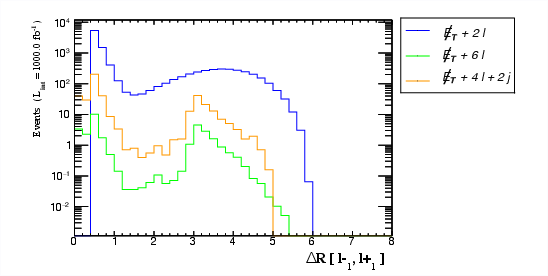
Figure 5: Spectra in lepton pseudorapidity (left) and separation between oppositely charged leptons (right), providing handles for event selection at the ILC.
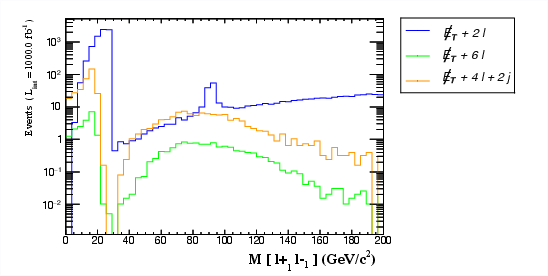
Figure 6: Invariant mass of pairs of oppositely charged leptons, directly probing the mass spectrum of the inert scalar sector.
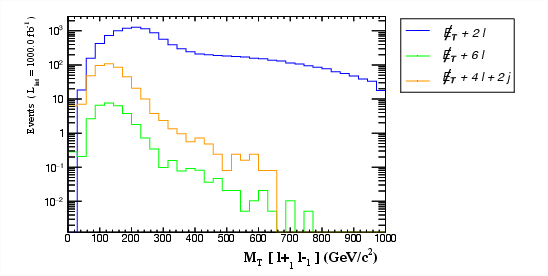
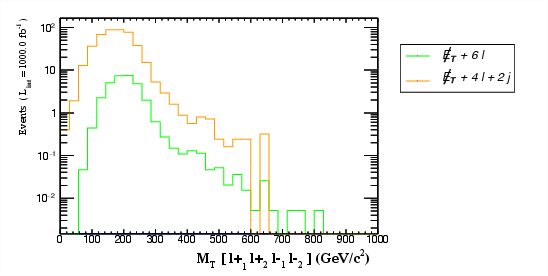
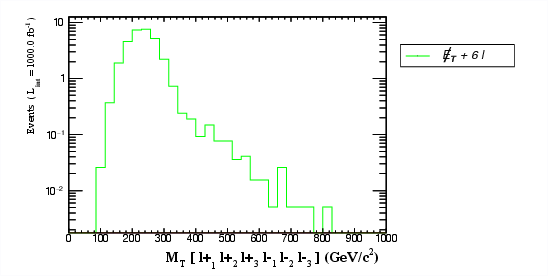
Figure 7: Transverse mass spectra for multiple lepton pairs, further characterizing signal topology and underlying mass structure.
The predicted cross-sections for exotic signatures (multi-leptons plus Z33 with displaced vertices) are quantified. The paper asserts that these are distinctive and potentially accessible at future lepton colliders, contingent on Z34 and the underlying mass spectrum.
Implications and Outlook
The study delineates a framework wherein the I(2+1)HDM with soft Z35 breaking can yield both single- and multi-component DM scenarios, subject to experimentally viable parameter choices. The phenomenology is exceptionally rich, with collider signals ranging from invisible production to displaced vertices in multi-lepton final states. Constraints from direct and indirect detection, cosmological relic abundance, and collider searches are synergistically respected.
Bold claims include the potential explanation for DM as multi-component, the compatibility with current DD constraints via loop-induced suppression of dangerous couplings, and the possibility to probe the model at future colliders through unique signatures not accessible in traditional single-doublet or Z36-protected scalar DM models.
The theoretical implication is that discrete symmetry breaking in extended scalar sectors naturally accommodates both cosmological stability and collider accessibility, offering a robust pathway for DM model-building. Practically, the interplay between mass splittings, loop-induced couplings, and lifetime calculations provides guidance for designing next-generation DM search strategies.
Looking ahead, further detailed studies on cosmological impact (e.g., Big Bang Nucleosynthesis, structure formation) and comprehensive signal-to-background analyses at colliders will be necessary. The methodological advances in parameter scanning and loop calculation are broadly applicable to other BSM scenarios with extended scalar sectors and non-trivial symmetry properties.
Conclusion
This paper systematically explores the consequences of Z37 soft breaking in a three-Higgs-doublet scenario with two inert doublets. It demonstrates that the resulting scalar spectrum allows for both cosmologically viable multi-component and single-component DM, with direct and indirect detection constraints satisfied via loop-level effects. The model predicts distinctive collider signatures characterized by displaced vertices and multi-lepton final states, potentially accessible at the ILC or similar facilities. The theoretical and practical framework established in this study enhances the landscape of scalar DM models and provides clear guidance for future experimental and theoretical directions.

