- The paper introduces a comprehensive model that accurately predicts mass-radius relationships for sub-Earth to sub-Neptune planets.
- It integrates advanced equations of state, detailed mineralogical inventories, and non-adiabatic thermal profiles to capture phase transitions and compositional effects.
- Results benchmarked against Solar System bodies reveal sub-percent precision and observationally relevant differences compared to legacy models.
Introduction and Motivation
The paper "A Validated Low-to-Intermediate Mass Planetary Interior Structure Model and New Mass-Radius Relations" (2604.15304) presents a state-of-the-art planetary interior structure model that aims to rigorously predict mass-radius (M-R) relations for planets spanning the range from sub-Earth analogs to sub-Neptunes ($0.01$--100M⊕). This model integrates recent advances in equations of state (EOS), mineral physics, phase transitions, and atmospheric physics. Its design directly addresses known deficiencies in prior mass-radius frameworks, particularly the interpretation of super-Earths, sub-Neptunes, the so-called radius valley, and the characterization of super-Mercury exoplanets.
Model Architecture and Physical Ingredients
The model advances current methodologies along four principal axes:
- Expanded Equations of State: Incorporation of state-of-the-art EOS for all major planetary materials, integrating recent experimental and ab initio results. This includes non-ideal mixing for H/He, up-to-date thermal and anharmonic terms, and use of physically-motivated high-pressure extrapolations.
- Comprehensive Mineralogical Inventory: The model tracks the equilibrium mineralogy for planet mantles via Gibbs free energy minimization, enabling multiple coexisting species within layers. Detailed treatment of high-pressure silicate, oxide, and iron phases is provided, crucial for interpreting super-Earth interiors.
- Realistic Thermal and Boundary Conditions: Non-adiabatic thermal profiles with explicit treatment of temperature discontinuities at silicate boundary layers, solid/liquid melting, and surface boundary conditions at the transit radius, as probed in exoplanet observations. The formalism includes a radiative transfer-driven temperature profile in atmospheres and self-consistent calculation of intrinsic planetary luminosity.
- Core Composition and Partitioning: Explicit treatment of light element partitioning (O, S) between solid and liquid metal core phases, reflecting constraints from seismology for Earth and allowing for extrapolation to exoplanetary parameter space.
This structure produces self-consistent radial profiles of ρ(r), P(r), and T(r) from the outermost atmospheric layer to the central core, with explicit mass partitioning among H/He, water/ice, silicates, and metals. The model natively predicts observable transit radii by integrating the pertinent (τ=2/3) optical depth for chordal light paths (see below).
Validation Against Solar System Bodies
The model is benchmarked against Earth, Mars, Moon, Venus, Mercury, and Europa using constraints from seismology, gravity, and geochemical data. Notably, the forward-modeled Earth analog matches the observed radius and moment of inertia coefficient to within 0.2%—a level not previously attained in exoplanet-focused models. High-fidelity replication is also reported for Mars, the Moon, Mercury, and Venus, generally within 0.5% error in radius and moment of inertia coefficient, provided Solar System-inferred interior compositions are supplied.
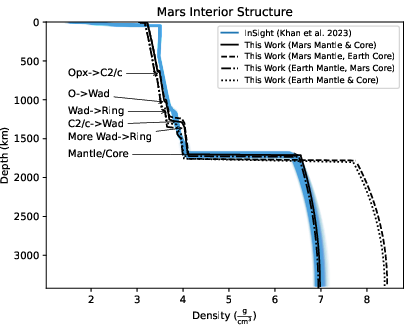
Figure 2: Density structure and key interior boundaries for model Mars compared against seismologically-retrieved profiles.
This validation underscores the necessity of including light elements in the core, mantle compositional variation, solid-liquid transitions, and temperature discontinuities for robust planetary interior predictions. Neglecting any of these factors produces systematic biases, particularly in the high-mass, high-core fraction regime.
New Mass-Radius Relations: Structure, Phase Boundaries, and Dependencies
The model is used to compute an extensive suite of (∼33,000) planetary models spanning composition (H/He, H2O, silicate, iron), mass, equilibrium temperature, core fraction, and age. The resultant M-R curves reveal several key features:
- Power-law Scalings and Their Limits: For terrestrial planets, 100M⊕0 relations are fit, but the exponent 100M⊕1 grows with mass and core mass fraction, due to increased interior compression and high-pressure phase transitions. The simple power-law approximation breaks down beyond 2--3 100M⊕2 due to these transitions, a regime previously treated inadequately in the literature.
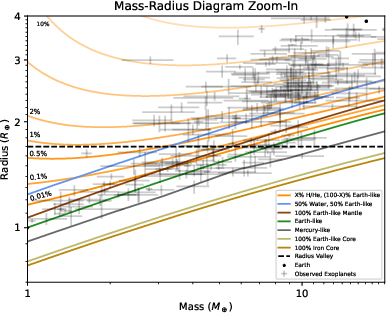
Figure 4: Zoom on the super-Earth to sub-Neptune regime mass-radius relations and locus of the observed radius valley.
- Radius Valley and Volatile Degeneracy: The M-R distributions explicitly demonstrate that distinguishing water-rich worlds from H/He-dominated sub-Neptunes requires sub-percent precision, as even small inaccuracies in EOS, mixing, or the treatment of the measurement radius produce radius changes comparable to observational uncertainties. The model's improvements yield radii systematically smaller than prior literature at low incident flux and systematically larger at high incident flux due to more complete treatment of atmospheric expansion and phase transitions.
- Steam Atmospheres and Instellation Response: High-precision treatment of water-rich planets at high equilibrium temperature (i.e., "steam worlds") captures the impact of extended steam atmospheres, yielding radii tens of percent larger than models neglecting this phenomenon. This is essential to interpreting planets near or above the radius valley with 100M⊕3 K.
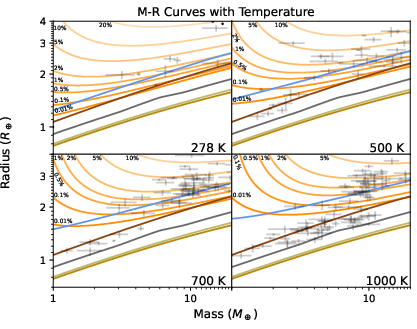
Figure 6: Mass-radius curves for varying equilibrium temperatures, demonstrating instellation-driven radius inflation, particularly for planets with significant volatile envelopes.
- Core Fraction and Composition Sensitivity: The model robustly produces the high-densities required to explain super-Mercury candidates and correctly imposes the physical boundary for planets denser than pure iron, contrasting with older mass-radius models that may yield unphysical solutions.
- Transition and Phase Boundary Effects: The inclusion of high-pressure mantle dissociation (e.g., to oxides above a few Mbar) generates marked compressional increases and corresponding bends in M-R curves at high mass, implying previous models—which extrapolated Earth's present-day structure—systematically overpredicted the radii of super-Earths.
Treatment of Observational Biases: Transit Radii and Systematics
Crucially, the model predicts the transit radius as measured by exoplanet surveys, rather than reporting radius at a fixed (e.g., 100 Pa) pressure boundary, as is common in older literature. This reduces systematic bias in theoretical versus observational comparisons by several percent, a critical correction within the present precision of high-SNR transit and RV mass-radius measurements.
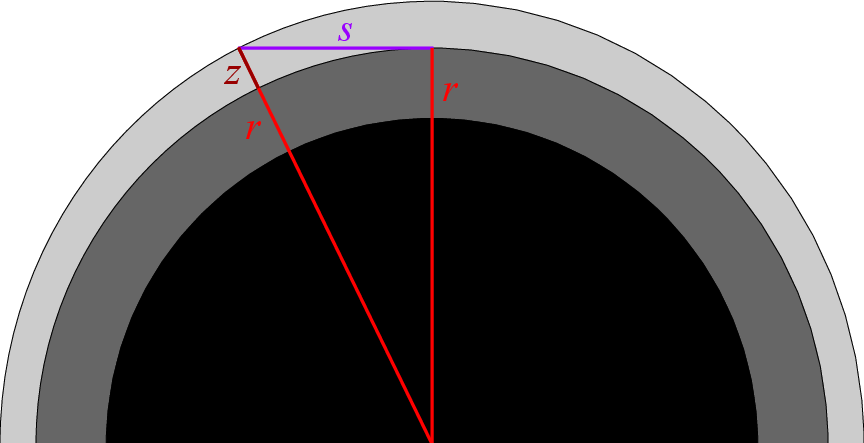
Figure 7: Schematic illustration of the planetary geometry relevant for transit radius predictions.
Strong Numerical Results and Contradictory Claims
The strong result is the model's ability to produce (Earth, Mars, Moon, Mercury, Venus, Europa) radii and internal profiles to within 100M⊕4 in all test cases, often much better—matching Earth's moment of inertia to 100M⊕5 and its radius to 100M⊕6. Contradicting common assumptions, the paper shows that improved interior physics produces bulk radii generally smaller than many legacy models at low instellation but larger at high instellation, thus the sign and even the magnitude of radius corrections are not always monotonic or unidirectional with improved model fidelity. Furthermore, for the population of observed super-Earths and sub-Neptunes, the improvements in mass-radius modeling are now directly comparable to observational uncertainties.
Implications and Prospects for Theory and Observation
This work enables robust statistical and compositional inference for exoplanet populations, including resolving the water/H/He degeneracy, setting physical composition boundaries (e.g., excluding planets with 100M⊕7) and tracking the composition-driven structure of the radius valley across stellar type and instellation. The approach is readily extensible as equations of state, laboratory data, or planetary composition hypotheses improve, and as multi-tier constraints (e.g., moments of inertia or tidal Love numbers) become accessible for exoplanets.
Several practical implications arise:
- Re-interpretation of Population-level Radius Distributions: Observational exoplanet demographics (e.g., the locus and slope of the radius valley) must account for the full physics captured here. Population fits based on older mass-radius curves can induce incorrect compositional inferences.
- Targeted Inference for Individual Exoplanets: For key "benchmark" planets (e.g., high-density super-Mercuries or transiting steam worlds), the formalism enables accurate translation of 100M⊕8, 100M⊕9, ρ(r)0 into compositional posterior distributions, supporting atmospheric retrievals or planet formation and migration hypotheses.
- Quantifying EOS Systematic Errors: When planet measurements exceed ρ(r)1 precision in both mass and radius, systematic theory uncertainties in EOS, phase transitions, and compositional mixing become a major limitation—these have been mitigated in this model, but the need for ongoing laboratory and computational EOS expansion is clear.
Future Directions
The model framework is poised for near-term extensions. Important avenues include incorporation of additional species in mantle and core inventories (e.g., Al, Ca, C), robust treatment of water and H/He miscibility regimes, coupling with time-dependent thermal/contraction/differentiation models, and implementation of observed cloud/haze effects in the calculation of transit radii. Further, direct comparison with exoplanet population synthesis outputs and constraints from JWST and ARIEL will shape how this formalism is employed in both empirical and theoretical studies.
Conclusion
The validated planetary interior structure model developed and deployed in (2604.15304) provides a framework for interpreting planetary mass and radius observations with physically complete, up-to-date microphysics and thermodynamics. The model achieves exceptional agreement with Solar System bodies and produces M-R relations that supersede prior literature in precision and reliability across the low-to-intermediate mass regime. Accurate compositional and structural inference for exoplanets now demands models that incorporate the level of sophistication and validation demonstrated here.