R3D: Revisiting 3D Policy Learning
Abstract: 3D policy learning promises superior generalization and cross-embodiment transfer, but progress has been hindered by training instabilities and severe overfitting, precluding the adoption of powerful 3D perception models. In this work, we systematically diagnose these failures, identifying the omission of 3D data augmentation and the adverse effects of Batch Normalization as primary causes. We propose a new architecture coupling a scalable transformer-based 3D encoder with a diffusion decoder, engineered specifically for stability at scale and designed to leverage large-scale pre-training. Our approach significantly outperforms state-of-the-art 3D baselines on challenging manipulation benchmarks, establishing a new and robust foundation for scalable 3D imitation learning. Project Page: https://r3d-policy.github.io/
Paper Prompts
Sign up for free to create and run prompts on this paper using GPT-5.
Top Community Prompts
Explain it Like I'm 14
Plain-English Summary of “R3D: Revisiting 3D Policy Learning”
What is this paper about?
This paper is about teaching robots to do tasks by watching demonstrations, but in a smarter way that uses 3D information instead of flat 2D images. The authors show why earlier 3D methods often struggled to train well, and they introduce a new, more stable and accurate system called R3D that learns from 3D data to control robots.
What questions does the paper try to answer?
The paper focuses on three simple questions:
- Why do stronger 3D vision models sometimes perform worse than simpler ones when training robot policies?
- How can we stop 3D robot policies from overfitting (memorizing training examples instead of learning general skills) and becoming unstable during training?
- Can a new design—using a powerful 3D “reader” and a careful “step-by-step action planner”—work better in both simulations and the real world?
How did they approach the problem?
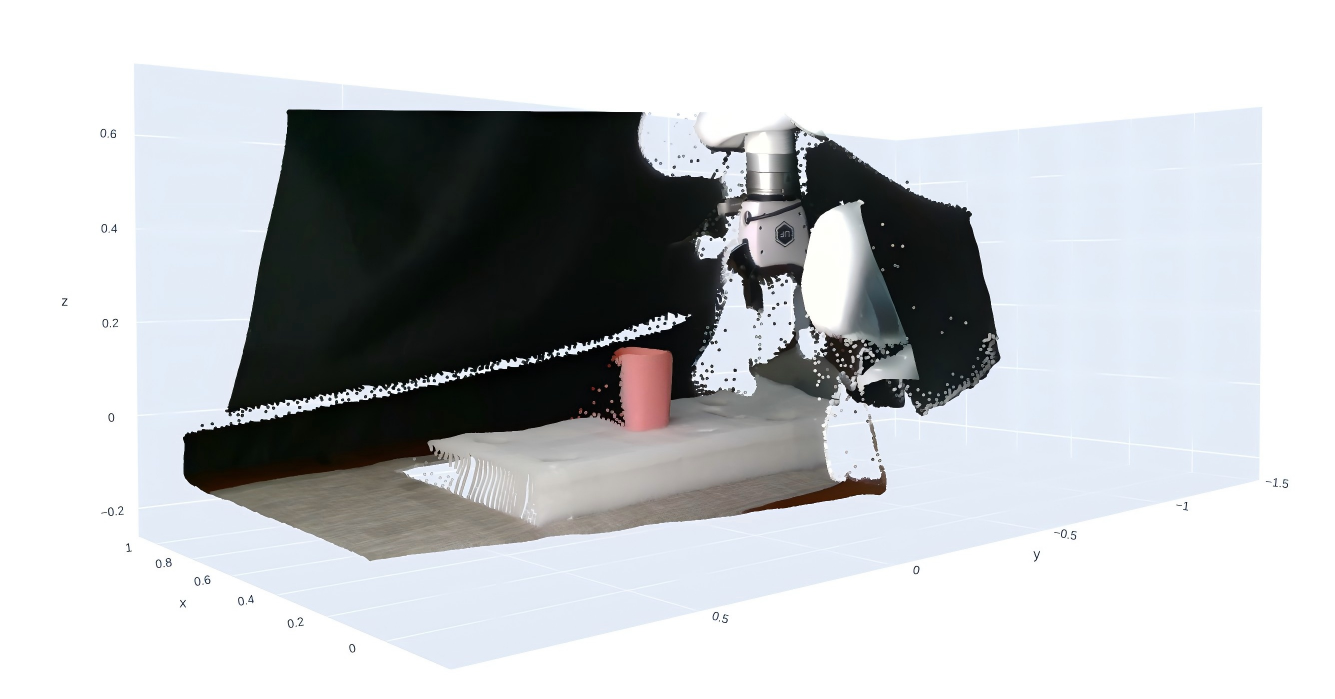
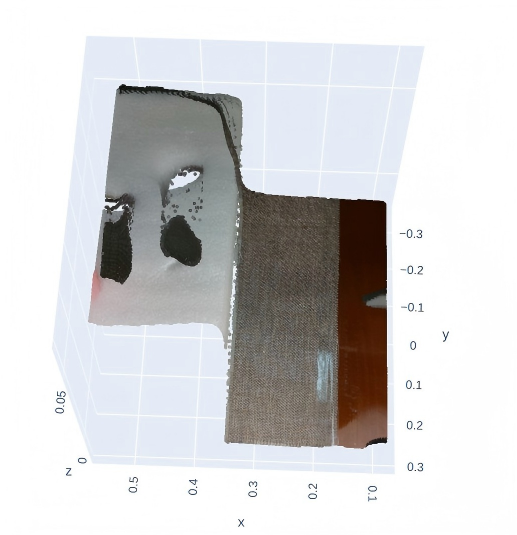
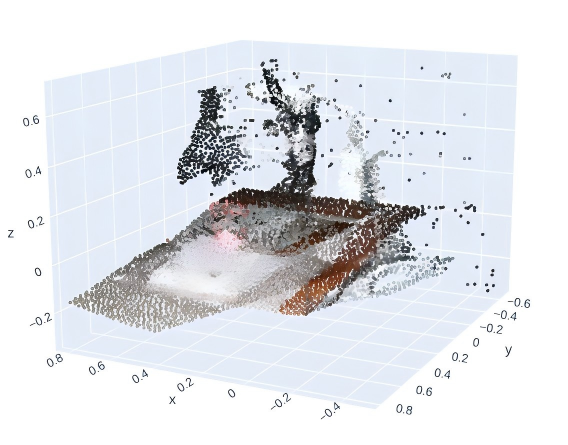
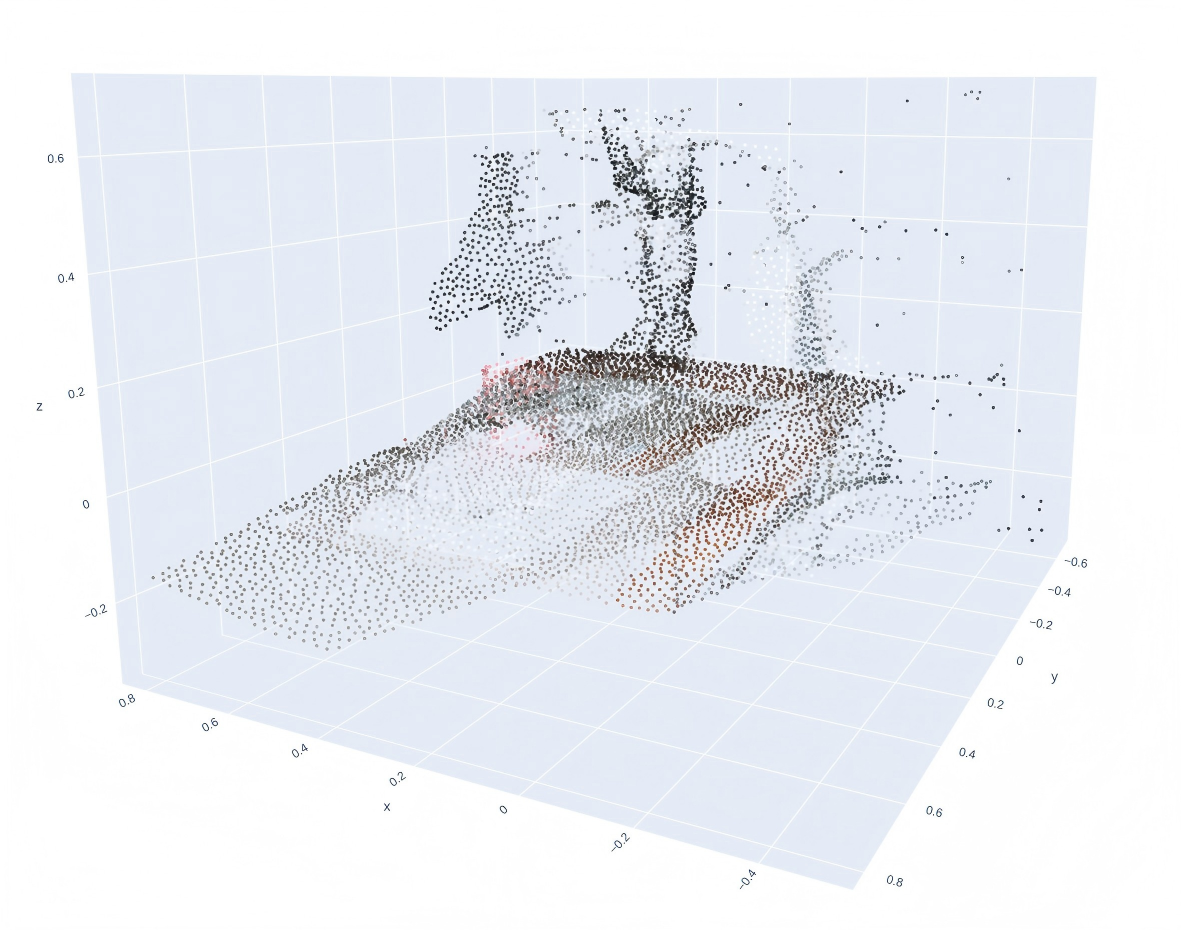
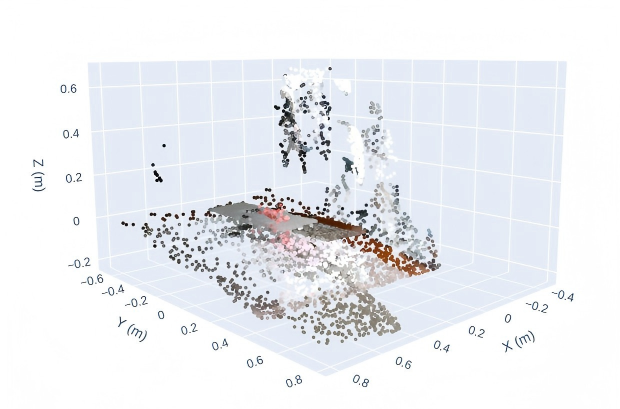
Think of a robot trying to understand a scene like you looking at a LEGO model made of tiny dots—this is a point cloud, a 3D “dot” picture of the world. The robot needs to read this 3D dot cloud, understand where important things are (like a drawer handle), and then plan a series of moves to complete a task.
Here’s what the authors found and changed:
- The two hidden troublemakers:
- Batch Normalization (BN): A common technique that “balances” the numbers inside a network. It works best with large batch sizes, but robot imitation learning usually uses small batches. That made training unstable and hurt performance, especially for big models.
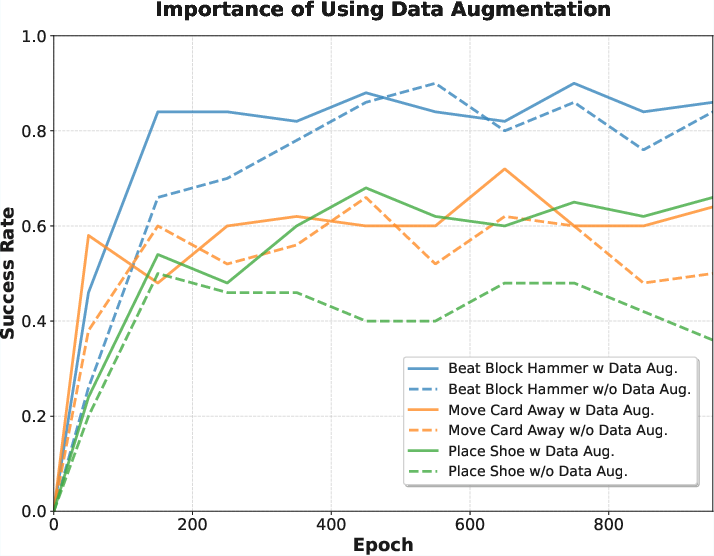
- Missing 3D data augmentation: The usual 2D trick of randomly changing images to prevent overfitting wasn’t being used for 3D. Without it, models memorized training scenes and didn’t generalize well.
- Their fixes and new design:
- Use Layer Normalization (LN) instead of BN: LN doesn’t rely on batch size and made training stable for large 3D models.
- Add 3D data augmentation: They
- Shuffle which points are picked (so the model can’t rely on the exact order),
- Jitter colors (brightness, contrast, saturation),
- Add small noise and randomly drop some points (so the model learns to handle imperfect or missing data).
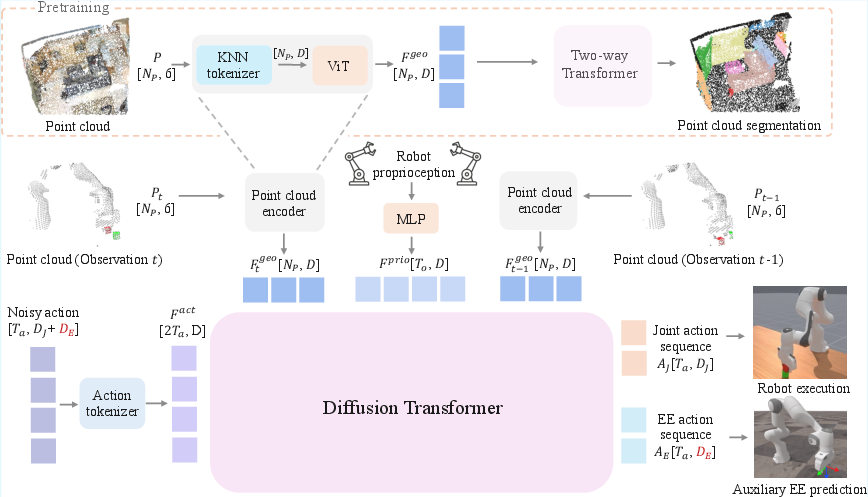
- A better 3D “reader” (encoder): A transformer-based 3D encoder that keeps the detailed spatial layout instead of squashing the whole scene into a single summary number. It’s like keeping the full map instead of just a short description.
- A smarter “action planner” (diffusion decoder): Imagine you start with a very fuzzy idea of what to do and gradually “unblur” it step by step. That’s a diffusion model: it turns noisy “action guesses” into clean action sequences. Their decoder uses attention to look back at the detailed 3D map and the robot’s own body state at every step, so it stays spatially aware.
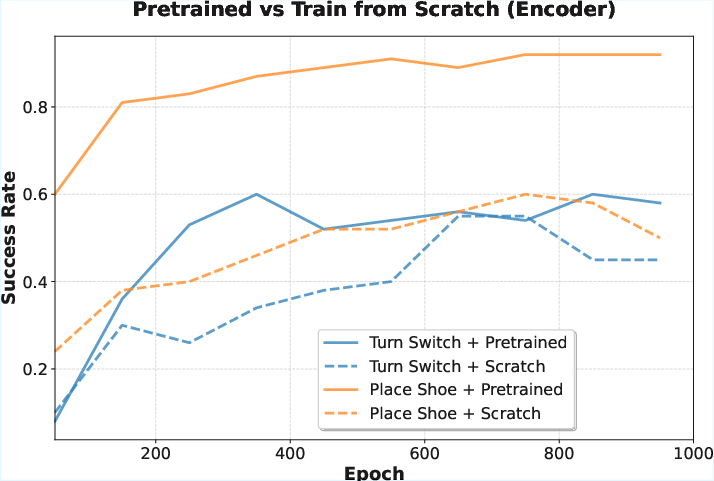
- Pretraining on 3D segmentation: Before learning robot tasks, the 3D encoder is trained to understand general 3D scenes (like labeling objects in point clouds). This gives it a strong head start—like learning the language before reading a book.
- An extra helpful prediction: The model predicts both joint angles and the end-effector pose (where the robot’s hand is in space). This extra supervision is like giving the model another clue, which improves precision.
What did they find?
The authors tested R3D in both simulation and the real world, and saw consistent gains.
- Stability and generalization:
- Replacing BN with LN made big 3D models finally train well (no more “stronger model performs worse” paradox).
- 3D data augmentation reduced overfitting and stabilized training curves.
- Architecture wins:
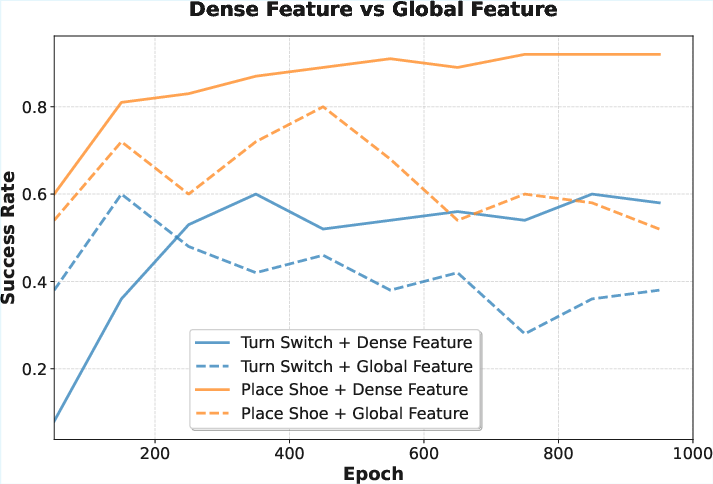
- Keeping dense 3D features (the full map) and using attention beat the old approach of using a single global feature.
- Pretraining the 3D encoder helped the model learn faster and perform better.
- The extra end-effector prediction gave a small but reliable boost.
- Performance highlights (simplified):
- RoboTwin 2.0 (simulation):
- “Easy” tasks: R3D had the best average success rate across challenging bimanual tasks.
- “Hard” tasks with lots of distractions and lighting changes: R3D again came out on top, showing strong robustness.
- ManiSkill2 (simulation):
- On fine-control tasks like “Peg Insertion,” R3D did much better than others in the tricky Align and Insert stages where precise geometry matters.
- Real robots (xArm6 with two depth cameras):
- On three real tasks—placing a kettle on a stove, opening a drawer, and folding a towel—R3D achieved the highest average success (about 69%), beating other strong baselines.
- Using two camera views helped all methods, but R3D was best with one or two views.
- Under “disco light” (changing colors), performance dropped for everyone, but R3D stayed the most robust.
- Practical tips they discovered:
- Pick encoder size to match point-cloud density: smaller encoders worked best for 1,024 points; slightly larger ones for 8,192 points.
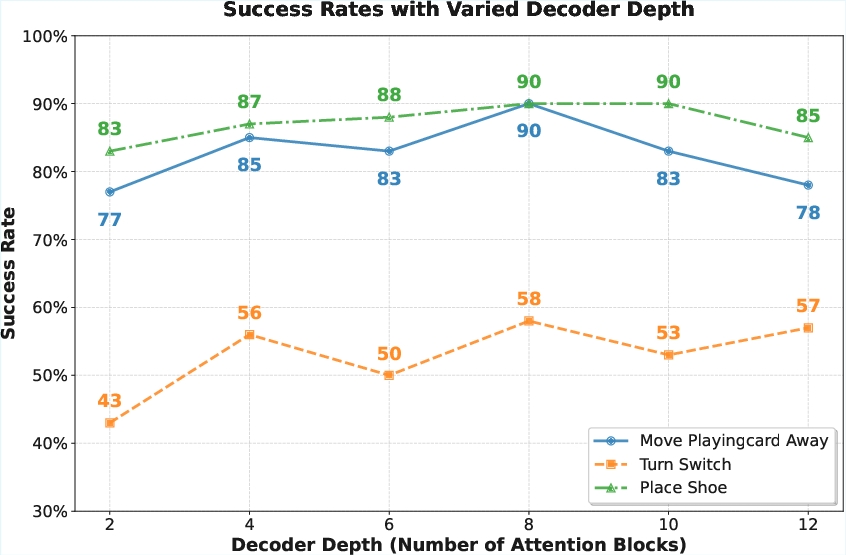
- Don’t overbuild the action decoder: 4–8 transformer blocks worked best; going deeper didn’t help and could overfit.
Why is this important?
Robots live in a 3D world. Policies that truly understand 3D:
- Handle different camera angles and viewpoints naturally,
- Are more robust in messy, cluttered scenes,
- Transfer better across different robot bodies (because everything is grounded in a common 3D world frame),
- Perform precise tasks (like aligning a peg) more reliably.
This work shows how to make such 3D policies trainable and scalable in practice, unlocking the benefits of modern 3D perception for robot control.
What could this lead to?
- More reliable home and factory robots that can handle changes in environment, lighting, and camera placement.
- Faster development cycles thanks to pretraining on large 3D datasets.
- Stronger building blocks for future Vision-Language-Action systems that reason in 3D (e.g., following instructions like “put the blue cup on the top shelf” while understanding the full 3D scene).
- Better cross-robot transfer of skills, since actions are aligned with consistent 3D geometry.
In short, R3D provides a stable, high-performing way to learn robot policies from 3D data, closing the gap between powerful 3D perception and real robot control.
Knowledge Gaps
Knowledge gaps, limitations, and open questions
Below is a concise, actionable list of what remains missing, uncertain, or unexplored in the paper and could guide future research:
- Cross-embodiment transfer is not evaluated despite being a stated motivation; how well does the policy transfer across arms with different kinematics, DOFs, grippers, and control interfaces without retraining?
- Language/instruction conditioning is absent; how to integrate the proposed 3D encoder–DiT stack into VLA settings while retaining spatial precision and stability?
- Pretraining scope and design are underexplored: which 3D datasets (indoor scenes vs. manipulation-centric data), tasks (segmentation vs. self-supervised/contrastive), and pretraining objectives yield the best transfer to manipulation?
- Negative transfer from segmentation pretraining is not analyzed; are there tasks where pretraining hurts (domain mismatch), and what mitigations (adapters, partial freezing, LoRA) help?
- No scaling laws for pretraining are provided; how performance scales with the amount/diversity of pretraining data and with mismatched point densities between pretrain and finetune.
- Normalization analysis is limited to BN vs. LN; do alternatives (GroupNorm, RMSNorm, ScaleNorm, Pre-LN vs. Post-LN transformer variants) further improve stability with small batches?
- BN’s failure mode is not deeply diagnosed; how do batch size, point count variance, and multi-view fusion interact with BN/LN and gradient noise to cause instability?
- Data augmentation ablations are coarse-grained; which individual augmentations (e.g., rotation/scale jitter, axis-aligned vs. full 3D rotations, occlusion/masking, elastic distortions, mixup/cutmix for point clouds) contribute most, and what magnitudes are optimal per task?
- No robustness evaluation to calibration drift or extrinsic/intrinsic camera errors; how sensitive is the world-frame fusion to small-to-moderate pose errors and time-sync mismatches?
- Limited robustness testing beyond lighting/color; resilience under depth artifacts (holes, speckle), reflective/transparent materials, severe occlusions, moving distractors, and sensor dropouts remains unknown.
- Multi-view fusion strategy is simplistic (world-frame fusion of concatenated points); does learned cross-view fusion, per-view encoders, or asynchronous fusion improve performance or robustness?
- Computational efficiency and latency are not reported; what are training/inference FLOPs, memory footprint, and closed-loop control rates (Hz) under varying point counts, views, and horizons?
- Cross-attention over dense 3D tokens may scale poorly; how do token count (N_C), patch size, and sparsification/pruning (e.g., stride, top‑k attention, clustering) trade off accuracy vs. compute?
- Action decoding design space is underexplored; how does DiT compare to flow matching, consistency models, diffusion distillation, or hybrid (flow + diffusion) decoders in sample efficiency and latency?
- Diffusion hyperparameters are under-specified; how do number of diffusion steps, noise schedules, and guidance/conditioning strategies affect performance and real-time feasibility?
- Action representation choices are limited; how do joint-space vs. task-space vs. impedance/velocity/torque commands or frame choices (base vs. end-effector vs. object frame) impact precision and stability?
- Auxiliary tasks are narrow (end-effector pose); do richer auxiliary objectives (contact state, gripper force, affordance/keypoint prediction, collision penalties, scene flow) improve control accuracy?
- Long-horizon generalization is only partially tested (PegInsertion split into subtasks); can the method tackle long, compositional tasks end-to-end without segmentation or task resets?
- Few-shot and low-data regimes (<10–20 demos) are not studied; how effective are augmentations, pretraining, and regularization in data-scarce real-world settings?
- Multi-task learning and continual learning are untested; can a single policy jointly learn many tasks without interference, and does dense feature conditioning scale in multi-task scenarios?
- Generalization to novel objects/categories and unseen scenes is not quantified; beyond domain randomization, how does the model handle category-level generalization and open-set objects?
- Real-world evaluation is limited (3 tasks, 50 demos each); broader benchmarks with more object diversity, articulated categories, deformables, and clutter would better stress-test claims.
- Dependence on preprocessing (ground/table cropping) is unexamined; what happens when cropping is imperfect, or in scenes without easily removable supports?
- Sensitivity to point density and distribution shifts is not fully characterized; how do dynamically varying point counts, view occlusions, or non-uniform sampling affect performance?
- Interpretability and failure modes are not analyzed; where does attention focus during successful vs. failed trials, and what systematic errors (pose bias, grasp misalignment) recur?
- Alternative 3D encoders are not benchmarked; how do sparse 3D CNNs (e.g., Minkowski), PTv3, or Uni3D variants compare under the same training recipes?
- Proprioception modeling is minimal; can structure-aware encodings (e.g., kinematic graph embeddings, normalized joint spaces) improve cross-embodiment and control accuracy?
- Safety and constraint handling are absent; how to incorporate collision avoidance, joint limits, and force constraints into diffusion decoding or guidance?
- Reproducibility details (training hyperparameters, seeds, exact schedules) are incomplete in the text; thorough reporting is needed to verify the stability claims across labs and setups.
Practical Applications
Practical Applications of R3D: Revisiting 3D Policy Learning
R3D introduces a stable, scalable 3D imitation-learning policy that combines a LayerNorm-only transformer point-cloud encoder with a spatially aware diffusion transformer decoder, augmented by effective 3D data augmentation and optional 3D segmentation pretraining. The method consistently outperforms 2D and prior 3D baselines in simulation and real-world manipulation, shows robustness to viewpoint changes and lighting, and benefits from multi-view RGB-D fusion. Below are actionable applications, grouped by immediacy, with sector linkages, potential tools/workflows, and feasibility considerations.
Immediate Applications
The following can be deployed now with available RGB‑D sensors, off-the-shelf robot arms, and modest engineering effort. They leverage R3D’s demonstrated gains in stability, generalization, and precision.
- Industrial robotics (manufacturing/assembly)
- Use case: Fine-grained pick-and-place, insertion, drawer/door manipulation, and fixture operation in variable lighting and clutter.
- Why R3D: Dense 3D features + cross-attention improve spatial precision (e.g., “PegInsertion-Align/Insert”), LN-only encoder stabilizes training with small batches, and 3D augmentations reduce overfitting.
- Tools/workflows/products:
- R3D-based “3D Diffusion Policy” controller for assembly cells.
- Multi-view RGB‑D fusion module for cell-level camera rigs.
- Point-cloud augmentation library (color jitter, dropout, FPS randomization, noise) for imitation learning pipelines.
- Dependencies/assumptions:
- Calibrated, time-synchronized RGB‑D sensors; reliable point-cloud quality.
- Sufficient demonstrations (e.g., ~50–200 per task) and compute for training diffusion models.
- Safety interlocks for physical deployment.
- Warehousing and logistics
- Use case: Robust bin picking, sorting, tote/drawer interaction, and object relocation under diverse lighting and occlusions.
- Why R3D: Viewpoint invariance and multi-view fusion reduce failures from occlusions; dense features support grasping thin handles/edges.
- Tools/workflows/products:
- R3D-powered picking stack with segment‑then‑act or end-to-end imitation learning.
- Pretrained 3D encoder bootstrapped from ScanNet/ARKitScenes to reduce data needs.
- Dependencies/assumptions:
- Camera placement that reduces blind spots; robust pose estimation of totes/racks.
- Dataset coverage for target SKU geometries.
- Service and domestic robots
- Use case: Home tasks like placing handled objects (kettle on stove), opening drawers/doors, and folding textiles.
- Why R3D: Demonstrated real-world efficacy on these tasks with multi-view input and resilience to dynamic lighting (“disco light”).
- Tools/workflows/products:
- On-robot inference pipeline (edge GPU) with quantized DiT and ViT-tiny/small encoders selected by point density.
- Teleoperation-to-imitation workflow for rapid skill capture (50 demos per task).
- Dependencies/assumptions:
- Reliable multi-view setup (eye-in-hand + external camera) or high-quality single view.
- Safety measures around humans; variability in household objects may require incremental fine-tuning.
- Laboratory automation and R&D prototyping
- Use case: Reliable 3D policy baseline for new manipulation tasks, benchmarking 3D vs. 2D policies, rapid prototyping of robots with differing embodiments.
- Why R3D: Stable training with LayerNorm, data augmentation, and clear scaling recipes (encoder size vs. point density; decoder depth).
- Tools/workflows/products:
- Open-source R3D training/evaluation harness for RoboTwin/ManiSkill2 and real robots.
- Ablation-ready toolkit for studying dense vs. global conditioning, pretraining, and auxiliary EE decoding.
- Dependencies/assumptions:
- Access to simulators (RoboTwin 2.0, ManiSkill2) and datasets (ScanNet, ARKitScenes).
- Moderate GPU resources for diffusion training.
- Retail and micro-fulfillment
- Use case: Shelf/drawer interactions, precise placement in displays, object restocking under variable lighting.
- Why R3D: Better generalization to viewpoint/lighting changes; multi-view fusion improves reliability in cluttered, tight spaces.
- Tools/workflows/products:
- Store-deployable camera rigs with standardized calibration workflow.
- Pretrained 3D encoder fine-tuned on retail object scans.
- Dependencies/assumptions:
- Robustness to reflective surfaces and sensor noise; governance for in-store safety and uptime.
- Software/tools vendors (robotics SDKs and platforms)
- Use case: Embed R3D components in commercial stacks as a “3D Imitation Learning Module” for partners.
- Why R3D: Clear recipes (LN-only encoders, 3D augmentation, dense conditioning, 4–8 layer decoders) improve out-of-the-box performance.
- Tools/workflows/products:
- R3D SDK with:
- Encoder pretraining service on public 3D segmentation datasets.
- Multi-view point-cloud fusion and augmentation APIs.
- Policy export (e.g., TensorRT) and benchmarking dashboard for lighting/viewpoint robustness.
- Dependencies/assumptions:
- Integration with client data pipelines and robot stacks; productization of training/inference tooling.
- Public-sector and standards bodies (policy/benchmarking)
- Use case: Update manipulation benchmarks and procurement guidelines to include 3D perception robustness (multi-view, lighting changes).
- Why R3D: Demonstrates practical gains from 3D representations and multi-view setups; provides concrete training recipes that reduce instability and overfitting.
- Tools/workflows/products:
- Standardized test protocols for lighting/viewpoint robustness.
- Reference datasets with multi-view RGB‑D and demonstration logs.
- Dependencies/assumptions:
- Stakeholder alignment; data-sharing agreements for 3D datasets; reproducibility infrastructure.
Long-Term Applications
These require further research, scaling, or engineering to reach production reliability at large scale or in safety-critical contexts.
- Cross-embodiment skill transfer at scale
- Vision: Train manipulation skills once and transfer across robot arms/grippers by leveraging canonical 3D world frames and dense spatial features.
- Potential products:
- “Skill library” marketplaces where policies trained on one platform transfer to others with minimal adaptation.
- Dependencies/assumptions:
- Robust kinematic adapters and calibration standards; broader demonstrations covering embodiment variations; safety validation across hardware.
- 3D Vision-Language-Action (VLA) generalist robots
- Vision: Integrate R3D’s 3D encoder/decoder into VLA frameworks for instruction-following with 3D spatial grounding.
- Potential products:
- 3D-VLA assistants for homes/factories that understand language instructions and act with precise 3D control.
- Dependencies/assumptions:
- Large multimodal datasets with high-quality 3D and action labels; scalable training infrastructure; safety and interpretability.
- Field robotics in energy, utilities, and infrastructure
- Vision: Robots that manipulate valves, switches, and doors on rigs/substations/plants with poor illumination and occlusions.
- Potential products:
- Maintenance robots with multi-view sensing rigs and R3D policies for fine manipulation in hard-to-reach areas.
- Dependencies/assumptions:
- Ruggedized sensors, weather-proofing, latency-tolerant inference; domain adaptation; regulatory approvals.
- Healthcare and hospital operations
- Vision: Logistics and support tasks (e.g., opening drawers/doors, handling containers, fabric folding or bed-making) with strict spatial and safety constraints.
- Potential products:
- 3D manipulation modules integrated into hospital service robots for reliable operation under lighting variability.
- Dependencies/assumptions:
- Clinical safety certification, hygiene-compliant hardware, exhaustive testing in mixed human environments.
- Construction and facilities management
- Vision: Robots performing door/window manipulation, tool handling, and material placement with viewpoint-invariant policies.
- Potential products:
- Task-specific R3D controllers integrated into mobile manipulation platforms.
- Dependencies/assumptions:
- Robust SLAM and scene understanding beyond local manipulation; heavy occlusion handling; compliance with site safety norms.
- Agricultural robotics
- Vision: Delicate crop handling, drawer/bin access, and equipment operation in highly variable outdoor lighting.
- Potential products:
- Harvesting/packing arms leveraging dense 3D conditioning for fine-grained manipulations.
- Dependencies/assumptions:
- Outdoor 3D sensing robustness, dust/rain tolerance, domain-specific datasets.
- Cloud-scale pretraining and federated 3D learning
- Vision: Continual pretraining of 3D encoders on ever-growing segmentation/scene datasets to improve generalization across domains.
- Potential products:
- Cloud pretraining services; federated data-sharing consortia for 3D robotics.
- Dependencies/assumptions:
- Data governance and privacy; standard formats for 3D data and annotations; compute budgets.
- Regulatory frameworks for data-driven manipulation
- Vision: Standards for training data quality (3D point clouds, multi-view calibration), robustness tests (lighting/viewpoints), and safety audits for imitation-learned policies.
- Potential outputs:
- Certification programs, compliance checklists for 3D policy-based robots.
- Dependencies/assumptions:
- Industry consensus and reference implementations; monitoring/telemetry for deployed policies.
- Hardware acceleration and on-device inference
- Vision: Real-time, power-efficient deployment of diffusion transformers with dense 3D conditioning on embedded platforms.
- Potential products:
- ASIC/FPGA acceleration for DiT layers and cross-attention; optimized quantization/compilers for point-cloud pipelines.
- Dependencies/assumptions:
- Co-design of model architectures and accelerators; acceptable accuracy vs. latency trade-offs; maintainability.
- Robust multi-view perception stacks for mobile manipulation
- Vision: Turnkey rigs (calibration, synchronization, fusion) for robots to exploit R3D’s multi-view strengths across dynamic environments.
- Potential products:
- “Perception-in-a-box” kits for integrators with calibration tools, diagnostics, and failure-detection monitoring.
- Dependencies/assumptions:
- Standardized interfaces, easy field recalibration, and lifecycle maintenance.
Notes on feasibility across applications:
- Data and sensors: Success depends on reliable RGB‑D or depth-equivalent sensors, accurate extrinsic calibration, and stable point-cloud quality. More cameras generally improve performance but add calibration/maintenance overhead.
- Compute: Diffusion transformers are compute-intensive; decoder depths of 4–8 blocks are a good trade-off. Real-time on edge devices may require model compression and optimization.
- Training regime: LN-only encoders and 3D augmentations (point dropout, color jitter, Gaussian noise, FPS randomization) are critical to avoid overfitting; encoder pretraining on 3D segmentation datasets reduces demo requirements.
- Task coverage: Generalization still hinges on demonstration diversity and coverage of edge cases (e.g., varied object shapes/materials).
- Safety and compliance: Physical manipulation requires safety interlocks, human-aware motion planning, and compliance with local regulations, especially in public or clinical environments.
Glossary
- Action chunking: Grouping multiple low-level actions into temporally contiguous chunks to simplify long-horizon control. "which introduced powerful paradigms like diffusion-based action decoding and action chunking."
- Additive noise: Injecting random perturbations into inputs or states during training to improve robustness and prevent overfitting. "Additive Noise and Dropout: We apply modest Gaussian noise to both point cloud coordinates and proprioceptive vectors."
- Auxiliary task: A secondary prediction objective used to regularize and improve the main task’s learning signal. "we introduce an auxiliary task to jointly decode end-effector poses and joint angles"
- Base frame: A fixed coordinate frame (often robot base) in which poses or actions are expressed. "represented in the base frame."
- Batch Normalization (BN): A normalization layer that standardizes activations using batch statistics; can be unstable with small, variable batches. "Batch Normalization significantly degrades the performance of more powerful 3D backbones."
- Canonical 3D scene representation: A consistent, geometry-centric representation of the environment that is independent of viewpoint. "By reasoning over a canonical 3D scene representation,"
- Causal attention mask: An attention constraint that only allows each token to attend to past tokens, enforcing autoregressive causality. "we employ a causal attention mask within the self-attention layers of the decoder"
- Color jittering: Randomly perturbing color channels (brightness, contrast, saturation) to augment training data. "we apply color jittering directly to the point cloud's RGB channels."
- Cross-attention: An attention mechanism where one set of tokens (queries) attends to another set (keys/values) for conditioning. "conditions the denoising process through cross-attention."
- Cross-embodiment transfer: Transferring learned skills or policies across different robot bodies or morphologies. "3D policy learning promises superior generalization and cross-embodiment transfer"
- Data augmentation: Systematic transformations applied to training data to improve generalization and reduce overfitting. "We address it by introducing a data augmentation pipeline consisting of three key strategies."
- Denoising process: The iterative refinement in diffusion models that transforms noisy samples into clean outputs. "conditions the denoising process via FiLM."
- Diffusion iteration: A time step in the diffusion sampling process during which noise is incrementally removed. "a sinusoidal embedding representing the diffusion iteration k is prepended to the action sequence."
- Diffusion Transformer (DiT): A transformer architecture used as the denoising network in diffusion models. "coupled with a Diffusion Transformer for action decoding."
- Domain randomization: Randomizing visual and physical properties in simulation to improve real-world generalization. "via strong domain randomization (e.g., random irrelevant objects, varying lighting and textures, larger pose variances)"
- Egocentric spatial encodings: Spatial representations tied to the robot’s own viewpoint to improve geometric grounding. "introduce depth cues or egocentric spatial encodings to improve geometric grounding"
- End-effector (EE): The robot’s tool or gripper whose pose in task space is often controlled directly. "task-space actions (end-effector poses)"
- Farthest Point Sampling (FPS): A point cloud subsampling method that selects points to maximize spatial coverage. "employs Farthest Point Sampling (FPS) to sample center points"
- FiLM: Feature-wise linear modulation; a conditioning technique that modulates intermediate activations. "DP3 uses a global feature extracted from the input point cloud, and conditions the denoising process via FiLM."
- Flow-based formulations: Generative methods that use invertible transformations (flows), sometimes combined with diffusion, for policy learning. "Flow-based formulations such as 3D FlowMatch Actor~\cite{gkanatsios20253dflowmatchactorunified} and ManiFlow~\cite{yan2025maniflowgeneralrobotmanipulation} combine diffusion and flow mechanisms to improve motion smoothness and sample efficiency."
- Forward kinematics: Computing the end-effector pose from joint angles using the robot’s kinematic chain. "via forward kinematics"
- Global pooling: Aggregating all spatial features into a single vector, often causing loss of fine-grained geometry. "This avoids the information bottlenecks inherent in global pooling"
- k-Nearest Neighbors (k-NN): A method to group local neighborhoods around sampled centers in a point cloud. "k-Nearest Neighbors (-NN) to group their local neighborhoods"
- Layer Normalization (LN): A normalization technique applied across features per token that is stable for small-batch training. "replacing BN with Layer Normalization (LN) allows the Uni3D backbone to not only become trainable but to significantly outperform PointNet."
- Multi-view fusion: Combining information from multiple camera viewpoints to build a coherent geometric representation. "constructs geometry-aware policies via multi-view fusion"
- Observation horizon: The number of past timesteps of observations provided to the policy. "We define as the observation horizon"
- Point cloud: A set of 3D points (often with color) representing scene geometry. "a point cloud (with point colors)"
- Point dropout: Randomly removing points from a point cloud during training to improve robustness to missing data. "random point dropout"
- PointNet++: A hierarchical neural architecture for point cloud processing using local neighborhoods. "Following PointNet++~\cite{qi2017pointnet++}, we randomize the point order"
- Pretraining (encoder pretraining): Training a model on large-scale proxy tasks to transfer knowledge to the target task. "we are able to pretrain our encoder on large-scale 3D scene datasets"
- Proprioception: Internal robot state information (e.g., joint angles), used for control and grounding. "a proprioceptive state "
- Quaternions: A 4D representation of 3D rotation that avoids gimbal lock. "4D quaternions ()"
- Sinusoidal embedding: A positional/time encoding using sine and cosine functions. "a sinusoidal embedding representing the diffusion iteration k is prepended to the action sequence."
- Spatial resolution: The granularity of spatial features retained by the representation or model. "preserves the spatial resolution of 3D features"
- Teleoperated demonstrations: Expert demonstrations collected by directly controlling the robot. "We collect 50 teleoperated demonstrations for training each task."
- Two-way Transformer: A bidirectional interaction design where two token sets (e.g., points and prompts) update each other via attention. "architectures like Point-SAM~\cite{zhou2024point} utilize a two-way Transformer"
- Vision-Language-Action (VLA): Models that integrate visual, linguistic, and action modalities for robotic control. "Vision-Language-Action (VLA) models"
- Vision Transformer (ViT): A transformer-based architecture originally designed for image recognition. "2D Vision Transformers~\cite{dosovitskiy2020image}"
- Viewpoint invariance: The capability to perform consistently across changes in camera viewpoint. "achieve inherent viewpoint invariance"
- World frame: A global, consistent coordinate frame used to express scene geometry and robot poses. "establish a consistent world frame"
Collections
Sign up for free to add this paper to one or more collections.