- The paper demonstrates that hydrodynamic electron transport induces significant heat flux deflection in a graphene Corbino disk under a magnetic field.
- It employs a stationary Boltzmann transport equation with the Callaway model to contrast diffusive and hydrodynamic regimes via momentum-conserving and momentum-relaxing scattering.
- Results reveal that the interplay between device geometry and Lorentz force results in reversed transport properties, offering new insights for thermal management in nanoscale devices.
Hydrodynamic Heat Flux Deflection in a Corbino Disk Under Magnetic Field
Introduction and Motivation
The study addresses hydrodynamic electron transport in solid-state systems, specifically focusing on the emergence of macroscopic heat flux deflection in a homogeneous, two-dimensional (2D) Corbino disk geometry under perpendicular magnetic field. Historically, electron hydrodynamics—where electron-electron momentum-conserving (MC) scattering exceeds all momentum-relaxing (MR) sources—has revealed behavior analogous to classical fluid flows, including Poiseuille-type current, vorticity, and even deviations from the Wiedemann-Franz law. However, previous work predominantly explored electric transport phenomena, leaving a gap regarding thermal properties and their interplay with hydrodynamic regimes, especially in nontrivial geometries and under simultaneous electric/magnetic and thermal gradients.
This work computationally solves the electron Boltzmann transport equation (eBTE) coupled with the Poisson equation using a relaxation-time approach (Callaway model) to rigorously investigate both electric and thermal transport phenomena in the hydrodynamic regime.
The electron dynamics are described by the stationary eBTE with explicit MC and MR channels, incorporating external electric (E) and magnetic (B) fields and device-scale boundary conditions. Momentum scattering is partitioned into MC (electron-electron) and MR (impurity, phonon, and boundary) processes via independent relaxation times (τmc, τmr). This enables controlled exploration from diffusive (τmr≪τmc) to hydrodynamic (τmc≪τmr) limits.
The Poisson equation ensures self-consistency for the electric potential under imposed boundary voltages or temperature gradients. All numerical simulations employ graphene parameters (isotropic linear bands, vF=106 m/s, nD=1012 cm−2), with system length scales comparable to electron mean free paths.
The Corbino disk geometry, characterized by concentric contacts, introduces unique symmetry, leading to distinct electromagnetic and electrothermal response as compared to channel or Hall-bar devices.
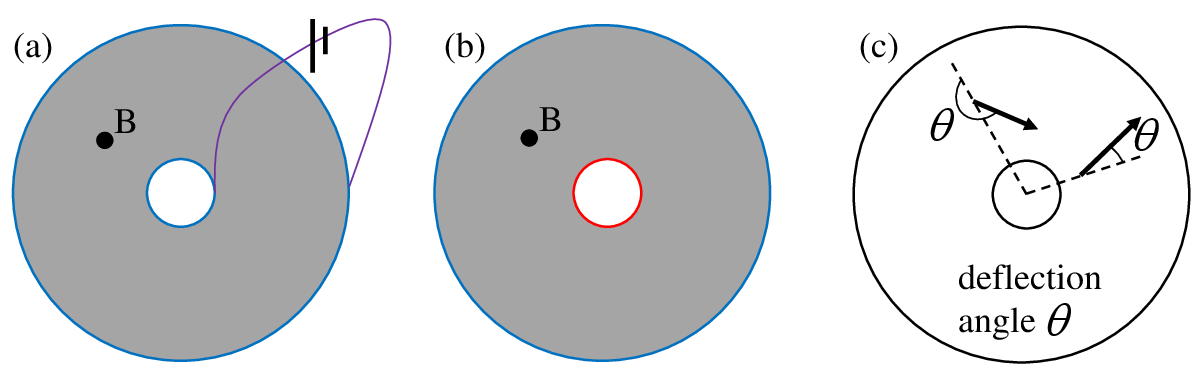
Figure 1: Schematic illustration of a homogeneous Corbino disk with inner and outer radii rin and B0 under perpendicular magnetic field, highlighting electric and temperature-driven cases and definition of heat flux/electric current deflection angle B1.
Numerical Results: Electric Field Driven Transport
When an electric potential difference (B2 V) is applied between inner and outer contacts with temperature held constant (300 K), the system develops significant radial electric field and resultant electron drift. For B3 T, both diffusive and hydrodynamic limits are analyzed.
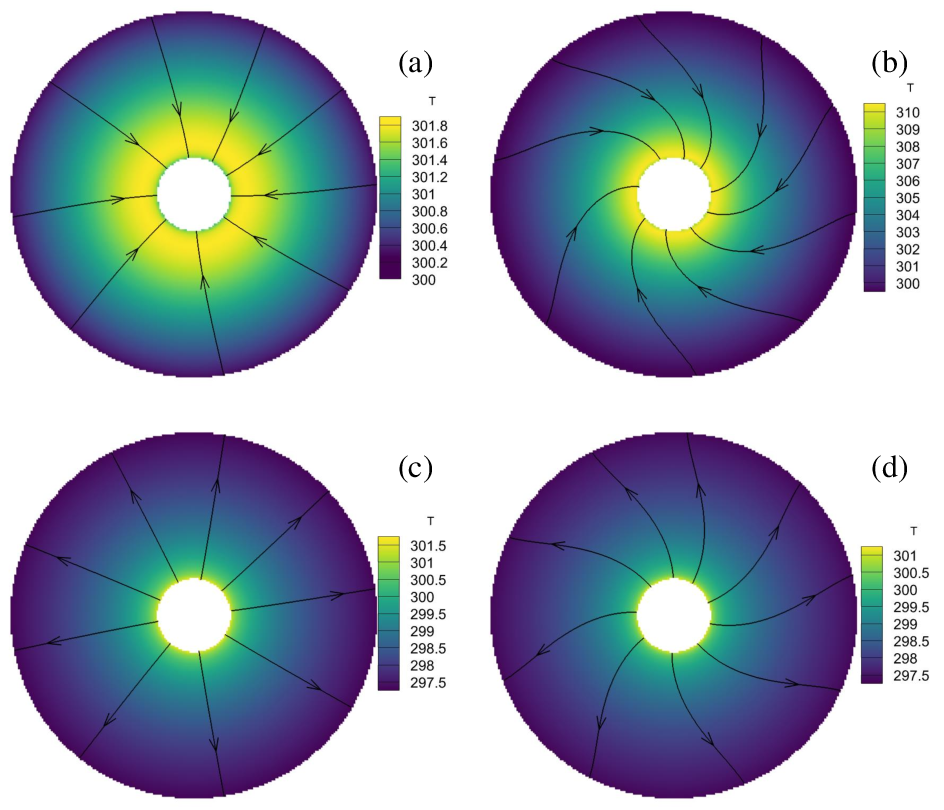
Figure 2: Temperature contour and heat flux streamlines for (a,b) electric field and (c,d) temperature gradient driven cases, comparing diffusive (left) and hydrodynamic (right) regimes (B4 vs. B5).
Key findings:
- In the diffusive regime, both the electric current and heat flux primarily follow radial lines, with minor tangential (deflected) components (deflection angle B6).
- As the system transitions to hydrodynamic behavior with dominant MC scattering, heat flux not only increases in magnitude (enhanced thermoelectricity) but also develops pronounced tangential components—streamlines curve, indicating heat flux deflection not aligned with the radial temperature gradient or electric field. This effect is promoted by MC and suppressed by MR scattering.
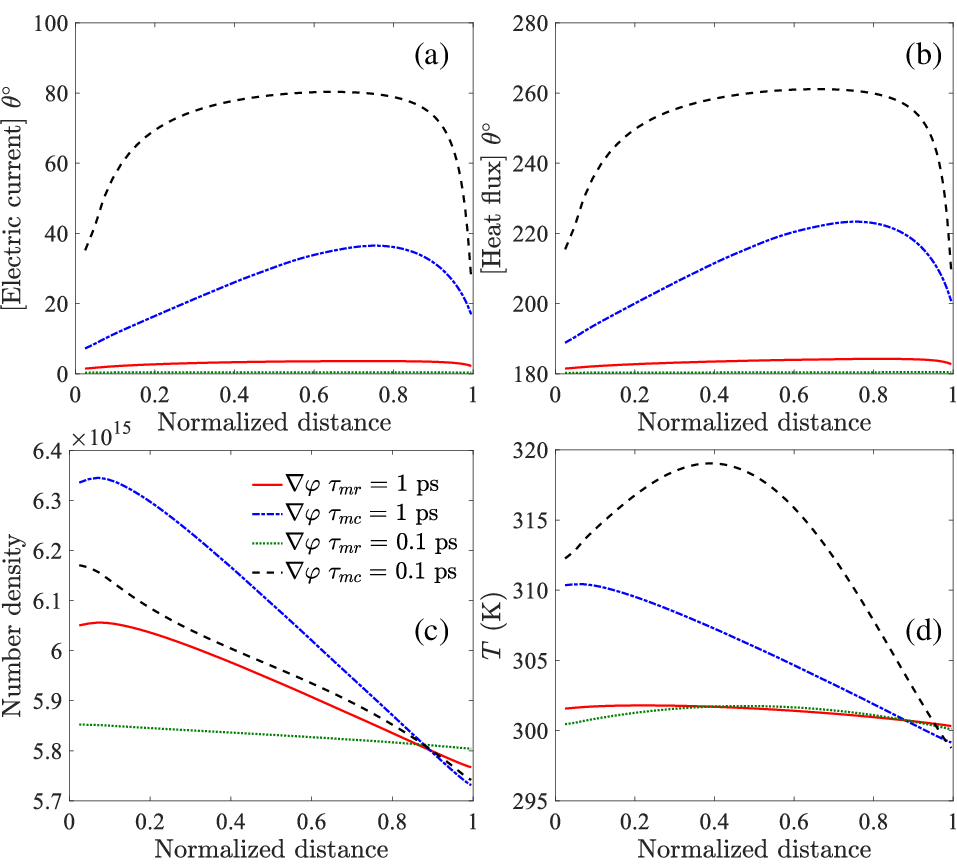
Figure 3: Radial profiles of (a) electric current deflection angle, (b) heat flux deflection angle, (c) carrier density, and (d) temperature under electric-field driving, for both diffusive and hydrodynamic regimes.
The data exhibit substantial density accumulation and temperature elevation near the inner radius in the hydrodynamic regime, with significantly larger heat flux and current deflection angles (B7 maximized), contrasting the nearly radial transport in the diffusive limit.
Numerical Results: Temperature Gradient Driven Transport
Analogous simulations are performed where the Corbino disk is driven by an imposed temperature gradient (from B8 K at the inner edge to B9 K at the outer edge) while the chemical potential is uniform.
Observations:
- The hydrodynamic regime again induces strong heat flux deflection, with the directionality of both heat and charge currents reversed compared to the electric field driven case.
- Deflection is weak in the diffusive regime, consistent with dominant MR scattering suppressing both collective motion and Lorentz force effects.
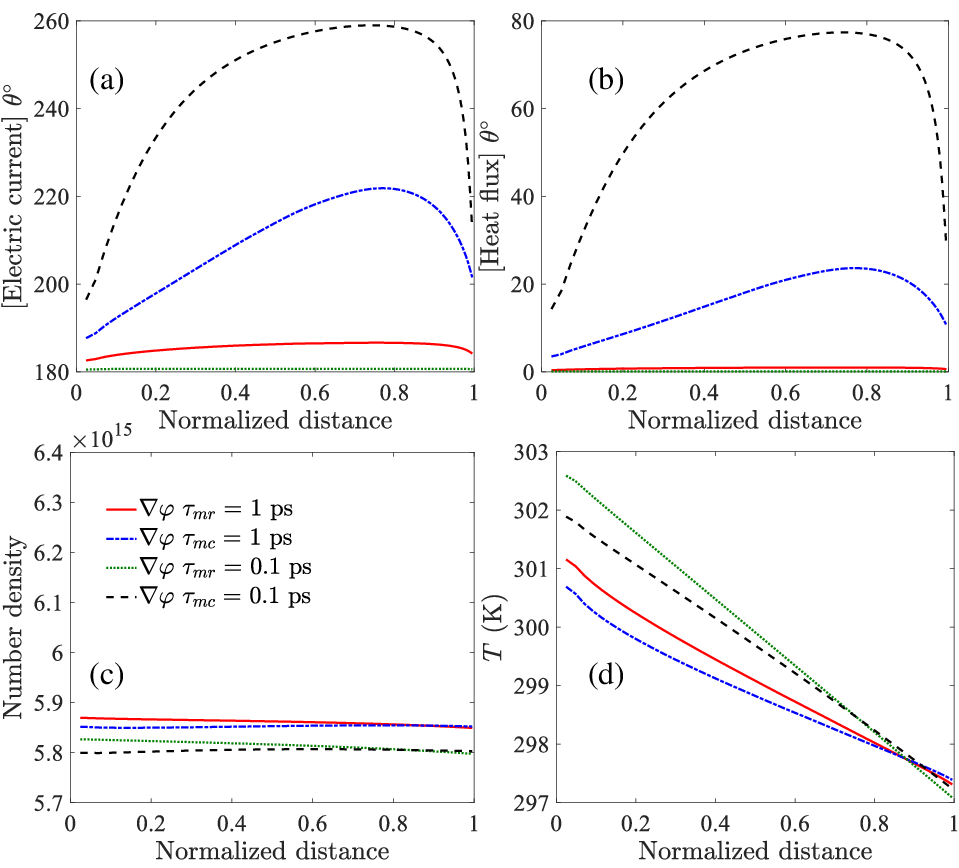
Figure 4: Radial profiles of (a) electric current and (b) heat flux deflection angle, (c) carrier density, and (d) temperature under temperature gradient driving, enabling clear comparison of hydrodynamic vs. diffusive scenarios.
For both driving scenarios, the model predicts that heat flux deflection is a consequence of the interplay between non-equilibrium drift (set by drive and MC collision time), Lorentz force directionality in curved geometry, and the predominance of fluid-like conservation laws over simple diffusion.
Physical Mechanism and Theoretical Insights
The emergence of non-radial heat flux in the hydrodynamic regime is rooted in the non-trivial coupling between drift velocity, Lorentz force, and boundary geometry. Unlike a conventional Hall bar, the Corbino geometry enforces radial field symmetry while the Lorentz force introduces azimuthal components. When MC scattering dominates, electrons collectively acquire non-equilibrium momentum, which the Lorentz force deflects in directions not compensated by electrostatics due to radial symmetry constraints. This results in persistent tangential components of both heat and charge transport.
The first-order Chapman-Enskog expansion quantitatively confirms that in the hydrodynamic limit, the magnitude of deflection is linear in τmc0 (and nonlinear in MR rate), whereas in the diffusive regime, all deflections are higher order and thus negligible.
The reversal of heat flux direction for electric vs. thermal driving, and the distinct behavior under MR and MC scattering, represent a strong, non-classical claim of the work. These effects do not conform to expectations from conventional diffusive, Fourier-based transport or Ohmic laws.
Implications and Outlook
These results provide unambiguous evidence that hydrodynamic electron transport can be accompanied by qualitatively new macroscopic thermal behaviors—specifically, the deflection of heat flux in the presence of magnetic fields and complex boundary geometries. As traditional models of heat management in nanoelectronics and 2D systems often neglect such collective effects, these findings have consequences for the design of devices operating in hydrodynamic or quasi-ballistic regimes, e.g., high-mobility graphene or ultra-clean semiconductor heterostructures.
On a fundamental level, the study demonstrates how collective scattering processes can mediate new types of non-diffusive, geometry- and field-dependent heat transport, with possible extensions towards thermal/electrothermal Hall effects, hydrodynamic thermal vortices, and the design of systems leveraging nonlocal thermoelectric responses.
Advancing simulation methodologies—including ab initio input, multiscale eBTE approaches, and integration with machine learning for rapid property estimation—will enhance the predictive power for engineering applications, while further experimental exploration in devices with tunable MR/MC ratios will be crucial for validating model predictions.
Conclusion
The paper establishes that in a homogeneous graphene Corbino disk, hydrodynamic electron transport under perpendicular magnetic field fundamentally alters the spatial structure of heat flux, enabling substantial deflection from the radial direction. The degree of deviation is strongly controlled by the competition between MC and MR scatterings, with clear reversals in transport direction for different drives. These phenomena highlight the necessity of including hydrodynamic effects in models of electro-thermal transport in 2D and nanoscale devices, with significant theoretical and applied implications for future high-performance electronics and quantum materials.
Reference:
"Heat flux deflection induced by hydrodynamic electron transport in a homogeneous Corbino disk under magnetic field" (2604.15062)

