- The paper demonstrates that embedding a quantum dot-based Kitaev chain in a photonic cavity yields photon-number-dependent sweet spot conditions for robust Majorana bound states.
- Using a comprehensive microscopic model, the analysis reveals how photon dressing via Laguerre polynomials and Kummer functions renormalizes tunneling, pairing, and electron interactions.
- Results indicate that the quantum light regime facilitates tunable Majorana states with enhanced interaction screening, offering new control in topological device engineering.
Poor Man's Majorana Bound States in Quantum Dot-Based Kitaev Chains Coupled to a Photonic Cavity
Introduction
The study addresses the realization and control of poor man’s Majorana bound states (MBSs) in a double quantum dot (QD) Kitaev chain with local s-wave superconductivity embedded in a photonic cavity (2604.15036). By extending canonical models of the minimal Kitaev chain to include cavity quantum electrodynamics (cQED) effects, the work provides a fully microscopic derivation of effective Hamiltonians capturing the impact of cavity photons on tunneling, superconducting pairing, and electron-electron interactions in the chain. The focus lies on identifying and characterizing sweet spot conditions for the emergence of isolated MBSs, including the previously unexplored role of photon-dressed pairing in realistic interacting systems.
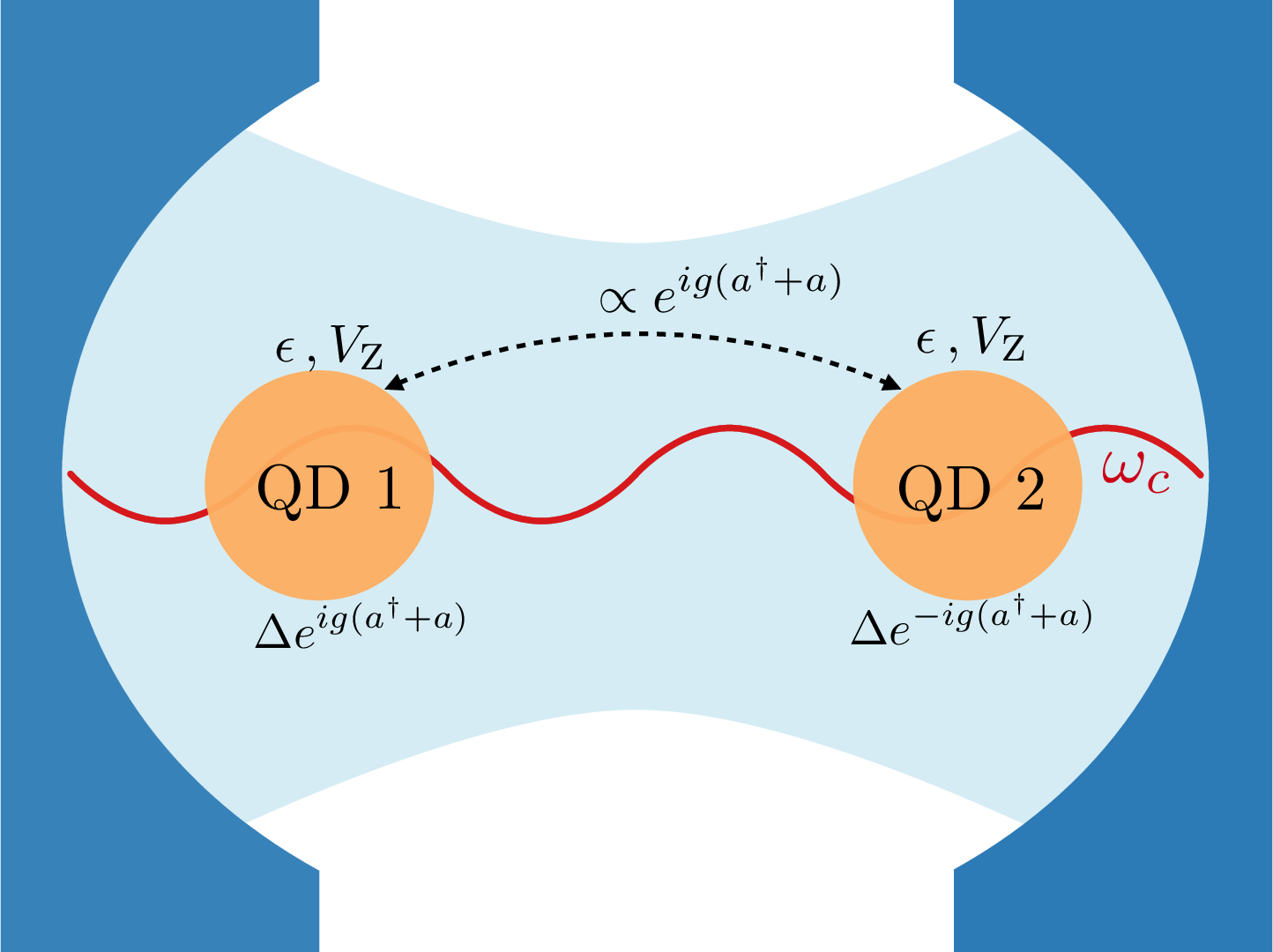
Figure 1: Scheme of the double quantum dot Kitaev chain with local s-wave pairing, Zeeman field, and both spin-conserving (t) and spin-flipping (tso) interdot couplings, embedded in a single-mode photonic cavity.
Microscopic Model and Hamiltonian Engineering
The system consists of two spinful quantum dots described by site energy ϵ, Zeeman field VZ, and proximity-induced s-wave superconducting pairing Δ, coupled via both spin-conserving (t) and spin-flip (tso) terms. The full Hamiltonian incorporates a single photonic cavity mode with light-matter coupling g. The electromagnetic field is introduced through Peierls phases, leading to photon-number-dependent renormalizations of all electronic processes.
Following adiabatic elimination and projection methods in the large detuning regime, the authors derive an effective Hamiltonian in the photon occupation basis with photon-dependent renormalizations:
- Superconducting pairing and hopping become nontrivially dependent on both n and g via Laguerre polynomials and Kummer functions.
- The effective model features photon-mediated interactions tso0 which can either screen or enhance the intrinsic electron-electron interactions, depending on the cavity occupation.
A central analytical outcome is the identification of photon-number-dependent sweet spot conditions for perfect MBS localization:
- For the cavity ground state (tso1), the cavity induces an effective attractive interaction, enabling full compensation of intrinsic attractive electron-electron interactions. The sweet spot is defined by simultaneous vanishing of the total interaction, chemical potential tuning, and equality of the effective hopping and pairing amplitude.
- When the cavity is populated with a single photon (tso2), the photon-induced interaction becomes repulsive. Thus, repulsive Coulomb interactions can also be screened, a result absent in earlier minimal models.
These sweet spot solutions no longer appear as isolated points but as continuous curves in the parameter space of tso3, tso4, and tso5, greatly enhancing experimental tunability.
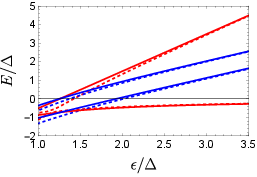
Figure 2: Many-body spectrum as a function of tso6 for the system without explicit particle interactions, showing good agreement between the exact and effective models at high tso7.
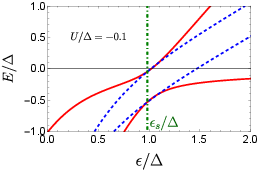
Figure 3: With attractive interactions (tso8) and the cavity in tso9, the even and odd parity ground states cross at the cavity-induced sweet spot.
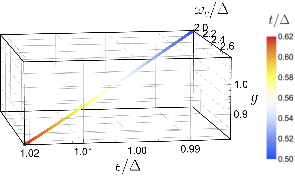
Figure 4: Density plot of sweet spot values for ϵ0 as function of ϵ1 and other parameters, demonstrating the broadening to a continuous curve enabled by photon coupling for ϵ2.
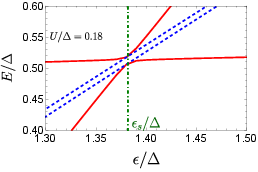
Figure 5: Many-body spectrum for repulsive interaction (ϵ3) and ϵ4 photon state; the sweet spot again produces a parity crossing matching the analytic condition.
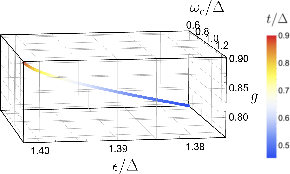
Figure 6: Sweet spot curve for ϵ5 for ϵ6 and ϵ7, confirming the tunability in parameter space due to the cavity photon.
Limiting Behavior: Classical Light Regime and Photon-Induced Degeneracy
In the regime where ϵ8 is kept constant with large ϵ9 (classical light limit), hopping and pairing amplitudes are renormalized by a Bessel function, which can be strongly suppressed. Consequently, the spectrum becomes highly degenerate and the system does not realize well-isolated MBS modes. Thus, the quantum light regime (low photon number) is optimal for engineering and controlling poor man’s MBSs in quantum dot platforms.
Comparison to the Cavity-Free Case and Role of Interactions
The microscopic treatment demonstrates that, in contrast to cavity-free cases, photon dressing generically leads to both enhancement and cancellation of effective interactions. The renormalized parameters allow the realization of Majorana bound states under conditions previously inaccessible due to interactions. This demonstrates that cavity QED platforms offer nontrivial new control degrees of freedom for topological states in engineered mesoscopic devices.
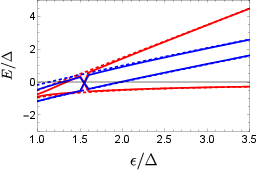
Figure 7: Many-body energy spectrum of the effective Hamiltonian versus VZ0 in the absence of the cavity, showing standard parity eigenvalues in the isolated limit.
Implications and Outlook
The results clarify how cQED enables practical schemes for both the realization and manipulation of Majorana bound states in mesoscopic superconducting hybrids. The identification of photon-number-dependent sweet spot curves, the possibility to screen either sign of electron interactions, and the detailed analytic forms for all relevant energy scales facilitate systematic device design and control in future experiments. The authors highlight that, in the quantum regime, photon occupation in the cavity is a potent tuning parameter not only for one-body terms but also for effective two-body interactions and the topology of the spectrum.
The theoretical framework further raises new questions about the interplay with decoherence effects, such as photon losses and quasiparticle poisoning, and opens avenues for studying nontrivial hybrid light-matter many-body phenomena in the context of cavity-embedded topological devices. The extension of these results to longer chains, more complex interaction structures, and different cavity environments would give further insight into the coherence and stability criteria for topological quantum operations in engineered matter-light systems.
Conclusion
This work provides a comprehensive microscopic analysis of poor man’s Majorana bound states in realistic, interacting quantum dot-based Kitaev chains embedded in single-mode cavities. By demonstrating how cavity photons not only renormalize but also qualitatively reshape the conditions for Majorana physics, including robust sweet spot emergence and tunable interaction screening, the paper establishes the microscopic foundations for cavity-assisted topological engineering in strongly correlated mesoscopic devices (2604.15036).